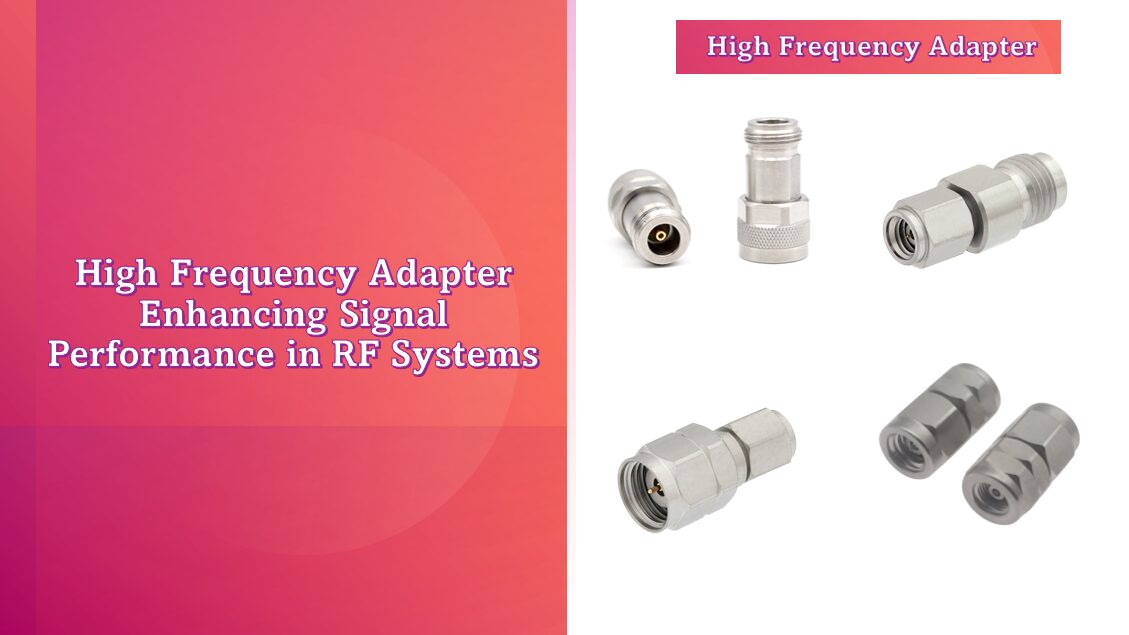
As communication technologies continue to evolve, maintaining signal integrity at microwave and millimeter-wave frequencies has become increasingly important. Whether in 5G infrastructure, satellite communication, aerospace, defense, radar systems, or laboratory testing, every component within an RF transmission path directly impacts overall system performance. Among these components, the High Frequency Adapter plays a critical role by ensuring seamless connectivity between different RF connectors while preserving signal quality.
A high-quality RF adapter is more than a simple connector. It is a precision-engineered component designed to minimize insertion loss, maintain impedance matching, reduce reflections, and ensure reliable signal transmission even at extremely high frequencies. Choosing the right High Frequency Adapter can significantly improve system efficiency, measurement accuracy, and long-term reliability.
What Is a High Frequency Adapter?
A High Frequency Adapter is a precision RF interconnect used to join two different RF connectors while maintaining excellent electrical performance. These adapters are specifically engineered to operate across microwave and millimeter-wave frequency ranges, typically from DC up to 18 GHz, 26.5 GHz, 40 GHz, 50 GHz, or even 67 GHz depending on the connector type.
Unlike standard RF adapters, high-frequency versions are manufactured with extremely tight mechanical tolerances to ensure minimal signal degradation.
They are commonly available in connector combinations such as:
- SMA to SMA
- SMA to N Type
- 2.92mm (K Connector)
- 2.4mm Adapter
- 1.85mm (V Connector)
- SMP Adapter
- SMPM Adapter
- SSMA Adapter
- MMCX Adapter
- MCX Adapter
- BNC to SMA
- TNC Adapter
- Custom RF Adapters
These adapters provide seamless transitions between different connector interfaces without affecting RF performance.
Why High Frequency Adapters Matter
At high frequencies, even small impedance discontinuities can create significant reflections, insertion loss, and phase errors.
A precision High Frequency Adapter helps eliminate these problems by:
- Maintaining consistent 50 Ohm impedance
- Reducing signal reflections
- Improving return loss
- Lowering insertion loss
- Preserving phase stability
- Supporting accurate measurements
- Preventing connector damage
- Increasing equipment compatibility
For high-performance RF systems, adapter quality directly influences overall system accuracy.
How High Frequency Adapters Enhance Signal Performance
1. Minimize Insertion Loss
Insertion loss represents the amount of signal power lost as the signal passes through an adapter.
Precision-machined RF adapters use optimized internal geometry and premium conductive materials to keep insertion loss extremely low.
Benefits include:
- Higher transmitted power
- Better receiver sensitivity
- Improved communication range
- Higher system efficiency
2. Maintain Proper Impedance Matching
Most RF systems are designed around a 50 Ohm impedance.
Poor impedance matching causes reflections that reduce transmitted power and increase standing waves.
High Frequency Adapters maintain consistent impedance throughout the signal path, minimizing mismatch losses.
Understanding RF Signal Behavior
Signal performance at high frequencies depends on frequency, wavelength, and propagation speed.
v=fλ
v=fλ=2×3=6m/s
f
Hz
f
λ
m
λλ
As frequency increases, wavelengths become shorter, making precision connector and adapter design much more important to avoid reflections and losses.
3. Reduce VSWR
Voltage Standing Wave Ratio (VSWR) measures how efficiently RF power is transferred.
Lower VSWR indicates:
- Better power transfer
- Reduced reflected energy
- Improved antenna efficiency
- Better transmitter performance
High-quality adapters typically achieve very low VSWR values across their operating frequency range.
4. Improve Return Loss
Return loss measures the amount of reflected energy returning toward the source.
A precision High Frequency Adapter offers:
- Better return loss
- Cleaner RF signals
- Improved measurement accuracy
- Reduced system noise
This is especially important for microwave testing and high-speed communication networks.
5. Preserve Signal Phase
Many RF systems rely on precise phase relationships.
Applications such as:
- Phased array antennas
- Radar
- Satellite communication
- Beamforming
- Microwave imaging
require adapters that introduce minimal phase variation.
High Frequency Adapters are manufactured with tight dimensional accuracy to maintain excellent phase stability.
Construction of High Frequency Adapters
Premium RF adapters are manufactured using high-quality materials to ensure durability and electrical performance.
Typical construction includes:
Stainless Steel Body
Provides:
- Mechanical strength
- Corrosion resistance
- Long service life
Gold-Plated Contacts
Gold plating offers:
- Excellent conductivity
- Low contact resistance
- Corrosion protection
- Stable electrical performance
Precision Dielectric
Most adapters use PTFE or advanced dielectric materials for:
- Stable impedance
- Low dielectric loss
- High-frequency performance
Precision Machining
Modern CNC machining ensures:
- Accurate connector alignment
- Excellent repeatability
- Reduced mismatch
- Superior mating performance
Types of High Frequency Adapters
Several adapter designs are available depending on application requirements.
Straight Adapter
Provides direct connector-to-connector connection.
Applications include:
- Test equipment
- RF systems
- Laboratory measurements
Right Angle Adapter
Used where installation space is limited.
Benefits include:
- Better cable routing
- Reduced cable stress
- Compact installations
Bulkhead Adapter
Designed for panel mounting.
Common applications:
- Test benches
- Communication cabinets
- RF enclosures
Gender Changer Adapter
Converts:
- Male to Female
- Female to Male
Useful during equipment integration.
Between-Series Adapter
Connects different connector types.
Examples include:
- SMA to N
- SMA to BNC
- SMA to TNC
- 2.92mm to SMA
Key Features of High Frequency Adapters
Premium RF adapters offer numerous performance advantages.
These include:
- Low insertion loss
- Excellent return loss
- Low VSWR
- Precision impedance matching
- High mechanical durability
- Wide frequency coverage
- Gold-plated contacts
- Corrosion resistance
- High repeatability
- Excellent shielding
- Compact design
- Long operational life
Applications of High Frequency Adapters
5G Communication
Modern 5G infrastructure requires adapters capable of supporting microwave frequencies with minimal loss.
Applications include:
- Base stations
- Small cells
- Massive MIMO systems
- Network optimization
Satellite Communication
Satellite ground stations require extremely stable RF connections.
Adapters support:
- Up converters
- Down converters
- Satellite antennas
- RF transceivers
Aerospace Industry
Aircraft communication systems use precision RF adapters for:
- Navigation
- Telemetry
- Avionics
- Flight communication
Defense Systems
Military communication systems require adapters capable of operating under harsh environmental conditions.
Applications include:
- Radar
- Electronic warfare
- Missile guidance
- Tactical communication
Test and Measurement
Laboratories use High Frequency Adapters with:
- Vector Network Analyzers
- Spectrum Analyzers
- Signal Generators
- Oscilloscopes
- RF Power Meters
Medical Equipment
Medical RF devices utilize precision adapters for:
- MRI systems
- Imaging equipment
- Diagnostic instruments
Industrial Automation
High-frequency communication supports:
- Factory automation
- Wireless monitoring
- Industrial IoT
- Smart manufacturing
Research Laboratories
Universities and R&D organizations rely on RF adapters for:
- Microwave experiments
- Antenna testing
- Material characterization
- Communication research
Factors to Consider When Selecting a High Frequency Adapter
Selecting the correct adapter requires evaluating several technical specifications.
Consider:
- Frequency range
- Connector type
- Impedance
- VSWR
- Return loss
- Insertion loss
- Power handling
- Environmental rating
- Material quality
- Connector durability
Choosing the correct specifications ensures reliable long-term performance.
Benefits of High Quality RF Adapters
Using premium High Frequency Adapters provides several operational benefits.
Advantages include:
- Improved RF efficiency
- Higher measurement accuracy
- Reduced signal reflections
- Longer equipment life
- Reliable high-frequency operation
- Better communication quality
- Lower maintenance costs
- Enhanced connector durability
- Increased system compatibility
Why Choose SRFS Teleinfra High Frequency Adapters?
SRFS Teleinfra manufactures precision-engineered High Frequency Adapters designed for demanding RF and microwave applications. Every adapter is produced using advanced CNC machining, premium materials, and strict quality control to deliver reliable electrical and mechanical performance.
Key advantages include:
- Wide frequency range up to millimeter-wave bands
- Low insertion loss
- Excellent return loss
- Precision 50 Ohm impedance
- Gold-plated contacts
- Superior mechanical durability
- Custom connector configurations
- Consistent performance in telecom, defense, aerospace, and laboratory applications
Whether you need standard RF adapters or customized interconnect solutions, SRFS Teleinfra provides dependable products engineered for modern high-frequency systems.
Conclusion
A High Frequency Adapter is an essential component in modern RF and microwave systems. Although compact, it has a significant impact on signal integrity, power transfer, measurement accuracy, and overall system reliability. By maintaining precise impedance matching, minimizing insertion loss, reducing VSWR, and ensuring stable phase performance, these adapters enable efficient operation across demanding applications such as 5G networks, satellite communications, aerospace, defense, industrial automation, and advanced RF testing.
Investing in high-quality precision RF adapters ensures long-term performance, dependable connectivity, and optimal signal transmission, making them a critical part of any high-frequency communication infrastructure.
Frequently Asked Questions
What is a High Frequency Adapter?
A High Frequency Adapter is a precision RF connector used to connect two RF interfaces while maintaining excellent signal integrity, low insertion loss, and proper impedance matching at microwave and millimeter-wave frequencies.
What frequency range do High Frequency Adapters support?
Depending on the connector type, High Frequency Adapters can operate from DC up to 18 GHz, 26.5 GHz, 40 GHz, 50 GHz, or even 67 GHz.
Why is low insertion loss important?
Low insertion loss minimizes signal power reduction, ensuring stronger signal transmission, improved communication quality, and higher system efficiency.
What is the difference between a standard RF adapter and a High Frequency Adapter?
High Frequency Adapters are manufactured with tighter mechanical tolerances, superior materials, and optimized internal designs to provide reliable performance at much higher frequencies with lower signal loss.
Where are High Frequency Adapters commonly used?
They are widely used in 5G infrastructure, satellite communication, aerospace, defense systems, radar, RF laboratories, test equipment, medical devices, and industrial automation.
What connector types are available for High Frequency Adapters?
Common options include SMA, N Type, 2.92mm, 2.4mm, 1.85mm, SMP, SMPM, BNC, TNC, MMCX, MCX, SSMA, and custom connector combinations.
How do High Frequency Adapters improve RF performance?
They improve RF performance by maintaining 50 Ohm impedance, reducing reflections, lowering VSWR, minimizing insertion loss, and preserving signal phase stability.
How do I choose the right High Frequency Adapter?
Consider factors such as connector type, operating frequency, impedance, insertion loss, VSWR, return loss, power handling, environmental requirements, and application to select the most suitable adapter.