RG 58 Cable is a widely used 50-ohm coaxial cable designed for radio frequency (RF) signal transmission in communication, networking, wireless systems, and electronic applications. Known for its flexible construction, compact size, and versatility, RG 58 Cable is commonly used in applications where reliable signal connectivity and easy installation are important.
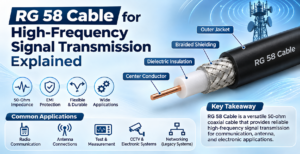
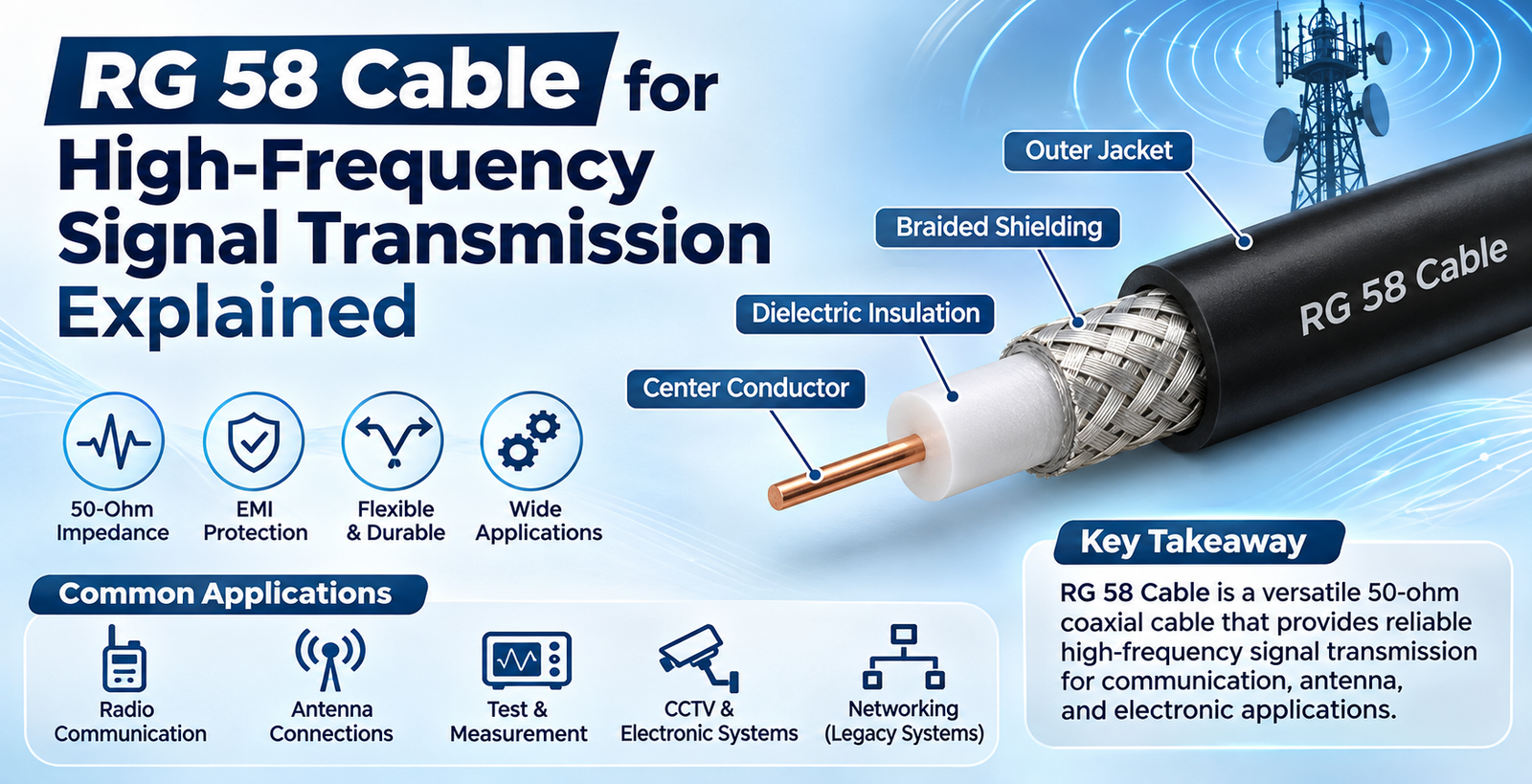
Coaxial cables play an essential role in transmitting high-frequency electrical signals while minimizing electromagnetic interference and signal leakage. RG 58 Cable features a central conductor, dielectric insulation, metallic shielding, and an outer protective jacket. This layered construction helps maintain signal integrity and provides protection against external interference.
RG 58 Cable is particularly suitable for low- to moderate-frequency RF applications, antenna connections, radio communication equipment, test instruments, and electronic systems. Its 50-ohm impedance makes it compatible with a wide range of RF components, including antennas, connectors, transmitters, receivers, and communication devices.
Understanding the construction, technical specifications, performance characteristics, and applications of RG 58 Cable helps engineers and system integrators select the appropriate cable for their RF connectivity requirements.
What Is RG 58 Cable?
RG 58 Cable is a 50-ohm coaxial cable originally developed for radio frequency communication and electronic signal transmission. The RG designation comes from the historical Radio Guide classification system, which identifies different types of coaxial cables according to their construction and electrical characteristics.
The cable is designed to carry RF signals between connected electronic devices while maintaining controlled impedance. Its flexible structure makes it suitable for installations that require cable routing through equipment racks, communication panels, electronic enclosures, and antenna systems.
RG 58 Cable generally features a solid or stranded center conductor, polyethylene dielectric insulation, braided metallic shielding, and a PVC or similar protective outer jacket. Different manufacturers offer variations in conductor material, shielding coverage, dielectric composition, and jacket specifications.
One of the primary advantages of RG 58 Cable is its versatility. It can be used in various RF applications where moderate power handling, flexibility, and convenient installation are required.
Construction of RG 58 Cable
The construction of RG 58 Cable consists of multiple layers, with each layer performing a specific electrical or mechanical function. These components work together to provide controlled impedance, signal transmission, shielding, and environmental protection.
1. Inner Conductor
The inner conductor is responsible for carrying the electrical RF signal through the cable. Depending on the cable design, it may use solid bare copper, tinned copper, or copper-clad steel.
The conductor material influences electrical resistance, flexibility, attenuation, and overall cable performance.
Solid conductors generally provide consistent electrical characteristics, while stranded conductors offer improved flexibility for installations involving repeated movement or bending.
2. Dielectric Insulation
The dielectric layer surrounds the central conductor and maintains the required spacing between the conductor and outer shielding.
RG 58 Cable commonly uses solid polyethylene insulation. The dielectric material plays an important role in determining the cable’s characteristic impedance, capacitance, velocity factor, and electrical performance.
Consistent dielectric dimensions help maintain the 50-ohm impedance required for RF signal transmission.
3. Metallic Shielding
The shielding layer is generally made from braided copper or tinned copper wires.
Its primary purpose is to reduce electromagnetic interference (EMI), minimize unwanted signal radiation, and protect the transmitted RF signal from external electrical noise.
Shielding coverage and braid construction can vary depending on the manufacturer and cable version. Higher shielding coverage generally provides better protection against external interference.
4. Outer Protective Jacket
The outer jacket provides mechanical and environmental protection to the cable.
RG 58 Cable commonly uses PVC jackets, although other jacket materials may be available for specialized applications.
The jacket protects the internal cable components from abrasion, handling damage, dust, and environmental exposure within the limits of its specified rating.
Technical Specifications of RG 58 Cable
RG 58 Cable is available in different configurations depending on the manufacturer and intended application. The following table presents typical characteristics of conventional RG-58 designs. Actual specifications should always be verified against the manufacturer’s datasheet.
| Parameter | Typical Specification |
|---|---|
| Cable Type | RG 58 Coaxial Cable |
| Characteristic Impedance | 50 Ohms |
| Center Conductor | Solid or Stranded Copper / Copper-Clad Steel |
| Dielectric Material | Solid Polyethylene (PE) |
| Shielding | Braided Copper or Tinned Copper |
| Outer Jacket | PVC or Other Specified Material |
| Frequency Range | Application and Manufacturer Dependent |
| Velocity Factor | Approximately 66% for Solid PE Designs |
| Operating Temperature | Manufacturer Dependent |
| Cable Structure | Coaxial |
| Application | RF, Radio Communication and Antenna Systems |
These values are representative rather than universal. For accurate cable selection, consider the manufacturer’s specifications for attenuation, maximum operating frequency, voltage rating, shielding effectiveness, and temperature range.
How RG 58 Cable Supports High-Frequency Signal Transmission
High-frequency signal transmission requires a cable that can maintain controlled impedance, minimize signal losses, and reduce unwanted electromagnetic interference.
RG 58 Cable supports RF signal transmission through its coaxial construction, which keeps the center conductor and shielding arranged along a common axis.
Several characteristics contribute to its performance.
1. Controlled 50-Ohm Impedance
Impedance matching is important in RF systems because mismatched components can cause signal reflections.
RG 58 Cable is designed with a nominal characteristic impedance of 50 ohms, making it compatible with many RF transmitters, receivers, antennas, and communication devices.
Using compatible 50-ohm connectors and equipment helps minimize reflections and maintain effective signal transfer.
2. Electromagnetic Interference Protection
External electromagnetic interference can affect RF signal quality, especially in environments containing electrical equipment, switching devices, and communication systems.
The braided shielding of RG 58 Cable helps reduce the influence of external electromagnetic noise.
However, the actual shielding performance depends on braid coverage, construction quality, and installation conditions.
3. Flexible Cable Construction
RG 58 Cable is relatively flexible compared with many larger coaxial cable designs.
This flexibility allows installers to route cables through equipment cabinets, communication enclosures, and compact electronic systems.
Proper bend-radius management is important to prevent deformation and maintain electrical performance.
4. Reliable RF Connectivity
RG 58 Cable can be terminated with compatible 50-ohm RF connectors, such as BNC, TNC, and SMA connectors, depending on the specific cable construction and connector design.
Proper termination helps maintain impedance continuity and reduce insertion losses at connection points.
5. Signal Loss Considerations
Like all coaxial cables, RG 58 Cable experiences attenuation as RF signals travel through it.
Signal loss generally increases with frequency and cable length. Therefore, RG 58 Cable is more appropriate for applications where its attenuation characteristics are acceptable than for long-distance, high-frequency transmission systems requiring very low signal loss.
Key Features and Benefits of RG 58 Cable
RG 58 Cable offers several practical advantages that make it a common choice for RF connectivity applications.
1. Standard 50-Ohm Impedance
Its 50-ohm impedance supports compatibility with a broad range of RF communication equipment and electronic systems.
2. Compact Cable Design
The relatively small diameter makes RG 58 Cable suitable for installations where space is limited.
It can be routed through equipment panels, communication cabinets, and electronic enclosures without requiring excessive installation space.
3. Flexible Installation
Its flexible construction simplifies cable routing and handling, especially in applications involving multiple RF connections.
4. Shielding Against External Interference
The metallic braid helps protect transmitted signals from external electromagnetic interference.
5. Wide Range of Connector Compatibility
RG 58 Cable can be assembled with suitable RF connectors, including BNC, TNC, and SMA interfaces.
The connector must be specifically designed for the cable’s diameter and construction.
6. Versatile Applications
The cable is used in radio communication, antenna connections, laboratory equipment, instrumentation, and other RF systems.
7. Practical RF Connectivity Solution
For applications that do not require extremely low attenuation or high power handling, RG 58 Cable can provide a practical and economical connectivity option.
Applications of RG 58 Cable
RG 58 Cable is used in various industries and electronic systems that require reliable RF signal transmission.
1. Radio Communication Systems
RG 58 Cable is commonly used in radio communication equipment to connect transmitters, receivers, antennas, and other RF components.
Its 50-ohm impedance makes it suitable for many conventional radio frequency installations.
2. Wireless Communication Systems
Wireless communication equipment requires coaxial connections between RF modules, antennas, and communication devices.
RG 58 Cable can be used in selected wireless installations where cable length, operating frequency, and attenuation requirements are within acceptable limits.
3. Antenna Connections
RG 58 Cable is frequently used to connect antennas with radio equipment and RF receivers.
It provides a flexible connection option for installations involving antenna systems, communication devices, and radio accessories.
4. Test and Measurement Equipment
Electronic laboratories and testing environments use coaxial cables to connect RF instruments, signal generators, oscilloscopes, and measurement equipment.
RG 58 Cable can be used for suitable 50-ohm measurement connections, depending on the frequency range and required measurement accuracy.
5. CCTV and Electronic Systems
Certain electronic and video transmission systems use coaxial cable connections.
RG 58 Cable may be used in specialized 50-ohm RF or video applications, but it should not automatically be considered a replacement for 75-ohm CCTV cables such as RG59.
6. Industrial Electronics
Industrial electronic equipment often requires reliable signal connections between different components.
RG 58 Cable can support selected RF control, monitoring, instrumentation, and communication applications.
7. Amateur Radio Applications
Amateur radio operators frequently use 50-ohm coaxial cables for antenna connections and radio equipment installations.
RG 58 Cable is suitable for shorter cable runs and applications where its power-handling and attenuation characteristics meet system requirements.
8. Networking and Data Communication
RG 58 Cable was historically used in 10BASE2 Ethernet networks, commonly known as Thin Ethernet.
Although modern Ethernet networks primarily use twisted-pair copper and fiber-optic technologies, RG 58 remains relevant in certain legacy systems and specialized electronic applications.
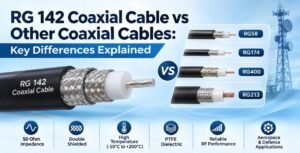
RG 58 Cable vs Other Coaxial Cables
Different coaxial cable types are designed for different electrical, mechanical, and environmental requirements.
Understanding the differences between RG 58 Cable and other commonly used coaxial cables helps engineers select the correct option.
| Cable Type | Impedance | General Characteristics | Common Applications |
|---|---|---|---|
| RG 58 | 50 Ohms | Flexible, compact coaxial cable | RF communication and antennas |
| RG 174 | 50 Ohms | Smaller diameter and highly flexible | Compact electronic equipment |
| RG 213 | 50 Ohms | Larger diameter with higher power-handling potential | Radio and antenna installations |
| RG 316 | 50 Ohms | Small-diameter, PTFE dielectric cable | High-temperature and compact RF systems |
| RG 59 | 75 Ohms | Video-oriented coaxial cable | CCTV and video transmission |
| RG 6 | 75 Ohms | Low-loss design for broadband applications | Television and broadband distribution |
The selection of a coaxial cable should depend on frequency, attenuation, impedance, power requirements, environmental conditions, and installation constraints.
Factors to Consider When Selecting RG 58 Cable
Selecting the correct RG 58 Cable requires evaluating several technical and installation-related factors.
1. Operating Frequency
Determine the frequency range of the application before selecting the cable.
Attenuation increases with frequency, so the cable must provide acceptable signal loss across the intended operating band.
2. Cable Length
Longer cable runs generally produce greater signal attenuation.
For installations involving longer distances, compare the attenuation of RG 58 Cable with alternative low-loss 50-ohm coaxial cables.
3. Impedance Compatibility
Ensure that the cable, connectors, and connected RF equipment use compatible 50-ohm impedance.
Incorrect impedance matching can cause reflections and reduce signal transmission efficiency.
4. Power Handling Capacity
Consider the RF power level transmitted through the cable.
Power-handling capacity depends on frequency, cable construction, ambient temperature, installation conditions, and voltage standing wave ratio (VSWR).
Always consult the manufacturer’s power-rating specifications.
5. Shielding Requirements
Evaluate the electromagnetic environment where the cable will be installed.
Applications involving significant external interference may require cables with higher shielding effectiveness or additional shielding layers.
6. Operating Temperature
The outer jacket and dielectric materials determine the cable’s permissible temperature range.
Select the appropriate construction for indoor, outdoor, industrial, or temperature-sensitive environments.
7. Connector Compatibility
Select connectors specifically designed for the chosen RG 58 Cable construction.
Correct connector installation is essential for mechanical stability, impedance continuity, and reliable electrical performance.
Importance of Proper RG 58 Cable Installation
Proper installation is necessary to maintain the electrical and mechanical performance of RG 58 Cable.
Even a high-quality coaxial cable can experience performance degradation if it is installed incorrectly.
The following installation practices help maintain reliable connectivity:
- Avoid sharp bends and maintain the manufacturer’s recommended minimum bend radius.
- Prevent excessive pulling force during cable installation.
- Use compatible 50-ohm RF connectors.
- Ensure proper connector termination and shielding contact.
- Avoid crushing or compressing the cable.
- Keep RF cables away from strong sources of electromagnetic interference where practical.
- Inspect connectors for loose fittings, corrosion, and physical damage.
- Use appropriate cable supports to prevent mechanical stress.
- Verify cable continuity and RF performance after installation.
Proper cable management also helps simplify maintenance and troubleshooting in communication equipment and RF installations.
Common Problems Affecting RG 58 Cable Performance
Several factors can affect the performance of RG 58 Cable during operation.
1. Excessive Signal Attenuation
Long cable runs and higher operating frequencies can increase insertion loss.
Selecting a suitable cable type and minimizing unnecessary cable length can help reduce attenuation.
2. Impedance Mismatch
Using incompatible connectors or equipment can cause impedance discontinuities.
This can result in signal reflections, increased VSWR, and reduced power transfer.
3. Shielding Damage
Damaged or improperly terminated shielding can reduce electromagnetic interference protection.
Proper connector installation and routine cable inspection help maintain shielding effectiveness.
4. Physical Cable Damage
Excessive bending, crushing, abrasion, and pulling can damage the internal conductor and dielectric.
Such damage may change the cable’s electrical characteristics and reduce transmission reliability.
5. Poor Connector Termination
Incorrect stripping dimensions, loose connections, and improper crimping can increase insertion loss and create intermittent signal problems.
Using the correct assembly procedure and compatible connectors is essential.
RG 58 Cable in Modern RF and Communication Infrastructure
Modern RF and communication infrastructure requires reliable interconnections between antennas, radio equipment, transmitters, receivers, and electronic systems.
RG 58 Cable continues to serve applications where its size, flexibility, impedance, and electrical characteristics meet system requirements.
It is particularly useful in compact RF assemblies, laboratory connections, radio communication equipment, and selected antenna installations.
However, modern communication systems increasingly operate across wider frequency bands and require lower attenuation, improved shielding, and higher power-handling capabilities.
For these applications, engineers may consider alternatives such as RG 213, RG 214, RG 316, LMR-type cables, and specialized low-loss coaxial assemblies.
The correct selection depends on the complete electrical and mechanical requirements of the system rather than the cable designation alone.
Why Choose Quality RG 58 Cable for RF Applications?
Cable quality plays an important role in the reliability of RF and microwave connectivity systems.
A properly manufactured RG 58 Cable should maintain consistent electrical characteristics, reliable shielding, and durable mechanical construction.
When evaluating a cable supplier or manufacturer, consider the following factors:
- Consistent 50-ohm characteristic impedance.
- Verified conductor and dielectric construction.
- Reliable shielding coverage.
- Clearly documented attenuation specifications.
- Suitable operating temperature and jacket properties.
- Compatibility with required RF connectors.
- Quality inspection and testing procedures.
- Technical documentation and product traceability.
Choosing a quality cable helps reduce installation problems and supports consistent performance in RF communication and electronic systems.
Frequently Asked Questions About RG 58 Cable
1. What is RG 58 Cable used for?
RG 58 Cable is primarily used for RF signal transmission in radio communication systems, antenna connections, electronic equipment, test instruments, and selected networking applications.
2. What is the impedance of RG 58 Cable?
RG 58 Cable has a nominal characteristic impedance of 50 ohms, making it suitable for many RF communication and electronic applications.
3. Is RG 58 Cable suitable for high-frequency applications?
RG 58 Cable can support RF signal transmission at various frequencies, but its attenuation increases as frequency rises. Its suitability depends on cable length, operating frequency, and acceptable signal loss.
4. What is the difference between RG 58 and RG 174 Cable?
Both are generally 50-ohm coaxial cables. RG 58 is larger in diameter, while RG 174 is thinner and more flexible. Their attenuation and power-handling characteristics also differ.
5. Can RG 58 Cable be used for antenna connections?
Yes. RG 58 Cable is commonly used for antenna connections in radio communication and amateur radio applications where its attenuation and power-handling characteristics are suitable.
6. Which connectors are compatible with RG 58 Cable?
Compatible connectors may include BNC, TNC, and SMA connectors. The selected connector must match the cable’s diameter, conductor construction, and dielectric dimensions.
7. Is RG 58 Cable suitable for outdoor installations?
RG 58 Cable can be used outdoors when its jacket and overall construction are specifically rated for the environmental conditions. Standard PVC versions should not automatically be considered suitable for prolonged outdoor exposure.
8. What is the difference between RG 58 and RG 213 Cable?
RG 58 is a smaller and more flexible coaxial cable, while RG 213 has a larger diameter and generally offers lower attenuation and higher power-handling potential. Actual performance depends on the specific cable design.
9. Does RG 58 Cable support 50-ohm RF systems?
Yes. RG 58 Cable is designed for 50-ohm RF systems and can connect compatible antennas, transmitters, receivers, and other RF equipment.
10. How do I select the right RG 58 Cable?
Consider operating frequency, cable length, attenuation, impedance, power-handling requirements, shielding, temperature rating, and connector compatibility before selecting RG 58 Cable.
Conclusion
RG 58 Cable remains a versatile coaxial cable solution for radio frequency communication, antenna connections, electronic instrumentation, and selected wireless applications. Its 50-ohm impedance, flexible construction, compact design, and braided shielding make it suitable for numerous RF connectivity requirements.
Although RG 58 Cable can support high-frequency signal transmission, its suitability depends on attenuation, cable length, operating frequency, and power-handling requirements. Engineers should evaluate the manufacturer’s technical datasheet before selecting it for demanding RF installations.
For applications requiring lower signal loss, higher power handling, or improved shielding performance, alternative coaxial cable designs may provide better results.
Selecting the right RG 58 Cable and ensuring proper installation can help maintain reliable signal transmission and consistent performance across RF communication and electronic systems.