Choosing the right coaxial cable is essential for maintaining reliable signal transmission, reducing signal loss and ensuring consistent performance in electronic and communication systems. Among the various types of coaxial cables available, RG 174 Cable is widely used in applications where compact size, flexibility and convenient installation are important.
RG 174 Cable is a lightweight, 50-ohm coaxial cable designed for RF signal transmission in communication equipment, wireless devices, GPS systems, antennas, electronic instruments and other low-power applications. Its small diameter and flexible construction make it suitable for installations where space is limited and cables need to be routed through compact enclosures or around tight corners.
However, selecting the correct RG 174 Cable requires more than simply choosing a cable based on its size. Factors such as operating frequency, cable length, attenuation, impedance, shielding effectiveness, environmental conditions and connector compatibility can significantly influence overall system performance.
In this guide, we will explain how to choose the right RG 174 Cable for your application, explore its important specifications, discuss its benefits and highlight the factors that should be considered before purchasing.
1. Understanding What RG 174 Cable Is
RG 174 Cable is a miniature coaxial cable commonly used for transmitting radio frequency signals in compact electronic and wireless communication systems. It features a central conductor, dielectric insulation, metallic shielding and an outer protective jacket.
Its compact construction makes it particularly useful in applications where conventional coaxial cables may be too thick, heavy or difficult to install.
The cable generally has a characteristic impedance of 50 ohms, making it suitable for RF systems that require impedance matching between transmitters, receivers, antennas and other connected components.
RG 174 Cable is commonly available with different conductor materials, shielding configurations and jacket options depending on manufacturer specifications and application requirements.
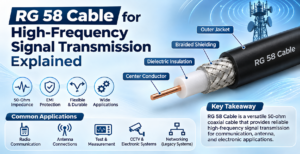
The main components of RG 174 Cable include:
Center Conductor: The inner conductor carries the RF signal through the cable. Depending on the cable construction, it may use stranded or solid copper-based conductors.
Dielectric Insulation: The dielectric material separates the center conductor from the outer shield and helps maintain the cable’s electrical characteristics.
Shielding: The metallic shield surrounds the dielectric and helps reduce electromagnetic interference while limiting unwanted signal radiation.
Outer Jacket: The external protective jacket provides mechanical protection against abrasion, handling and environmental exposure.
Understanding these construction elements helps determine whether RG 174 Cable is suitable for a particular installation.
2. Identify Your Application Requirements
The first step in selecting the right RG 174 Cable is understanding the application in which it will be used. Different electronic and communication systems have different requirements for signal transmission, cable flexibility, operating frequency and installation conditions.
RG 174 Cable is commonly used in the following applications:
RF Communication Systems
RG 174 Cable is used in RF communication equipment for connecting internal electronic components, antennas and communication modules. Its compact size makes it convenient for installations inside communication devices.
GPS Antenna Connections
GPS receivers and antenna systems often require lightweight coaxial cables for transmitting signals between the antenna and receiver. RG 174 Cable can be suitable for short-distance GPS connections when its attenuation and frequency performance meet the system requirements.
Wireless Communication Equipment
Wireless communication devices use coaxial cables to connect RF modules, antennas and other electronic components. RG 174 Cable is useful in compact equipment where installation space is limited.
Electronic Testing Instruments
RG 174 Cable can be used in laboratory equipment, test fixtures and electronic measurement systems for RF signal connections. Connector compatibility and cable performance should be verified according to the instrument’s specifications.
Automotive Electronics
Certain automotive electronic systems require compact coaxial connections for antennas, navigation equipment and communication modules. RG 174 Cable may be considered where its temperature rating, vibration resistance and electrical characteristics are appropriate.
Internal Equipment Connections
One of the common applications of RG 174 Cable is internal wiring in electronic devices. Its small diameter allows convenient routing through compact equipment enclosures and limited installation spaces.
Before selecting a cable, identify the operating environment, signal frequency, required cable length and connector configuration.
3. Check the Characteristic Impedance
Impedance is one of the most important electrical parameters when selecting an RF coaxial cable. RG 174 Cable generally features a characteristic impedance of 50 ohms, which is commonly used in RF and wireless communication systems.
Impedance matching helps minimize signal reflections and maintain efficient power transfer between connected components.
When selecting RG 174 Cable, consider the following points:
- Confirm that the cable has a 50-ohm characteristic impedance.
- Ensure that connected devices, antennas and RF components also support 50-ohm impedance.
- Check connector impedance compatibility.
- Avoid mixing 50-ohm and 75-ohm components in systems that require consistent impedance matching.
For applications involving RF transmitters, receivers, antennas and communication modules, maintaining proper impedance matching is essential for reliable signal transmission.
4. Consider the Operating Frequency Range
Operating frequency is another critical factor when choosing the right RG 174 Cable. Different RF applications operate across different frequency bands, and cable performance can vary depending on the frequency.
As frequency increases, attenuation generally increases as well. This means that a cable suitable for a lower-frequency application may not provide the same performance at higher frequencies.
RG 174 Cable is commonly considered for applications involving:
- GPS frequency bands
- VHF communication systems
- UHF communication equipment
- Wireless communication devices
- RF signal connections
- Electronic testing equipment
Before purchasing RG 174 Cable, verify its specified frequency range and attenuation characteristics from the manufacturer’s datasheet.
Do not assume that every RG 174 Cable has identical high-frequency performance. The conductor material, dielectric construction, shielding and manufacturing quality can affect its electrical characteristics.
5. Evaluate Cable Attenuation and Signal Loss
Attenuation refers to the reduction in signal strength as an RF signal travels through a coaxial cable. It is generally measured in decibels (dB) per unit length, such as dB per 100 feet or dB per 100 metres.
For RG 174 Cable, attenuation is an important consideration because its relatively small diameter can result in higher signal loss compared with larger coaxial cables.
When evaluating attenuation, consider the following factors:
Cable Length: Longer cable lengths generally produce greater insertion loss. If your application requires a long cable connection, calculate the expected signal loss before selecting RG 174 Cable.
Operating Frequency: Signal attenuation generally increases with frequency. Check the manufacturer’s attenuation specifications at the actual operating frequency of your system.
Conductor Material: The material and construction of the centre conductor influence electrical resistance and signal transmission characteristics.
Connector Quality: Poor-quality connectors or improperly installed terminations can introduce additional insertion loss and signal reflections.
Cable Construction: Dielectric properties and shielding design also influence the overall electrical performance of RG 174 Cable.
For applications where signal strength is critical, compare the attenuation specifications of RG 174 Cable with alternative coaxial cables before making a final decision.
6. Choose the Right Cable Length
Cable length directly affects signal transmission performance. Although RG 174 Cable is flexible and convenient to install, selecting an unnecessarily long cable can increase signal loss.
Before ordering RG 174 Cable, measure the required installation distance carefully.
Consider the following recommendations:
- Measure the actual distance between connected devices.
- Include additional length for connector installation and routing.
- Avoid unnecessary cable loops.
- Do not select an excessively long cable when a shorter option is available.
- Check the expected insertion loss at the operating frequency.
For example, a short RG 174 Cable assembly may be appropriate for connecting a GPS antenna to a receiver inside a compact electronic system. However, for a longer connection where low signal attenuation is important, a larger low-loss coaxial cable may be a better option.
Selecting the correct length helps maintain signal quality while reducing installation complexity.
7. Check the Shielding Configuration
Shielding is an important part of coaxial cable construction because it helps protect transmitted signals from external electromagnetic interference.
RG 174 Cable typically uses a metallic braided shield, although shielding construction can vary depending on the manufacturer and cable design.
When selecting RG 174 Cable, evaluate the following shielding characteristics:
Shield Coverage: Higher braid coverage can help improve protection against external interference, depending on the complete cable construction.
Shielding Material: Copper and tinned copper are commonly used in coaxial cable shielding. Material selection can influence conductivity, corrosion resistance and mechanical characteristics.
Electromagnetic Compatibility: Consider the electromagnetic environment in which the cable will operate. Equipment installed near motors, power supplies or other sources of interference may require additional shielding considerations.
Signal Integrity: Proper shielding helps reduce unwanted electromagnetic coupling and supports reliable RF signal transmission.
For sensitive RF applications, review the shielding effectiveness specifications provided by the cable manufacturer.
8. Select the Appropriate Connector Type
The connector is just as important as the cable itself. Even a high-quality RG 174 Cable may not perform correctly if it is connected using an incompatible or poorly installed RF connector.
RG 174 Cable assemblies can be manufactured with different connector configurations depending on equipment requirements.
Common connector options include:
SMA Connectors: SMA connectors are widely used in RF and microwave applications. They are suitable for compact connections in wireless communication equipment, antennas and testing instruments.
BNC Connectors: BNC connectors are commonly used in RF testing equipment, laboratory instruments and certain communication systems.
TNC Connectors: TNC connectors feature a threaded coupling mechanism and are used in applications requiring a more secure mechanical connection.
MCX Connectors: MCX connectors are compact RF connectors suitable for space-constrained electronic devices and communication modules.
U.FL Connectors: U.FL connectors are miniature RF connectors frequently used in compact wireless devices, GPS modules and embedded antenna systems.
When choosing connectors for RG 174 Cable, verify the following:
- Connector gender, including male and female configurations.
- Connector interface and mating compatibility.
- Cable termination compatibility.
- Operating frequency requirements.
- Impedance matching.
- Mechanical durability and installation requirements.
A properly manufactured RG 174 Cable assembly ensures reliable connectivity between RF components and helps minimize unwanted signal loss.
9. Consider Flexibility and Installation Requirements
One of the major advantages of RG 174 Cable is its compact and flexible construction. Its relatively small outside diameter makes it suitable for applications where space is limited.
However, cable flexibility should not be the only factor considered during selection.
Evaluate the following installation requirements:
Bend Radius: Every coaxial cable has a recommended minimum bend radius. Avoid bending RG 174 Cable beyond the manufacturer’s specified limits because excessive bending can damage the dielectric or alter its electrical characteristics.
Routing Space: Check whether the cable can pass through the available installation space, equipment openings and cable channels.
Mechanical Stress: Avoid pulling, twisting or stretching the cable excessively during installation.
Movement and Vibration: For applications involving continuous movement or vibration, select a cable construction designed for the required mechanical conditions.
Installation Environment: Consider whether the cable will be installed inside equipment, in a protected enclosure or in an exposed environment.
Proper cable routing helps maintain the electrical performance and mechanical reliability of RG 174 Cable throughout its service life.
10. Evaluate the Operating Temperature and Environmental Conditions
Environmental conditions can influence coaxial cable performance and service life. Therefore, selecting RG 174 Cable according to the operating environment is essential.
Before purchasing, check the following specifications:
- Minimum and maximum operating temperature.
- Outer jacket material.
- Resistance to moisture and humidity.
- Resistance to abrasion.
- Chemical exposure compatibility.
- UV resistance, if outdoor installation is required.
- Vibration and mechanical durability.
Standard RG 174 Cable constructions may not be suitable for every harsh industrial or outdoor environment.
For applications involving high temperatures, moisture, chemicals or direct sunlight, confirm that the selected cable has an appropriate jacket and environmental rating.
If the cable will be installed outdoors, additional protection such as suitable conduit or weatherproof enclosures may be necessary.
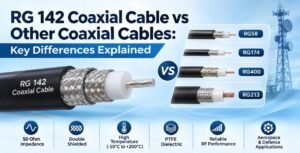
11. Compare RG 174 Cable with Other Coaxial Cables
Before making a purchasing decision, it is useful to compare RG 174 Cable with other commonly used coaxial cables. Different cable types offer different combinations of flexibility, diameter, attenuation and mechanical strength.
| Cable Type | General Characteristics | Common Applications |
|---|---|---|
| RG 174 | Miniature, lightweight and flexible | GPS, RF modules and compact electronics |
| RG 178 | Small-diameter, lightweight coaxial cable | Compact RF and electronic equipment |
| RG 316 | Flexible cable with a PTFE dielectric in common constructions | RF, aerospace and high-temperature applications |
| RG 58 | Larger diameter and commonly available in 50-ohm versions | RF communication and networking |
| RG 400 | Double-shielded construction in common versions | Aerospace, military and RF communication |
| LMR-100 | Compact low-loss cable construction | Wireless and RF installations |
The comparison highlights why RG 174 Cable is often selected for compact equipment and short RF connections.
However, the best choice depends on the actual electrical specifications, operating frequency, cable length, environmental conditions and mechanical requirements of the application.
12. Understand the Important RG 174 Cable Specifications
Reviewing the technical datasheet is one of the most effective ways to select the correct RG 174 Cable.
The following table highlights common specifications to examine when evaluating this cable. Actual values can vary depending on the manufacturer and construction.
| Specification | What to Check |
|---|---|
| Cable Type | RG 174 Coaxial Cable |
| Characteristic Impedance | 50 Ohms |
| Center Conductor | Solid or stranded conductor, as specified |
| Dielectric | Commonly polyethylene (PE) |
| Shielding | Metallic braided shielding |
| Outer Jacket | Commonly PVC or another specified material |
| Cable Diameter | Approximately 2.8 mm, depending on construction |
| Operating Frequency | Verify manufacturer datasheet |
| Attenuation | Manufacturer-specific, frequency-dependent |
| Temperature Rating | Verify manufacturer datasheet |
| Connector Options | SMA, BNC, TNC, MCX, U.FL and others, subject to assembly compatibility |
These specifications should be verified against the actual product datasheet before ordering. Not all RG 174 Cable products have identical construction or electrical performance.
13. Consider the Quality and Manufacturing Standards
Cable manufacturing quality plays an important role in determining the reliability and consistency of RF signal transmission.
When selecting RG 174 Cable, consider the manufacturer’s quality control processes and product documentation.
Important quality considerations include:
Conductor Quality: The centre conductor should meet the required material and dimensional specifications.
Dielectric Consistency: Uniform dielectric construction helps maintain stable impedance and electrical performance.
Shielding Quality: Proper shielding construction supports effective protection against electromagnetic interference.
Jacket Quality: The outer jacket should provide appropriate protection against mechanical damage and environmental exposure.
Electrical Testing: Check whether the cable has been tested for continuity, characteristic impedance, insertion loss and other relevant parameters.
Product Documentation: Reliable manufacturers and suppliers should provide technical datasheets and relevant product specifications.
Choosing a quality RG 174 Cable helps reduce installation issues and supports consistent performance in RF communication and electronic applications.
14. Decide Between Bulk RG 174 Cable and Custom Cable Assemblies
Another important consideration is whether you need RG 174 Cable in bulk lengths or as a ready-to-install cable assembly.
Both options are useful, depending on the installation requirements.
Bulk RG 174 Cable
Bulk cable is suitable for manufacturers, system integrators and engineering companies that require cable for multiple installations or custom assembly production.
Benefits include:
- Flexibility to cut cable according to required lengths.
- Suitable for large-scale production.
- Custom connector installation.
- Useful for equipment manufacturing and integration projects.
RG 174 Cable Assemblies
Pre-terminated RG 174 Cable assemblies are supplied with connectors already installed at one or both ends.
Benefits include:
- Convenient installation.
- Reduced assembly time.
- Consistent connector configuration.
- Availability in customized cable lengths.
- Suitable for connecting antennas, receivers and RF modules.
If your application requires specific connectors, cable lengths or termination configurations, a custom RG 174 Cable assembly can be a practical solution.
15. Common Mistakes to Avoid When Choosing RG 174 Cable
Selecting the wrong coaxial cable can affect signal quality, installation efficiency and overall system reliability.
Here are some common mistakes to avoid:
Ignoring Attenuation: Selecting a cable without checking its signal loss can result in poor performance, particularly at higher frequencies.
Choosing Incorrect Impedance: Using incompatible impedance components can cause signal reflections and transmission problems.
Selecting Excessive Cable Length: Longer cable connections introduce additional attenuation.
Ignoring Connector Compatibility: Incorrect connector interfaces or genders can prevent proper installation.
Overlooking Environmental Conditions: A standard cable jacket may not be suitable for harsh outdoor or industrial environments.
Ignoring Bend Radius: Excessive bending can damage internal cable components and affect electrical performance.
Not Checking Technical Datasheets: Relying only on the RG 174 designation without reviewing actual manufacturer specifications can lead to incorrect product selection.
Avoiding these mistakes helps ensure that the selected RG 174 Cable meets the electrical and mechanical requirements of your application.
16. Where to Buy High-Quality RG 174 Cable?
Selecting a reliable supplier is an important part of purchasing RG 174 Cable. A professional RF cable supplier should provide accurate product specifications, consistent manufacturing quality and suitable customization options.
Before selecting a supplier, consider:
- Availability of detailed technical datasheets.
- Consistent product quality.
- Availability of different cable lengths.
- Custom connector and cable assembly options.
- Technical support for product selection.
- Quality assurance and testing documentation.
- Reliable delivery and customer support.
SRFS Teleinfra provides RF and microwave connectivity solutions for telecommunications, wireless communication, electronic equipment and industrial applications.
Visit SRFS Teleinfra to explore RF cables, cable assemblies, connectors, adapters and other RF connectivity products.
17. Frequently Asked Questions About RG 174 Cable
Q1. What is RG 174 Cable used for?
RG 174 Cable is commonly used in RF communication equipment, GPS antenna connections, wireless devices, electronic testing instruments and compact electronic systems. Its small diameter and flexible construction make it suitable for installations where space is limited.
Q2. What is the impedance of RG 174 Cable?
RG 174 Cable generally has a characteristic impedance of 50 ohms. It is commonly used in RF systems that require 50-ohm impedance matching between antennas, transmitters, receivers and other communication components.
Q3. Is RG 174 Cable suitable for GPS applications?
Yes. RG 174 Cable can be used for GPS antenna connections, particularly in short-distance installations. However, its attenuation should be checked at the relevant GPS frequencies to ensure adequate signal strength.
Q4. What is the typical diameter of RG 174 Cable?
RG 174 Cable typically has an outside diameter of approximately 2.8 mm. Actual dimensions may vary depending on the manufacturer and cable construction.
Q5. Is RG 174 Cable flexible?
Yes. RG 174 Cable is a miniature, lightweight and flexible coaxial cable. It can be routed through compact electronic equipment and limited installation spaces, provided the manufacturer’s minimum bend radius is maintained.
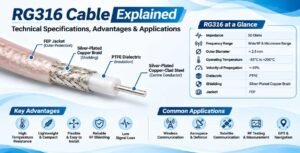
Q6. What is the difference between RG 174 and RG 316 Cable?
Both are 50-ohm coaxial cables commonly used in RF applications. RG 174 is generally a lightweight cable with a polyethylene dielectric, while RG 316 commonly uses a PTFE dielectric and offers better temperature-handling capabilities in standard constructions. Their attenuation and mechanical characteristics also differ.
Q7. Can RG 174 Cable be used for outdoor applications?
RG 174 Cable can be used in protected outdoor installations if its jacket and environmental ratings are suitable. For direct exposure to sunlight, moisture and harsh weather, verify the manufacturer’s environmental specifications and use additional protection where necessary.
Q8. Does RG 174 Cable support high-frequency applications?
RG 174 Cable can carry RF signals across a range of frequencies, but its suitability depends on attenuation, cable length and operating frequency. Always consult the manufacturer’s datasheet before using it in high-frequency applications.
Q9. Which connectors are available for RG 174 Cable assemblies?
Common connector options include SMA, BNC, TNC, MCX and U.FL, depending on the cable assembly design. The connector should be selected according to the connected equipment’s interface, impedance and frequency requirements.
Q10. How do I select the correct RG 174 Cable length?
Measure the distance between the connected devices and account for routing and termination requirements. Select the shortest practical cable length while ensuring that the cable can be installed without excessive bending or mechanical stress.
Conclusion
Choosing the right RG 174 Cable requires careful consideration of electrical performance, mechanical construction and installation requirements. Factors such as characteristic impedance, operating frequency, attenuation, shielding, cable length, connector compatibility and environmental conditions all influence the suitability of the cable.
RG 174 Cable is a practical choice for compact RF systems, GPS antenna connections, wireless communication equipment and electronic devices where flexibility and space-saving installation are important.
However, it is essential to compare manufacturer specifications and evaluate the actual requirements of your application before making a purchasing decision.
By selecting the appropriate RG 174 Cable and ensuring proper installation, you can achieve reliable RF connectivity, maintain signal quality and improve the overall performance of your communication system.
Explore RF cable and connectivity solutions at SRFS Teleinfra: https://www.srfsteleinfra.in/