Communication systems depend on reliable cables to transmit signals between different electronic devices and equipment. Whether used in CCTV surveillance, video distribution, broadcasting, or other electronic applications, selecting the right coaxial cable is essential for maintaining signal quality and system performance. Among the commonly used cable types, RG 59 Coaxial Cable is a popular choice for video transmission and low-frequency RF applications.
RG 59 Coaxial Cable is designed with a 75-ohm characteristic impedance, making it suitable for transmitting video signals across various communication and surveillance systems. Its coaxial construction helps protect transmitted signals from external electromagnetic interference while maintaining consistent performance in suitable operating conditions.
Due to its flexible construction, practical installation characteristics, and compatibility with different video transmission equipment, RG 59 Coaxial Cable continues to be used in residential, commercial, and industrial installations.
In this article, we will explore the major benefits of RG 59 Coaxial Cable, its construction, technical characteristics, applications, and important factors to consider when selecting the right cable for your communication requirements.
What Is RG 59 Coaxial Cable?
RG 59 Coaxial Cable is a type of coaxial transmission cable commonly used for carrying video signals and certain RF signals. It features a 75-ohm impedance, which makes it particularly suitable for applications where video signal transmission is required.
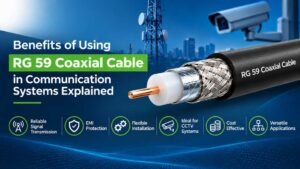
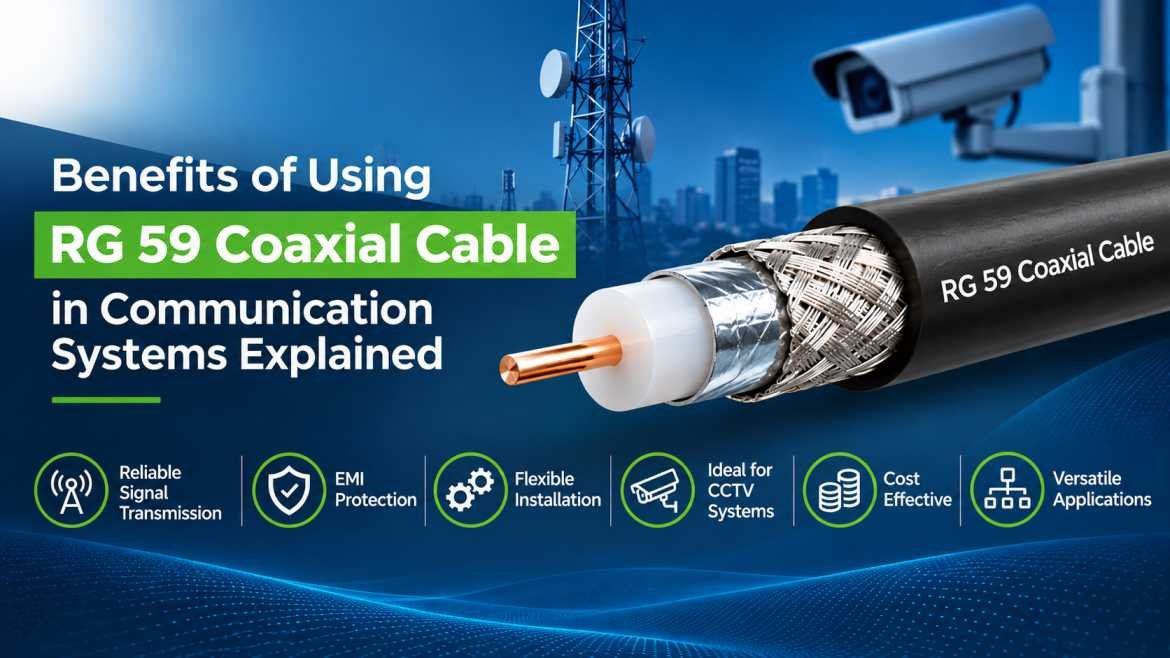
The cable consists of a central conductor surrounded by dielectric insulation, a metallic shielding layer, and an outer protective jacket. This layered construction helps maintain signal integrity and provides protection against external interference.
RG 59 is frequently used in CCTV camera installations, analogue video systems, video distribution networks, and other applications that require dependable signal transmission over relatively short to moderate distances.
Its relatively small diameter and flexible construction make it convenient to route through conduits, cable trays, walls, and equipment installations.
Construction of RG 59 Coaxial Cable
Understanding the construction of RG 59 Coaxial Cable helps explain why it is suitable for various communication applications.
1. Centre Conductor
The centre conductor carries the electrical signal through the cable. Depending on the cable design, it may be manufactured using solid copper, copper-clad steel, or other conductor materials.
The conductor material influences electrical conductivity, attenuation, and overall transmission performance.
2. Dielectric Insulation
The dielectric layer surrounds the centre conductor and maintains the required spacing between the conductor and shielding.
It is commonly manufactured using polyethylene or other suitable insulating materials. This layer helps maintain the cable’s characteristic impedance of 75 ohms.
3. Shielding Layer
The shielding layer provides protection against external electromagnetic interference and helps reduce unwanted signal coupling.
Depending on the cable construction, shielding may consist of braided copper, aluminium, or a combination of foil and braid.
4. Outer Jacket
The outer jacket protects the internal cable components against physical damage, dust, moisture, and environmental exposure.
Jacket materials vary according to installation requirements, including indoor, outdoor, and specialised environments.
Key Benefits of Using RG 59 Coaxial Cable in Communication Systems
RG 59 Coaxial Cable offers several advantages that make it a practical option for video transmission and selected communication applications.
1. Reliable Video Signal Transmission
One of the primary benefits of RG 59 Coaxial Cable is its ability to transmit video signals with consistent performance when used within its recommended distance and frequency limits.
Its 75-ohm impedance is widely used in video equipment, making it suitable for connecting CCTV cameras, monitors, DVRs, video distribution systems, and other compatible devices.
Proper impedance matching between the cable, connectors, and connected equipment helps minimise signal reflections and maintain transmission quality.
2. Effective Protection Against Electromagnetic Interference
Communication installations often operate near electrical equipment, power cables, motors, and other sources of electromagnetic interference.
The metallic shielding in RG 59 Coaxial Cable helps reduce the effects of external interference on transmitted signals.
This shielding is particularly useful in CCTV and video installations where unwanted noise can affect image quality.
The actual shielding effectiveness depends on braid coverage, foil construction, material quality, and installation conditions.
3. Flexible and Easy Installation
RG 59 Coaxial Cable is generally smaller and more flexible than several larger coaxial cable types.
This makes it easier to install in locations with limited space or complex routing requirements.
Its flexibility offers several practical advantages:
- Convenient routing through conduits and cable trays.
- Easier installation around corners and bends.
- Reduced handling difficulty during cable deployment.
- Suitable for many indoor surveillance installations.
- Convenient connections with compatible coaxial connectors.
These characteristics make RG 59 a practical choice for installers working on residential, commercial, and industrial communication projects.
4. Suitable for CCTV Surveillance Systems
CCTV surveillance is one of the most common applications of RG 59 Coaxial Cable.
It is widely used in analogue video surveillance systems to connect cameras with DVR equipment and monitoring devices.
The 75-ohm impedance supports compatibility with standard video transmission equipment.
RG 59 can be used in applications such as:
- Commercial building surveillance.
- Residential security systems.
- Retail store monitoring.
- Industrial facility security.
- Office and warehouse surveillance.
- Educational institution security networks.
For longer cable runs, installers should evaluate attenuation and signal requirements before selecting RG 59.
5. Cost-Effective Cable Solution
Another important advantage of RG 59 Coaxial Cable is its cost-effectiveness for suitable video transmission applications.
Its availability in different constructions, lengths, and shielding configurations makes it accessible for various installation requirements.
For projects involving multiple CCTV cameras or video connections, selecting an appropriate RG 59 cable can help manage installation costs without compromising the basic requirements of the system.
However, cable selection should always consider conductor material, shielding quality, attenuation, and environmental conditions rather than price alone.
6. Consistent 75-Ohm Impedance
Impedance matching is essential for maintaining signal quality in coaxial transmission systems.
RG 59 Coaxial Cable is designed with a nominal characteristic impedance of 75 ohms, which is commonly used in video and broadcast applications.
Maintaining proper impedance matching between the cable and connected equipment helps minimise:
- Signal reflections.
- Transmission losses caused by impedance mismatch.
- Unwanted distortion.
- Signal quality degradation.
This makes RG 59 suitable for equipment designed specifically for 75-ohm coaxial connections.
7. Versatility Across Different Applications
RG 59 Coaxial Cable is not limited to CCTV installations. It can also be used in several other video and electronic signal transmission applications.
Its versatility makes it useful in:
- Analogue video transmission.
- Video distribution networks.
- Broadcast video equipment.
- Security and monitoring systems.
- Audio-video installations.
- Selected low-frequency RF applications.
The suitability of RG 59 for a particular application depends on the required frequency range, cable length, attenuation, and system specifications.
Technical Specifications of RG 59 Coaxial Cable
The technical specifications of RG 59 Coaxial Cable can vary depending on the manufacturer, conductor material, dielectric design, and shielding configuration.
The following table provides commonly associated characteristics of RG 59 cables. Actual product specifications should be verified against the manufacturer’s datasheet.
| Parameter | Typical Description |
|---|---|
| Cable Type | RG 59 Coaxial Cable |
| Characteristic Impedance | 75 Ohms |
| Centre Conductor | Solid Copper or Copper-Clad Steel |
| Dielectric Material | Polyethylene (PE) |
| Shielding | Copper Braid, Aluminium Braid or Foil |
| Outer Jacket | PVC or PE |
| Cable Construction | Coaxial |
| Signal Type | Video and RF Signals |
| Primary Application | CCTV and Video Transmission |
| Installation | Indoor or Outdoor, depending on jacket |
| Connector Compatibility | Suitable 75-Ohm Connectors |
8. Durable Construction for Long-Term Performance
Cable durability plays an important role in communication infrastructure, particularly in installations where cables remain in operation for extended periods.
RG 59 Coaxial Cable features multiple protective layers that help safeguard its internal components against physical stress and environmental exposure.
The outer jacket protects the cable from abrasion, handling damage, and other installation-related conditions.
Depending on its construction, an RG 59 cable designed for outdoor use may also provide additional protection against sunlight, moisture, and temperature variations.
Selecting the appropriate jacket material and cable construction helps improve operational reliability and service life.
9. Compatibility with Standard Coaxial Connectors
RG 59 Coaxial Cable supports a range of connectors designed for 75-ohm coaxial transmission systems.
Common connector options include:
- BNC connectors.
- F-type connectors.
- RCA connectors.
- Other compatible 75-ohm coaxial connectors.
BNC connectors are frequently used in professional video and CCTV installations, while F-type connectors are common in certain video distribution and television systems.
Choosing the correct connector according to cable dimensions, conductor type, and equipment interface is important for achieving a reliable connection.
10. Suitable for Residential and Commercial Installations
RG 59 Coaxial Cable can be used in different installation environments, making it a practical option for various projects.
In residential environments, it is commonly used for CCTV camera connections, television signal distribution, and video equipment.
In commercial environments, it can support surveillance infrastructure, video monitoring systems, and equipment interconnections.
Industrial applications may also use RG 59 for suitable monitoring and video transmission requirements, provided the cable construction meets the operating environment and electrical specifications.
Applications of RG 59 Coaxial Cable in Communication Systems
RG 59 Coaxial Cable is used across several industries where reliable 75-ohm video transmission is required.
CCTV Camera Systems
CCTV surveillance systems frequently use RG 59 to transmit video signals between cameras and recording equipment.
It is suitable for compatible analogue surveillance systems installed in offices, retail stores, factories, warehouses, and residential buildings.
Video Distribution Systems
RG 59 can be used to distribute video signals between different electronic devices and display equipment.
It supports various video distribution installations where the cable’s attenuation and frequency characteristics meet system requirements.
Broadcasting Equipment
Certain broadcasting and professional video installations use RG 59 for connecting video equipment and transmitting signals over relatively short distances.
Its 75-ohm impedance makes it compatible with many standard video interfaces.
Television Signal Transmission
RG 59 can be used in selected television signal distribution applications, particularly where cable length and signal frequency remain within acceptable limits.
For installations involving higher frequencies or longer distances, other coaxial cable options may provide better performance.
Audio and Video Equipment
Audio-video systems may use RG 59 for compatible video connections between cameras, monitors, recording equipment, and distribution devices.
Security and Monitoring Infrastructure
Security infrastructure requires dependable connections between cameras, monitoring equipment, and recording systems.
RG 59 provides a practical cable option for suitable analogue video surveillance installations.
RG 59 vs RG 6 Coaxial Cable: Understanding the Differences
RG 59 and RG 6 are both 75-ohm coaxial cables, but they are designed for different installation and transmission requirements.
Understanding their differences helps engineers and installers select the appropriate cable for their applications.
| Parameter | RG 59 Coaxial Cable | RG 6 Coaxial Cable |
|---|---|---|
| Impedance | 75 Ohms | 75 Ohms |
| Cable Diameter | Generally Smaller | Generally Larger |
| Flexibility | Generally More Flexible | Generally Less Flexible |
| Centre Conductor | Solid Copper or Copper-Clad Steel | Copper-Clad Steel or Copper, depending on design |
| Signal Attenuation | Generally Higher | Generally Lower |
| Shielding | Varies by construction | Often available with enhanced shielding |
| Common Applications | CCTV and Video Systems | CATV, Satellite and Video Distribution |
| Installation | Shorter video runs and compact routing | Longer runs and higher-frequency distribution |
RG 59 is often preferred when flexibility and compact cable routing are important.
RG 6 is generally preferred for applications requiring lower attenuation, particularly in longer cable runs and higher-frequency television or broadband distribution systems.
The final choice should depend on the actual electrical specifications and system requirements rather than cable type alone.
Important Factors to Consider When Selecting RG 59 Coaxial Cable
Choosing the right RG 59 Coaxial Cable requires evaluating several technical and installation-related factors.
1. Centre Conductor Material
The centre conductor directly influences electrical conductivity and cable performance.
Solid copper conductors generally offer good electrical conductivity, while copper-clad steel conductors are used in certain cable designs for specific applications.
Always check the conductor material against the intended application.
2. Shielding Coverage
Shielding helps protect the transmitted signal from external interference.
For installations near electrical equipment or other potential interference sources, selecting a cable with suitable shielding coverage is important.
Foil and braided shielding combinations may provide improved protection compared with basic braid-only constructions.
3. Cable Length
Cable length has a direct impact on signal attenuation.
As transmission distance increases, signal strength decreases due to electrical losses within the cable.
Before installation, evaluate the cable’s attenuation at the operating frequency and the maximum permissible signal loss of the connected equipment.
4. Operating Frequency
Different coaxial cables perform differently across frequency ranges.
Although RG 59 is commonly used for video transmission and selected RF applications, its suitability depends on frequency-dependent attenuation and other electrical characteristics.
Always verify the manufacturer’s frequency and attenuation specifications.
5. Environmental Conditions
The installation environment determines the required cable jacket and protective construction.
For indoor installations, standard PVC jackets may be suitable.
For outdoor applications, UV-resistant and moisture-resistant jacket materials may be necessary.
Underground installations may require specially designed cables with suitable moisture protection.
6. Connector Compatibility
Selecting the correct connectors is essential for achieving a reliable cable connection.
Ensure that connectors match the cable diameter, conductor construction, shielding arrangement, and required 75-ohm impedance.
Incorrect connector selection can lead to poor electrical contact, signal reflections, and transmission problems.
Installation Best Practices for RG 59 Coaxial Cable
Proper installation helps maintain signal quality and improve cable reliability.
The following practices should be considered during installation.
Avoid Excessive Bending: Maintain the manufacturer’s recommended minimum bend radius to prevent damage to the conductor and dielectric.
Use Compatible Connectors: Select connectors specifically designed for the RG 59 cable construction.
Maintain Proper Impedance: Use compatible 75-ohm equipment and connectors throughout the transmission path.
Avoid Excessive Cable Length: Keep cable runs within the limits supported by the system and the cable’s attenuation characteristics.
Protect Outdoor Installations: Use cables with appropriate UV and moisture resistance when installing outdoors.
Separate from Power Cables: Where practical, maintain separation from high-voltage wiring and other sources of electrical interference.
Inspect Cable Connections: Check connectors and cable terminations for loose connections, incorrect assembly, and damaged shielding.
Avoid Physical Damage: Protect the cable from crushing, sharp edges, excessive pulling tension, and abrasion during installation.
Common Problems Associated with RG 59 Coaxial Cable
Although RG 59 is a reliable cable option for suitable applications, improper selection or installation can affect its performance.
Signal Attenuation
Signal attenuation occurs when signal strength decreases as it travels through the cable.
Long cable runs, higher operating frequencies, and poor-quality cable construction can increase transmission losses.
Electromagnetic Interference
Insufficient shielding or improper cable installation can allow external interference to affect the transmitted signal.
Selecting an appropriate shielding configuration helps reduce this problem.
Connector-Related Issues
Incorrectly installed or incompatible connectors may result in poor contact, impedance mismatch, and signal degradation.
Proper connector selection and installation are essential.
Cable Damage
Physical damage to the outer jacket, dielectric, or conductor can affect electrical performance.
Regular inspection helps identify damaged sections before they cause significant system problems.
Moisture Ingress
Moisture entering an unsuitable cable or poorly sealed connection can damage internal components and affect signal transmission.
Outdoor installations should use appropriately rated cables and weather-resistant connections.
Why Choose Quality RG 59 Coaxial Cable?
The quality of coaxial cable has a direct impact on the performance and reliability of communication systems.
A properly manufactured RG 59 Coaxial Cable offers several practical advantages:
- Consistent 75-ohm impedance for compatible video systems.
- Reliable signal transmission within specified operating limits.
- Suitable shielding to reduce external interference.
- Flexible construction for convenient cable routing.
- Compatibility with commonly used coaxial connectors.
- Multiple jacket options for different installation environments.
- Practical use in CCTV, video monitoring, and distribution systems.
For professional installations, it is important to select cables from manufacturers that provide clear technical specifications, consistent product quality, and application-specific cable configurations.
Frequently Asked Questions About RG 59 Coaxial Cable
1. What is RG 59 Coaxial Cable used for?
RG 59 Coaxial Cable is primarily used for video signal transmission, CCTV surveillance systems, video distribution networks, and selected RF applications. Its 75-ohm impedance makes it suitable for compatible video equipment.
2. What is the impedance of RG 59 Coaxial Cable?
RG 59 Coaxial Cable has a nominal characteristic impedance of 75 ohms. It is commonly used in video transmission and surveillance applications.
3. Is RG 59 Coaxial Cable suitable for CCTV cameras?
Yes. RG 59 is commonly used in analogue CCTV installations to connect surveillance cameras with DVRs and monitoring equipment. Its suitability depends on cable length, signal format, and attenuation requirements.
4. What is the difference between RG 59 and RG 6 cables?
Both cables have a nominal impedance of 75 ohms. However, RG 59 generally has a smaller diameter and greater flexibility, while RG 6 typically provides lower attenuation and is preferred for many longer-distance and higher-frequency distribution applications.
5. Can RG 59 Coaxial Cable be used outdoors?
Yes, provided the cable has an appropriate outdoor-rated jacket and moisture protection. Standard indoor RG 59 cables should not automatically be used for outdoor installations.
6. Which connectors are compatible with RG 59 Coaxial Cable?
Common connector options include BNC, F-type, and RCA connectors. The connector must match the cable dimensions, conductor design, and application requirements.
7. Does RG 59 Coaxial Cable reduce signal interference?
Yes. Its metallic shielding helps reduce external electromagnetic interference. However, actual shielding effectiveness depends on the cable’s shielding construction and installation conditions.
8. Is RG 59 suitable for long-distance signal transmission?
RG 59 can support certain longer cable runs, but signal attenuation increases with distance and frequency. For longer runs, RG 6 or another suitable coaxial cable may provide better performance.
9. What factors affect the performance of RG 59 Coaxial Cable?
Important factors include conductor material, dielectric properties, shielding coverage, cable length, operating frequency, connector quality, and environmental conditions.
10. How do I select the right RG 59 Coaxial Cable?
Consider the required impedance, conductor material, shielding configuration, attenuation, cable length, jacket material, connector compatibility, and installation environment before selecting a cable.
Conclusion
RG 59 Coaxial Cable remains a practical solution for video transmission and various communication applications. Its 75-ohm impedance, flexible construction, shielding capabilities, and compatibility with commonly used coaxial connectors make it suitable for CCTV surveillance, video distribution, monitoring systems, and selected RF installations.
Understanding its construction, technical characteristics, benefits, and limitations helps engineers, installers, and system integrators make informed cable selection decisions.
For reliable system performance, it is important to choose RG 59 Coaxial Cable according to the required frequency range, transmission distance, environmental conditions, and equipment compatibility.
Businesses looking for dependable RF and communication infrastructure solutions should prioritise cable quality, verified technical specifications, and application-specific requirements when selecting coaxial cables.
About SRFS Teleinfra
SRFS Teleinfra provides RF and microwave components, coaxial cables, cable assemblies, connectors, antennas, and communication infrastructure solutions for various industrial and telecom applications.
Explore the range of RF cable and connectivity solutions at www.srfsteleinfra.in.
Suggested SEO keywords to target:
- RG 59 Coaxial Cable
- RG59 Coaxial Cable
- RG 59 Cable
- RG 59 Cable Specifications
- 75 Ohm Coaxial Cable
- RG 59 CCTV Cable
- RG 59 Cable Applications
- RG 59 RF Cable
- RG 59 Cable Benefits
- RG 59 vs RG 6 Cable