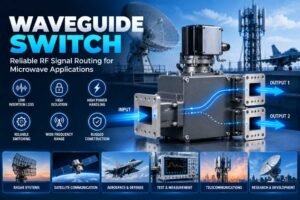
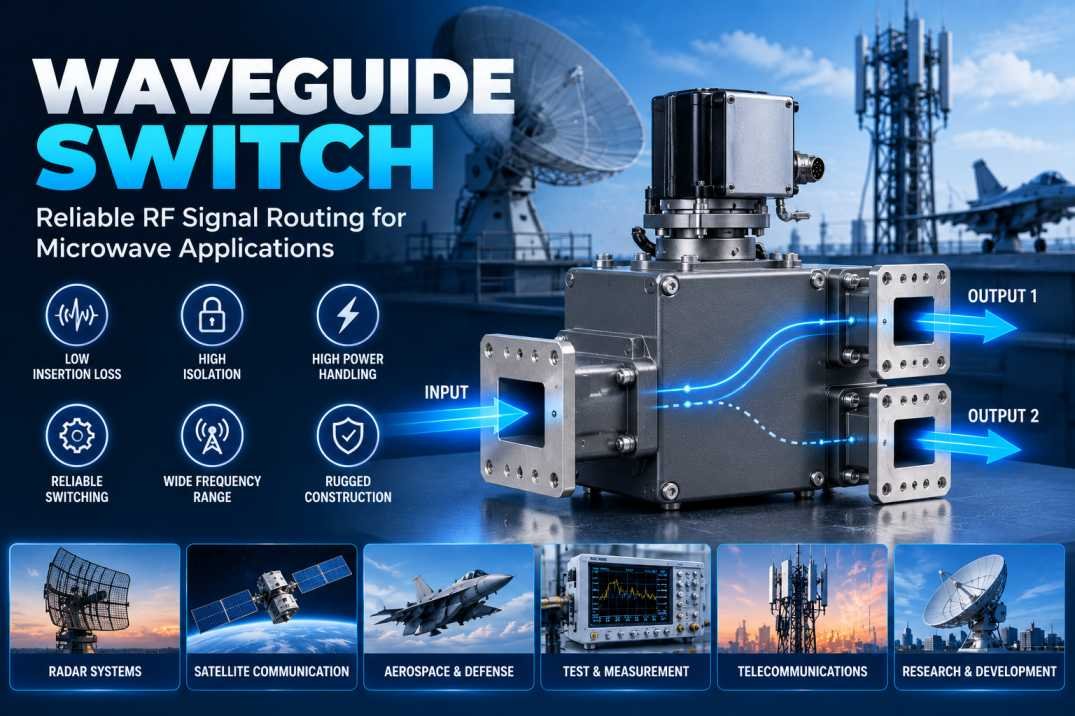
A waveguide switch is an RF and microwave component used to control the path of high-frequency electromagnetic signals through a waveguide transmission system. It allows a microwave signal to be directed from one waveguide port to another, enabling signal routing, system switching, equipment selection, and redundancy.
Waveguide switches are widely used in radar, satellite communication, aerospace and defense systems, microwave test equipment, telecommunications, and other high-frequency applications where low-loss and reliable signal routing are required.
What Is a Waveguide Switch?
A waveguide switch is a mechanical or electronically controlled microwave device that changes the transmission path of an RF signal between different waveguide ports. Unlike conventional electrical switches that use conductors to route signals, a waveguide switch controls electromagnetic energy traveling through a hollow metallic waveguide structure.
Depending on its configuration, a waveguide switch can connect one input to multiple outputs, select between different signal paths, or isolate an unused path.
The primary purpose of a waveguide switch is to provide controlled RF signal routing while maintaining low insertion loss, good isolation, and reliable microwave performance.
How Does a Waveguide Switch Work?
The working principle of a waveguide switch depends on its mechanical or electromagnetic switching mechanism.
In a mechanical waveguide switch, an internal movable component changes position to establish a specific waveguide path. The switching element may rotate or move between predetermined positions, connecting the input port with the required output port.
For example, in a single-pole, double-throw configuration, one input waveguide can be connected to either of two output waveguides. Moving the switching mechanism changes the selected RF path.
The switch is designed so that the electromagnetic signal experiences controlled transitions between waveguide sections. Proper internal geometry is important because discontinuities can increase reflection and insertion loss.
Key Features of Waveguide Switch
A high-quality waveguide switch can provide several important characteristics for microwave systems:
- Low insertion loss
- High isolation between ports
- High power-handling capability
- Reliable RF signal routing
- Repeatable switching operation
- High-frequency operation
- Robust mechanical construction
- Low VSWR
- Compact system integration
- Suitable for demanding microwave environments
The actual performance depends on the waveguide size, frequency band, switching mechanism, materials, and manufacturer-specific design.
Types of Waveguide Switches
Waveguide switches are available in different configurations to support different RF system requirements.
Single-Pole Double-Throw Waveguide Switch
An SPDT waveguide switch allows one input signal to be routed to one of two output ports. It is useful when two signal paths need to be selected from a common RF source.
Transfer Waveguide Switch
A transfer switch provides controlled routing between multiple waveguide ports. It can be used to change the connection between different components or transmission paths.
Waveguide Switch with Multiple Ports
Multi-port configurations allow microwave systems to select between several signal paths. These designs are useful in complex RF networks and automated test systems.
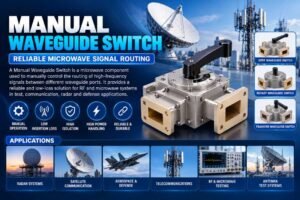
Manual Waveguide Switch
A manual waveguide switch is operated physically by an operator. It is useful in laboratory systems, test setups, and applications where switching does not need to be automated.
Motorized Waveguide Switch
Motorized switches use an actuator or motor to change the internal switching mechanism. They can be integrated into remotely controlled microwave systems.
Important Specifications of Waveguide Switch
Selecting the appropriate waveguide switch requires evaluation of several technical parameters.
| Parameter | Importance |
|---|---|
| Frequency Range | Defines the supported microwave operating band |
| Waveguide Size | Determines physical and RF compatibility |
| Insertion Loss | Indicates signal loss through the selected path |
| Isolation | Indicates unwanted signal suppression between ports |
| VSWR | Indicates impedance matching and signal reflection |
| Power Handling | Defines maximum RF power capability |
| Switching Time | Important for automated and fast switching systems |
| Operating Life | Indicates expected switching durability |
| Connector/Flange Type | Determines mechanical system compatibility |
Specifications should always be verified against the datasheet of the specific waveguide switch model.
Applications of Waveguide Switch
Waveguide switches are used in a wide range of high-frequency systems.
Radar Systems
Radar equipment may use waveguide switches to route microwave energy between antennas, transmitters, receivers, and testing paths.
Satellite Communication
In satellite and ground communication systems, waveguide switching can provide signal-path selection and equipment redundancy.
Aerospace and Defense
High-frequency communication, radar, electronic systems, and specialized microwave equipment often require reliable signal routing. Waveguide switches can support these systems where low-loss microwave transmission is important.
Microwave Test and Measurement
Automated test systems can use waveguide switches to select different devices under test, measurement paths, or calibration configurations.
Telecommunications
Microwave communication networks can use switching components for signal-path management, redundancy, and equipment selection.
RF Research and Development
Laboratories and engineering facilities use waveguide switches when testing antennas, filters, amplifiers, microwave sources, and other high-frequency components.
Advantages of Waveguide Switch
One major advantage of a waveguide switch is its ability to route microwave signals while maintaining the characteristics required for high-frequency transmission.
Waveguide technology can support high power levels and low transmission loss compared with some conventional transmission technologies at microwave frequencies. A properly designed switch can also provide high isolation, helping prevent unwanted signals from entering inactive paths.
For automated systems, motorized or remotely controlled waveguide switches can provide repeatable operation and enable computer-controlled RF testing.
Waveguide Switch vs RF Coaxial Switch
Waveguide switches and coaxial RF switches perform similar signal-routing functions but are designed for different transmission structures.
Coaxial switches use a center conductor, dielectric, and outer conductor, while waveguide switches use hollow metallic transmission paths. Waveguide switches are particularly useful at microwave and millimeter-wave frequencies where waveguide transmission can provide suitable power handling and low-loss performance.
The appropriate technology depends on frequency, power, physical dimensions, insertion loss, isolation, and system architecture.
How to Select a Waveguide Switch
Before selecting a waveguide switch, consider the following factors:
- Operating frequency: Ensure the switch covers the required frequency band.
- Waveguide interface: Verify waveguide size and flange compatibility.
- Insertion loss: Select a design appropriate for the system’s signal budget.
- Isolation: Check isolation requirements between active and inactive ports.
- Power handling: Confirm the switch can safely handle the expected RF power.
- Switching mechanism: Choose manual, motorized, or other suitable operation.
- Switching speed: Consider the required switching response.
- Environmental requirements: Check temperature, vibration, humidity, and other operating conditions.
Conclusion
A waveguide switch is an important microwave component used to control and route high-frequency electromagnetic signals between different transmission paths. Its low-loss transmission characteristics, isolation, power-handling capability, and reliable switching operation make it suitable for radar, satellite communication, aerospace, defense, telecommunications, and microwave test systems.
Choosing the correct waveguide switch requires careful consideration of frequency, waveguide size, insertion loss, isolation, VSWR, power handling, switching time, and environmental requirements. Proper selection ensures dependable RF signal routing and efficient integration into high-frequency systems.
FAQs About Waveguide Switch
1. What is a waveguide switch?
A waveguide switch is an RF/microwave device used to route electromagnetic signals between different waveguide ports or transmission paths.
2. Where are waveguide switches used?
They are commonly used in radar, satellite communication, aerospace, defense, telecommunications, microwave testing, and RF research systems.
3. What is the purpose of a waveguide switch?
Its primary purpose is to select or change the transmission path of a microwave signal between different RF components.
4. What is insertion loss in a waveguide switch?
Insertion loss represents the amount of RF signal power lost while the signal passes through the selected switching path.
5. What is isolation in a waveguide switch?
Isolation indicates how effectively the switch prevents unwanted RF energy from passing between ports that are not selected.
6. Are waveguide switches available in different frequency bands?
Yes. Waveguide switches are designed for specific microwave frequency bands and waveguide standards. The required frequency range should be checked before selection.
7. What is the difference between a manual and motorized waveguide switch?
A manual switch is operated physically, while a motorized switch uses an actuator or motor and can be integrated into remotely controlled or automated RF systems.
8. How do I choose the right waveguide switch?
Consider operating frequency, waveguide size, flange type, insertion loss, isolation, VSWR, power handling, switching speed, operating life, and environmental requirements.