
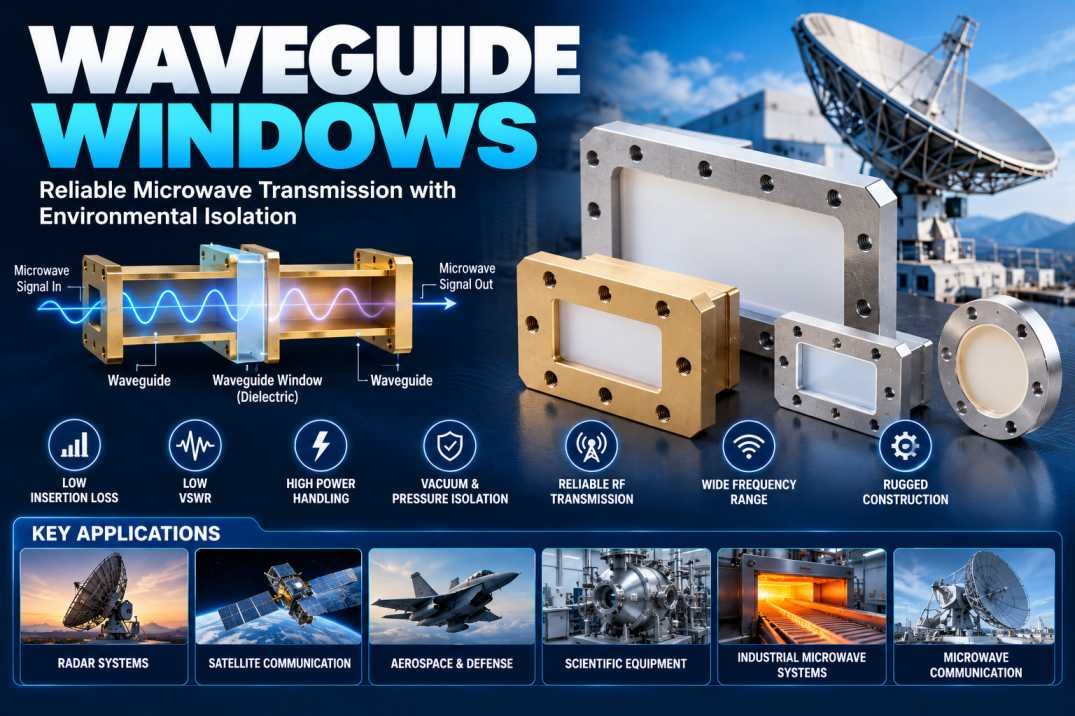
A waveguide window is a microwave and RF component designed to allow electromagnetic energy to pass between sections of a waveguide or through a physical barrier while maintaining controlled transmission characteristics. It can provide electrical isolation, environmental protection, pressure separation, or vacuum isolation without significantly affecting the RF signal.
Waveguide windows are widely used in microwave communication, radar, satellite systems, aerospace, defense, RF heating, scientific equipment, and high-power microwave systems. They are particularly important when a waveguide must cross a sealed wall, enclosure, pressure boundary, or vacuum chamber.
What Is a Waveguide Window?
A waveguide window is a specially engineered RF interface installed within a waveguide transmission system. Its primary function is to permit microwave energy to travel through the transmission path while maintaining the required mechanical or environmental barrier.
Unlike a conventional transparent window that allows visible light to pass, an RF waveguide window is designed according to the electromagnetic properties of the operating frequency and waveguide mode.
The window material, thickness, dimensions, mounting arrangement, and dielectric properties are carefully selected to achieve low RF reflection and insertion loss.
Depending on the application, a waveguide window may be used to:
- Separate two different environments
- Maintain vacuum or pressure
- Prevent moisture and contaminants from entering a waveguide
- Provide electrical isolation
- Protect sensitive microwave equipment
- Create a sealed RF transmission path
- Support high-power microwave transmission
How Does a Waveguide Window Work?
A waveguide carries electromagnetic energy through a controlled metallic structure. When a physical barrier is introduced into this transmission path, it can potentially cause reflection, loss, or impedance mismatch.
A properly designed waveguide window minimizes these effects.
The window is normally manufactured using a carefully selected dielectric or RF-transparent material. Its electromagnetic characteristics are matched with the waveguide dimensions and operating frequency.
When microwave energy reaches the window, the structure allows the electromagnetic field to pass through while preventing the surrounding environment from crossing the barrier.
The design therefore needs to balance two requirements:
Mechanical/environmental isolation + RF transmission performance
This makes waveguide windows different from simple mechanical seals or covers.
Construction of Waveguide Windows
The construction of a waveguide window depends on its application, frequency range, power level, and environmental requirements.
Waveguide Body
The waveguide body provides the electromagnetic transmission path. It is normally manufactured from conductive materials suitable for microwave applications.
Window Material
The window section is made from a material that provides suitable electromagnetic transmission characteristics. Material selection depends on frequency, power, temperature, pressure, and environmental conditions.
Sealing Structure
For vacuum, pressure, or environmental applications, the window may incorporate specialized sealing arrangements. The seal must maintain the required isolation without compromising RF performance.
Mounting Flange
Waveguide windows commonly use flange interfaces to connect with other waveguide components. Accurate flange dimensions are important for mechanical compatibility and RF alignment.
Types of Waveguide Windows
Different types of waveguide windows are available for different microwave applications.
1. Dielectric Waveguide Windows
Dielectric windows use a non-metallic material that allows microwave energy to pass through. Their thickness and dielectric properties are carefully controlled to minimize reflections.
They are commonly used when environmental separation is required.
2. Pressure Waveguide Windows
Pressure windows are designed to maintain a pressure difference between two environments while allowing RF energy to pass through.
They can be used in systems where one side of the waveguide operates under pressure while the other side is exposed to another environment.
3. Vacuum Waveguide Windows
Vacuum waveguide windows are designed for systems requiring vacuum isolation. They are commonly found in scientific equipment, particle accelerator systems, vacuum chambers, and specialized microwave systems.
4. High-Power Waveguide Windows
High-power applications require windows capable of handling significant microwave energy without excessive heating, dielectric breakdown, arcing, or mechanical failure.
These windows require careful electromagnetic and thermal design.
5. RF Isolation Windows
Some waveguide windows are designed to provide electrical or environmental isolation while maintaining microwave transmission. Their construction depends heavily on the required isolation level and application environment.
Important Specifications of Waveguide Windows
When selecting a waveguide window, several specifications should be evaluated.
| Parameter | Importance |
|---|---|
| Operating Frequency | Determines suitable RF performance |
| Waveguide Size | Defines mechanical and electromagnetic compatibility |
| Insertion Loss | Indicates signal loss through the window |
| VSWR | Indicates impedance matching |
| Return Loss | Indicates reflected microwave energy |
| Power Handling | Defines maximum RF power capability |
| Pressure Rating | Important for pressure isolation |
| Vacuum Rating | Important for vacuum applications |
| Temperature Range | Determines environmental suitability |
| Material | Influences RF and mechanical performance |
| Flange Type | Determines installation compatibility |
| Sealing Method | Provides environmental isolation |
Exact specifications vary according to the waveguide window design and manufacturer.
Why Is Low VSWR Important?
VSWR, or Voltage Standing Wave Ratio, is an important parameter in microwave transmission systems.
An improperly designed window can create an impedance discontinuity. This can cause part of the microwave signal to be reflected toward the source.
A low VSWR waveguide window helps maintain efficient RF transmission and reduces unwanted reflections.
This is particularly important in high-frequency and high-power systems where reflected energy can affect system efficiency and component reliability.
Insertion Loss in Waveguide Windows
Insertion loss represents the amount of RF power lost when the signal passes through the component.
A high-quality waveguide window should provide low insertion loss within its specified operating frequency range.
Lower insertion loss can be particularly important in:
- Satellite communication
- Radar
- Microwave links
- RF power transmission
- Scientific systems
- High-power microwave equipment
The acceptable insertion loss depends on the overall system requirements.
Applications of Waveguide Windows
Waveguide windows are used in numerous RF and microwave systems.
Radar Systems
Radar equipment requires reliable transmission of microwave signals between RF components and antennas. Waveguide windows can provide environmental or pressure isolation while maintaining RF transmission.
Satellite Communication
Satellite and space communication systems require compact and reliable microwave components. Waveguide windows can be used where environmental isolation is required in RF transmission paths.
Aerospace and Defense
Aerospace and defense equipment often operates under demanding temperature, vibration, pressure, and environmental conditions. Waveguide windows can provide protected microwave interfaces.
Microwave Communication
Microwave communication systems use waveguides to transport high-frequency signals. Windows can help isolate sections of the transmission system while maintaining signal continuity.
RF and Microwave Testing
Laboratory and test systems may require sealed or isolated RF interfaces. Waveguide windows can provide controlled transmission between equipment and test environments.
Vacuum Systems
Vacuum chambers and scientific equipment often require microwave energy to enter or leave a controlled vacuum environment without compromising the vacuum.
Industrial Microwave Systems
Industrial microwave heating and processing equipment may use waveguide windows to transmit microwave energy while protecting the transmission system from the operating environment.
Advantages of Waveguide Windows
A properly designed waveguide window can provide several benefits:
- Reliable microwave signal transmission
- Environmental separation
- Pressure and vacuum isolation
- Protection against moisture and contaminants
- Controlled impedance characteristics
- Low RF reflection
- Low insertion loss
- High mechanical reliability
- Compatibility with microwave waveguide systems
- Potential for high-power operation
Factors to Consider When Selecting a Waveguide Window
Choosing the right waveguide window requires consideration of both RF and mechanical requirements.
First, identify the operating frequency and waveguide size. The window must be compatible with the electromagnetic mode and frequency range.
Next, evaluate VSWR, insertion loss, and return loss. These parameters determine how efficiently the window integrates into the RF transmission path.
For demanding applications, power handling and thermal performance are also important. High RF power can generate heat within the window material, potentially affecting performance.
Environmental requirements should also be considered. If the window is being used for vacuum or pressure isolation, verify its pressure and vacuum ratings.
Finally, check the flange configuration, dimensions, mounting requirements, sealing method, and material compatibility before installation.
Waveguide Window vs Conventional RF Connector
A conventional RF connector provides an electrical interface between a cable, PCB, or RF equipment port. A waveguide window serves a different purpose.
The primary purpose of a waveguide window is to allow microwave energy to pass through a barrier while maintaining environmental or mechanical isolation.
This makes waveguide windows particularly useful in specialized systems where a conventional connector cannot provide the required sealing or transmission structure.
Maintenance and Reliability
Waveguide windows should be inspected according to the requirements of the application. Physical damage, contamination, improper mounting, or deterioration of seals can affect performance.
For high-power applications, thermal conditions should also be monitored. Excessive heating can affect the window material and surrounding structure.
Correct flange alignment and proper installation are important because mechanical misalignment can introduce unwanted RF discontinuities.
Conclusion
A waveguide window is an important microwave component that combines RF transmission with mechanical and environmental isolation. It allows electromagnetic energy to pass through a barrier while helping maintain pressure, vacuum, environmental protection, or electrical isolation.
Waveguide windows are used in radar, satellite communication, aerospace, defense, microwave communication, scientific equipment, vacuum systems, and industrial microwave applications.
Selecting the appropriate window requires careful evaluation of operating frequency, waveguide dimensions, VSWR, insertion loss, power handling, material, pressure or vacuum requirements, temperature range, flange configuration, and sealing method. With the correct design and installation, waveguide windows can provide reliable RF performance in demanding microwave systems.
FAQs About Waveguide Windows
1. What is a waveguide window?
A waveguide window is an RF component that allows microwave energy to pass through a physical barrier while providing environmental, pressure, vacuum, or electrical isolation.
2. What is the main purpose of a waveguide window?
Its primary purpose is to maintain separation between two environments while allowing microwave signals to pass through with controlled RF performance.
3. Where are waveguide windows used?
They are used in radar, satellite communication, aerospace, defense, microwave communication, vacuum systems, scientific equipment, and industrial microwave systems.
4. What materials are used in waveguide windows?
Materials vary according to the frequency, power, temperature, pressure, and environmental requirements of the application. Dielectric and RF-transparent materials are commonly used.
5. What is VSWR in a waveguide window?
VSWR indicates the degree of impedance mismatch and reflected RF energy within the transmission path. Lower VSWR generally indicates better matching.
6. Can waveguide windows be used for high-power applications?
Yes. Specialized high-power waveguide windows can be designed for high microwave power, but their power, thermal, and environmental ratings must be verified for the intended application.
7. What is a vacuum waveguide window?
A vacuum waveguide window allows microwave energy to pass between a waveguide and a vacuum environment while maintaining the required vacuum isolation.
8. What specifications should be checked before purchasing?
Important specifications include frequency range, waveguide size, insertion loss, VSWR, return loss, power handling, pressure/vacuum rating, temperature range, material, and flange configuration.
9. Why is insertion loss important?
Insertion loss indicates the amount of RF energy lost as the microwave signal passes through the window. Lower loss can improve overall system transmission efficiency.
10. Are waveguide windows suitable for aerospace and defense systems?
Yes. Specialized waveguide windows can be designed for demanding aerospace and defense applications where reliable microwave transmission and environmental isolation are required.