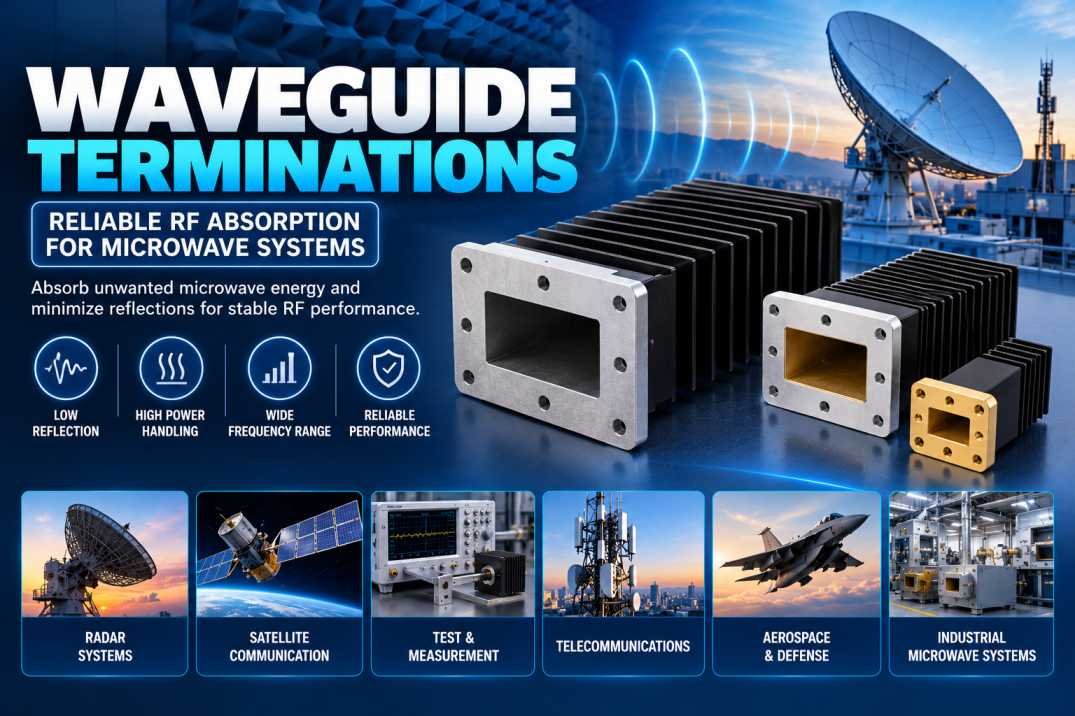
Waveguide terminations are RF and microwave components designed to absorb electromagnetic energy at the end of a waveguide while minimizing unwanted signal reflections. They are widely used in microwave communication systems, radar, satellite communication, test and measurement equipment, RF laboratories, and high-frequency electronic systems.
A waveguide termination provides a controlled endpoint for a waveguide transmission line. By absorbing the incoming microwave energy instead of reflecting it back toward the source, it helps maintain stable system performance, improves measurement accuracy, and protects connected RF equipment.
What Is a Waveguide Termination?
A waveguide termination is a passive microwave component connected to the end of a waveguide. Its primary purpose is to absorb RF energy and provide a low-reflection termination to the transmission path.
In an ideal system, electromagnetic energy entering the termination is absorbed completely. In practical applications, a small amount of energy may be reflected because of impedance mismatch and manufacturing tolerances. The quality of a waveguide termination is therefore often evaluated by parameters such as VSWR, return loss, frequency range, and power-handling capability.
Waveguide terminations are available for different waveguide standards and frequency bands. The correct termination must match the mechanical dimensions and operating frequency of the waveguide system.
How Does a Waveguide Termination Work?
Waveguides transport electromagnetic energy through a hollow metallic structure. When the waveguide reaches its endpoint, the RF energy needs to be absorbed or controlled.
A waveguide termination incorporates an absorbing structure or material that converts the incoming electromagnetic energy into a small amount of heat. The design is carefully engineered to provide an appropriate impedance transition between the waveguide and absorbing element.
The basic process is:
RF Energy → Waveguide → Absorbing Structure → Energy Absorption → Minimal Reflection
Reducing reflected energy is important because excessive reflections can create standing waves, affect signal measurements, and potentially increase stress on sensitive microwave equipment.
Why Are Waveguide Terminations Important?
Waveguide systems operate at high frequencies where even relatively small impedance discontinuities can influence RF performance. An unsuitable termination can produce reflections that travel back through the waveguide.
A properly designed termination helps:
- Reduce unwanted RF reflections
- Improve impedance matching
- Control standing-wave ratio
- Provide a defined endpoint for waveguide systems
- Support accurate RF measurements
- Protect microwave sources and equipment
- Improve system stability
- Absorb unwanted microwave energy
For these reasons, waveguide terminations are commonly used in both operational microwave systems and laboratory test environments.
Types of Waveguide Terminations
Different termination designs are available depending on the application, frequency range, power level, and required RF performance.
Matched Waveguide Termination
A matched termination is designed to provide an impedance close to the characteristic impedance of the waveguide. Its primary purpose is to absorb incoming RF energy while minimizing reflections.
Matched terminations are frequently used during RF testing, calibration, microwave measurements, and system development.
Low-Power Waveguide Termination
Low-power terminations are designed for applications where the RF energy level is relatively low. They are commonly used with laboratory instruments, measurement systems, microwave modules, and test setups.
Their compact construction can make them suitable for equipment where space is limited.
High-Power Waveguide Termination
High-power waveguide terminations are designed to absorb significantly higher levels of microwave energy. Their construction generally requires improved thermal management and carefully selected absorbing materials.
They may be used in radar, high-power microwave systems, transmitters, and other applications where substantial RF energy must be safely absorbed.
Precision Waveguide Termination
Precision terminations are designed for applications requiring controlled RF characteristics and low reflection. They are particularly useful in test and measurement systems where measurement accuracy is important.
Construction of Waveguide Terminations
The construction of a waveguide termination depends on its frequency and power requirements. Typical components may include:
Waveguide Body
The metallic waveguide body provides the transmission path for electromagnetic energy and establishes the mechanical interface with the connected waveguide system.
Absorbing Material
The absorbing element is responsible for converting microwave energy into heat. The material and geometry are selected according to the operating frequency and power requirements.
Matching Structure
A matching structure helps reduce the impedance difference between the waveguide and absorbing element. Proper matching improves return loss and reduces reflected energy.
Mechanical Flange
Waveguide terminations commonly incorporate standardized flanges for connection to compatible waveguide components. Flange dimensions and configuration must match the intended waveguide standard.
Thermal Management
High-power designs may incorporate additional thermal-management features to dissipate heat generated when RF energy is absorbed.
Important Specifications of Waveguide Terminations
When selecting a waveguide termination, several specifications should be evaluated.
| Specification | Importance |
|---|---|
| Frequency Range | Defines the microwave band in which the termination operates |
| Waveguide Size | Ensures mechanical and electromagnetic compatibility |
| VSWR | Indicates the level of impedance mismatch |
| Return Loss | Indicates reflected RF power |
| Power Handling | Determines the maximum RF energy that can be absorbed |
| Flange Type | Ensures correct mechanical installation |
| Material | Influences durability and RF performance |
| Operating Temperature | Defines suitable environmental conditions |
Exact specifications vary according to the termination design and manufacturer.
VSWR and Return Loss in Waveguide Terminations
VSWR, or Voltage Standing Wave Ratio, is an important parameter for evaluating impedance matching. A lower VSWR generally indicates better matching and lower reflected energy.
Return loss expresses the amount of reflected RF energy in decibels. Higher return loss generally indicates less reflected power.
For precision microwave applications, both parameters should be considered when selecting a waveguide termination.
Waveguide Termination Power Handling
Power handling is particularly important when a termination is used with high-power microwave equipment.
When RF energy is absorbed, it is converted into heat. If the termination cannot dissipate this heat effectively, excessive temperature rise can affect performance or damage the component.
Power-handling specifications should therefore be considered together with:
- Continuous RF power
- Peak RF power
- Pulse duration
- Duty cycle
- Operating temperature
- Cooling conditions
- Frequency range
A termination rated for a specific continuous power level may not necessarily have the same rating for pulsed microwave signals.
Applications of Waveguide Terminations
Waveguide terminations are used across a wide range of RF and microwave applications.
Radar Systems
Radar systems use waveguide components extensively. Terminations can provide controlled endpoints and absorb unwanted microwave energy during testing and operation.
Satellite Communication
Satellite and ground-station equipment often uses waveguide transmission paths at microwave frequencies. Terminations can be used for testing, system integration, and RF subsystem development.
RF and Microwave Testing
Test laboratories use waveguide terminations to create controlled RF conditions for measurements involving amplifiers, antennas, filters, couplers, and other microwave components.
Telecommunications
Microwave communication systems can use waveguide components for high-frequency signal transmission. Terminations provide controlled RF interfaces for testing and system maintenance.
Aerospace and Defense
Waveguide terminations are used in various aerospace and defense electronics, including radar, communication, electronic systems, and microwave test equipment.
Industrial Microwave Systems
Certain industrial systems use microwave energy for heating, processing, sensing, or material treatment. Waveguide terminations can help manage unused or test RF energy.
Advantages of Waveguide Terminations
Waveguide terminations provide several important benefits:
- Controlled absorption of microwave energy
- Reduced signal reflections
- Improved impedance matching
- Better RF measurement stability
- Protection for microwave sources
- Availability across multiple waveguide standards
- Options for low- and high-power applications
- Reliable operation at microwave frequencies
How to Select the Right Waveguide Termination
Choosing the appropriate termination requires more than simply matching the physical waveguide size.
First, identify the operating frequency range. The termination must be designed for the required microwave band.
Next, verify the waveguide type and flange configuration. Mechanical compatibility is essential for proper installation.
The required power rating should then be determined. Consider both continuous and peak power if the system operates with pulsed signals.
Finally, review RF parameters such as VSWR, return loss, insertion characteristics, and operating temperature.
For demanding applications, environmental conditions such as vibration, humidity, temperature cycling, and altitude may also need to be considered.
Waveguide Termination vs Waveguide Load
The terms waveguide termination and waveguide load are sometimes used interchangeably, but their application context can differ.
A termination generally describes a component used to provide a defined endpoint and minimize reflections. A waveguide load can refer more broadly to a component that absorbs RF energy connected to a waveguide system.
In many microwave applications, a matched waveguide load effectively functions as a waveguide termination.
Installation Considerations
Correct installation is important for achieving the expected RF performance.
The mating flange surfaces should be clean and properly aligned. Any mechanical gap, contamination, or incorrect hardware can affect the RF interface.
The termination should also be operated within its specified frequency and power limits. For high-power systems, adequate thermal management should be provided.
Care should be taken not to mechanically damage the waveguide flange or connector interface during installation.
Conclusion
Waveguide terminations are essential passive microwave components used to absorb RF energy and minimize unwanted reflections at the end of a waveguide transmission path. They support stable microwave operation, accurate testing, impedance control, and protection of RF equipment.
They are available in different configurations for various frequency bands, waveguide standards, power levels, and performance requirements. Applications include radar, satellite communication, telecommunications, aerospace, defense, RF testing, and industrial microwave systems.
When selecting a waveguide termination, key factors such as frequency range, waveguide size, flange type, VSWR, return loss, power handling, and operating environment should always be evaluated.
FAQs About Waveguide Terminations
1. What is a waveguide termination?
A waveguide termination is a passive microwave component designed to absorb RF energy at the end of a waveguide while minimizing signal reflections.
2. What is the main purpose of a waveguide termination?
Its primary purpose is to provide a controlled endpoint for a waveguide and absorb microwave energy with minimal reflection.
3. What is VSWR in a waveguide termination?
VSWR indicates how effectively the termination is matched to the waveguide. Lower VSWR generally indicates better impedance matching.
4. What is return loss?
Return loss measures the amount of RF power reflected back toward the source. Higher return loss generally represents lower reflected power.
5. Can waveguide terminations handle high power?
Yes. High-power waveguide terminations are specifically designed to absorb greater RF power and typically require appropriate thermal-management capabilities.
6. Where are waveguide terminations used?
They are used in radar, satellite communication, telecommunications, aerospace, defense, microwave testing, RF laboratories, and industrial microwave systems.
7. How do I select a waveguide termination?
Consider the required frequency range, waveguide size, flange type, power rating, VSWR, return loss, environmental conditions, and installation requirements.
8. Are waveguide terminations available for different frequency bands?
Yes. Waveguide terminations are manufactured for different waveguide standards and microwave frequency bands.
9. What happens if a waveguide is poorly terminated?
A poor termination can cause increased reflections, standing waves, measurement errors, and potentially undesirable stress on connected microwave equipment.
10. Are waveguide terminations passive components?
Yes. Waveguide terminations are passive RF components because they do not require an external power source to perform their primary function.