
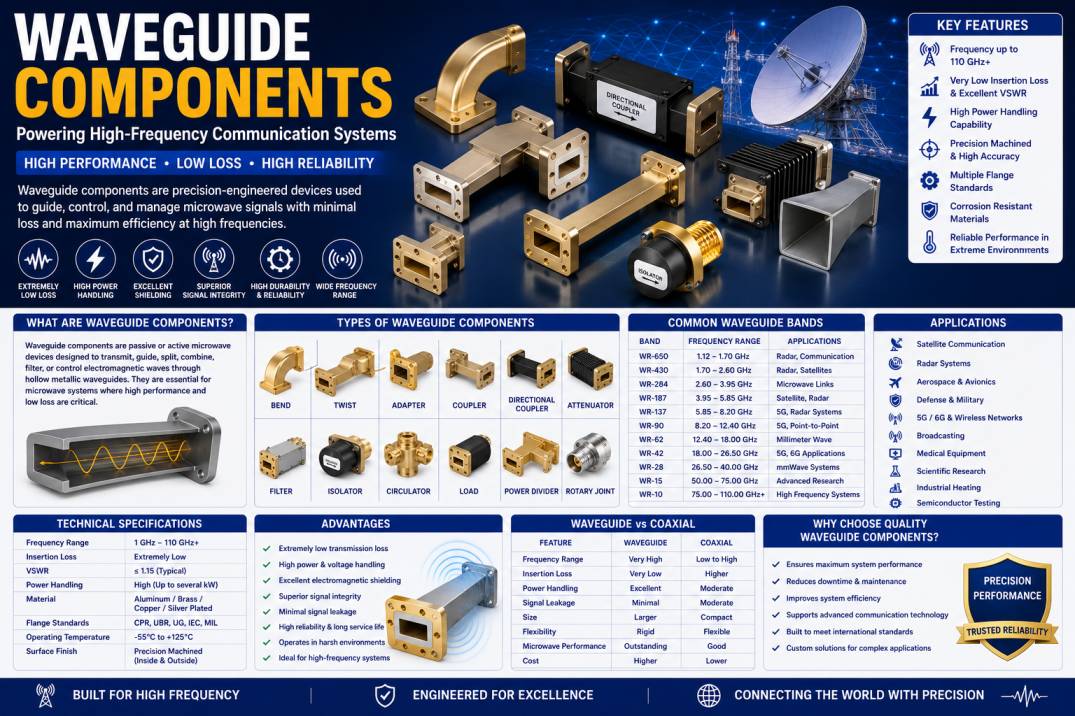
Waveguide Components are specialized microwave transmission devices used to guide and control electromagnetic waves at extremely high frequencies with minimal signal loss. Unlike conventional coaxial cables, which become increasingly inefficient at microwave and millimeter-wave frequencies, waveguides provide an ideal transmission medium for frequencies typically above 3 GHz.
Waveguide technology has become an essential part of modern communication systems, supporting applications in satellite communication, radar systems, aerospace, defense, broadcasting, medical equipment, scientific research, industrial heating, and advanced wireless networks. Their ability to transmit high-power RF signals while maintaining low attenuation makes them indispensable in microwave engineering.
Waveguide Components include a wide range of precision-engineered devices such as bends, twists, couplers, attenuators, adapters, filters, circulators, isolators, directional couplers, rotary joints, loads, and power dividers. Each component performs a specific function within the RF transmission path while maintaining signal integrity and minimizing reflections.
As technologies such as 5G, satellite internet, autonomous vehicles, aerospace communication, and future 6G systems continue to evolve, Waveguide Components remain critical building blocks of high-frequency communication infrastructure.
This comprehensive guide explains everything you need to know about Waveguide Components, including their working principles, construction, types, specifications, applications, advantages, limitations, and selection criteria.
What Are Waveguide Components?
Waveguide Components are passive or active microwave devices designed to transmit, guide, split, combine, filter, or control electromagnetic waves traveling inside a waveguide.
Unlike traditional transmission lines that use conductors to carry electrical current, waveguides guide electromagnetic energy through hollow metallic structures.
These components are specifically designed for microwave frequencies where conventional coaxial cables experience excessive signal attenuation.
Waveguide Components are manufactured to precise dimensions based on the operating frequency band to ensure optimal electrical performance.
How Do Waveguide Components Work?
Waveguide Components operate by directing electromagnetic waves through hollow metallic channels.
When microwave energy enters the waveguide, the electromagnetic field propagates along the interior walls without significant energy loss.
Each waveguide component manipulates the microwave signal according to its intended function.
Examples include:
- Bends change signal direction.
- Couplers split microwave power.
- Attenuators reduce signal strength.
- Filters remove unwanted frequencies.
- Isolators prevent reflected signals.
- Circulators route signals between multiple ports.
Because waveguides have extremely low insertion loss and excellent shielding, they provide superior performance at microwave frequencies.
Construction of Waveguide Components
Metallic Body
Waveguide Components are typically manufactured from:
- Aluminum
- Brass
- Copper
- Silver-Plated Aluminum
- Gold-Plated Brass
These materials provide excellent electrical conductivity and corrosion resistance.
Flanges
Waveguide flanges provide secure mechanical connections between components.
Common flange standards include:
- CPR
- UBR
- UG
- IEC
- MIL Standards
Precision Machining
Waveguide interiors are precision-machined to maintain consistent dimensions that support the desired microwave frequency.
Surface Finish
High-quality surface finishing minimizes conductor loss while improving long-term reliability.
Key Features of Waveguide Components
- Extremely low insertion loss
- High power handling
- Excellent shielding effectiveness
- Superior microwave performance
- Minimal signal leakage
- Excellent VSWR
- Precision mechanical construction
- Long operational life
- Wide frequency compatibility
- High reliability
- Excellent thermal stability
- Corrosion-resistant materials
Types of Waveguide Components
Waveguide Bend
Changes the direction of microwave transmission while minimizing signal reflection.
Waveguide Twist
Rotates the electromagnetic field orientation.
Waveguide Adapter
Connects different waveguide sizes or waveguide-to-coaxial interfaces.
Waveguide Coupler
Splits or samples microwave power.
Waveguide Attenuator
Reduces RF signal power by a controlled amount.
Waveguide Filter
Passes desired frequencies while rejecting unwanted signals.
Waveguide Isolator
Allows microwave signals to travel in one direction only.
Waveguide Circulator
Routes signals between multiple ports with minimal loss.
Waveguide Load
Absorbs microwave power without reflection.
Waveguide Rotary Joint
Allows microwave transmission through rotating mechanical systems.
Waveguide Power Divider
Splits microwave signals into multiple output paths.
Waveguide Horn Antenna
Converts guided waves into free-space electromagnetic radiation.
Common Waveguide Frequency B@ands
| Waveguide Band | Frequency Range |
| WR-650 | 1.12 – 1.70 GHz |
| WR-430 | 1.70 – 2.60 GHz |
| WR-284 | 2.60 – 3.95 GHz |
| WR-187 | 3.95 – 5.85 GHz |
| WR-137 | 5.85 – 8.20 GHz |
| WR-90 | 8.20 – 12.40 GHz |
| WR-62 | 12.40 – 18.00 GHz |
| WR-42 | 18.00 – 26.50 GHz |
| WR-28 | 26.50 – 40.00 GHz |
| WR-15 | 50.00 – 75.00 GHz |
| WR-10 | 75.00 – 110.00 GHz |
Technical Specifications
| Specification | Typical Value |
| Operating Frequency | 1 GHz – 110 GHz+ |
| Insertion Loss | Extremely Low |
| VSWR | ≤ 1.15 |
| Return Loss | Excellent |
| Power Handling | Very High |
| Material | Aluminum, Brass, Copper |
| Surface Finish | Silver or Gold Plating |
| Operating Temperature | -55°C to +125°C |
| Flange Standard | CPR, UBR, UG |
| Mechanical Tolerance | Precision Machined |
Applications of Waveguide Components
Radar Systems
Used for military radar, weather radar, marine radar, and air traffic control systems.
Satellite Communication
Supports satellite uplink, downlink, ground stations, and VSAT communication.
Aerospace
Used in aircraft communication, navigation, avionics, and space exploration systems.
Defense
Supports electronic warfare, missile guidance, surveillance, and secure military communication.
5G and Future 6G Networks
Used in millimeter-wave communication, antenna systems, and base station testing.
Broadcasting
Supports microwave television and radio transmission.
Medical Equipment
Used in microwave imaging, RF diagnostics, and cancer treatment systems.
Industrial Heating
Used in microwave drying, plasma generation, and material processing.
Scientific Research
Essential for particle accelerators, physics laboratories, and microwave measurement systems.
Semiconductor Testing
Supports high-frequency IC characterization and wafer probing.
Advantages of Waveguide Components
- Extremely low transmission loss
- Excellent power handling capability
- Superior signal integrity
- Minimal electromagnetic leakage
- Outstanding mechanical durability
- High-frequency capability
- Excellent thermal performance
- Reliable long-term operation
- Low maintenance
- High precision manufacturing
- Suitable for harsh environments
- Exceptional microwave efficiency
Limitations of Waveguide Components
- Larger physical size than coaxial cables
- Higher manufacturing cost
- Precision installation required
- Frequency-specific dimensions
- Less flexible than coaxial transmission lines
How to Choose the Right Waveguide Components
Selecting the correct Waveguide Components depends on several important factors.
- Operating frequency band
- Waveguide size
- Power handling requirements
- VSWR performance
- Insertion loss
- Flange compatibility
- Mechanical durability
- Environmental conditions
- Application type
- Material selection
Waveguide Components vs Coaxial Components
| Feature | Waveguide Components | Coaxial Components |
| Frequency Range | Very High | Low to High |
| Power Handling | Excellent | Moderate |
| Insertion Loss | Extremely Low | Higher |
| Signal Leakage | Minimal | Moderate |
| Mechanical Size | Larger | Compact |
| Flexibility | Rigid | Flexible |
| Cost | Higher | Lower |
| Microwave Performance | Outstanding | Good |
Industries Using Waveguide Components
Waveguide Components are widely used in:
- Telecommunications
- Aerospace
- Defense
- Satellite Communication
- Broadcasting
- Scientific Research
- Medical Electronics
- Semiconductor Manufacturing
- Industrial Processing
- RF Test Laboratories
Maintenance Tips
To ensure long-term reliability:
- Keep flange surfaces clean.
- Inspect waveguide joints regularly.
- Avoid mechanical deformation.
- Protect internal surfaces from contamination.
- Verify flange alignment during installation.
- Store components in dry environments.
- Replace damaged seals immediately.
Future Trends of Waveguide Components
The rapid expansion of 5G Advanced, 6G, satellite internet, autonomous systems, aerospace communication, quantum technologies, and millimeter-wave radar is driving continuous innovation in Waveguide Components. Manufacturers are developing lighter materials, lower-loss surface finishes, precision additive manufacturing techniques, and compact integrated waveguide assemblies. Emerging technologies such as terahertz communication and high-speed semiconductor testing will further increase demand for advanced waveguide solutions capable of supporting frequencies well beyond 110 GHz while maintaining exceptional electrical performance and reliability.
Conclusion
Waveguide Components are essential elements of modern microwave and millimeter-wave communication systems. Their ability to transmit high-frequency signals with extremely low loss, high power handling, and superior shielding makes them indispensable in aerospace, defense, satellite communication, radar, medical electronics, scientific research, broadcasting, and industrial applications. Selecting the correct waveguide component based on frequency band, power handling, flange compatibility, and environmental requirements ensures maximum system efficiency, long-term reliability, and optimal microwave performance.
Frequently Asked Questions (FAQs)
1. What are Waveguide Components?
Waveguide Components are microwave devices used to guide, control, split, filter, and transmit electromagnetic waves through hollow metallic waveguides with minimal signal loss.
2. What are Waveguide Components us ed for?
They are widely used in radar systems, satellite communication, aerospace, defense, broadcasting, medical equipment, industrial heating, semiconductor testing, and RF laboratories.
3. Why are waveguides preferred at high frequencies?
Waveguides offer lower insertion loss, higher power handling, better shielding, and superior signal integrity than coaxial cables at microwave and millimeter-wave frequencies.
4. What frequency range do Waveguide Components support?
Depending on the waveguide size, they can operate from approximately 1 GHz to over 110 GHz, with specialized designs supporting even higher frequencies.
5. What materials are used to manufacture Waveguide Components?
Common materials include aluminum, brass, copper, silver-plated aluminum, and gold-plated brass for excellent conductivity and corrosion resistance.
6. What are the main types of Waveguide Components?
Common types include waveguide bends, twists, adapters, couplers, attenuators, filters, isolators, circulators, loads, rotary joints, power dividers, and horn antennas.
7. What are the advantages of Waveguide Components?
They provide extremely low insertion loss, high power handling, excellent shielding, superior microwave performance, long service life, and outstanding reliability.
8. How do I choose the right Waveguide Component?
Choose based on operating frequency, waveguide size, power handling, insertion loss, VSWR, flange type, environmental conditions, and application requirements.
9. What industries use Waveguide Components?
Waveguide Components are widely used in telecommunications, aerospace, defense, satellite communication, broadcasting, semiconductor manufacturing, scientific research, medical electronics, and industrial processing.
10. How should Waveguide Components be maintained?
Keep flange surfaces clean, protect internal passages from contamination, inspect mechanical joints regularly, verify proper alignment, and store components in clean, dry environments for maximum performance.