
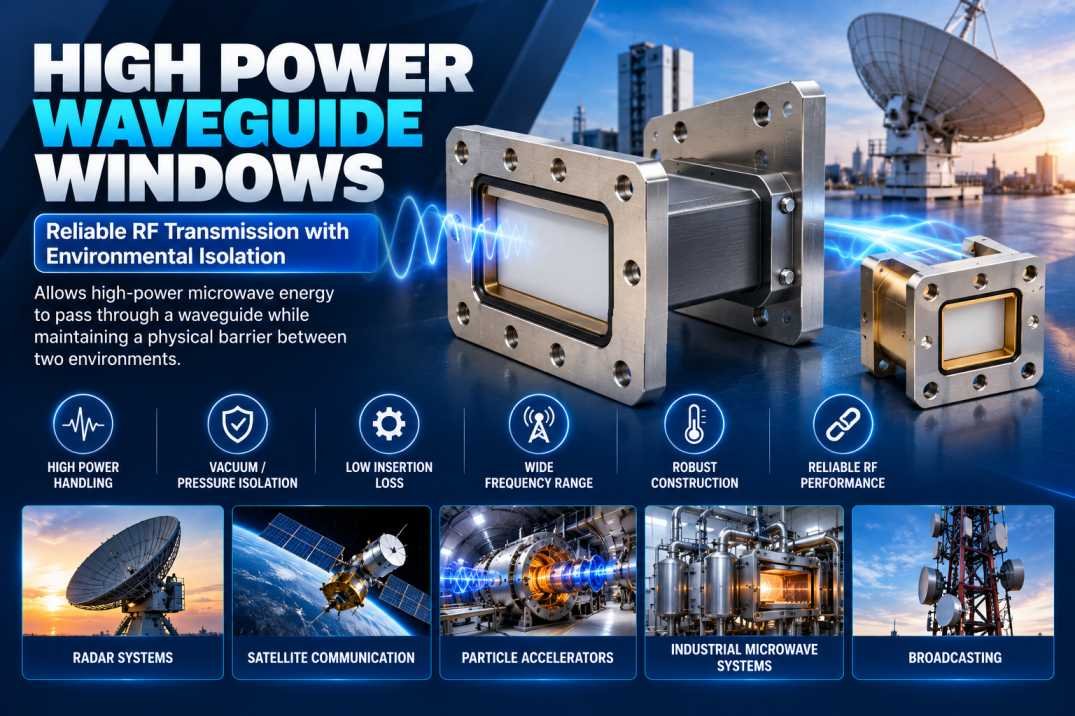
High Power Waveguide Windows are specialized microwave and RF components designed to allow electromagnetic energy to pass through a waveguide while maintaining a physical barrier between two environments. They are particularly important in high-power RF systems where pressure isolation, vacuum separation, environmental protection, and reliable microwave transmission are required.
Unlike conventional RF connectors or coaxial components, a waveguide window is integrated directly into a waveguide transmission system. It is engineered to withstand high RF power while minimizing reflection, insertion loss, heating, and electrical stress. High Power Waveguide Windows are widely used in radar, satellite communication, particle accelerators, industrial microwave systems, broadcasting, scientific equipment, and high-power RF transmitters.
What Is a High Power Waveguide Window?
A High Power Waveguide Window is a microwave component that creates a sealed physical boundary within a waveguide while allowing RF energy to pass through with minimal disruption.
The window generally incorporates a low-loss dielectric or ceramic material that is capable of transmitting microwave energy. The material and mechanical structure are carefully designed so that the window can handle the required RF power, pressure difference, temperature, and environmental conditions.
In high-power applications, even a small amount of RF loss can produce significant heat. Therefore, the design of the window must carefully control dielectric losses, impedance matching, electric-field concentration, and thermal dissipation.
Why Are Waveguide Windows Required?
High-power RF equipment may need to transfer microwave energy between two areas that cannot share the same physical environment.
For example, a vacuum chamber may need to receive RF energy from a high-power transmitter while maintaining its vacuum condition. A waveguide window provides the required RF path while preventing air, gases, moisture, or contaminants from entering the protected section.
The major functions of a waveguide window include:
- RF energy transmission
- Pressure isolation
- Vacuum protection
- Environmental separation
- Protection of sensitive equipment
- Electrical isolation between system sections
- High-power microwave transmission
How Does a High Power Waveguide Window Work?
A waveguide carries electromagnetic energy through its internal structure. When a window is installed in the waveguide, its dielectric section becomes part of the RF transmission path.
The window material must be selected and shaped to minimize impedance discontinuity. If the transition is poorly designed, RF energy can be reflected back toward the source, increasing VSWR and potentially creating excessive heating.
A properly designed High Power Waveguide Window allows most of the RF energy to pass through while maintaining the required pressure or vacuum barrier.
The design typically considers:
- Operating frequency
- Waveguide size
- RF power level
- Dielectric properties
- VSWR
- Insertion loss
- Pressure differential
- Temperature
- Cooling requirements
- Mechanical strength
Construction of High Power Waveguide Windows
A High Power Waveguide Window typically consists of a waveguide body, dielectric window element, sealing structure, and mounting interfaces.
Waveguide Body
The waveguide body provides the mechanical structure and electromagnetic transmission path. Its dimensions are selected according to the operating frequency and waveguide standard.
Dielectric Window
The dielectric element forms the actual RF-transparent barrier. Materials are selected based on dielectric constant, dielectric loss, mechanical strength, thermal performance, and RF power requirements.
Ceramic materials are commonly considered for demanding high-power microwave applications because of their combination of electrical and mechanical properties.
Sealing System
The sealing arrangement prevents leakage across the window. Depending on the application, sealing may be designed for vacuum, pressure, gas isolation, or environmental protection.
Mounting Interface
The window may incorporate flanges or other mechanical interfaces for integration into the waveguide system. Dimensional accuracy is essential because mechanical misalignment can affect RF performance.
Key Specifications of High Power Waveguide Windows
The specifications of a High Power Waveguide Window vary according to its frequency band, waveguide configuration, and application.
| Parameter | Description |
|---|---|
| Frequency Range | Operating microwave frequency |
| Waveguide Type | Defines the waveguide interface and dimensions |
| RF Power Handling | Maximum specified RF power capability |
| VSWR | Indicates impedance matching |
| Insertion Loss | RF energy lost through the window |
| Isolation | Physical separation between environments |
| Pressure Rating | Maximum supported pressure differential |
| Window Material | Dielectric or ceramic material |
| Temperature Range | Permitted operating temperature |
| Cooling | Passive or active thermal management |
| Flange Type | Mechanical integration interface |
Exact specifications should be selected according to the required system operating conditions and manufacturer design.
High Power Handling Capability
High-power operation is one of the most important characteristics of a waveguide window.
When microwave energy passes through a dielectric material, a portion of the energy can be converted into heat. At low power, this heating may be manageable. At very high power, however, even small dielectric losses can result in substantial thermal loading.
A high-power window therefore needs:
- Low dielectric loss
- Controlled electric-field distribution
- Effective thermal dissipation
- Suitable dielectric strength
- Robust mechanical construction
- Reliable sealing
- Proper RF matching
Thermal design becomes particularly important in continuous-wave and high-duty-cycle applications.
RF Performance of Waveguide Windows
A High Power Waveguide Window should introduce minimal disruption to the microwave transmission system.
Important RF performance parameters include insertion loss, return loss, VSWR, power handling, and operating bandwidth.
Low Insertion Loss
Low insertion loss helps ensure that most of the transmitter’s RF power reaches the intended load.
Low VSWR
A low VSWR indicates better impedance matching and reduces reflected RF power.
High Power Handling
The window must withstand the specified RF power without electrical breakdown, excessive heating, arcing, or physical damage.
Frequency Stability
The window should maintain predictable performance across its specified operating frequency range.
Types of High Power Waveguide Windows
Waveguide windows can be designed in different configurations depending on the system requirements.
Single Window Designs
A single dielectric barrier provides the required environmental separation while allowing microwave transmission.
Multilayer Window Designs
Multiple materials or layers can be used to improve impedance matching, mechanical strength, thermal performance, or environmental isolation.
Pressure Windows
These are designed to separate different pressure environments while allowing RF transmission.
Vacuum Windows
Vacuum windows are used where microwave energy must enter or leave a vacuum chamber without compromising vacuum integrity.
High-Power Ceramic Windows
Ceramic-based designs can be used in demanding RF systems where high power handling, mechanical durability, and low RF loss are required.
Applications of High Power Waveguide Windows
High Power Waveguide Windows are used in several advanced RF and microwave systems.
Radar Systems
High-power radar transmitters require reliable microwave transmission between RF equipment and antennas or other system components. Waveguide windows can provide environmental or pressure isolation while maintaining RF performance.
Particle Accelerators
Particle accelerators frequently use high-power RF systems and vacuum environments. Waveguide windows can transfer RF energy into accelerator structures while maintaining vacuum isolation.
Satellite and Space Communication
High-power microwave systems used for satellite communications can require specialized waveguide components capable of reliable operation under demanding environmental conditions.
Industrial Microwave Systems
Industrial heating and processing systems use microwave energy at high power levels. Waveguide windows can help isolate microwave generators from processing chambers.
Broadcasting
High-power RF broadcasting equipment may use waveguide transmission systems where environmental isolation and reliable microwave power transfer are required.
Scientific Research Equipment
Laboratory and research systems involving high-power microwave energy, vacuum chambers, and specialized RF equipment can use waveguide windows as isolation components.
Advantages of High Power Waveguide Windows
High Power Waveguide Windows offer several important advantages:
- Enable RF transmission through a physical barrier
- Support high-power microwave systems
- Provide vacuum or pressure isolation
- Help protect sensitive RF equipment
- Reduce environmental contamination
- Can be designed for low insertion loss
- Support demanding microwave frequencies
- Provide mechanical and electrical separation
- Enable integration with specialized RF systems
Factors to Consider When Selecting a Waveguide Window
Selecting the correct waveguide window requires more than simply matching the frequency.
Operating Frequency
The window must be compatible with the intended microwave frequency and waveguide mode.
RF Power
Both average and peak power should be considered. Pulsed systems and continuous-wave systems can create different thermal requirements.
Pressure Differential
The window must withstand the pressure difference between the two sides without mechanical failure or leakage.
Vacuum Requirements
For vacuum applications, sealing quality, outgassing characteristics, and mechanical integrity are important.
Thermal Management
High-power operation may require heat dissipation or active cooling depending on RF losses and duty cycle.
Mechanical Interface
Flange dimensions, mounting configuration, material compatibility, and alignment must match the existing waveguide system.
High Power Waveguide Window vs Conventional RF Window
Conventional RF windows may be suitable for lower-power systems, but high-power waveguide windows require more sophisticated electrical, thermal, and mechanical engineering.
High-power designs must address dielectric heating, electric-field concentration, breakdown risk, pressure loading, and thermal expansion. Consequently, their construction and material selection are typically optimized for specific operating conditions.
Maintenance and Reliability
Waveguide windows are generally designed for long-term operation, but system performance should be monitored in demanding applications.
Inspection may include checking for:
- Physical cracks
- Seal degradation
- Surface contamination
- RF arcing
- Excessive temperature
- Pressure or vacuum leakage
- Changes in VSWR
- Increased insertion loss
Proper installation and operation within specified limits can significantly improve reliability.
Conclusion
High Power Waveguide Windows are essential components for transferring microwave energy through a sealed physical boundary. They combine RF transmission with pressure, vacuum, and environmental isolation, making them valuable in high-power radar, satellite communication, particle accelerators, industrial microwave systems, broadcasting, and scientific equipment.
The performance of a waveguide window depends on its dielectric material, waveguide configuration, operating frequency, RF power, thermal design, pressure rating, sealing method, and mechanical construction. Choosing the correct window requires careful consideration of both electrical and environmental requirements.
For demanding microwave systems, a properly engineered High Power Waveguide Window can provide reliable RF transmission while maintaining the required physical separation and system integrity.
FAQs About High Power Waveguide Windows
1. What is a High Power Waveguide Window?
A High Power Waveguide Window is an RF component that allows microwave energy to pass through a waveguide while maintaining a physical, pressure, or vacuum barrier.
2. Why are waveguide windows used?
They are used to transfer RF energy between two environments while preventing air, gas, moisture, contaminants, or vacuum loss from passing through the waveguide.
3. What materials are used in waveguide windows?
Dielectric and ceramic materials are commonly considered because they can provide suitable RF transmission, mechanical strength, and thermal performance for demanding applications.
4. Can waveguide windows handle high RF power?
Yes. High-power waveguide windows are specifically engineered for high RF power applications, with designs addressing dielectric loss, thermal loading, electric fields, and mechanical stress.
5. What is a vacuum waveguide window?
A vacuum waveguide window is designed to transmit microwave energy into or out of a vacuum environment while maintaining the vacuum seal.
6. What parameters are important when selecting a waveguide window?
Important parameters include frequency, waveguide type, RF power, VSWR, insertion loss, pressure rating, temperature, window material, cooling requirements, and flange configuration.
7. Where are High Power Waveguide Windows used?
They are used in radar, satellite communication, particle accelerators, industrial microwave systems, broadcasting, scientific equipment, and high-power RF transmitters.
8. Why is thermal management important?
RF energy can produce heat within the dielectric window due to material losses. At high power, effective thermal management helps prevent excessive temperature and performance degradation.
9. What is VSWR in a waveguide window?
VSWR indicates how well the waveguide window is matched to the transmission system. A suitable design minimizes reflections and helps transfer RF power efficiently.
10. How can waveguide window reliability be improved?
Reliability can be improved through correct frequency and power selection, proper installation, suitable thermal management, clean RF interfaces, effective sealing, and operation within specified limits.