Waveguide adapters are specialized microwave components used to connect waveguides with different interfaces, sizes, configurations, or other RF components. They provide a practical transition between transmission systems while helping maintain reliable microwave signal transmission.
Unlike conventional coaxial connectors, waveguides transmit electromagnetic energy through a hollow metallic structure. Because different microwave systems may use different waveguide sizes, connector interfaces, or transmission technologies, waveguide adapters are essential for creating compatible and properly matched RF connections.
They are widely used in radar, satellite communication, aerospace, defense, wireless communication, microwave test equipment, and RF laboratory systems.
What Are Waveguide Adapters?
A waveguide adapter is a passive microwave component designed to provide a transition between two different RF interfaces. The adapter may connect one waveguide type to another waveguide, or provide a transition between a waveguide and a coaxial connector or other microwave component.
The primary purpose of an adapter is to provide mechanical compatibility while maintaining the required electrical characteristics of the RF transmission path.
Depending on the application, waveguide adapters can be designed for specific frequency bands, waveguide dimensions, flange configurations, and connector interfaces.
How Do Waveguide Adapters Work?
Waveguide adapters work by creating a controlled electromagnetic transition between two microwave interfaces.
For example, when a rectangular waveguide needs to connect to a coaxial RF cable, a waveguide-to-coaxial adapter provides the transition. The internal geometry is designed to transfer electromagnetic energy from one transmission structure to another while minimizing unwanted reflections and signal losses.
A properly designed adapter considers parameters such as impedance matching, operating frequency, waveguide mode, VSWR, insertion loss, and mechanical dimensions.
This makes the adapter an important part of maintaining signal integrity throughout a microwave system.
Types of Waveguide Adapters
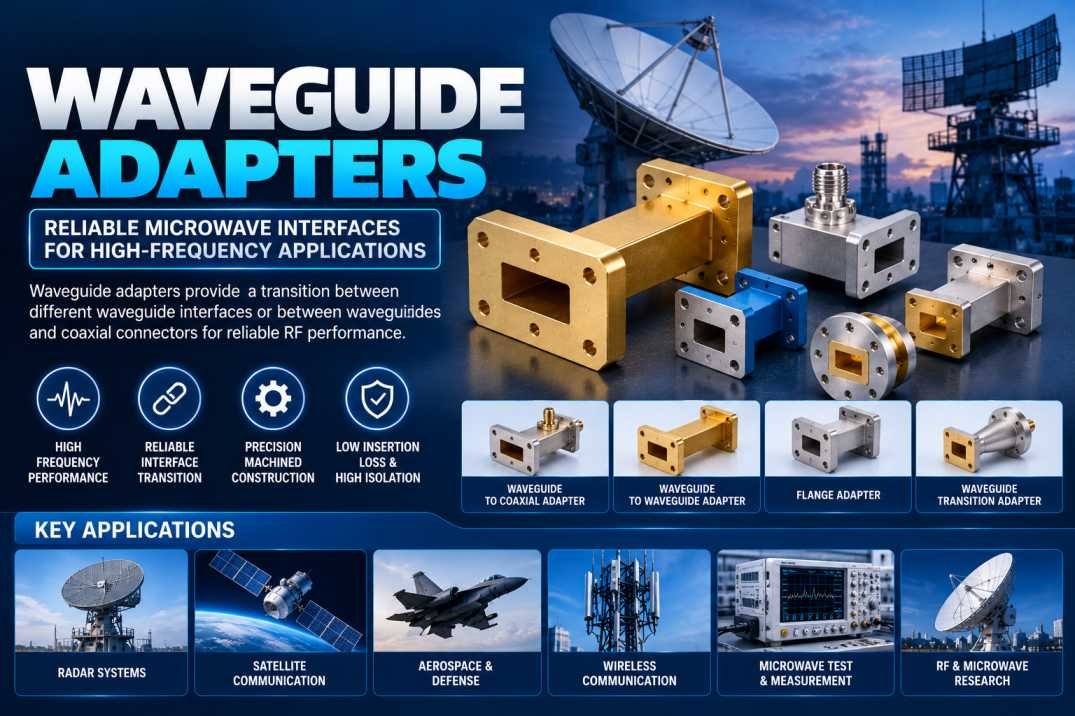
Different applications require different types of adapters. Common configurations include:
Waveguide-to-Coaxial Adapters
These adapters connect a waveguide to a coaxial interface such as SMA, N-Type, or other RF connectors. They are useful when microwave equipment needs to interface with coaxial cable assemblies.
Waveguide-to-Waveguide Adapters
These adapters connect waveguides with different dimensions, flange arrangements, or configurations. They are commonly used when two microwave components do not have directly compatible waveguide interfaces.
Waveguide Flange Adapters
Flange adapters provide mechanical and electrical transitions between different flange types. Proper flange alignment is important for maintaining reliable microwave performance.
Waveguide Transition Adapters
Transition adapters are designed to gradually or specifically transform one transmission structure into another. They can be used in measurement systems, microwave modules, antennas, and RF equipment.
Key Features of Waveguide Adapters
Waveguide adapters are designed with several important characteristics:
- High-frequency microwave operation
- Precision-machined construction
- Reliable mechanical interface
- Low signal transmission loss
- Controlled RF transition
- Low reflection characteristics
- Multiple flange configurations
- Compatibility with different waveguide standards
- Compact and rugged construction
- Suitable for laboratory and field applications
The exact performance depends on the adapter design, materials, dimensions, frequency band, and manufacturing tolerances.
Important RF Specifications
When selecting waveguide adapters, several specifications should be evaluated.
| Specification | Importance |
|---|---|
| Frequency Range | Defines the usable microwave frequency band |
| Waveguide Size | Determines physical and electromagnetic compatibility |
| Flange Type | Determines mechanical connection |
| VSWR | Indicates impedance matching and reflected energy |
| Insertion Loss | Indicates signal loss through the adapter |
| Power Handling | Defines the maximum applicable RF power |
| Material | Influences durability and RF performance |
| Plating | Can affect conductivity and environmental resistance |
For high-frequency systems, even small dimensional variations can influence RF performance, making precision manufacturing important.
Waveguide Adapters and Waveguide Switch Systems
Waveguide adapters can also be used alongside a waveguide switch in microwave routing and signal-selection systems. A waveguide switch allows microwave signals to be directed between different transmission paths, while an adapter provides the required interface transition between compatible components.
For example, a microwave test system may use a waveguide switch for selecting different signal paths and waveguide adapters for connecting the switch to antennas, measurement equipment, filters, amplifiers, or other microwave components.
The adapter and switch must be selected according to their frequency range, flange configuration, RF performance, and mechanical compatibility.
Applications of Waveguide Adapters
Radar Systems
Waveguide adapters are commonly used in radar equipment for connecting antennas, transmitters, receivers, filters, and other microwave components.
Satellite Communication
Satellite communication systems operate at high microwave frequencies where controlled RF transitions are important. Waveguide adapters can provide reliable connections between different microwave interfaces.
Aerospace and Defense
Rugged waveguide adapters are used in communication, radar, electronic systems, and microwave test equipment where reliable RF performance is required.
Microwave Test and Measurement
Laboratories use waveguide adapters to connect test equipment, waveguide components, antennas, cables, and measurement fixtures.
Wireless Communication
Microwave communication systems may use adapters to connect transmission lines, antennas, filters, and other RF components.
RF and Microwave Research
Waveguide adapters are useful for prototyping, research laboratories, experimental microwave systems, and RF component evaluation.
Advantages of Waveguide Adapters
The main advantage of waveguide adapters is interface flexibility. They allow microwave components with different interfaces to be integrated into the same RF system.
Other benefits include:
- Simplified system integration
- Reliable mechanical connection
- Controlled microwave transition
- Reduced compatibility limitations
- Support for modular RF architectures
- Easy integration of test equipment
- Availability in different frequency bands and configurations
How to Select the Right Waveguide Adapter
Before selecting a waveguide adapter, consider the following factors:
- Operating frequency: Ensure the adapter supports the required frequency range.
- Waveguide type: Confirm the waveguide dimensions and standard.
- Flange configuration: Verify flange size, type, and mounting arrangement.
- RF performance: Check VSWR, insertion loss, and return loss requirements.
- Power handling: Select an adapter suitable for the intended RF power.
- Material: Consider conductivity, strength, and environmental requirements.
- Connector interface: For coaxial transitions, verify the required connector type.
- Application environment: Consider temperature, vibration, humidity, and installation conditions.
Conclusion
Waveguide adapters are essential microwave components that provide reliable transitions between different waveguide and RF interfaces. They help integrate antennas, filters, cables, switches, amplifiers, test equipment, and other microwave components into a complete RF system.
From radar and satellite communication to aerospace, defense, wireless communication, and laboratory testing, the correct waveguide adapter can simplify system integration while supporting reliable microwave signal transmission.
When used with a waveguide switch, the adapter can also help create flexible microwave signal-routing and testing configurations. Selecting the correct frequency range, waveguide standard, flange type, RF specifications, and mechanical configuration is essential for dependable system performance.
FAQs About Waveguide Adapters
1. What is a waveguide adapter?
A waveguide adapter is a microwave component that connects different waveguide interfaces or provides a transition between a waveguide and another RF interface.
2. What are waveguide adapters used for?
They are used in radar, satellite communication, aerospace, defense, wireless communication, microwave testing, and RF research systems.
3. Can a waveguide adapter connect to coaxial cable?
Yes. Waveguide-to-coaxial adapters can connect a waveguide to compatible coaxial RF connectors and cable assemblies.
4. What is a waveguide switch?
A waveguide switch is a microwave component used to route an RF signal between different transmission paths. Waveguide adapters can be used to provide compatible interfaces around the switch.
5. What specifications should be checked when selecting an adapter?
Important specifications include frequency range, waveguide type, flange configuration, VSWR, insertion loss, power handling, material, and connector interface.
6. Are waveguide adapters suitable for high-frequency applications?
Yes. They are specifically designed for microwave and high-frequency transmission systems, provided the selected adapter is rated for the required frequency.
7. Why is flange compatibility important?
Correct flange compatibility ensures proper mechanical alignment and helps maintain the intended RF transmission characteristics of the connection.