
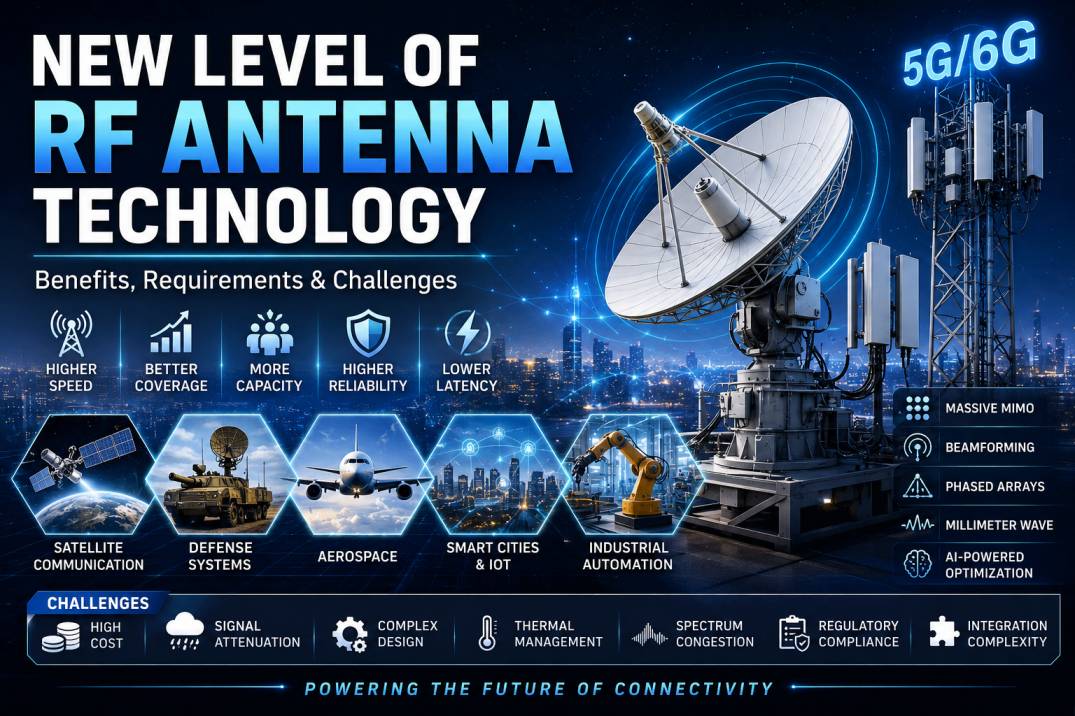
The rapid evolution of wireless communication has created the need for advanced RF antenna technology capable of delivering higher speeds, greater reliability, and improved signal coverage. From 5G and 6G networks to satellite communication, defense radar, aerospace, autonomous vehicles, and IoT, RF antennas have become the backbone of modern wireless infrastructure.
Traditional antennas are no longer sufficient for handling high-frequency signals, massive data transmission, and ultra-low latency applications. The new generation of RF antenna technology incorporates intelligent beamforming, phased arrays, MIMO architecture, AI optimization, and millimeter-wave frequencies to achieve exceptional communication performance.
This article explores the latest developments in RF antenna technology, its benefits, design requirements, applications, and challenges while explaining why next-generation antennas are transforming global wireless communications.
What is New RF Antenna Technology?
New RF antenna technology refers to advanced antenna systems designed to operate efficiently across higher frequencies with improved radiation patterns, wider bandwidth, lower signal loss, and intelligent signal steering.
Unlike conventional antennas that radiate signals in fixed directions, modern RF antennas dynamically adjust signal transmission using software-controlled electronics, making communication faster and more efficient.
These antennas are designed for:
- 5G & 6G Networks
- Satellite Communication
- Military Communication
- Radar Systems
- Aerospace
- Internet of Things (IoT)
- Autonomous Vehicles
- Smart Cities
- Medical Equipment
- Industrial Automation
Evolution of RF Antenna Technology
First Generation
- Analog communication
- Low-frequency operation
- Limited bandwidth
Second Generation
- Digital communication
- GSM networks
- Better spectrum efficiency
Third Generation
- Mobile internet
- Increased data rates
- Improved antenna efficiency
Fourth Generation
- LTE technology
- MIMO antennas
- Broadband wireless communication
Fifth Generation
- Massive MIMO
- Beamforming
- Millimeter-wave antennas
- Smart antenna arrays
Future 6G Technology
- AI-controlled antennas
- Terahertz communication
- Intelligent Reflective Surfaces (IRS)
- Extremely low latency communication
- Space-air-ground integrated networks
Key Technologies Behind Modern RF Antennas
Massive MIMO
Massive Multiple Input Multiple Output (Massive MIMO) uses dozens or even hundreds of antenna elements to transmit multiple signals simultaneously, significantly increasing network capacity.
Benefits include:
- Higher throughput
- Better spectrum utilization
- Increased coverage
- Improved reliability
Beamforming
Beamforming directs RF energy toward the intended receiver instead of broadcasting signals in every direction.
Advantages include:
- Reduced interference
- Stronger signal
- Longer communication distance
- Better network efficiency
Millimeter-Wave Antennas
Millimeter-wave antennas operate at frequencies above 24 GHz and support extremely high-speed communication.
Applications include:
- 5G
- Wireless backhaul
- Satellite communication
- High-capacity wireless links
Phased Array Antennas
Phased arrays electronically steer the antenna beam without moving mechanical parts.
Used in:
- Radar
- Defense
- Aerospace
- Satellite tracking
AI-Based Smart Antennas
Artificial Intelligence continuously optimizes antenna performance by learning network traffic patterns and environmental conditions.
Capabilities include:
- Automatic beam optimization
- Dynamic frequency allocation
- Network self-healing
- Interference reduction
Benefits of New RF Antenna Technology
Higher Data Speed
Modern antennas support extremely high data transfer rates, making ultra-HD streaming, cloud computing, and industrial automation possible.
Improved Signal Coverage
Advanced beamforming technology increases communication range while minimizing dead zones.
Better Network Capacity
Massive MIMO allows networks to support thousands of connected devices simultaneously.
Reduced Power Consumption
Smart antennas transmit energy only where needed, reducing unnecessary power usage.
Lower Latency
Real-time applications such as autonomous driving and remote surgery require latency below one millisecond, which advanced RF antennas help achieve.
Improved Spectrum Efficiency
Modern antenna systems maximize the use of available frequency spectrum, reducing congestion.
Enhanced Security
Directed communication beams reduce signal interception and improve communication security.
Higher Reliability
Adaptive antennas maintain stable communication even in harsh environments.
Design Requirements for Next-Generation RF Antennas
Designing advanced RF antennas involves several critical factors.
Wide Frequency Coverage
Modern antennas must support multiple frequency bands ranging from MHz to millimeter-wave frequencies.
Low VSWR
Low Voltage Standing Wave Ratio ensures efficient power transfer with minimal signal reflection.
High Gain
Higher gain improves communication distance and signal quality.
Excellent Radiation Efficiency
Efficient antennas convert maximum input power into useful RF radiation.
Compact Size
Miniaturization is essential for smartphones, IoT devices, drones, and wearable electronics.
Thermal Stability
Antennas must maintain performance under extreme temperature conditions.
Weather Resistance
Outdoor antennas require protection against moisture, dust, UV radiation, and corrosion.
Mechanical Durability
Military and aerospace applications require antennas capable of surviving vibration, shock, and harsh environments.
Applications of New RF Antenna Technology
5G Mobile Networks
Modern RF antennas enable ultra-fast internet, lower latency, and higher network capacity.
Satellite Communication
Advanced antennas provide stable long-distance communication between satellites and ground stations.
Defense Systems
Military communication relies on secure, high-performance antennas for surveillance, radar, electronic warfare, and tactical communication.
Aerospace
Aircraft use advanced RF antennas for navigation, communication, weather monitoring, and satellite connectivity.
Smart Cities
RF antennas connect traffic management systems, surveillance cameras, environmental sensors, and public infrastructure.
Internet of Things (IoT)
Millions of connected devices communicate efficiently through compact high-performance antennas.
Autonomous Vehicles
Vehicles use RF antennas for V2X communication, GPS, radar, and real-time navigation.
Healthcare
Hospitals use RF antennas in wireless monitoring systems, imaging equipment, and telemedicine.
Industrial Automation
Factories deploy RF antennas for robotics, machine communication, predictive maintenance, and wireless control systems.
Challenges of New RF Antenna Technology
High Manufacturing Cost
Advanced antenna arrays require precision engineering, increasing production costs.
Millimeter-Wave Signal Loss
Higher frequencies experience greater atmospheric attenuation and shorter transmission distances.
Complex Design
Modern antennas involve sophisticated simulations, optimization, and manufacturing techniques.
Thermal Management
High-power antenna systems generate heat that must be effectively dissipated.
Spectrum Congestion
The increasing number of wireless devices creates interference across available frequency bands.
Regulatory Compliance
Antennas must comply with international RF regulations, emission standards, and safety requirements.
Integration Complexity
Integrating antennas into compact electronic devices without affecting performance remains challenging.
Environmental Factors
Rain, snow, buildings, vegetation, and terrain can impact RF signal propagation.
Future Trends in RF Antenna Technology
The future of RF antennas is driven by innovation across multiple domains:
- AI-powered adaptive antennas
- Reconfigurable intelligent surfaces
- Terahertz communication
- Holographic beamforming
- Software-defined antennas
- Integrated satellite-terrestrial communication
- Quantum communication research
- Energy-efficient antenna materials
- Metamaterial antennas
- Flexible and wearable antennas
These advancements will enable faster, smarter, and more reliable communication networks.
Why High-Quality RF Antennas Matter
Investing in premium RF antenna technology provides long-term advantages, including:
- Superior signal quality
- Reduced maintenance costs
- Longer operational life
- Better wireless coverage
- Higher network efficiency
- Improved reliability in critical applications
- Future-ready communication infrastructure
Choosing the Right RF Antenna
When selecting an RF antenna, consider:
- Operating frequency
- Gain requirements
- Polarization
- Bandwidth
- VSWR
- Connector type
- Environmental protection
- Power handling
- Mounting method
- Application requirements
- Compliance standards
- Future scalability
Conclusion
The new level of RF antenna technology is revolutionizing wireless communication by enabling faster speeds, higher capacity, lower latency, and greater reliability across industries. Advanced technologies such as Massive MIMO, beamforming, phased arrays, and AI-driven optimization are redefining how communication systems perform in 5G, satellite, defense, aerospace, IoT, and smart city applications.
Although challenges such as cost, complexity, and high-frequency signal propagation remain, continuous innovation in antenna materials, intelligent control systems, and wireless architecture is paving the way for next-generation communication networks. Organizations investing in advanced RF antenna solutions today will be well-positioned to support the rapidly evolving demands of future wireless technologies.
Frequently Asked Questions (FAQ)
1. What is new RF antenna technology?
New RF antenna technology refers to advanced antenna systems that use innovations such as beamforming, Massive MIMO, phased arrays, and AI optimization to deliver faster, more reliable wireless communication.
2. What are the main benefits of advanced RF antennas?
They provide higher data speeds, improved signal coverage, lower latency, better spectrum efficiency, enhanced reliability, and increased network capacity.
3. Where are modern RF antennas used?
They are widely used in 5G networks, satellite communications, defense systems, aerospace, IoT devices, smart cities, industrial automation, healthcare, and autonomous vehicles.
4. What is beamforming in RF antennas?
Beamforming is a technology that directs RF signals toward specific users or devices instead of broadcasting in all directions, improving signal strength and reducing interference.
5. What is Massive MIMO?
Massive MIMO uses multiple transmitting and receiving antenna elements to improve wireless capacity, speed, and overall network performance.
6. Why are millimeter-wave antennas important?
Millimeter-wave antennas support ultra-high-speed data transmission and are essential for 5G, wireless backhaul, and future 6G communication systems.
7. What are the biggest challenges of next-generation RF antennas?
Key challenges include higher manufacturing costs, complex design, thermal management, spectrum congestion, signal attenuation at high frequencies, and regulatory compliance.
8. How do RF antennas improve defense communication?
Advanced RF antennas provide secure communication, electronic warfare capabilities, radar functionality, satellite connectivity, and reliable performance in harsh environments.
9. What should be considered when choosing an RF antenna?
Important factors include operating frequency, gain, bandwidth, VSWR, power handling, connector compatibility, environmental protection, and application requirements.
10. What is the future of RF antenna technology?
Future developments include AI-controlled antennas, terahertz communication, software-defined antennas, intelligent reflective surfaces, metamaterial antennas, and integrated satellite-terrestrial communication systems.