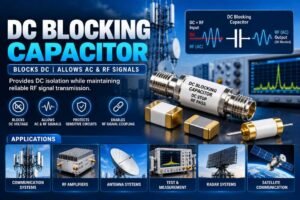
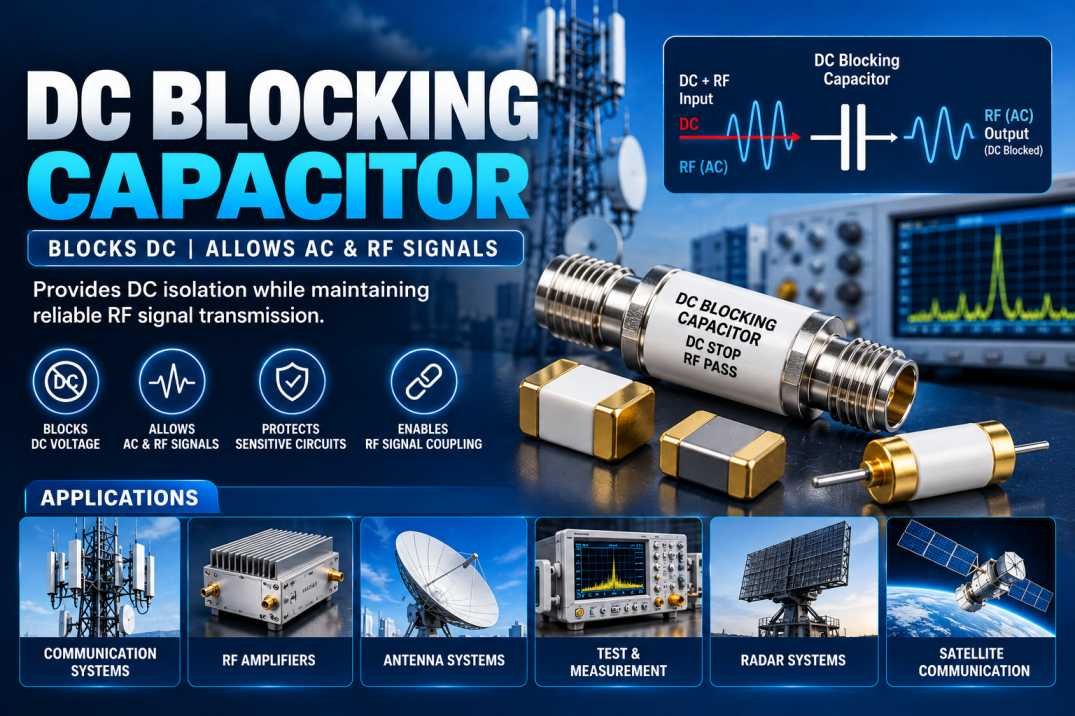
A DC Blocking Capacitor is an electronic component used to prevent direct current (DC) from passing through a circuit while allowing alternating current (AC) and RF signals to pass. It is widely used in RF circuits, communication systems, amplifiers, antennas, test equipment, filters, and electronic devices where DC isolation is required without interrupting the desired signal.
DC blocking is particularly important in high-frequency systems because different circuit stages may operate at different DC voltage levels while still needing to exchange RF signals. A properly selected DC Blocking Capacitor provides electrical isolation while maintaining the required signal path and minimizing unwanted RF losses.
What Is a DC Blocking Capacitor?
A DC Blocking Capacitor is a capacitor connected in series with a signal path to block DC voltage and allow AC or RF signals to pass.
The basic operating principle is based on the electrical behavior of a capacitor. A capacitor resists steady-state DC because its reactance becomes extremely high as frequency approaches zero. At higher frequencies, its capacitive reactance decreases, allowing the desired AC or RF signal to pass through.
The capacitive reactance is represented by:
Xc = 1 / (2πfC)
Where:
- Xc = Capacitive reactance
- f = Signal frequency
- C = Capacitance
As frequency increases, capacitive reactance decreases. This makes the capacitor increasingly effective at passing higher-frequency signals.
How Does a DC Blocking Capacitor Work?
When a DC Blocking Capacitor is placed in series with an RF signal path, it separates the DC operating voltage between two circuit sections.
For example, consider an RF amplifier connected to another RF circuit. One section may have a DC bias voltage while the next stage should operate at a different DC level. Directly connecting the two sections could cause unwanted current flow or disturb the bias conditions.
A DC Blocking Capacitor allows the RF signal to travel between the stages while preventing the DC component from being transferred.
This makes the component useful for:
- DC isolation
- RF signal coupling
- Bias separation
- Protection of sensitive circuits
- Interconnection of different RF stages
- Preventing unwanted DC current flow
Why Is DC Blocking Important in RF Systems?
RF circuits often contain active devices such as amplifiers, oscillators, mixers, transistors, and integrated RF modules. These components may require specific bias voltages for correct operation.
If DC voltage enters an incompatible circuit, it can change the operating point or potentially damage sensitive components.
A DC Blocking Capacitor provides a simple method of separating the DC bias conditions of different stages while maintaining an RF signal connection.
In RF systems, the capacitor must provide low impedance at the operating frequency. A capacitor that works well at a low frequency may not necessarily provide the required RF performance at microwave frequencies.
Construction of a DC Blocking Capacitor
A typical capacitor consists of two conductive electrodes separated by an insulating dielectric material.
Common dielectric materials include:
- Ceramic
- PTFE
- Mica
- Film
- Other specialized dielectric materials
The dielectric material affects capacitance, voltage rating, temperature stability, losses, and high-frequency performance.
For RF applications, the physical construction becomes particularly important because parasitic inductance and capacitance can affect performance at high frequencies.
Key Specifications of a DC Blocking Capacitor
Selecting the correct DC Blocking Capacitor requires consideration of several electrical and mechanical specifications.
| Specification | Importance |
|---|---|
| Capacitance | Determines capacitive reactance |
| Operating Frequency | Defines suitable signal range |
| Voltage Rating | Determines maximum allowable DC voltage |
| Insertion Loss | Indicates signal loss through the component |
| VSWR | Indicates impedance matching performance |
| Return Loss | Indicates reflected signal performance |
| ESR | Affects losses and efficiency |
| Temperature Range | Determines environmental suitability |
| Package/Connector | Defines mechanical integration |
For high-frequency applications, manufacturers may provide additional specifications such as RF power handling, isolation, frequency response, and maximum operating frequency.
DC Blocking Capacitor in RF Applications
DC Blocking Capacitors are commonly used in RF and microwave systems.
RF Amplifiers
They can isolate the DC bias of an amplifier from other circuit stages while allowing the amplified RF signal to continue through the signal path.
Antenna Systems
DC blocking can help separate RF signals from unwanted DC components in antenna and transmission-line systems.
RF Filters
Filters may require DC isolation between different circuit sections. A DC Blocking Capacitor can provide signal coupling while preventing DC transmission.
Mixers and Oscillators
RF mixers and oscillators often operate with different bias conditions. DC blocking can help maintain the required operating conditions.
Test and Measurement Equipment
RF test equipment frequently uses DC blocking to protect measurement instruments from unwanted DC voltage while allowing RF signals to be measured.
Communication Systems
Wireless communication equipment, radio systems, RF modules, and transceiver circuits can use DC Blocking Capacitors to maintain signal integrity and electrical isolation.
DC Blocking Capacitor and RF Signal Performance
In high-frequency systems, simply selecting a capacitor with the correct capacitance is not enough.
The capacitor’s parasitic characteristics can become significant as frequency increases. Equivalent Series Resistance (ESR), Equivalent Series Inductance (ESL), package dimensions, mounting method, and circuit layout can all influence RF performance.
A suitable RF DC Blocking Capacitor should therefore be selected according to the actual operating frequency and signal requirements.
Important performance considerations include:
- Low insertion loss
- Low VSWR
- High return loss
- Appropriate capacitance
- Suitable voltage rating
- Low parasitic inductance
- Adequate RF power handling
- Stable performance across temperature
Choosing the Correct Capacitance
The required capacitance depends largely on the lowest frequency that must pass through the circuit.
Since:
Xc = 1 / (2πfC)
a larger capacitance produces lower reactance at a given frequency.
For example, a capacitor that provides very low reactance at several GHz may require a different capacitance value when used in a lower-frequency RF system.
The goal is to select a capacitance that provides sufficiently low impedance at the lowest operating frequency while also considering the capacitor’s self-resonant behavior.
Self-Resonant Frequency
Every practical capacitor contains parasitic inductance. At sufficiently high frequencies, this inductance becomes significant.
The capacitor therefore has a self-resonant frequency (SRF). Below its SRF, the component generally behaves primarily as a capacitor. Near and above the SRF, its behavior becomes increasingly influenced by parasitic inductance.
For RF and microwave applications, selecting a capacitor with an appropriate frequency rating and SRF is essential.
Advantages of DC Blocking Capacitors
A DC Blocking Capacitor provides several important benefits:
- Blocks unwanted DC voltage
- Allows AC and RF signals to pass
- Provides DC isolation between circuit stages
- Helps protect sensitive RF components
- Supports bias separation
- Enables flexible circuit interconnection
- Can reduce unwanted DC current flow
- Available in compact packages
- Suitable for RF and microwave systems
- Helps maintain proper circuit operating conditions
Common Applications
The technology is used across a wide range of electronics and RF systems, including:
- RF amplifiers
- Wireless communication equipment
- Antenna systems
- Microwave circuits
- RF filters
- Signal generators
- Spectrum analyzers
- Test and measurement equipment
- Radar systems
- Satellite communication
- Broadcast equipment
- Cellular infrastructure
- Industrial electronics
- High-frequency instrumentation
DC Blocking Capacitor vs Coupling Capacitor
The terms DC blocking capacitor and coupling capacitor are often used in similar contexts.
A coupling capacitor transfers an AC or RF signal from one circuit stage to another while preventing DC bias from being transferred. Therefore, a DC Blocking Capacitor can effectively perform a coupling function when used in a signal path.
The difference is primarily related to the application and design objective rather than the fundamental capacitor operation.
How to Select a DC Blocking Capacitor
Before selecting a DC Blocking Capacitor, evaluate the following factors:
1. Operating Frequency
Determine the complete frequency range of the RF signal.
2. Capacitance
Choose a capacitance that provides sufficiently low reactance at the minimum operating frequency.
3. DC Voltage
Verify that the capacitor’s voltage rating exceeds the maximum DC voltage present in the circuit.
4. RF Power
For high-power RF applications, confirm the component’s RF power handling capability.
5. Insertion Loss
Select a component with sufficiently low insertion loss for the application.
6. VSWR
Low VSWR is important for maintaining good impedance matching in RF systems.
7. Temperature
Check the operating temperature range when the capacitor will be used in outdoor, industrial, aerospace, or other demanding environments.
8. Physical Configuration
Consider PCB mounting, surface-mount packages, coaxial configurations, or other installation requirements.
Installation and Design Considerations
Proper PCB layout and installation are important for RF performance. Unnecessary lead length can introduce parasitic inductance and affect signal transmission.
For high-frequency applications, the capacitor should be mounted as close as practical to the intended circuit interface. Ground connections should also be designed carefully to minimize unwanted inductance.
Engineers should follow the manufacturer’s recommended mounting pattern, operating limits, and RF specifications.
Conclusion
A DC Blocking Capacitor is an essential component for circuits that need to pass AC or RF signals while preventing DC voltage from traveling between circuit stages. Its ability to provide DC isolation makes it valuable in amplifiers, filters, antennas, communication systems, microwave circuits, and test equipment.
For high-frequency applications, capacitance is only one part of the selection process. Engineers should also evaluate operating frequency, self-resonant frequency, insertion loss, VSWR, voltage rating, RF power handling, temperature range, and parasitic characteristics.
By selecting and installing the correct DC Blocking Capacitor, designers can maintain proper bias conditions, protect sensitive components, and achieve reliable RF signal transmission.
FAQs About DC Blocking Capacitor
1. What is a DC Blocking Capacitor?
A DC Blocking Capacitor is a capacitor used in series with a signal path to prevent DC voltage from passing while allowing AC or RF signals to pass.
2. Why is a DC Blocking Capacitor used in RF circuits?
It provides DC isolation between circuit stages while allowing the desired RF signal to travel through the circuit.
3. Does a DC Blocking Capacitor block AC?
No. A capacitor can pass AC signals, with its impedance depending on the frequency and capacitance.
4. How does capacitance affect DC blocking?
Higher capacitance produces lower capacitive reactance at a given frequency, generally making it easier for lower-frequency signals to pass.
5. Can DC Blocking Capacitors be used at high frequencies?
Yes. Specialized RF and microwave capacitors are designed for high-frequency applications, but their frequency rating, parasitics, and self-resonant frequency must be considered.
6. What is self-resonant frequency?
Self-resonant frequency is the frequency at which the capacitor’s capacitive and parasitic inductive effects interact, changing its effective behavior.
7. What factors should be considered when selecting a DC Blocking Capacitor?
Important factors include capacitance, frequency range, voltage rating, RF power handling, insertion loss, VSWR, temperature range, and physical configuration.
8. Where are DC Blocking Capacitors used?
They are used in RF amplifiers, antennas, filters, communication equipment, microwave circuits, radar, satellite systems, and test and measurement equipment.