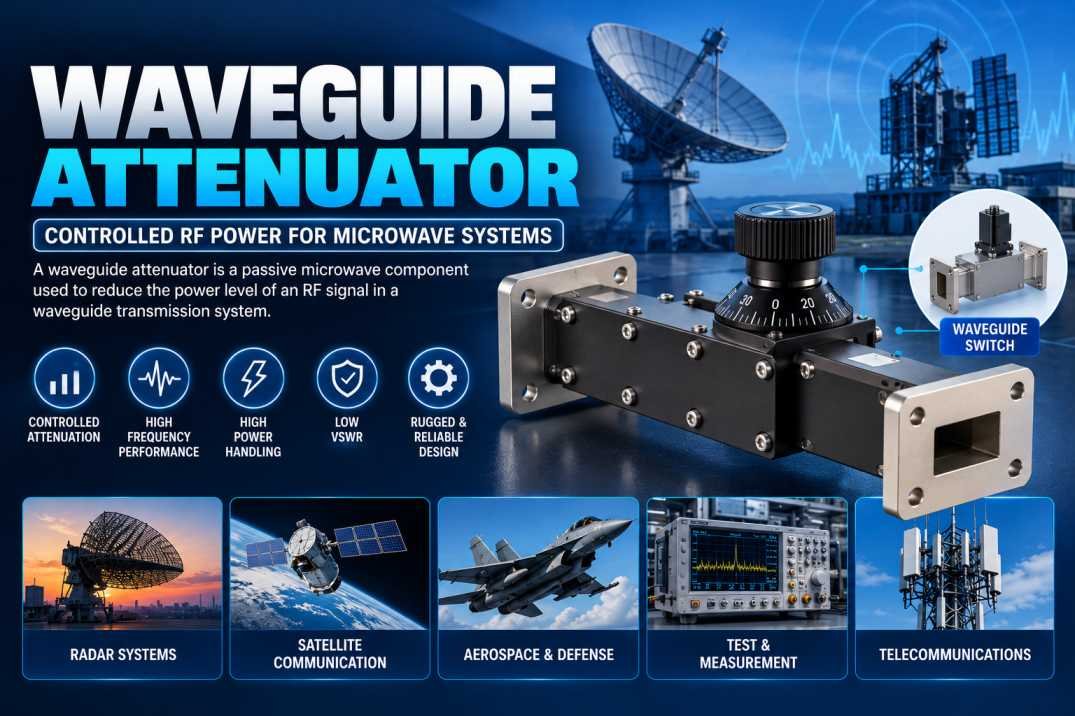
A waveguide attenuator is a passive microwave component used to reduce the power level of an RF or microwave signal travelling through a waveguide transmission system. It provides controlled attenuation while maintaining the desired signal characteristics and impedance conditions within the microwave system.
Waveguide attenuators are widely used in radar, satellite communication, aerospace, defense, microwave test equipment, telecommunications, and RF measurement systems. By controlling signal power, they help protect sensitive components, prevent receiver overload, improve measurement accuracy, and establish suitable signal levels for different stages of a microwave system.
What Is a Waveguide Attenuator?
A waveguide attenuator is a microwave device designed to introduce a specific amount of signal loss into a waveguide transmission path. Unlike an amplifier, which increases signal power, an attenuator deliberately reduces RF energy by a defined value, usually expressed in decibels (dB).
For example, a 10 dB waveguide attenuator reduces the transmitted power to approximately one-tenth of its original level under ideal conditions. The actual performance depends on frequency, construction, attenuation accuracy, VSWR, insertion loss, and the specific waveguide standard.
Waveguide attenuators are available in fixed and variable configurations depending on whether a constant or adjustable attenuation level is required.
How Does a Waveguide Attenuator Work?
A waveguide carries electromagnetic energy through a hollow metallic transmission structure. A waveguide attenuator introduces a controlled loss mechanism into this transmission path.
Depending on its design, an attenuating element can absorb or interact with part of the electromagnetic energy traveling through the waveguide. The remaining RF energy continues toward the output port at a lower power level.
The attenuation level is determined by the design and position of the resistive, absorptive, or other microwave-loss element. In variable attenuators, the attenuation can be mechanically adjusted to provide different output power levels.
Types of Waveguide Attenuators
Fixed Waveguide Attenuator
A fixed waveguide attenuator provides a predetermined attenuation value. Common attenuation levels can include 3 dB, 6 dB, 10 dB, 20 dB, and higher values depending on the application.
These attenuators are useful when a consistent and repeatable reduction in microwave signal power is required.
Variable Waveguide Attenuator
A variable waveguide attenuator allows the attenuation level to be adjusted across a specified range. It is commonly used in microwave laboratories, test systems, calibration equipment, and systems where signal power needs to be continuously controlled.
Rotary Vane Attenuator
A rotary vane attenuator uses a movable absorbing vane or similar structure to control the amount of microwave energy being attenuated. Its adjustable construction can provide precise control over signal levels.
Waveguide Programmable Attenuator
Some advanced microwave systems use electronically or digitally controlled attenuation. These configurations can be integrated into automated RF test systems and communication equipment.
Key Specifications of Waveguide Attenuator
When selecting a waveguide attenuator, several technical parameters should be evaluated:
| Specification | Importance |
|---|---|
| Frequency Range | Defines the microwave operating band |
| Attenuation | Specifies the amount of signal reduction |
| Attenuation Accuracy | Indicates how closely actual attenuation matches the rated value |
| VSWR | Indicates impedance matching quality |
| Insertion Loss | Represents additional transmission loss |
| Power Handling | Defines the maximum RF power capability |
| Waveguide Interface | Determines mechanical and system compatibility |
| Material | Influences durability and RF performance |
Exact specifications vary according to the waveguide size, frequency band, design, and manufacturer.
Waveguide Attenuator vs Waveguide Switch
A waveguide attenuator and waveguide switch perform different functions within microwave systems.
A waveguide attenuator controls the power level of an RF signal by introducing a specified amount of loss. A waveguide switch, on the other hand, controls the signal path, allowing microwave energy to be routed between different transmission paths or ports.
For example, an attenuator may be installed to reduce a signal by 10 dB, while a waveguide switch may select between two antennas, test paths, or RF subsystems. In sophisticated microwave test equipment, both components can be used together.
Applications of Waveguide Attenuators
Radar Systems
Waveguide attenuators are used in radar systems for controlling microwave power levels and protecting sensitive receiver components.
Satellite Communication
Satellite and ground communication equipment can use attenuators to establish appropriate RF power levels throughout microwave signal chains.
Aerospace and Defense
High-frequency communication, electronic warfare, radar, and instrumentation systems can require precise microwave power control.
Microwave Test and Measurement
Waveguide attenuators are important laboratory components for calibration, signal-level testing, receiver evaluation, and microwave measurements.
RF and Microwave Research
Research laboratories use adjustable attenuators to control signal levels during antenna testing, component characterization, and experimental microwave setups.
Telecommunications
Microwave communication infrastructure can use attenuation components to manage signal levels and optimize RF system performance.
Benefits of Using a Waveguide Attenuator
A properly selected waveguide attenuator can provide several benefits:
- Controlled microwave signal power
- Protection against excessive RF power
- Improved measurement accuracy
- Better system-level power management
- Repeatable signal attenuation
- Suitable performance at microwave frequencies
- Compatibility with standardized waveguide interfaces
- Fixed or adjustable attenuation options
How to Select a Waveguide Attenuator
The correct attenuator should be selected according to the complete RF system requirements. First, identify the operating frequency and compatible waveguide size. Next, determine the required attenuation range and maximum RF power.
For precision applications, pay particular attention to attenuation accuracy, VSWR, insertion loss, and frequency response. Mechanical requirements such as flange type, mounting configuration, dimensions, and environmental conditions should also be considered.
For systems containing components such as a waveguide switch, verify that the attenuator’s interface and electrical specifications are compatible with the complete microwave signal path.
Conclusion
A waveguide attenuator is an essential passive component for controlled microwave signal-power reduction. It helps engineers manage RF levels, protect sensitive equipment, improve test accuracy, and optimize microwave transmission systems.
Available in fixed and variable configurations, waveguide attenuators are used across radar, satellite communication, aerospace, defense, telecommunications, and RF test applications. When selecting one, frequency range, attenuation, power handling, VSWR, insertion loss, and waveguide interface should be carefully evaluated.
FAQs About Waveguide Attenuator
1. What is a waveguide attenuator?
A waveguide attenuator is a passive microwave component that reduces the power level of an RF signal travelling through a waveguide.
2. What is attenuation measured in?
Attenuation is normally expressed in decibels (dB).
3. What is the difference between fixed and variable waveguide attenuators?
A fixed attenuator provides a predetermined amount of attenuation, while a variable attenuator allows the attenuation level to be adjusted.
4. Where are waveguide attenuators used?
They are used in radar, satellite communication, aerospace, defense, telecommunications, microwave laboratories, and RF test equipment.
5. Does a waveguide attenuator amplify a signal?
No. An attenuator reduces RF signal power by introducing controlled loss into the transmission path.
6. What specifications are important when selecting a waveguide attenuator?
Important parameters include frequency range, attenuation, attenuation accuracy, VSWR, insertion loss, power handling, and waveguide interface.
7. Can a waveguide attenuator work with a waveguide switch?
Yes. A waveguide attenuator and waveguide switch can be used together in microwave systems, with the attenuator controlling signal power and the switch controlling signal routing.
8. Why is VSWR important in a waveguide attenuator?
VSWR indicates how well the attenuator matches the transmission system. Lower VSWR generally indicates better impedance matching and reduced signal reflection.