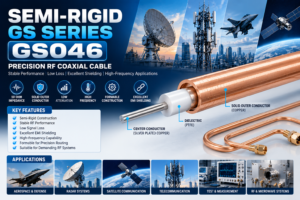
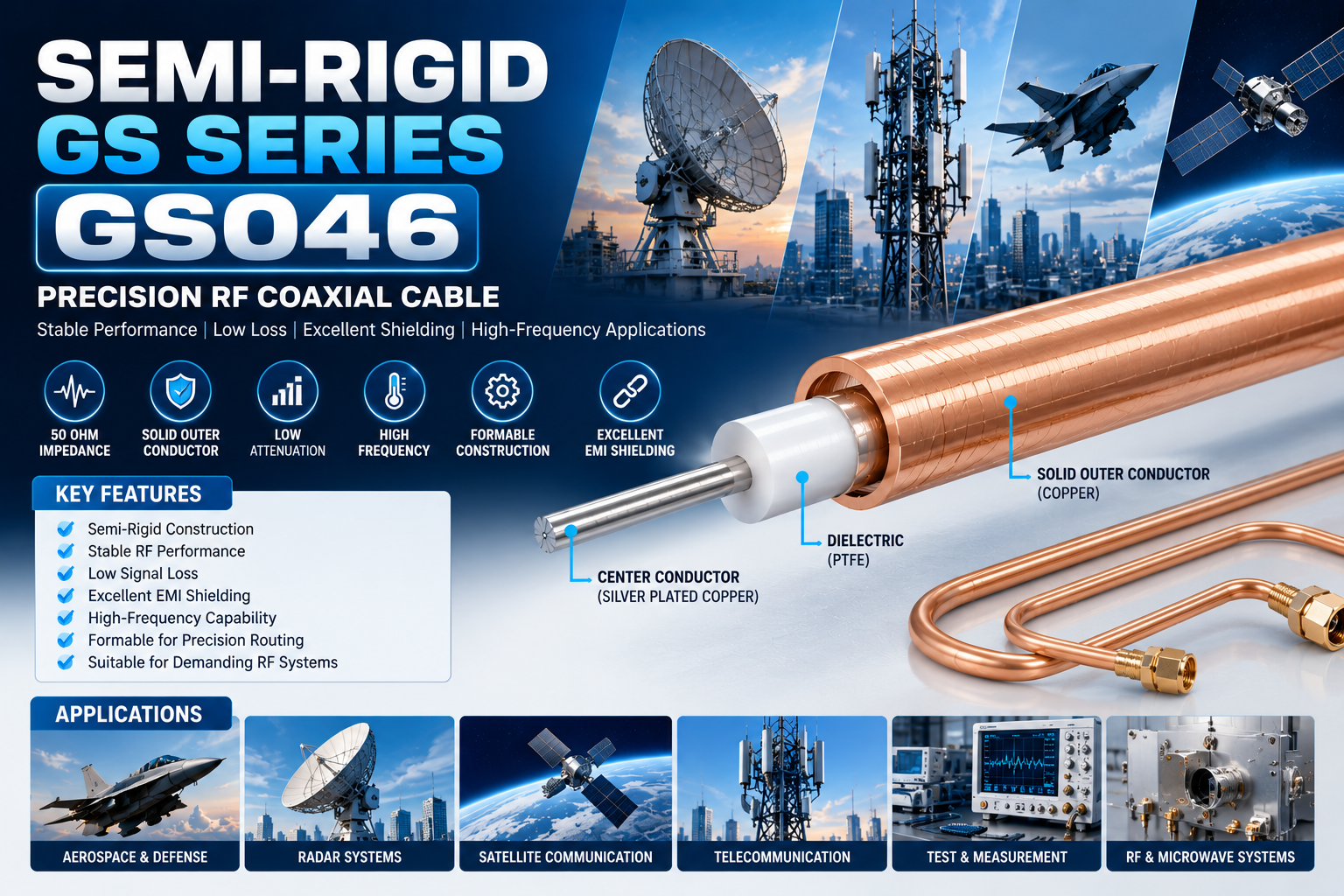
The Semi-Rigid GS Series GS046 is a precision RF coaxial cable concept designed for high-frequency applications where stable impedance, strong shielding, low signal loss, and reliable mechanical performance are important. Semi-rigid RF cables use a solid metallic outer conductor rather than a conventional braided shield, providing strong electromagnetic shielding and consistent electrical characteristics.
Note: The currently available SRFS Teleinfra GS Series page lists GS120, GS141, GS086S, GS086, GS047S, and GS047, but does not provide a specific GS046 datasheet. Therefore, the content below describes GS046 as a GS-Series semi-rigid cable and avoids unsupported GS046-specific dimensional or frequency specifications.
What Is Semi-Rigid GS Series GS046?
Semi-Rigid GS Series GS046 is intended for precision RF and microwave signal transmission in systems where cable movement is limited after installation. Its semi-rigid construction allows the cable to be formed into a required routing position while maintaining a controlled coaxial structure.
Unlike flexible RF cables that normally rely on braided shielding, semi-rigid cables use a solid metallic outer conductor. This construction provides high shielding effectiveness, stable impedance, and reduced susceptibility to external electromagnetic interference.
The GS Series is designed for applications including microwave communication, aerospace and defense systems, radar, satellite communication, RF testing, telecom infrastructure, precision RF assemblies, and laboratory instrumentation.
Construction of Semi-Rigid GS046 Cable
A typical Semi-Rigid GS Series cable consists of several precision-engineered layers.
Inner Conductor
The inner conductor carries the RF signal through the cable. GS Series construction commonly uses silver-plated copper, which supports efficient high-frequency signal transmission.
PTFE Dielectric
PTFE insulation separates the inner conductor from the outer conductor and helps maintain controlled electrical spacing. PTFE is widely used in precision coaxial cables because of its suitable high-frequency electrical characteristics.
Solid Outer Conductor
The solid metallic outer conductor is one of the defining characteristics of semi-rigid cable construction. It provides strong shielding against electromagnetic interference and helps maintain a stable coaxial geometry.
Precision Cable Geometry
The controlled relationship between the inner conductor, dielectric, and outer conductor helps maintain characteristic impedance and predictable RF performance.
Key Features of Semi-Rigid GS Series GS046
Excellent EMI Shielding
The solid outer conductor provides strong protection against electromagnetic interference. This is particularly useful in dense RF environments where nearby equipment can introduce unwanted signals.
Stable RF Performance
A controlled coaxial structure helps maintain consistent impedance and signal characteristics, making semi-rigid cables suitable for precision microwave systems.
Low Signal Attenuation
The GS Series is designed for efficient high-frequency signal transmission with low signal attenuation, supporting reliable RF connections in demanding applications.
High-Frequency Capability
Semi-rigid GS cables are intended for microwave and high-frequency systems. The available GS Series information describes configurations supporting frequencies extending into high-GHz ranges, depending on cable construction.
Formable Construction
Semi-rigid cable can be mechanically formed during installation to follow a specific RF routing path. Once positioned, it provides a stable connection between RF components.
Long-Term Mechanical Stability
Because the outer conductor is solid, the cable maintains its geometry better than many flexible constructions, making it suitable for fixed RF assemblies.
Technical Characteristics
| Parameter | Semi-Rigid GS Series GS046 |
|---|---|
| Cable Type | Semi-Rigid RF Coaxial Cable |
| Typical Impedance | 50 Ohms |
| Outer Conductor | Solid Metallic Conductor |
| Dielectric | PTFE |
| Inner Conductor | Silver-Plated Copper |
| Shielding | Solid Metallic Shield |
| Performance | Low Loss & Stable RF Transmission |
| Application Range | RF, Microwave & High-Frequency Systems |
| Installation | Precision Formable |
| Typical Applications | Aerospace, Defense, Radar, Telecom & RF Testing |
Exact GS046 dimensions, attenuation, maximum operating frequency, VSWR, power handling, and temperature limits should be confirmed from the manufacturer’s product-specific datasheet before engineering use.
Applications of Semi-Rigid GS046
Semi-Rigid GS Series cables are suitable for applications where signal integrity and shielding are important.
Aerospace and Defense
RF systems used in aerospace and defense can require compact, mechanically stable connections with high shielding effectiveness. Semi-rigid cables can be used inside communication, navigation, radar, and electronic systems.
Radar Systems
Radar equipment operates at high frequencies and can be sensitive to impedance discontinuities and electromagnetic interference. Precision semi-rigid cable assemblies help provide controlled RF interconnections.
Satellite Communication
Satellite and RF communication equipment can benefit from stable, shielded cable connections between microwave components and test interfaces.
RF Testing and Measurement
Semi-rigid cables are widely suited to laboratory and measurement systems where repeatable RF performance is important. They can be used with instruments and precision RF assemblies.
Telecom Infrastructure
GS Series cables can be used in specialized RF connectivity applications within telecommunications equipment and microwave systems.
Laboratory RF Systems
Test fixtures, microwave equipment, RF modules, filters, amplifiers, and other laboratory systems can use semi-rigid cable assemblies where compact routing and shielding are required.
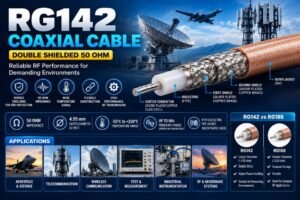
Semi-Rigid GS046 vs RG 188 Cable
The RG 188 Cable is a different coaxial cable construction and should not automatically be treated as an equivalent replacement for a GS Series semi-rigid cable.
| Feature | GS046 Semi-Rigid | RG 188 Cable |
|---|---|---|
| Construction | Semi-rigid | Flexible coaxial construction |
| Outer Shield | Solid metallic conductor | Shielded flexible construction |
| Flexibility | Formable, limited flexibility | More flexible |
| Shielding | Very high | Depends on construction |
| Typical Use | Precision RF & microwave | General RF interconnection |
| Installation | Formed routing | Flexible routing |
The appropriate cable depends on operating frequency, impedance, attenuation, bend requirements, connector type, environmental conditions, and mechanical installation requirements.
How to Select a Semi-Rigid GS046 Cable
Before selecting GS046 for an RF application, evaluate:
- Operating frequency – Confirm the cable’s specified frequency range.
- Characteristic impedance – Match the cable impedance with the connected RF equipment.
- Insertion loss – Check attenuation at the required operating frequency.
- VSWR and return loss – Important for minimizing RF reflections.
- Connector compatibility – Verify the required SMA, 2.92 mm, 2.4 mm, SMP, or other RF interface.
- Bend and routing requirements – Semi-rigid cable is designed for controlled forming rather than repeated flexing.
- Temperature requirements – Confirm the actual cable and assembly temperature rating.
- Power handling – Verify power capability at the operating frequency and environmental conditions.
Advantages of Semi-Rigid GS Series GS046
The main advantage of semi-rigid construction is the combination of excellent shielding, controlled geometry, stable impedance, and reliable high-frequency performance. These characteristics make the GS Series suitable for precision RF systems where ordinary flexible cable may not provide the desired mechanical or electrical stability.
Frequently Asked Questions
What is Semi-Rigid GS Series GS046?
Semi-Rigid GS046 refers to a GS-Series semi-rigid RF coaxial cable intended for controlled, high-frequency RF and microwave interconnections.
Is GS046 a 50 Ohm cable?
The GS Series information identifies its cables as typically designed around 50-ohm RF systems. The exact GS046 specification should be verified against its product datasheet.
What is the main advantage of semi-rigid cable?
Its solid metallic outer conductor provides excellent shielding and stable coaxial geometry, supporting consistent RF performance.
Where are GS Series cables used?
They are used in microwave communication, aerospace, defense, radar, satellite communication, telecom, RF testing, and precision RF assemblies.
Is GS046 flexible?
Semi-rigid cable is formable rather than continuously flexible. It can be shaped during installation but is not intended for repeated flexing.
Can GS046 be used for microwave applications?
Yes, the GS Series is designed for microwave and high-frequency RF applications. Exact frequency capability depends on the particular cable construction.
What dielectric is used in GS Series cables?
The available GS Series information specifies PTFE as the dielectric material.
Is GS046 the same as RG 188 Cable?
No. They represent different cable constructions. GS Series cables are semi-rigid, while RG 188 Cable is a flexible coaxial cable type. Selection should be based on the application’s electrical and mechanical requirements.
What connectors can be used with semi-rigid cables?
Connector selection depends on the RF system. Semi-rigid assemblies can be terminated with precision microwave connectors selected according to frequency, interface, and installation requirements.
What should be checked before ordering GS046?
Check impedance, frequency range, attenuation, VSWR, power handling, dimensions, temperature rating, cable length, and connector configuration against the required application.
Conclusion
Semi-Rigid GS Series GS046 is suited to precision RF environments where controlled impedance, strong shielding, low signal loss, and mechanically stable routing are important. Its semi-rigid construction makes it particularly relevant to microwave, aerospace, defense, radar, satellite, telecom, and RF test systems. For a production specification, the exact GS046 datasheet should be used to confirm dimensions and electrical limits, since the currently published GS Series information does not list a dedicated GS046 specification.