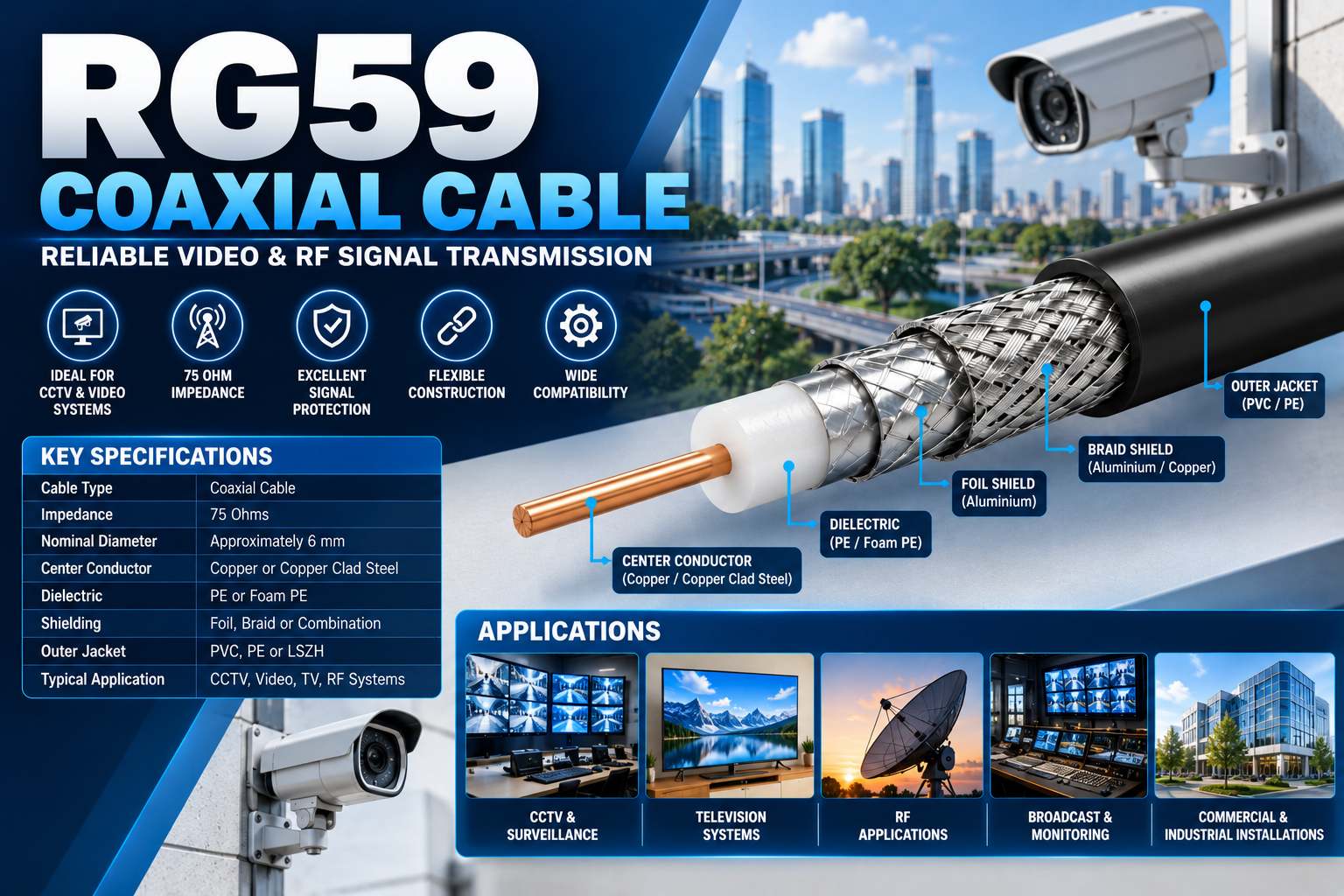
RG59 Coaxial Cable is a widely used 75-ohm coaxial cable designed primarily for video transmission, CCTV surveillance, television distribution, monitoring systems, and selected RF applications. Its coaxial construction provides controlled signal transmission by placing a central conductor inside an insulating dielectric, surrounded by a metallic shield and protective outer jacket.
The combination of 75-ohm impedance, flexibility, shielding, and relatively compact construction makes RG59 Coaxial Cable a practical choice for video and security installations where reliable signal transmission is required.
What Is RG59 Coaxial Cable?
RG59 Coaxial Cable is a type of coaxial transmission cable commonly used for carrying video and RF signals. Unlike many RF cables designed around 50-ohm systems, RG59 is generally associated with 75-ohm systems.
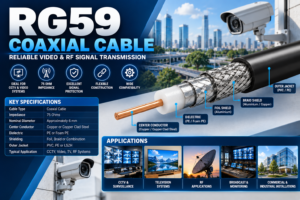
The cable is constructed with four primary layers:
- Center conductor
- Dielectric insulation
- Metallic shielding
- Outer protective jacket
The concentric structure helps maintain electrical characteristics while shielding the transmitted signal from external electromagnetic interference.
RG59 Coaxial Cable Construction
The performance of RG59 depends significantly on its internal construction.
Center Conductor
The center conductor carries the electrical signal. Depending on the cable design, it may use solid copper, copper-clad steel, or another conductive material.
Dielectric
The dielectric surrounds the center conductor and maintains separation between the conductor and shield. Polyethylene and foam polyethylene are commonly used dielectric materials.
Shield5
The metallic shield provides protection against electromagnetic interference and helps reduce unwanted signal leakage. RG59 designs can use a copper or aluminum braid, foil, or a combination of foil and braid.
Outer Jacket
The outer jacket protects the internal structure against mechanical damage, moisture, abrasion, and environmental exposure. Jacket materials can include PVC, PE, or LSZH compounds depending on the intended installation.
RG59 Coaxial Cable Specifications
Exact specifications vary according to manufacturer and cable construction, so the product datasheet should always be checked before selecting a cable.
| Parameter | Typical RG59 Characteristic |
|---|---|
| Cable Type | Coaxial Cable |
| Characteristic Impedance | 75 Ohms |
| Primary Use | Video and RF Signal Transmission |
| Center Conductor | Copper or Copper-Clad Steel |
| Dielectric | PE or Foam PE |
| Shield | Foil, Braid, or Combination |
| Outer Jacket | PVC, PE or LSZH |
| Cable Diameter | Approximately 6 mm |
| Connector Options | BNC, F-Type, RCA and Others |
Why Is 75-Ohm Impedance Important?
The 75-ohm characteristic impedance is one of the defining properties of RG59 Coaxial Cable. Video equipment, CCTV systems, television distribution equipment, and other 75-ohm systems are designed around this impedance.
Maintaining impedance compatibility between the source, cable, connectors, and receiving equipment helps reduce signal reflections and preserve signal quality.
For this reason, RG59 should generally be selected when the connected system is designed for 75-ohm transmission.
Key Features of RG59 Coaxial Cable
RG59 Coaxial Cable offers several features that make it suitable for video and monitoring installations:
- 75-ohm characteristic impedance
- Flexible coaxial construction
- Shielding against electromagnetic interference
- Compact cable diameter
- Easy termination with common coaxial connectors
- Suitable for CCTV and video systems
- Available in different jacket and shielding configurations
- Suitable for indoor and selected outdoor installations
- Available in various conductor materials and constructions
The actual performance depends on the specific cable design, shielding coverage, dielectric, conductor material, and installation environment.
Applications of RG59 Coaxial Cable
CCTV and Security Cameras
One of the most common applications of RG59 Coaxial Cable is CCTV. It can be used to connect cameras with recording equipment, monitors, and other video components.
Video Distribution
RG59 can be used for distributing analog video signals within buildings, facilities, studios, and monitoring systems.
Television Systems
The cable can also be used in selected television and RF distribution applications where 75-ohm coaxial transmission is required.
Surveillance Infrastructure
Security installations may use RG59 for connecting cameras, DVRs, monitors, and associated video equipment.
RF and Instrumentation
Depending on the cable’s construction and frequency requirements, RG59 can also be used for certain lower-frequency RF and instrumentation applications.
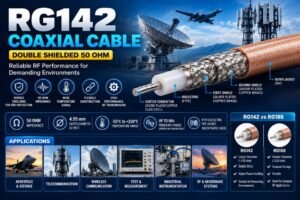
RG59 Coaxial Cable vs RG188 Cable
RG59 Coaxial Cable and RG188 Cable are designed for different types of systems.
RG59 is generally a 75-ohm cable commonly associated with video, CCTV, and television applications. RG188 Cable, in contrast, is typically a 50-ohm miniature coaxial cable used for compact RF, microwave, instrumentation, aerospace, and electronic applications.
Therefore, these cables should not be considered direct substitutes. The correct choice depends on impedance, frequency, cable dimensions, attenuation, environmental conditions, connector requirements, and the equipment being connected.
How to Select the Right RG59 Coaxial Cable
Before purchasing RG59 Coaxial Cable, consider the following factors:
Impedance: Confirm that the system requires 75-ohm coaxial cable.
Conductor: Select copper or copper-clad construction according to the application and performance requirements.
Shielding: Higher shielding coverage may be important in environments with significant electromagnetic interference.
Distance: Check attenuation at the operating frequency and determine whether the cable is suitable for the required transmission distance.
Jacket: Select PVC, PE, LSZH, or outdoor-rated construction based on the installation environment.
Connectors: Ensure the selected cable is compatible with the required BNC, F-Type, RCA, or other connector configuration.
Conclusion
RG59 Coaxial Cable remains an important solution for 75-ohm video and RF signal transmission. Its coaxial construction, shielding, flexible designs, and compatibility with common video connectors make it suitable for CCTV, surveillance, video distribution, television, and selected RF applications.
When selecting RG59, users should evaluate impedance, conductor construction, shielding, attenuation, jacket material, installation environment, and connector compatibility. For compact 50-ohm RF applications, products such as RG188 Cable may be more appropriate, depending on the system requirements.
FAQs About RG59 Coaxial Cable
1. What is RG59 Coaxial Cable?
RG59 Coaxial Cable is generally a 75-ohm coaxial cable used for video, CCTV, surveillance, television distribution, and selected RF applications.
2. Is RG59 a 75-ohm cable?
Yes. RG59 is commonly designed with a 75-ohm characteristic impedance.
3. What is RG59 Coaxial Cable used for?
It is commonly used for CCTV cameras, video transmission, surveillance systems, television distribution, monitoring equipment, and selected RF applications.
4. What connectors are used with RG59?
Common connector options include BNC, F-Type, RCA, and other compatible coaxial connectors.
5. Is RG59 suitable for CCTV?
Yes. RG59 is widely used in CCTV and video surveillance installations.
6. What is the difference between RG59 and RG188 Cable?
RG59 is generally a 75-ohm cable used primarily for video applications, while RG188 Cable is typically a smaller 50-ohm RF coaxial cable designed for compact RF and electronic systems.
7. What affects RG59 cable performance?
Conductor material, dielectric construction, shielding, cable length, frequency, connector quality, and installation conditions can all affect performance.
8. Can RG59 be used outdoors?
Outdoor use depends on the specific jacket and environmental rating. Outdoor-rated RG59 should be selected for exposed installations.
9. What impedance should I check before buying RG59?
For standard RG59 applications, verify that the cable has the required 75-ohm characteristic impedance.
10. How do I choose the right RG59 Coaxial Cable?
Check impedance, frequency range, attenuation, shielding, conductor material, jacket type, transmission distance, environmental conditions, and connector compatibility.