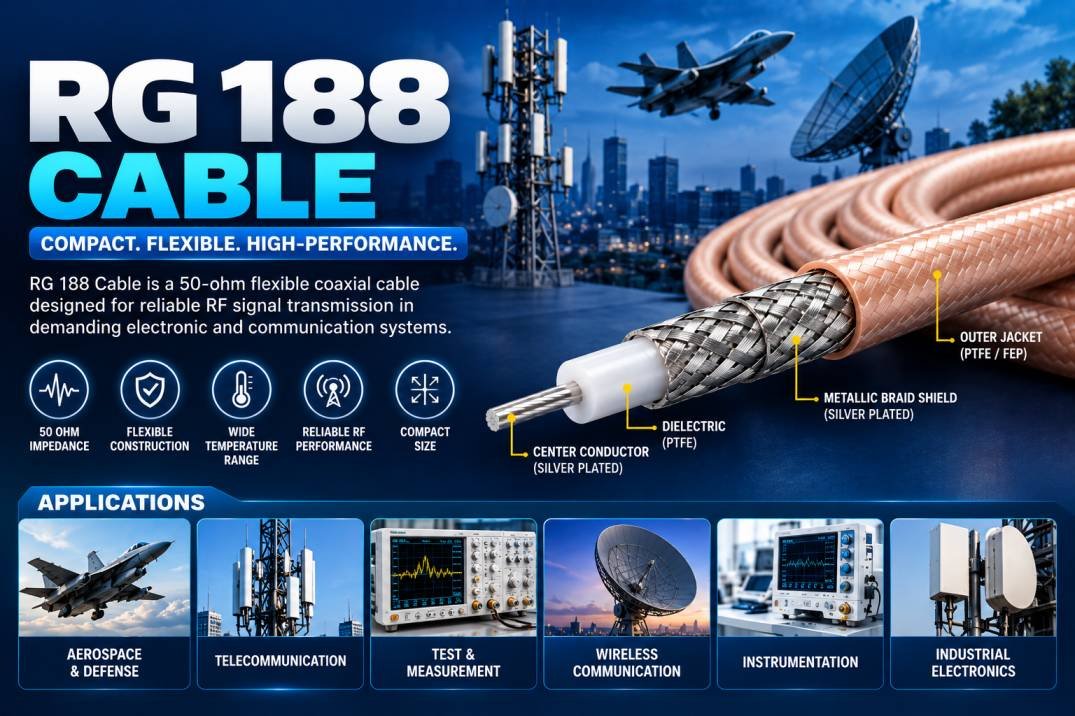
RG 188 Cable is a compact, 50-ohm coaxial RF cable designed for reliable high-frequency signal transmission where flexibility, small size, temperature resistance, and stable electrical performance are important. It is commonly associated with RF, microwave, aerospace, defense, telecommunications, laboratory, instrumentation, and wireless communication systems.
The cable typically uses a stranded silver-plated conductor, PTFE dielectric, metallic braid shielding, and a protective PTFE or FEP-based jacket. This construction provides a useful combination of electrical stability, mechanical flexibility, and environmental resistance.
What Is RG 188 Cable?
RG 188 Cable is a 50-ohm flexible coaxial cable belonging to the RG family of radio-frequency cables. Its compact construction makes it suitable for applications where conventional larger coaxial cables may not fit.
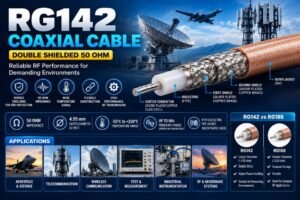
A typical RG 188 Cable construction consists of four primary layers:
- Center Conductor – Usually stranded silver-plated copper-clad steel or silver-plated copper, depending on the specification.
- Dielectric – PTFE insulation separates the conductor from the shield while maintaining controlled impedance.
- Outer Shield – A silver-plated or metallic copper braid provides RF shielding and helps reduce unwanted interference.
- Outer Jacket – PTFE, FEP, or another suitable fluoropolymer protects the cable against mechanical and environmental conditions.
This construction allows RG 188 Cable to maintain controlled 50-ohm impedance while remaining compact and flexible.
RG 188 Cable Specifications
Specifications can vary between manufacturers and specific MIL-style configurations, so the exact datasheet should always be checked before selecting a cable.
| Parameter | Typical RG 188 Cable Characteristics |
|---|---|
| Cable Type | Flexible RF Coaxial Cable |
| Characteristic Impedance | 50 Ohms |
| Center Conductor | Stranded Silver-Plated Conductor |
| Dielectric | PTFE |
| Shield | Metallic/Silver-Plated Copper Braid |
| Outer Jacket | PTFE or FEP |
| Construction | Compact & Flexible |
| Velocity of Propagation | Approximately 70% |
| Temperature Capability | High-temperature fluoropolymer construction |
| Applications | RF, Microwave, Aerospace, Defense, Test & Measurement |
The actual outside diameter, attenuation, voltage rating, frequency range, shielding coverage, and temperature rating depend on the manufacturer’s construction.
Construction of RG 188 Cable
Center Conductor
The center conductor is commonly made using stranded silver-plated copper-clad steel or a similar high-performance conductor. Stranded construction provides improved flexibility compared with a solid conductor, while silver plating supports reliable RF performance.
PTFE Dielectric
PTFE is used as the dielectric because of its electrical stability and temperature resistance. The dielectric maintains separation between the center conductor and outer shield and helps establish the cable’s controlled impedance.
Metallic Braid Shield
The outer conductor generally consists of a metallic braid. This shield provides a return path for the RF signal and helps reduce electromagnetic interference entering or leaving the cable.
Protective Jacket
The outer jacket protects the internal structure from mechanical damage, handling, moisture, and environmental exposure. Fluoropolymer jackets are particularly useful in demanding temperature environments.
Key Features of RG 188 Cable
50-Ohm Controlled Impedance
RG 188 Cable is designed for 50-ohm RF systems, making it suitable for many transmit, receive, antenna, instrumentation, and microwave circuits.
Compact Construction
Its relatively small diameter makes it useful for equipment where installation space is limited. It can be routed through compact assemblies and closely packed electronic systems.
Flexible Design
The stranded conductor and flexible dielectric/jacket construction allow the cable to be used in applications requiring bends and controlled cable routing.
High-Temperature Capability
PTFE and other fluoropolymer materials provide strong temperature resistance, making RG 188 Cable suitable for demanding environments when the selected construction has the required rating.
RF Shielding
The metallic braid helps protect signal integrity by reducing the effects of external electromagnetic interference and limiting RF leakage.
Applications of RG 188 Cable
RG 188 Cable can be used across several RF and electronic applications, including:
- Aerospace and avionics systems
- Defense and military communication equipment
- RF and microwave equipment
- Wireless communication systems
- Antenna interconnections
- Laboratory instrumentation
- Test and measurement equipment
- Electronic control systems
- High-temperature RF assemblies
- Compact electronic equipment
- Communication modules and RF subassemblies
Its compact dimensions are particularly valuable inside equipment where space and cable routing are major design considerations.
RG 188 Cable for RF and Microwave Systems
Signal integrity becomes increasingly important as operating frequency increases. Cable construction, connector quality, impedance matching, shielding, and attenuation all influence overall RF performance.
RG 188 Cable provides a controlled 50-ohm transmission path between RF components. When properly terminated with compatible connectors, it can be used for interconnecting antennas, RF modules, measurement equipment, transmitters, receivers, and other microwave components.
For high-frequency applications, engineers should evaluate attenuation, VSWR, return loss, maximum operating frequency, power handling, connector performance, and cable assembly configuration rather than selecting a cable based only on its RG designation.
RG 188 Cable vs Other RF Cables
RG 188 Cable occupies a compact position among 50-ohm RF coaxial cables. Compared with larger cables, its smaller construction can simplify routing and reduce space requirements. Compared with extremely small coaxial cables, it can offer a useful balance between flexibility, mechanical strength, shielding, and electrical performance.
The correct choice depends on the required frequency, attenuation, temperature, power, bending conditions, cable length, and installation environment.
How to Select RG 188 Cable
Before purchasing or specifying RG 188 Cable, consider:
- Impedance: Confirm that the system requires 50 ohms.
- Frequency: Verify the manufacturer’s maximum recommended frequency.
- Attenuation: Check insertion loss at the actual operating frequency.
- Temperature: Select a jacket and dielectric suitable for the operating environment.
- Flexibility: Consider minimum installation and repeated-bend requirements.
- Shielding: Check braid coverage and required RF isolation.
- Connectors: Ensure connector compatibility with the cable diameter and construction.
- Voltage and Power: Confirm the cable’s voltage and RF power limits.
- Assembly Length: Keep cable length appropriate to the required signal-loss budget.
Conclusion
RG 188 Cable is a compact 50-ohm RF coaxial cable designed for applications requiring reliable signal transmission, flexibility, controlled impedance, shielding, and temperature-resistant construction. Its PTFE-based dielectric, stranded conductor, metallic braid, and fluoropolymer jacket make it suitable for demanding RF and electronic environments.
For aerospace, defense, wireless communication, instrumentation, laboratory equipment, and compact RF assemblies, RG 188 Cable can provide an effective interconnection solution when its electrical and mechanical specifications match the application requirements.
FAQs About RG 188 Cable
1. What is RG 188 Cable?
RG 188 Cable is a compact, flexible 50-ohm coaxial RF cable used for signal transmission in RF, microwave, communication, instrumentation, aerospace, and defense applications.
2. Is RG 188 Cable 50 ohms?
Yes. RG 188 Cable is generally designed as a 50-ohm coaxial cable for RF systems.
3. What dielectric is used in RG 188 Cable?
PTFE is commonly used as the dielectric because it provides good electrical stability and high-temperature performance.
4. Is RG 188 Cable flexible?
Yes. Its stranded conductor and compact construction make it suitable for flexible RF interconnections and equipment wiring.
5. Where is RG 188 Cable used?
It is used in aerospace, defense, telecommunications, wireless communication, RF instrumentation, laboratory equipment, antenna systems, and electronic assemblies.
6. What type of shielding does RG 188 Cable use?
A metallic braid, commonly silver-plated copper or a similar conductive braid, is used for RF shielding.
7. Is RG 188 Cable suitable for high-temperature applications?
It can be, depending on the exact construction and jacket material. Always verify the manufacturer’s temperature rating for the selected cable.
8. What should be checked before buying RG 188 Cable?
Check impedance, frequency range, attenuation, temperature rating, voltage rating, shielding, outside diameter, bending requirements, and connector compatibility.
9. Can RG 188 Cable be supplied as a cable assembly?
Yes. RG 188 Cable can be terminated with suitable RF connectors to create customized cable assemblies for specific equipment and interconnection requirements.
10. Why choose RG 188 Cable?
RG 188 Cable is useful when an RF system requires a compact 50-ohm cable with flexible construction, controlled impedance, RF shielding, and temperature-resistant materials.