In modern RF (Radio Frequency), microwave, telecommunications, aerospace, defense, wireless networking, and test & measurement systems, reliable signal transmission is critical for optimal performance. One of the most widely used connectivity solutions in these industries is the SMA Cable Assembly.
SMA Cable Assemblies are precision-engineered RF interconnect solutions that combine high-performance coaxial cables with SMA connectors to provide low-loss, reliable signal transmission across a broad frequency range. Due to their compact size, excellent electrical characteristics, and durability, SMA cable assemblies have become a standard choice for RF engineers and communication professionals worldwide.
From antennas and wireless routers to military radar systems and 5G infrastructure, SMA cable assemblies play a vital role in ensuring efficient signal transfer between devices and systems.
In this comprehensive guide, we will explore what an SMA cable assembly is, how it works, its components, types, applications, benefits, specifications, and best practices for selection and installation.
What Is an SMA Cable Assembly?
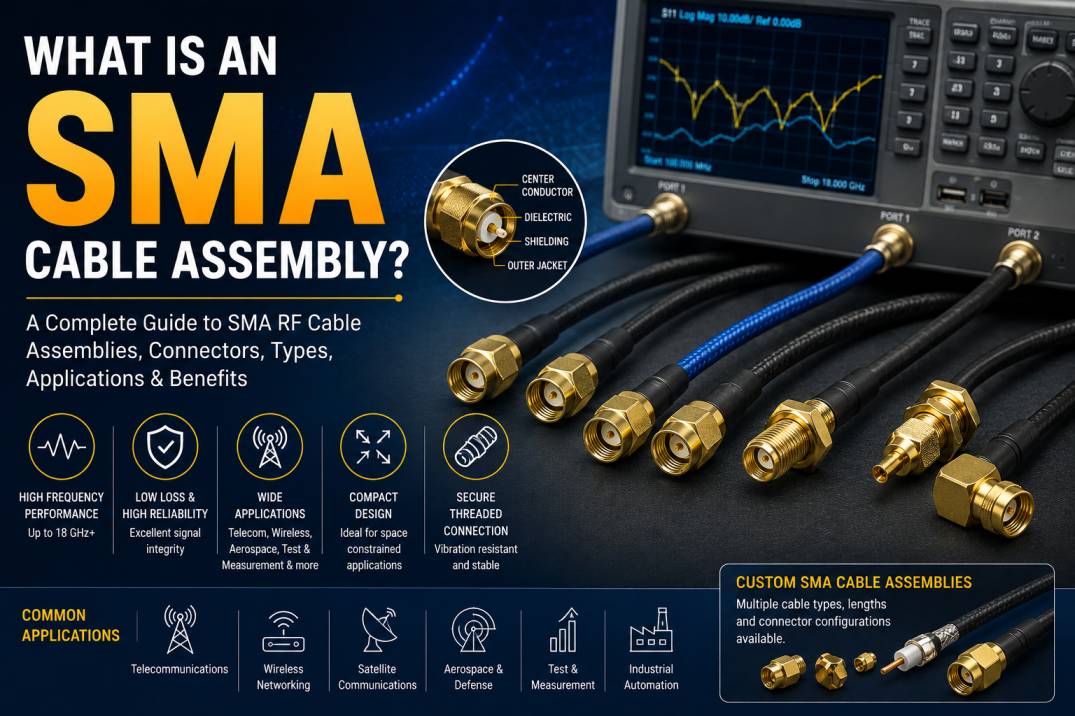
An SMA Cable Assembly is a complete RF cable solution consisting of:
- SMA Connectors
- RF Coaxial Cable
- Connector Terminations
- Protective Components
The assembly is designed to transmit RF and microwave signals between electronic devices while maintaining signal integrity and minimizing losses.
SMA stands for SubMiniature Version A, a connector type developed for high-frequency applications requiring excellent electrical performance and compact size.
These cable assemblies are commonly used in frequencies ranging from DC up to 18 GHz, 26.5 GHz, and even higher depending on cable and connector design.
Understanding SMA Connectors
The SMA connector is one of the most popular RF connector types used in modern communication systems.
Key Characteristics
- Threaded coupling mechanism
- Compact design
- Excellent RF performance
- High-frequency capability
- Secure connection
- Low VSWR
The threaded interface prevents accidental disconnection and ensures stable electrical performance.
How Does an SMA Cable Assembly Work?
An SMA cable assembly acts as a transmission path between two RF devices.
The process involves:
Signal Generation
A transmitter generates an RF signal.
Signal Transmission
The signal travels through the coaxial cable.
Signal Protection
The cable shielding protects the signal from electromagnetic interference (EMI).
Signal Delivery
The SMA connectors provide secure connections at both ends.
This allows signals to travel efficiently while maintaining signal quality.
Components of an SMA Cable Assembly
An SMA cable assembly consists of several important components.
SMA Connectors
The connector interfaces with RF equipment.
Common connector configurations include:
- SMA Male
- SMA Female
- Reverse Polarity SMA (RP-SMA)
- Right Angle SMA
- Bulkhead SMA
Coaxial Cable
The cable serves as the signal transmission medium.
Popular cable types include:
- RG58
- RG174
- RG316
- LMR100
- LMR195
- LMR240
- LMR400
The cable selection significantly impacts performance.
Center Conductor
The center conductor carries RF signals.
Materials commonly used include:
- Copper
- Silver-plated copper
- Copper-clad steel
These materials help reduce resistance and signal attenuation.
Dielectric Insulator
The dielectric separates the center conductor from the outer conductor.
Functions include:
- Electrical insulation
- Impedance control
- Signal stability
Materials include:
- PTFE (Teflon)
- Foam polyethylene
- FEP
Shielding Layer
The shielding prevents external interference.
Benefits:
- Reduced EMI
- Improved signal quality
- Enhanced performance
Protective Jacket
The outer jacket protects against:
- Moisture
- Abrasion
- Chemicals
- UV exposure
This extends cable lifespan and reliability.
Types of SMA Cable Assemblies
Different applications require different SMA cable configurations.
SMA Male to SMA Male Cable Assembly
The most common configuration.
Applications:
- RF equipment interconnection
- Antenna systems
- Wireless communication devices
SMA Male to SMA Female Cable Assembly
Used for extension and adaptation purposes.
Benefits:
- Increased flexibility
- Easy integration
RP-SMA Cable Assembly
Reverse polarity SMA connectors are commonly found in:
- Wi-Fi equipment
- Wireless routers
- IoT devices
Right Angle SMA Cable Assembly
Ideal where space is limited.
Advantages:
- Reduced cable stress
- Easier installation
- Compact design
Low-Loss SMA Cable Assembly
Designed for minimal attenuation.
Applications:
- Long cable runs
- High-frequency systems
- Cellular infrastructure
Flexible SMA Cable Assembly
Offers easier routing in confined spaces.
Used in:
- Laboratory environments
- Test systems
- Portable equipment
Key Features of SMA Cable Assemblies
High Frequency Performance
SMA assemblies support frequencies from:
- DC to 6 GHz
- DC to 18 GHz
- DC to 26.5 GHz
- DC to 40 GHz (precision versions)
This makes them suitable for modern RF systems.
Low Insertion Loss
High-quality assemblies minimize signal loss.
Benefits:
- Better signal quality
- Improved network efficiency
- Increased transmission distance
Excellent Return Loss
Provides superior impedance matching.
Advantages:
- Reduced signal reflection
- Improved RF performance
- Lower VSWR
Compact Size
SMA connectors are smaller than many traditional RF connectors.
This allows use in:
- Compact devices
- Embedded systems
- Dense RF equipment
Secure Threaded Coupling
The threaded design prevents accidental disconnection.
Benefits include:
- Reliable operation
- Enhanced durability
- Improved safety
Advantages of SMA Cable Assemblies
Superior Signal Integrity
SMA assemblies maintain signal quality across wide frequency ranges.
High Reliability
Suitable for demanding environments.
Used extensively in:
- Military systems
- Aerospace equipment
- Industrial automation
Wide Compatibility
Compatible with:
- Antennas
- RF modules
- Wireless devices
- Test equipment
- Network analyzers
Long Service Life
Manufactured using durable materials and precision engineering.
Versatility
Can be customized to various:
- Lengths
- Connector types
- Cable types
- Frequency requirements
Applications of SMA Cable Assemblies
Telecommunications
Telecom networks rely on SMA assemblies for:
- Base stations
- Small cells
- DAS systems
- RF testing
Wireless Networking
Used in:
- Wi-Fi routers
- Access points
- Wireless bridges
- IoT gateways
Aerospace and Defense
Critical for:
- Radar systems
- Satellite communication
- Electronic warfare systems
- Aircraft communication
Test and Measurement
Commonly used with:
- Spectrum analyzers
- Signal generators
- Vector network analyzers
- RF power meters
Medical Equipment
Applications include:
- Imaging systems
- Diagnostic devices
- Wireless monitoring equipment
Industrial Automation
Used in:
- Remote monitoring
- Wireless sensors
- Industrial communication systems
SMA Cable Assembly vs Other RF Cable Assemblies
| Feature | SMA Assembly | N-Type Assembly | BNC Assembly |
|---|---|---|---|
| Size | Compact | Larger | Medium |
| Frequency Range | Very High | High | Moderate |
| Threaded Coupling | Yes | Yes | No |
| Precision Testing | Excellent | Good | Limited |
| Wireless Devices | Excellent | Moderate | Limited |
SMA cable assemblies are often preferred for compact, high-frequency applications.
How to Choose the Right SMA Cable Assembly
Determine Operating Frequency
Select an assembly rated for your frequency range.
Higher frequencies require:
- Precision connectors
- Low-loss cables
- Better shielding
Consider Cable Length
Longer cables create more attenuation.
Choose the shortest practical length.
Evaluate Connector Type
Verify compatibility with existing equipment.
Examples:
- SMA Male
- SMA Female
- RP-SMA
- Right Angle SMA
Check Environmental Conditions
Outdoor installations may require:
- UV-resistant jackets
- Waterproof protection
- Ruggedized construction
Focus on Cable Quality
Premium cable materials improve:
- Reliability
- Performance
- Lifespan
Installation Best Practices
Avoid Excessive Bending
Sharp bends increase signal loss and cable damage.
Use Proper Torque
Follow connector torque specifications to avoid damage.
Keep Connectors Clean
Dust and contaminants can degrade RF performance.
Perform Regular Inspections
Check for:
- Loose connections
- Cable wear
- Connector damage
Protect Outdoor Installations
Use weatherproofing materials where necessary.
Future Trends in SMA Cable Assemblies
5G Expansion
The growth of 5G networks increases demand for high-performance SMA assemblies.
IoT Development
Billions of connected devices require reliable RF connectivity.
Satellite Communication Growth
Modern satellite systems continue utilizing precision RF cable assemblies.
Advanced Testing Systems
Increasing testing complexity drives demand for higher-performance SMA solutions.
Conclusion
An SMA Cable Assembly is one of the most widely used RF interconnect solutions in modern communication and electronic systems. Combining precision SMA connectors with high-quality coaxial cables, these assemblies provide exceptional signal integrity, low loss, excellent return loss, and reliable performance across a broad frequency spectrum.
From telecommunications and wireless networking to aerospace, defense, medical equipment, and RF testing laboratories, SMA cable assemblies have become an essential component of modern RF infrastructure.
By selecting the right cable type, connector configuration, and assembly quality, organizations can achieve improved network performance, greater reliability, and long-term operational efficiency.
As technologies such as 5G, IoT, satellite communications, and advanced RF testing continue to expand, SMA cable assemblies will remain a critical part of the global connectivity ecosystem.