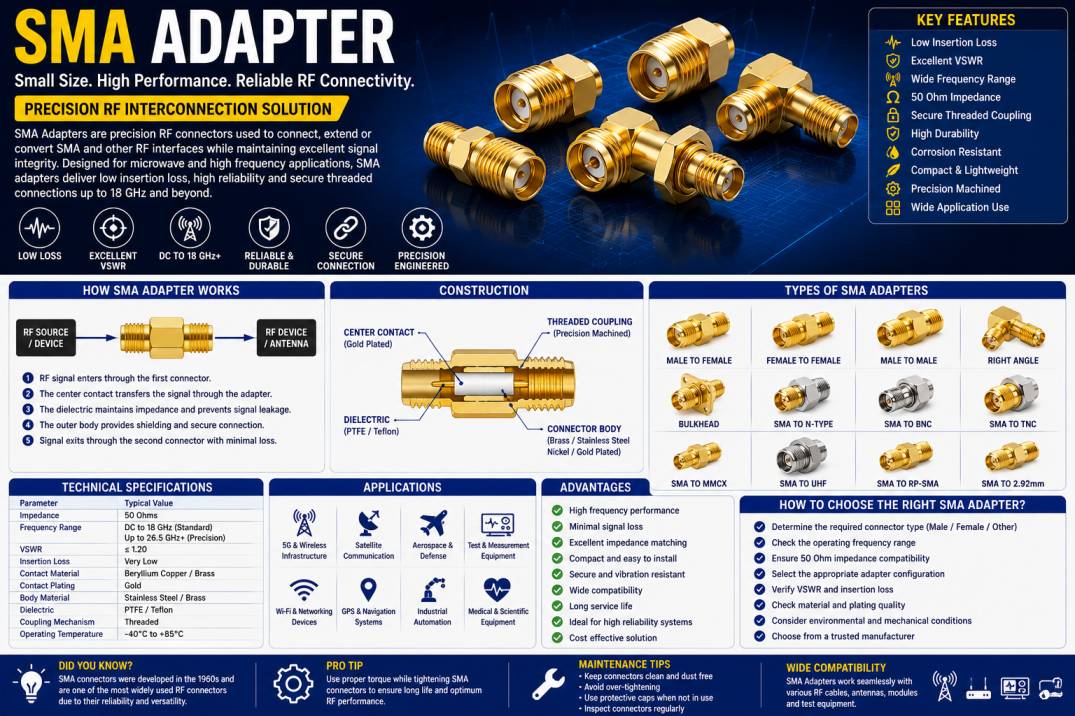
An SMA Adapter is one of the most widely used radio frequency (RF) interconnect components in modern communication systems. Designed to connect two RF connectors with different genders, orientations, or connector interfaces, SMA adapters provide a reliable solution for maintaining signal integrity while extending or converting RF connections. They are commonly used in telecommunications, wireless networking, aerospace, defense, satellite communication, medical equipment, industrial automation, and laboratory testing.
SMA adapters are known for their compact size, threaded coupling mechanism, excellent electrical performance, and ability to support microwave frequencies up to 18 GHz, 26.5 GHz, or even higher in precision versions. They provide low insertion loss, excellent impedance matching, and superior durability, making them ideal for both commercial and military RF applications.
Whether you are connecting antennas, RF modules, test instruments, Wi-Fi equipment, GPS systems, or 5G communication devices, SMA adapters offer a secure and efficient RF connection that minimizes signal degradation.
This comprehensive guide explains everything you need to know about SMA Adapters, including their construction, working principle, types, specifications, applications, advantages, and selection criteria.
What Is an SMA Adapter?
An SMA Adapter is a passive RF connector accessory designed to connect two SMA connectors or convert one RF connector type into another while maintaining a continuous RF transmission path.
The adapter allows engineers and technicians to:
- Change connector gender
- Extend RF cable connections
- Convert connector interfaces
- Connect RF equipment with different connector configurations
- Maintain impedance matching
Most SMA adapters are manufactured with a 50 Ohm impedance to ensure compatibility with RF and microwave communication systems.
How Does an SMA Adapter Work?
An SMA Adapter works by providing a precision mechanical and electrical connection between two RF connectors.
When the connectors are tightened using the threaded coupling mechanism:
- The center contacts establish electrical continuity.
- The outer conductor provides grounding and shielding.
- The adapter maintains controlled impedance.
- RF signals pass through with minimal insertion loss.
- Signal reflections are minimized through accurate connector alignment.
This ensures efficient transmission of RF energy between connected devices.
Construction of an SMA Adapter
Center Contact
The center conductor transfers RF signals through the adapter.
Common materials include:
- Beryllium Copper
- Brass
- Phosphor Bronze
Gold plating improves conductivity and corrosion resistance.
Dielectric Insulator
The dielectric separates the center conductor from the outer body.
Common dielectric materials include:
- PTFE
- Teflon
- High-performance polymers
These materials provide excellent electrical insulation and stable impedance.
Connector Body
The connector housing provides mechanical strength.
Common materials include:
- Stainless Steel
- Brass
- Nickel-Plated Brass
- Passivated Stainless Steel
Threaded Coupling
The threaded interface ensures:
- Secure connection
- Vibration resistance
- Excellent electrical contact
- Long-term reliability
Working Principle of an SMA Adapter
The adapter functions as a precision RF transition.
The process includes:
- RF signal enters the first connector.
- Signal passes through the center contact.
- The dielectric maintains impedance.
- The outer body provides shielding.
- RF energy exits through the opposite connector.
- Signal reaches the connected equipment with minimal loss.
Technical Specifications
| Specification | Typical Value |
|---|---|
| Connector Type | SMA Male / SMA Female |
| Characteristic Impedance | 50 Ohms |
| Frequency Range | DC to 18 GHz (Standard) |
| Precision Models | Up to 26.5 GHz or Higher |
| VSWR | ≤ 1.20 |
| Insertion Loss | Very Low |
| Contact Material | Beryllium Copper / Brass |
| Contact Plating | Gold |
| Body Material | Stainless Steel / Brass |
| Coupling Mechanism | Threaded |
Key Features of SMA Adapters
- Compact design
- Low insertion loss
- Excellent impedance matching
- High-frequency capability
- Secure threaded connection
- Superior shielding
- High durability
- Corrosion resistance
- Stable electrical performance
- Precision machining
- Easy installation
- Long service life
Types of SMA Adapters
SMA Male to SMA Female Adapter
Used for extending RF cable connections.
SMA Female to SMA Female Adapter
Connects two SMA Male connectors.
SMA Male to SMA Male Adapter
Connects two SMA Female interfaces.
Right-Angle SMA Adapter
Ideal for compact installations where cable bending is limited.
Bulkhead SMA Adapter
Designed for panel mounting applications.
SMA to N-Type Adapter
Converts SMA interfaces into N-Type connectors.
SMA to BNC Adapter
Allows interconnection between SMA and BNC RF systems.
SMA to TNC Adapter
Used in mixed RF communication systems.
SMA to MMCX Adapter
Supports miniature wireless devices.
SMA to UHF Adapter
Provides compatibility with legacy RF equipment.
Applications of SMA Adapters
Wireless Communication
Used in Wi-Fi routers, access points, and wireless modules.
5G Infrastructure
Supports RF front-end modules and antenna connections.
Satellite Communication
Connects RF equipment used in satellite uplink and downlink systems.
GPS Systems
Provides reliable antenna connections for navigation devices.
Aerospace
Supports aircraft communication and navigation equipment.
Defense
Used in radar systems, electronic warfare, and military communication.
RF Test Laboratories
Commonly used with:
- Spectrum Analyzers
- Network Analyzers
- Signal Generators
- Oscilloscopes
Medical Equipment
Supports RF diagnostic and imaging devices.
Industrial Automation
Connects wireless sensors, IoT gateways, and industrial communication equipment.
Consumer Electronics
Found in wireless modules, RF development boards, and communication devices.
Advantages of SMA Adapters
- Excellent RF performance
- Low signal loss
- High-frequency compatibility
- Compact size
- Reliable threaded connection
- Excellent shielding
- Easy installation
- High mechanical strength
- Corrosion resistance
- Long operational life
- Wide connector compatibility
- Cost-effective solution
Limitations of SMA Adapters
- Not designed for frequent connection cycles
- Smaller than N-Type connectors, resulting in lower power handling
- Precision connectors require careful handling
- Incorrect torque may damage the connector threads
- Limited weather resistance without proper sealing
How to Choose the Right SMA Adapter
When selecting an SMA Adapter, consider the following factors:
- Operating frequency
- Connector gender
- Connector interface
- Impedance
- Frequency rating
- VSWR
- Insertion loss
- Material quality
- Gold plating
- Environmental conditions
SMA Adapter vs N-Type Adapter
| Feature | SMA Adapter | N-Type Adapter |
|---|---|---|
| Connector Size | Compact | Larger |
| Frequency Range | Up to 26.5 GHz+ | Up to 18 GHz+ |
| Power Handling | Moderate | Higher |
| Thread Size | Small | Large |
| Outdoor Use | Moderate | Excellent |
| Common Applications | RF Modules | Base Stations |
Industries Using SMA Adapters
SMA Adapters are widely used in:
- Telecommunications
- Aerospace
- Defense
- Satellite Communication
- Medical Electronics
- Industrial Automation
- Wireless Networking
- Broadcasting
- Scientific Research
- RF Test Laboratories
Maintenance Tips
To maximize service life:
- Keep connector interfaces clean.
- Avoid excessive tightening.
- Use the recommended torque.
- Protect connectors from moisture.
- Inspect gold-plated contacts regularly.
- Store unused adapters with dust caps.
- Replace worn connectors immediately.
Future Trends of SMA Adapters
As RF technology advances toward 5G Advanced, 6G, satellite internet, autonomous vehicles, and high-frequency IoT applications, SMA adapters continue to evolve with better materials, tighter manufacturing tolerances, and enhanced electrical performance. Modern SMA adapters now support higher frequencies, lower insertion loss, improved shielding, and greater durability. Precision SMA adapters capable of operating beyond 26.5 GHz are becoming increasingly important in microwave communication, aerospace systems, semiconductor testing, and advanced RF laboratories.
Conclusion
SMA Adapters are essential RF interconnect components that provide reliable, low-loss connections between RF devices operating at microwave frequencies. Their compact design, threaded coupling mechanism, excellent impedance matching, and high-frequency capability make them ideal for telecommunications, satellite communication, aerospace, defense, wireless networking, medical equipment, industrial automation, and laboratory testing. Choosing the correct SMA Adapter based on frequency, connector type, impedance, and application ensures optimal signal integrity, long-term reliability, and superior RF system performance.
Frequently Asked Questions (FAQs)
1. What is an SMA Adapter?
An SMA Adapter is a passive RF connector used to connect, extend, or convert SMA connectors and other compatible RF interfaces while maintaining reliable signal transmission.
2. What is an SMA Adapter used for?
It is used in RF communication systems, antennas, wireless devices, laboratory equipment, satellite communication, GPS systems, and 5G infrastructure.
3. What impedance does an SMA Adapter have?
Most SMA Adapters are manufactured with a 50 Ohm characteristic impedance.
4. What frequency range does an SMA Adapter support?
Standard SMA Adapters typically operate from DC to 18 GHz, while precision versions support frequencies up to 26.5 GHz or higher.
5. What are the common types of SMA Adapters?
Common types include SMA Male to Female, Female to Female, Male to Male, Right-Angle, Bulkhead, SMA to N-Type, SMA to BNC, SMA to TNC, and SMA to MMCX adapters.
6. What are the advantages of SMA Adapters?
They provide low insertion loss, excellent impedance matching, compact size, reliable threaded connections, corrosion resistance, and high-frequency performance.
7. Where are SMA Adapters commonly used?
SMA Adapters are widely used in telecommunications, aerospace, defense, wireless networking, satellite communication, industrial automation, RF laboratories, and medical electronics.
8. Can SMA Adapters be used outdoors?
Yes. With proper environmental sealing and weatherproof protection, SMA Adapters can be used in outdoor RF installations.
9. What is the difference between an SMA Adapter and an N-Type Adapter?
SMA Adapters are smaller and support higher microwave frequencies, while N-Type Adapters offer higher power handling and are more suitable for outdoor and high-power RF applications.
10. How do I choose the right SMA Adapter?
Choose an SMA Adapter based on operating frequency, connector type, impedance, gender, insertion loss, VSWR, environmental conditions, and application requirements.