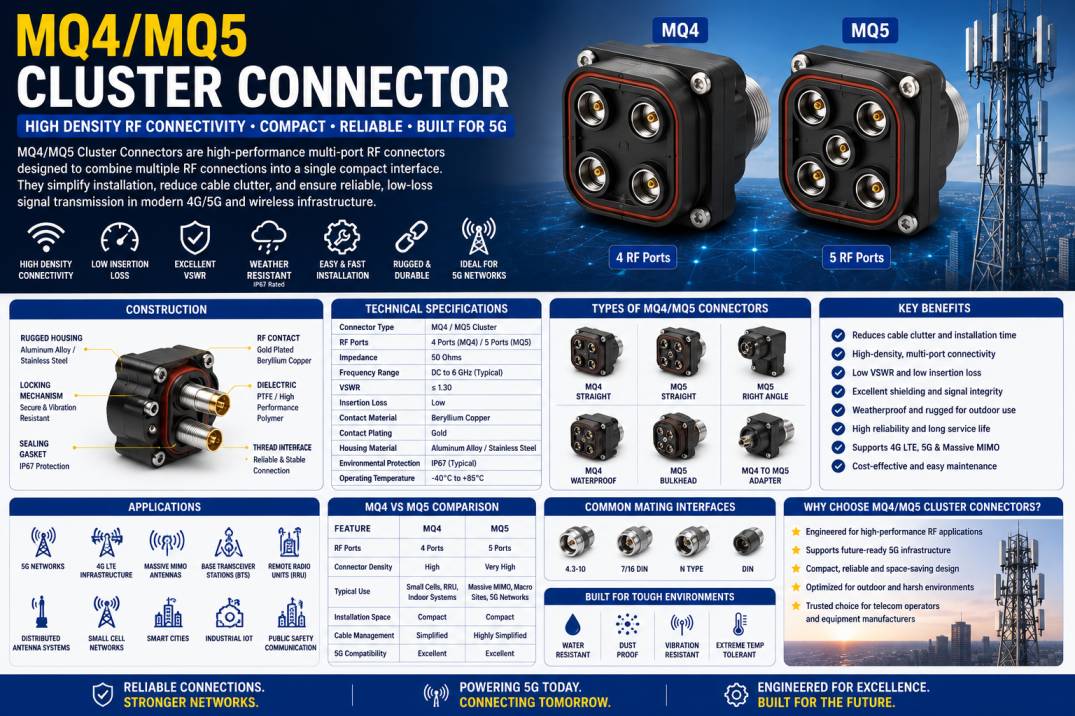
As wireless communication networks continue evolving toward higher capacity and greater efficiency, the demand for compact, high-density RF connectivity solutions has increased significantly. One of the most reliable solutions for modern telecommunications infrastructure is the MQ4/MQ5 Cluster Connector. These advanced multi-port RF connectors are specifically designed for high-density antenna systems, Remote Radio Units (RRUs), Base Transceiver Stations (BTS), Massive MIMO antennas, Distributed Antenna Systems (DAS), and 4G/5G wireless communication equipment.
MQ4 and MQ5 Cluster Connectors simplify RF installations by integrating multiple RF connections into a single compact interface. This design reduces installation time, minimizes cable clutter, improves maintenance efficiency, and enhances overall system reliability. Their rugged construction and weather-resistant sealing make them ideal for outdoor telecom environments where equipment is exposed to vibration, dust, moisture, and extreme temperatures.
Modern telecom operators and equipment manufacturers increasingly rely on MQ4/MQ5 Cluster Connectors to support high-performance wireless infrastructure, enabling faster deployment of cellular networks while maintaining excellent RF performance.
This comprehensive guide explains everything about MQ4/MQ5 Cluster Connectors, including their construction, working principle, features, specifications, applications, advantages, and selection criteria.
What Is an MQ4/MQ5 Cluster Connector?
An MQ4/MQ5 Cluster Connector is a high-density multi-port RF connector designed to combine several coaxial RF connections into a single compact connector assembly. It provides secure electrical connections between antennas, radio units, feeder cables, and other RF equipment used in cellular communication systems.
Unlike traditional individual RF connectors, MQ4/MQ5 Cluster Connectors reduce the number of separate cable terminations by grouping multiple RF channels into one connector housing. This improves installation efficiency and reduces the physical space required inside telecom equipment.
These connectors are widely used in 4G LTE, 5G NR, Massive MIMO, small cells, macro base stations, and outdoor wireless infrastructure.
How Does an MQ4/MQ5 Cluster Connector Work?
An MQ4/MQ5 Cluster Connector establishes multiple RF signal paths simultaneously through a single connector interface.
Each internal coaxial contact carries an independent RF signal while the outer shielding protects against electromagnetic interference (EMI). Precision alignment ensures that each contact maintains consistent impedance and low insertion loss throughout the connection.
The connector’s locking mechanism provides a secure mechanical interface capable of withstanding outdoor environmental conditions, vibration, and repeated maintenance operations.
This compact architecture enables high-performance signal transmission while reducing installation complexity.
Construction of an MQ4/MQ5 Cluster Connector
RF Contacts
Each RF channel contains precision-machined contacts.
Common materials include:
- Beryllium Copper
- Brass
- Phosphor Bronze
Gold plating improves electrical conductivity and corrosion resistance.
Dielectric Insulator
The dielectric separates each RF channel while maintaining proper impedance.
Typical materials include:
- PTFE
- High-performance engineering polymers
Connector Housing
The housing protects internal contacts and provides mechanical strength.
Common materials include:
- Aluminum Alloy
- Stainless Steel
- Zinc Alloy
These materials provide durability while resisting corrosion.
Environmental Sealing
Rubber seals and gaskets protect against:
- Water
- Dust
- Moisture
- Outdoor contaminants
Many MQ4/MQ5 connectors are designed to meet IP67 or higher environmental protection standards.
Locking Mechanism
A secure locking system prevents accidental disconnection and maintains reliable electrical performance.
Key Features of MQ4/MQ5 Cluster Connectors
- Compact multi-port design
- High-density RF connectivity
- Low insertion loss
- Excellent return loss
- Stable 50 Ohm impedance
- Weather-resistant construction
- High mechanical durability
- Fast installation
- Reduced cable management
- Excellent EMI shielding
- Long service life
- Suitable for outdoor telecom applications
Technical Specifications
| Specification | Typical Value |
| Connector Type | MQ4 / MQ5 Cluster |
| Characteristic Impedance | 50 Ohms |
| Frequency Range | DC to 6 GHz (Typical) |
| VSWR | ≤ 1.30 |
| Insertion Loss | Low |
| Contact Material | Beryllium Copper |
| Contact Plating | Gold |
| Housing Material | Aluminum Alloy / Stainless Steel |
| Environmental Protection | IP67 (Typical) |
| Operating Temperature | -40°C to +85°C |
Types of MQ4/MQ5 Cluster Connectors
MQ4 Cluster Connector
Provides four RF signal channels within a compact connector body.
Suitable for:
- Small Cell Systems
- Remote Radio Units
- Indoor Wireless Equipment
MQ5 Cluster Connector
Provides five RF signal channels for higher-density telecom applications.
Commonly used in:
- Massive MIMO
- Macro Base Stations
- Outdoor Antenna Systems
- 5G Infrastructure
Straight Cluster Connector
Designed for standard cable routing applications.
Right Angle Cluster Connector
Ideal for installations with limited mounting space.
Waterproof Cluster Connector
Designed for harsh outdoor environments requiring superior environmental protection.
Applications of MQ4/MQ5 Cluster Connectors
5G Networks
Used in massive MIMO antennas, active antenna systems, and radio units.
4G LTE Infrastructure
Supports cellular base stations and distributed antenna systems.
Base Transceiver Stations (BTS)
Provides reliable RF interconnections between antennas and radio equipment.
Remote Radio Units (RRU)
Enables compact, high-density RF connectivity.
Distributed Antenna Systems (DAS)
Simplifies indoor wireless signal distribution.
Small Cell Networks
Supports compact outdoor wireless installations.
Telecommunications Towers
Used for feeder cable connections and antenna interfaces.
Smart Cities
Supports intelligent communication infrastructure.
Industrial Wireless Networks
Provides RF connectivity for industrial IoT systems.
Public Safety Communication
Used in emergency communication and mission-critical wireless systems.
Advantages of MQ4/MQ5 Cluster Connectors
- Reduces cable clutter
- Faster installation
- Compact connector design
- High-density connectivity
- Excellent RF performance
- Weatherproof construction
- High reliability
- Low maintenance
- Reduced installation cost
- Superior shielding effectiveness
- Long operational life
- Simplified network upgrades
Limitations of MQ4/MQ5 Cluster Connectors
- Higher cost than single RF connectors
- Requires compatible telecom equipment
- Specialized installation tools may be required
- Connector replacement may require trained technicians
How to Choose the Right MQ4/MQ5 Cluster Connector
When selecting an MQ4/MQ5 Cluster Connector, consider the following factors:
- Number of RF channels
- Operating frequency
- Impedance
- Environmental protection rating
- Connector compatibility
- Cable type
- Installation location
- Mechanical durability
- VSWR requirements
- Manufacturer certifications
MQ4 vs MQ5 Cluster Connector
| Feature | MQ4 | MQ5 |
| RF Channels | 4 | 5 |
| Connector Density | High | Very High |
| Typical Applications | Small Cells | Massive MIMO |
| Installation Space | Compact | Compact |
| Outdoor Use | Yes | Yes |
| 5G Compatibility | Excellent | Excellent |
| Cable Management | Simplified | Highly Simplified |
| System Capacity | Standard | Higher |
Industries Using MQ4/MQ5 Cluster Connectors
MQ4/MQ5 Cluster Connectors are widely used in:
- Telecommunications
- Mobile Network Infrastructure
- 5G Networks
- 4G LTE Systems
- Smart Cities
- Industrial IoT
- Public Safety Networks
- Transportation Infrastructure
- Broadcasting
- Defense Communication Systems
Maintenance Tips
To ensure reliable long-term performance:
- Keep connector interfaces clean.
- Inspect sealing gaskets regularly.
- Avoid excessive mechanical force.
- Verify connector locking before operation.
- Protect unused ports with sealing caps.
- Inspect for corrosion during maintenance.
- Replace damaged connectors immediately.
Future Trends of MQ4/MQ5 Cluster Connectors
The expansion of 5G Advanced, Open RAN (O-RAN), private cellular networks, smart cities, and future 6G communication systems is driving the development of more compact and higher-density RF connectors. Future MQ4/MQ5 Cluster Connectors are expected to feature improved weather sealing, lower insertion loss, enhanced EMI shielding, higher frequency support, lightweight materials, and simplified installation mechanisms. These advancements will help telecom operators reduce deployment costs while improving network performance and scalability.
Conclusion
MQ4/MQ5 Cluster Connectors are advanced multi-port RF connectivity solutions designed to simplify modern telecommunications infrastructure. Their compact design, high-density connectivity, reliable weatherproof construction, and excellent RF performance make them an ideal choice for 4G LTE, 5G networks, Massive MIMO systems, Remote Radio Units, Base Transceiver Stations, and Distributed Antenna Systems. By reducing installation complexity and improving overall network reliability, MQ4/MQ5 Cluster Connectors have become essential components in next-generation wireless communication systems.
Frequently Asked Questions (FAQs)
1. What is an MQ4/MQ5 Cluster Connector?
An MQ4/MQ5 Cluster Connector is a multi-port RF connector that combines multiple coaxial connections into one compact interface for telecommunications equipment.
2. What are MQ4/MQ5 Cluster Connectors used for?
They are commonly used in 4G LTE, 5G networks, Massive MIMO antennas, Base Transceiver Stations (BTS), Remote Radio Units (RRU), and Distributed Antenna Systems (DAS).
3. What is the difference between MQ4 and MQ5 Cluster Connectors?
The primary difference is the number of RF channels. MQ4 typically supports four RF connections, while MQ5 supports five RF connections in a compact connector assembly.
4. What impedance do MQ4/MQ5 Cluster Connectors use?
Most MQ4/MQ5 Cluster Connectors are designed with a 50 Ohm characteristic impedance.
5. Are MQ4/MQ5 Cluster Connectors waterproof?
Yes. Many models are designed with IP67-rated sealing to provide protection against dust, moisture, and harsh outdoor environments.
6. What are the advantages of MQ4/MQ5 Cluster Connectors?
They reduce cable clutter, simplify installation, improve reliability, provide excellent RF performance, and support high-density telecom installations.
7. Which industries use MQ4/MQ5 Cluster Connectors?
They are widely used in telecommunications, smart cities, industrial IoT, public safety communication, transportation infrastructure, and wireless networking.
8. Can MQ4/MQ5 Cluster Connectors support 5G networks?
Yes. They are specifically designed to support modern 4G LTE, 5G NR, Massive MIMO, and advanced wireless communication systems.
9. How do I choose the right MQ4/MQ5 Cluster Connector?
Choose a connector based on the required number of RF channels, operating frequency, impedance, environmental protection, cable compatibility, and installation requirements.
10. How should MQ4/MQ5 Cluster Connectors be maintained?
Regularly inspect seals, keep contacts clean, protect unused ports with caps, verify locking mechanisms, and replace damaged connectors to maintain reliable long-term RF performance.