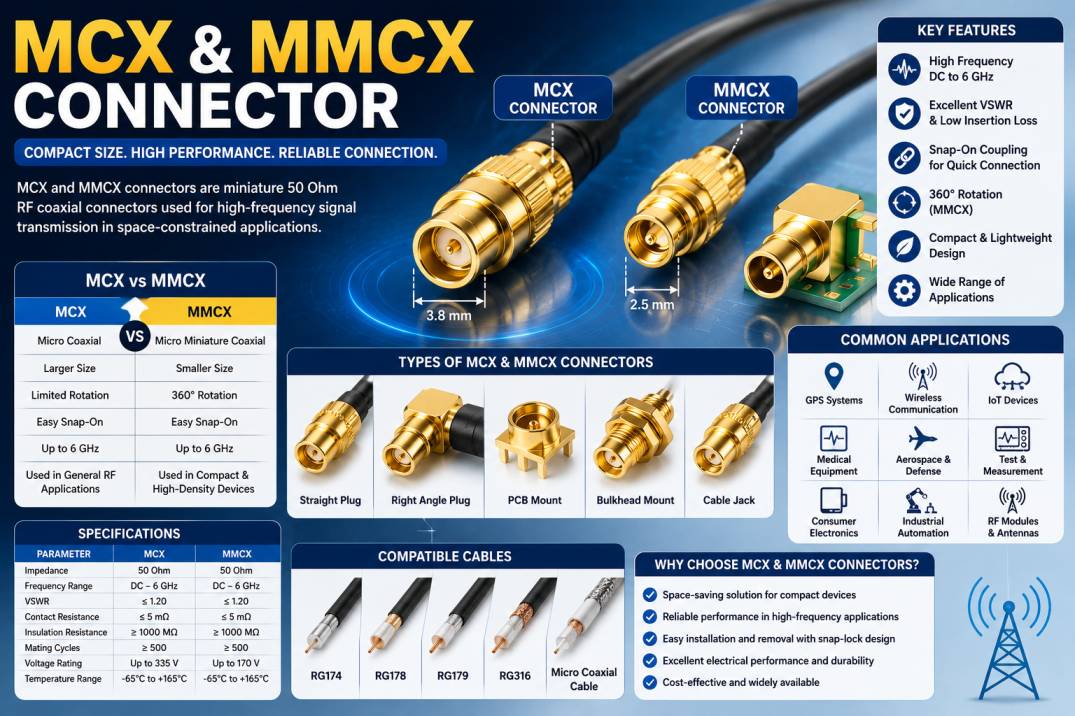
MCX (Micro Coaxial) and MMCX (Micro-Miniature Coaxial) connectors are compact RF coaxial connectors designed for high-frequency signal transmission in space-constrained electronic devices. These connectors provide reliable electrical performance, excellent impedance matching, and low signal loss, making them widely used in wireless communication, GPS systems, IoT devices, medical equipment, test instruments, military electronics, and consumer electronics.
As electronic devices continue to become smaller and more powerful, the demand for miniature RF connectors has increased significantly. MCX and MMCX connectors offer a compact alternative to larger RF connectors such as SMA, BNC, and N-Type while maintaining excellent performance at microwave frequencies.
Both connector types are designed with a snap-on coupling mechanism that allows quick installation and removal without requiring special tools. Their small size, lightweight construction, and reliable signal transmission make them ideal for applications where PCB space is limited.
This comprehensive guide explains everything you need to know about MCX and MMCX connectors, including their construction, working principle, specifications, types, applications, advantages, differences, and selection guide.
What Is an MCX Connector?
An MCX (Micro Coaxial Connector) is a compact RF connector developed to provide reliable signal transmission in applications where space is limited. It features a snap-on locking mechanism and typically supports frequencies up to 6 GHz.
MCX connectors are approximately 30% smaller than SMA connectors while maintaining a standard 50 Ohm impedance. Their compact size makes them suitable for wireless communication equipment, GPS modules, RF testing equipment, and embedded electronic systems.
What Is an MMCX Connector?
An MMCX (Micro-Miniature Coaxial Connector) is an even smaller version of the MCX connector. It offers a secure snap-lock connection combined with 360-degree rotational capability after mating, allowing greater installation flexibility.
MMCX connectors typically support frequencies up to 6 GHz and are commonly found in wearable devices, medical electronics, antennas, IoT modules, smartphones, wireless communication systems, and embedded RF circuits.
How Do MCX & MMCX Connectors Work?
MCX and MMCX connectors operate by creating a secure electrical connection between the center conductor and outer shield of two coaxial cables or PCB interfaces.
When the male connector is pushed into the female connector, the snap-lock mechanism securely holds both connectors together. The center contact carries the RF signal, while the outer conductor provides grounding and shielding against electromagnetic interference (EMI).
The coaxial design maintains constant impedance throughout the connection, minimizing signal reflections and insertion loss.
Construction of MCX & MMCX Connectors
MCX and MMCX connectors consist of several precision components.
Center Contact
The center conductor carries the RF signal.
Common materials include:
- Gold-plated brass
- Phosphor bronze
- Beryllium copper
Dielectric Insulator
The dielectric separates the center conductor from the outer shield.
Typical materials include:
- PTFE (Teflon)
- High-performance thermoplastics
Outer Conductor
The outer shell provides shielding and mechanical support.
Materials include:
- Brass
- Stainless steel
- Nickel-plated brass
Snap Coupling Mechanism
Unlike threaded connectors, MCX and MMCX connectors use a push-on snap coupling for fast installation and removal.
MCX vs MMCX Connector Comparison
| Feature | MCX Connector | MMCX Connector |
|---|---|---|
| Full Form | Micro Coaxial | Micro Miniature Coaxial |
| Size | Small | Ultra Compact |
| Coupling | Snap-On | Snap-On |
| Rotation | Limited | 360° Rotation |
| Frequency Range | DC to 6 GHz | DC to 6 GHz |
| Impedance | 50 Ohm | 50 Ohm |
| Applications | GPS, RF Modules | IoT, Medical, Wearables |
Technical Specifications
| Specification | MCX | MMCX |
|---|---|---|
| Impedance | 50 Ω | 50 Ω |
| Frequency Range | DC–6 GHz | DC–6 GHz |
| VSWR | ≤1.20 | ≤1.20 |
| Contact Resistance | Low | Low |
| Insulation Resistance | ≥1000 MΩ | ≥1000 MΩ |
| Voltage Rating | Up to 335 V | Up to 170 V |
| Mating Cycles | 500+ | 500+ |
Types of MCX & MMCX Connectors
Manufacturers offer several connector configurations.
Straight Plug
Used for direct cable connections.
Right Angle Plug
Ideal for compact installations where cable routing is limited.
PCB Mount Connector
Designed for direct installation on printed circuit boards.
Bulkhead Connector
Used for panel-mounted applications.
Cable Jack
Installed directly onto RF coaxial cables.
Common Cable Types
MCX and MMCX connectors are compatible with various RF cables including:
- RG174
- RG178
- RG179
- RG316
- Micro Coaxial Cable
- Flexible RF Cable
Applications of MCX & MMCX Connectors
GPS Systems
MCX and MMCX connectors are widely used in GPS antennas and navigation equipment.
Wireless Communication
Used in:
- Cellular devices
- Wi-Fi modules
- Bluetooth devices
- RF transceivers
IoT Devices
Compact IoT hardware frequently uses MMCX connectors because of their miniature size.
Medical Equipment
Applications include:
- Patient monitoring
- Diagnostic equipment
- Portable medical devices
Aerospace and Defense
Used in:
- Avionics
- Military communication
- Radar systems
- Navigation equipment
Test and Measurement
Common in:
- Spectrum analyzers
- Signal generators
- RF test instruments
- Network analyzers
Consumer Electronics
Found in:
- Wireless routers
- Embedded modules
- Communication adapters
- RF development boards
Advantages of MCX & MMCX Connectors
- Compact size
- Lightweight construction
- Excellent RF performance
- Low insertion loss
- Good return loss
- Reliable snap-lock coupling
- Excellent impedance matching
- Easy installation
- High durability
- Suitable for high-frequency applications
- Cost-effective
- Compatible with multiple RF cables
Limitations of MCX & MMCX Connectors
- Lower power handling than SMA connectors
- Limited outdoor durability without sealing
- Smaller connectors require careful handling
- Not suitable for extremely high-power RF applications
How to Choose the Right MCX or MMCX Connector
Before selecting a connector, evaluate:
- Operating frequency
- Connector size
- Cable compatibility
- Mounting style
- Impedance
- Power handling
- Environmental conditions
- Mechanical durability
- Required mating cycles
- Manufacturer quality
MCX vs SMA Connector
| Feature | MCX | SMA |
|---|---|---|
| Size | Smaller | Larger |
| Coupling | Snap-On | Threaded |
| Installation | Fast | Slower |
| Power Handling | Moderate | Higher |
| Frequency | Up to 6 GHz | Up to 26.5 GHz or higher |
| Applications | Compact RF Devices | High-performance RF Systems |
Industries Using MCX & MMCX Connectors
- Telecommunications
- Aerospace
- Defense
- Medical Devices
- Automotive Electronics
- Industrial Automation
- IoT Systems
- GPS Navigation
- Consumer Electronics
- RF Laboratories
Future Trends of MCX & MMCX Connectors
The growing demand for compact wireless devices, 5G infrastructure, wearable technology, autonomous vehicles, satellite communication, and industrial IoT continues to drive innovation in MCX and MMCX connectors. Manufacturers are developing connectors with improved shielding, lower insertion loss, higher durability, and better environmental protection. Future designs are expected to support higher frequencies, smaller footprints, and enhanced performance for next-generation RF communication systems.
Conclusion
MCX and MMCX connectors are essential miniature RF connectors designed for reliable high-frequency signal transmission in compact electronic devices. Their lightweight construction, snap-lock coupling, low insertion loss, and excellent impedance matching make them ideal for GPS systems, wireless communication, medical electronics, IoT devices, aerospace applications, and RF testing equipment. Choosing the appropriate connector based on frequency, cable compatibility, mounting style, and operating environment ensures long-term reliability and superior RF performance.
Frequently Asked Questions (FAQs)
1. What is an MCX connector?
An MCX connector is a compact 50 Ohm RF coaxial connector with a snap-on coupling mechanism used for high-frequency signal transmission up to 6 GHz.
2. What is an MMCX connector?
An MMCX connector is a smaller version of the MCX connector featuring a snap-lock design and 360-degree rotational capability for compact RF applications.
3. What is the difference between MCX and MMCX connectors?
The main difference is size. MMCX connectors are smaller and allow full 360-degree rotation after mating, while MCX connectors are slightly larger with limited rotational movement.
4. What impedance do MCX and MMCX connectors use?
Both MCX and MMCX connectors are typically designed with a 50 Ohm impedance.
5. What frequency range do v support?
Most standard MCX and MMCX connectors operate from DC up to 6 GHz, depending on the manufacturer and cable assembly.
6. Where are MCX and MMCX connectors used?
They are widely used in GPS antennas, wireless communication devices, IoT modules, medical equipment, aerospace systems, RF testing instruments, and industrial electronics.
7. Are MCX and MMCX connectors interchangeable?
No. Although they are similar, MCX and MMCX connectors have different physical sizes and are not mechanically compatible.
8. What cables are compatible with MCX and MMCX connectors?
They commonly support RF cables such as RG174, RG178, RG179, RG316, micro coaxial cables, and other miniature coaxial cable assemblies.
9. What are the advantages of MCX and MMCX connectors?
Their key advantages include compact size, low insertion loss, excellent impedance matching, snap-on installation, lightweight construction, and reliable RF performance.
10. How do I choose the right MCX or MMCX connector?
Select the connector based on operating frequency, impedance, cable type, mounting style, power requirements, environmental conditions, and available installation space.0