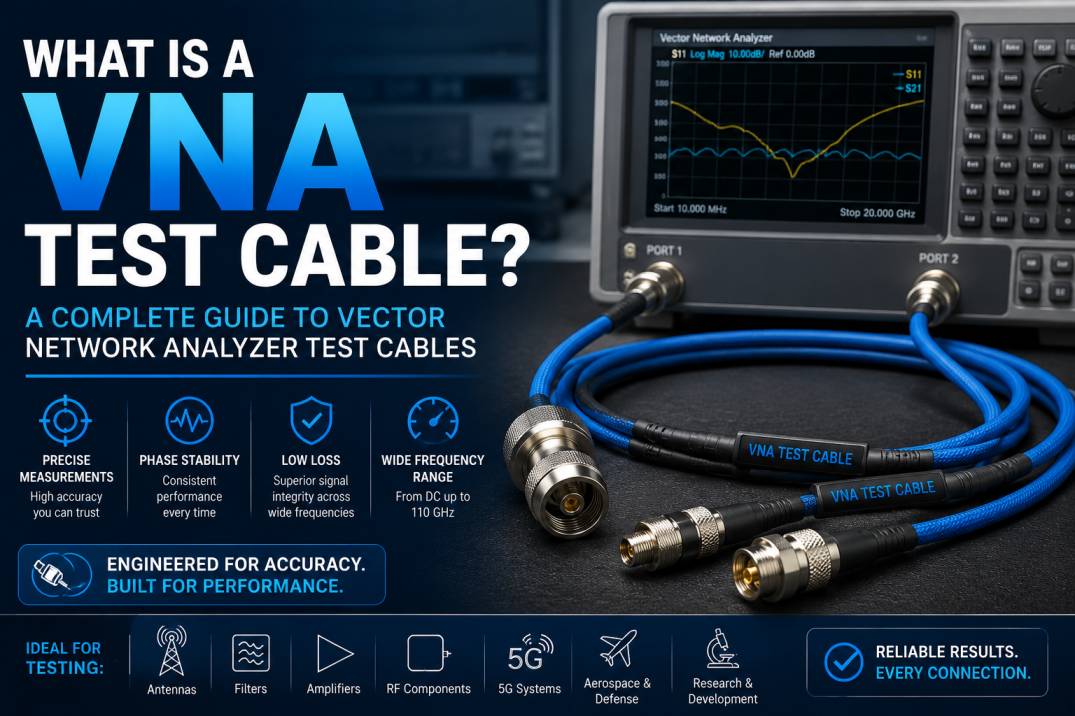
In the world of RF (Radio Frequency), microwave, telecommunications, aerospace, defense, and electronic testing, measurement accuracy is everything. Even the most advanced testing equipment can produce inaccurate results if poor-quality test cables are used. One of the most critical components in RF testing environments is the VNA Test Cable.
A VNA Test Cable is specifically designed to connect a Vector Network Analyzer (VNA) to devices under test (DUTs) while maintaining signal integrity, phase stability, and measurement accuracy. These specialized cables are engineered to operate across a wide frequency range and provide highly repeatable test results in demanding laboratory and field environments.
Whether you’re testing antennas, filters, amplifiers, RF connectors, base station equipment, microwave components, or 5G communication systems, VNA test cables play a crucial role in ensuring precise measurements.
In this comprehensive guide, we’ll explore what VNA test cables are, how they work, their construction, types, applications, advantages, selection criteria, and best practices for RF testing professionals.
What Is a VNA Test Cable?
A VNA Test Cable is a precision RF cable assembly specifically designed for use with a Vector Network Analyzer (VNA).
Unlike standard coaxial cables, VNA test cables are manufactured with extremely tight tolerances to minimize:
- Signal loss
- Phase variation
- Insertion loss
- Reflection errors
- Measurement uncertainty
These cables connect the VNA test ports to the device being measured and serve as a critical part of the measurement system.
Because VNAs measure complex RF parameters such as impedance, insertion loss, return loss, and S-parameters, cable performance directly affects the accuracy of the test results.
What Is a Vector Network Analyzer (VNA)?
Before understanding VNA test cables, it’s important to understand the role of a Vector Network Analyzer.
A Vector Network Analyzer is an advanced RF testing instrument used to measure:
- Reflection characteristics
- Transmission characteristics
- Impedance matching
- Antenna performance
- Filter response
- RF component behavior
VNAs measure both:
Magnitude
Signal strength or power.
Phase
Signal timing relative to the original signal.
Together, these measurements provide detailed information about RF and microwave devices.
Since these measurements are extremely sensitive, the test cables connecting the VNA to the DUT must maintain exceptional electrical stability.
Why Are VNA Test Cables Important?
The performance of a VNA measurement setup is only as good as its weakest component.
Even a high-end Vector Network Analyzer can produce inaccurate results if low-quality test cables are used.
VNA test cables help ensure:
- Accurate measurements
- Stable phase response
- Low insertion loss
- High repeatability
- Reduced measurement uncertainty
Without precision test cables, engineers may experience:
- Calibration drift
- Inconsistent readings
- False measurement results
- Increased testing errors
How Does a VNA Test Cable Work?
A VNA test cable acts as a high-performance transmission path between the analyzer and the device under test.
The cable transfers RF signals while minimizing:
- Attenuation
- Signal reflections
- Impedance mismatch
- Phase distortion
During testing:
- The VNA generates an RF signal.
- The signal travels through the VNA test cable.
- The device under test responds.
- The response signal returns through the cable.
- The VNA analyzes the results.
Any instability in the cable directly affects measurement accuracy.
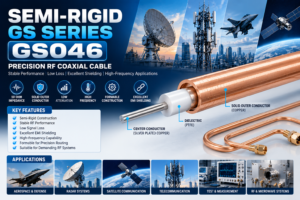
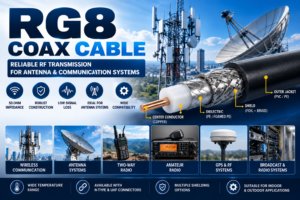
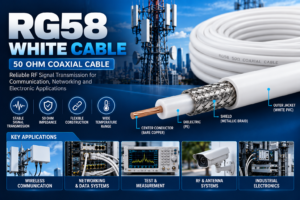
Construction of a VNA Test Cable
High-quality VNA test cables are carefully engineered using precision materials.
Center Conductor
The center conductor carries RF signals.
Materials include:
- Silver-plated copper
- Copper alloy
- High-conductivity copper
Benefits:
- Low resistance
- Excellent signal transmission
- Reduced attenuation
Dielectric Material
The dielectric insulates the center conductor.
Common materials:
- PTFE (Teflon)
- Air dielectric
- Foam dielectric
Advantages:
- Stable impedance
- Low signal loss
- High-frequency performance
Shielding Layer
Shielding protects against external interference.
Typically consists of:
- Braided shielding
- Foil shielding
- Multi-layer shielding
Benefits:
- EMI protection
- Reduced signal leakage
- Improved measurement accuracy
Outer Jacket
The protective jacket provides mechanical durability.
Common materials include:
- PVC
- Polyurethane
- TPE
- FEP
Functions:
- Environmental protection
- Flexibility
- Abrasion resistance
Key Characteristics of VNA Test Cables
Phase Stability
Phase stability is one of the most important specifications.
A quality VNA cable maintains consistent phase performance even when:
- Bent
- Twisted
- Moved during testing
This ensures reliable measurements.
Low Insertion Loss
Insertion loss measures signal power lost through the cable.
Lower insertion loss results in:
- Better signal integrity
- More accurate measurements
- Improved dynamic range
Excellent Return Loss
Return loss indicates how much signal reflects back due to impedance mismatch.
Good VNA cables offer:
- High return loss
- Low VSWR
- Better impedance matching
Flexibility
Many testing applications require frequent cable movement.
High-flex cables maintain electrical stability while remaining easy to handle.
High Frequency Capability
Modern VNA test cables support frequencies ranging from:
- DC to 6 GHz
- DC to 18 GHz
- DC to 26.5 GHz
- DC to 40 GHz
- DC to 67 GHz
- DC to 110 GHz
Depending on application requirements.
Types of VNA Test Cables
Flexible VNA Test Cables
Designed for everyday laboratory use.
Features:
- Easy handling
- Cost-effective
- Good electrical performance
Applications:
- General RF testing
- Antenna measurements
- Production testing
Phase-Stable VNA Test Cables
Maintain consistent electrical performance during movement.
Advantages:
- Reduced measurement drift
- Higher accuracy
- Better repeatability
Used in:
- Calibration laboratories
- Aerospace testing
- Research facilities
Armored VNA Test Cables
Feature protective metal armor.
Benefits:
- Enhanced durability
- Crush resistance
- Extended lifespan
Ideal for field testing environments.
High-Frequency VNA Test Cables
Designed for microwave and millimeter-wave applications.
Support:
- 26.5 GHz
- 40 GHz
- 50 GHz
- 67 GHz
- 110 GHz
Applications:
- 5G testing
- Radar systems
- Satellite communication
Common Connector Types Used in VNA Test Cables
Connector quality significantly impacts measurement performance.
N-Type Connectors
Commonly used up to 18 GHz.
Advantages:
- Rugged design
- Excellent RF performance
- Reliable connections
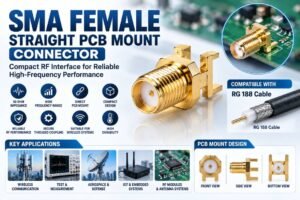
SMA Connectors
Widely used in RF and microwave testing.
Benefits:
- Compact size
- High-frequency capability
- Precision performance
3.5 mm Connectors
Provide superior microwave performance.
Applications:
- Laboratory testing
- Calibration standards
2.92 mm (K) Connectors
Support frequencies up to 40 GHz.
Used in:
- 5G testing
- Millimeter-wave measurements
2.4 mm and 1.85 mm Connectors
Designed for extremely high-frequency testing.
Applications include:
- Aerospace
- Defense
- Research laboratories
Applications of VNA Test Cables
VNA test cables are used across numerous industries.
Telecommunications
Telecom engineers use VNA cables for:
- Antenna testing
- Base station verification
- 4G network deployment
- 5G network optimization
Aerospace and Defense
Critical for testing:
- Radar systems
- Electronic warfare equipment
- Satellite communication systems
Research and Development
Used in laboratories for:
- Product development
- Prototype validation
- Component characterization
Manufacturing and Quality Control
Support production testing of:
- RF filters
- Amplifiers
- Couplers
- Antennas
Automotive Industry
Modern vehicles contain RF systems requiring precise validation.
Applications include:
- Connected vehicles
- ADAS systems
- Automotive radar
VNA Test Cable vs Standard RF Cable
| Feature | VNA Test Cable | Standard RF Cable |
|---|---|---|
| Phase Stability | Excellent | Moderate |
| Measurement Accuracy | Very High | Limited |
| Return Loss | Superior | Standard |
| Frequency Range | Extended | Limited |
| Repeatability | High | Moderate |
| Cost | Higher | Lower |
For critical RF measurements, VNA test cables are essential.
How to Choose the Right VNA Test Cable
Determine Frequency Range
Choose a cable supporting your maximum test frequency.
Examples:
- 6 GHz
- 18 GHz
- 26.5 GHz
- 40 GHz
- 67 GHz
Evaluate Phase Stability
Applications involving repeated movement require highly phase-stable cables.
Consider Connector Compatibility
Ensure compatibility with:
- VNA ports
- Calibration kits
- DUT connectors
Check Cable Flexibility
Laboratory environments often require flexible cable assemblies.
Review Insertion Loss Specifications
Lower insertion loss improves measurement quality.
Consider Environmental Conditions
Field testing may require:
- Armored cables
- Ruggedized connectors
- Weather-resistant assemblies
Best Practices for VNA Test Cable Handling
Proper handling significantly extends cable life.
Avoid Excessive Bending
Sharp bends can damage internal conductors.
Use Proper Torque
Always use calibrated torque wrenches when tightening connectors.
Protect Connectors
Keep connectors clean and covered when not in use.
Perform Regular Inspections
Check for:
- Connector wear
- Jacket damage
- Mechanical stress
Store Properly
Avoid twisting and tightly coiling cables.
Future Trends in VNA Testing
As RF technologies continue evolving, VNA cable requirements are becoming more demanding.
5G and 6G Development
Higher frequencies require:
- Better shielding
- Lower loss
- Improved phase stability
Millimeter-Wave Testing
Emerging applications above 40 GHz drive demand for advanced cable technologies.
Automated Testing Systems
Production environments increasingly require highly repeatable cable assemblies.
Satellite Communication Growth
Next-generation satellite networks require precision microwave testing solutions.
Conclusion
A VNA Test Cable is far more than a simple RF cable. It is a precision measurement component specifically engineered to maintain signal integrity, phase stability, and repeatable performance during RF and microwave testing.
Whether testing antennas, filters, amplifiers, radar systems, satellite communication equipment, or 5G infrastructure, the accuracy of your Vector Network Analyzer measurements depends heavily on the quality of the test cable used.
By selecting high-performance VNA test cables with excellent phase stability, low insertion loss, superior return loss, and appropriate connector configurations, engineers can achieve reliable, repeatable, and highly accurate measurement results.
As wireless technologies continue advancing toward higher frequencies and more complex communication systems, VNA test cables will remain a critical part of RF testing and network validation worldwide.
Frequently Asked Questions (FAQs) About VNA Test Cables
1. What is a VNA test cable?
A VNA (Vector Network Analyzer) test cable is a precision RF cable assembly designed to connect a Vector Network Analyzer to the device under test (DUT). It provides highly accurate signal transmission with low insertion loss, excellent phase stability, and minimal measurement uncertainty across a wide frequency range.
2. Why are VNA test cables different from standard RF cables?
Unlike standard RF cables, VNA test cables are engineered for precision measurements. They feature superior shielding, low VSWR, stable phase performance, flexible construction, and high-quality connectors to ensure repeatable and accurate test results, even after repeated bending.
3. What frequency range do VNA test cables support?
The supported frequency range depends on the cable and connector type. High-performance VNA test cables can operate from DC up to 18 GHz, 26.5 GHz, 40 GHz, 50 GHz, 67 GHz, or even 110 GHz for advanced microwave and millimeter-wave applications.
4. Which connectors are commonly used with VNA test cables?
Common connector types include SMA, 2.92 mm (K Connector), 2.4 mm, 1.85 mm (V Connector), N-Type, 3.5 mm, and SMP/SMPM connectors. The connector selection depends on the operating frequency and the testing application.
5. What factors should I consider when choosing a VNA test cable?
When selecting a VNA test cable, consider the operating frequency, insertion loss, phase stability, cable flexibility, connector type, return loss, shielding effectiveness, durability, and compatibility with your Vector Network Analyzer and DUT.
6. How long do VNA test cables typically last?
The lifespan depends on usage, handling, and environmental conditions. High-quality VNA test cables can withstand thousands of flex cycles while maintaining excellent electrical performance when handled and stored properly.
7. Can damaged VNA test cables affect measurement accuracy?
Yes. Damaged connectors, excessive cable bending, worn shielding, or internal conductor damage can introduce signal reflections, increased insertion loss, unstable phase, and inaccurate S-parameter measurements. Regular inspection and calibration are recommended.
8. Which industries use VNA test cables?
VNA test cables are widely used in telecommunications, 5G infrastructure, aerospace, defense, satellite communications, semiconductor testing, automotive radar, research laboratories, RF manufacturing, and wireless product development.
9. How can I maintain a VNA test cable for maximum accuracy?
To extend cable life and maintain measurement accuracy:
- Avoid bending below the minimum bend radius.
- Keep connector interfaces clean.
- Use protective connector caps.
- Do not twist or crush the cable.
- Store the cable properly when not in use.
- Perform regular calibration and inspection.
10. Why choose SRFS Teleinfra VNA test cables?
SRFS Teleinfra offers precision-engineered VNA test cables designed for high-frequency RF and microwave measurements. They feature low insertion loss, excellent phase stability, high shielding effectiveness, durable construction, and premium RF connectors, making them ideal for laboratory testing, production environments, aerospace, defense, and advanced 5G applications.