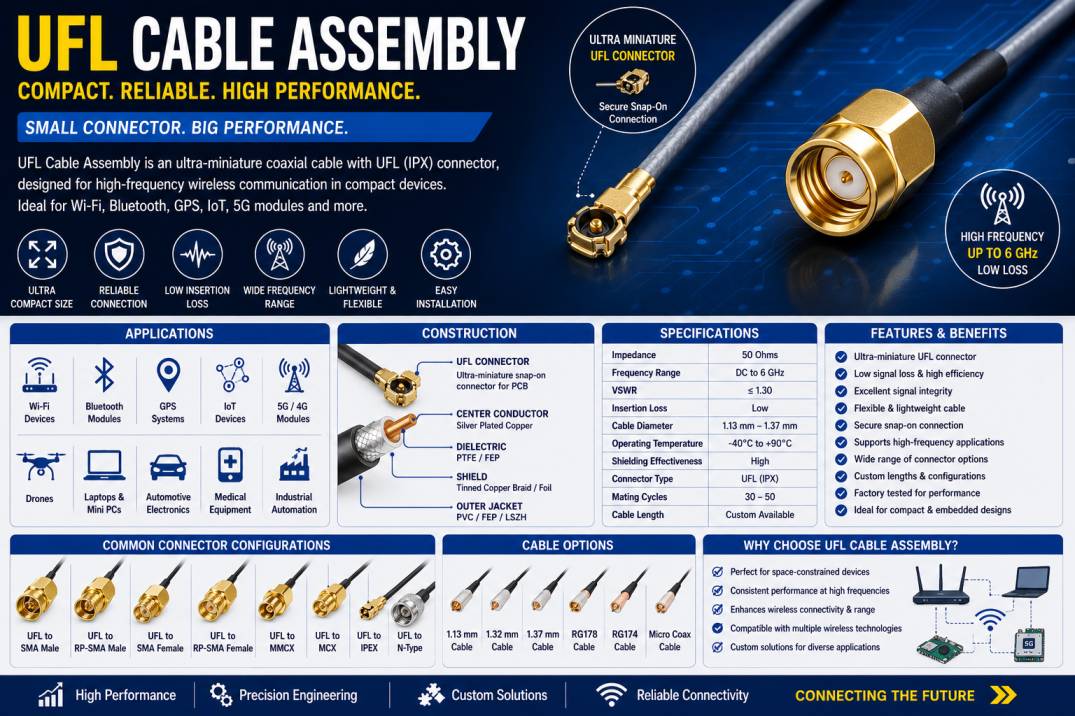
A UFL Cable Assembly is a miniature radio frequency (RF) cable assembly designed for compact wireless communication devices where space is limited and high-frequency signal transmission is required. Featuring a UFL (Ultra Miniature Coaxial) connector on one end and various RF connectors on the other, these cable assemblies provide a reliable connection between RF modules, antennas, and communication equipment.
As electronic devices continue to become smaller and more powerful, UFL Cable Assemblies have become increasingly important in applications such as Wi-Fi routers, Bluetooth modules, GPS receivers, IoT devices, drones, embedded systems, laptops, cellular modems, and 5G communication equipment. Their compact size, lightweight construction, and excellent electrical performance make them ideal for high-density PCB designs.
Manufactured using precision coaxial cables and miniature RF connectors, UFL Cable Assemblies offer low insertion loss, controlled impedance, and excellent signal integrity even at high frequencies. They are widely used in consumer electronics, industrial automation, medical devices, automotive systems, aerospace, and wireless networking.
This comprehensive guide explains everything you need to know about UFL Cable Assemblies, including their construction, working principle, specifications, applications, advantages, and selection criteria.
What Is a UFL Cable Assembly?
A UFL Cable Assembly is a pre-assembled miniature coaxial cable equipped with a UFL connector on one end and another RF connector such as SMA, RP-SMA, MMCX, MCX, N-Type, or IPEX on the opposite end. It is specifically designed to transmit RF signals between internal wireless modules and external antennas with minimal signal loss.
The UFL connector is one of the smallest RF connectors available, making it suitable for compact electronic devices where board space is limited. Despite its small size, it supports high-frequency communication and provides reliable signal transmission for modern wireless technologies.
How Does a UFL Cable Assembly Work?
A UFL Cable Assembly transmits RF signals through the center conductor of the coaxial cable while the surrounding shield protects the signal from electromagnetic interference (EMI).
The UFL connector snaps securely onto the PCB-mounted RF socket, creating a reliable electrical connection. The opposite connector interfaces with an external antenna or RF equipment.
The precision construction of the cable maintains constant impedance throughout the transmission path, reducing reflections, insertion loss, and signal degradation.
This allows wireless devices to achieve stable communication, improved signal quality, and higher data transmission efficiency.
Construction of a UFL Cable Assembly
UFL Connector
The UFL connector is an ultra-miniature snap-on RF connector designed for PCB applications.
Its compact design allows installation in devices with extremely limited internal space.
Coaxial Cable
Miniature coaxial cables commonly used include:
- 1.13 mm Cable
- 1.32 mm Cable
- 1.37 mm Cable
- RG178
- RG174
- Micro Coax Cable
These cables are selected based on flexibility, attenuation, and frequency requirements.
Center Conductor
The center conductor carries the RF signal.
Common conductor materials include:
- Copper
- Silver-plated copper
- Copper-clad steel
Dielectric
The dielectric maintains insulation and impedance.
Common materials include:
- PTFE
- Foam Polyethylene
- FEP
Shield
The shield protects against EMI and signal leakage.
Shield options include:
- Copper braid
- Aluminum foil
- Double shield
Outer Jacket
The outer jacket provides mechanical protection.
Common materials include:
- PVC
- FEP
- PTFE
- LSZH
Key Features of UFL Cable Assemblies
- Ultra-compact size
- Lightweight construction
- Low insertion loss
- High-frequency performance
- Excellent shielding
- Flexible cable design
- Secure snap-on connector
- Controlled impedance
- Easy installation
- Reliable signal transmission
- Factory-tested performance
- Compatible with multiple RF connectors
Technical Specifications
| Specification | Typical Value |
| Characteristic Impedance | 50 Ohms |
| Frequency Range | DC to 6 GHz (depending on cable) |
| Connector Type | UFL / IPEX |
| Cable Diameter | 1.13 mm – 1.37 mm |
| VSWR | ≤ 1.30 |
| Insertion Loss | Low |
| Operating Temperature | -40°C to +90°C |
| Connector Mating Cycles | 30–50 |
| Shielding Effectiveness | High |
| Cable Length | Custom Available |
Common Connector Configurations
UFL Cable Assemblies are available with numerous connector combinations.
Popular configurations include:
- UFL to SMA Male
- UFL to SMA Female
- UFL to RP-SMA Male
- UFL to RP-SMA Female
- UFL to MMCX
- UFL to MCX
- UFL to N-Type
- UFL to FAKRA
- UFL to BNC
- UFL to TNC
Applications of UFL Cable Assemblies
Wi-Fi Devices
Used to connect wireless modules to external antennas in routers and access points.
Bluetooth Modules
Provides reliable RF connections in embedded Bluetooth devices.
GPS Systems
Connects GPS receivers with external antennas for improved satellite reception.
IoT Devices
Supports wireless communication in smart sensors and connected devices.
Cellular Modules
Used in LTE, 4G, and 5G communication modules.
Drones
Provides lightweight RF connections for GPS, telemetry, and wireless communication systems.
Medical Equipment
Supports wireless monitoring and portable medical devices.
Automotive Electronics
Used in connected vehicles, telematics, and navigation systems.
Industrial Automation
Connects wireless sensors, controllers, and communication gateways.
Consumer Electronics
Commonly found in laptops, tablets, mini PCs, smart TVs, and wireless devices.
Advantages of UFL Cable Assemblies
- Extremely compact design
- Low signal loss
- High-frequency capability
- Easy snap-on installation
- Excellent flexibility
- Lightweight
- Reliable RF performance
- Suitable for compact PCB layouts
- Supports multiple wireless technologies
- Cost-effective
- Factory-tested quality
- Custom cable lengths available
Limitations of UFL Cable Assemblies
- Lower mating cycle life than larger RF connectors
- Not suitable for high mechanical stress
- Limited power handling
- Small connectors require careful handling
- Frequent reconnection can reduce connector life
How to Choose the Right UFL Cable Assembly
When selecting a UFL Cable Assembly, consider:
- Operating frequency
- Cable length
- Connector configuration
- Cable diameter
- Impedance
- Installation space
- Flexibility
- Shielding requirements
- Environmental conditions
- Device compatibility
UFL Cable Assembly vs SMA Cable Assembly
| Feature | UFL Cable Assembly | SMA Cable Assembly |
| Connector Size | Ultra Miniature | Standard |
| Mounting | PCB Snap-On | Threaded |
| Frequency Range | Up to 6 GHz | Up to 26.5 GHz |
| Power Handling | Low | Higher |
| Installation Space | Very Small | Moderate |
| Typical Applications | Embedded Devices | RF Equipment |
Industries Using UFL Cable Assemblies
UFL Cable Assemblies are widely used in:
- Telecommunications
- Consumer Electronics
- IoT
- Automotive
- Aerospace
- Medical Devices
- Industrial Automation
- Wireless Networking
- Robotics
- Smart Home Systems
Maintenance Tips
To maximize service life:
- Avoid excessive connector mating.
- Handle connectors carefully during installation.
- Do not pull the cable directly.
- Maintain the recommended bend radius.
- Protect connectors from dust and moisture.
- Inspect cable assemblies regularly.
- Replace damaged connectors immediately.
Future Trends of UFL Cable Assemblies
The growing adoption of IoT, Wi-Fi 6, Wi-Fi 7, Bluetooth Low Energy, 5G, smart devices, and embedded communication modules is driving increased demand for compact RF interconnect solutions. Future UFL Cable Assemblies will feature lower-loss cables, improved shielding, higher frequency support, enhanced durability, and compatibility with next-generation wireless technologies. Manufacturers are also developing smaller, lighter, and more flexible cable assemblies to support ultra-compact electronic products and advanced industrial applications.
Conclusion
UFL Cable Assemblies have become an essential component in modern wireless communication systems, providing compact, reliable, and efficient RF connections between antennas and communication modules. Their miniature design, low insertion loss, flexible construction, and compatibility with various RF connectors make them ideal for Wi-Fi devices, Bluetooth modules, GPS systems, IoT equipment, consumer electronics, automotive applications, and industrial automation. Selecting the correct cable type, connector configuration, frequency rating, and cable length ensures dependable performance and long-term reliability in today’s increasingly compact electronic devices.
Frequently Asked Questions (FAQs)
1. What is a UFL Cable Assembly?
A UFL Cable Assembly is a miniature RF coaxial cable with a UFL connector used to connect wireless modules to antennas in compact electronic devices.
2. What is a UFL connector used for?
UFL connectors are used in Wi-Fi modules, Bluetooth devices, GPS receivers, cellular modules, IoT devices, drones, and embedded communication systems.
3. What impedance does a UFL Cable Assembly have?
Most UFL Cable Assemblies are designed with a 50 Ohm characteristic impedance.
4. What frequency range does a UFL Cable Assembly support?
Depending on the cable type, UFL Cable Assemblies typically support frequencies from DC to 6 GHz, with some premium designs supporting higher frequencies.
5. Which connectors can be paired with a UFL connector?
Common configurations include UFL to SMA, RP-SMA, MMCX, MCX, N-Type, FAKRA, BNC, and TNC connectors.
6. What are the advantages of UFL Cable Assemblies?
They offer compact size, low insertion loss, lightweight construction, easy installation, high-frequency performance, and excellent flexibility.
7. Where are UFL Cable Assemblies commonly used?
They are widely used in Wi-Fi routers, GPS devices, Bluetooth modules, IoT equipment, drones, laptops, medical electronics, automotive systems, and wireless communication devices.
8. Can UFL Cable Assemblies be used outdoors?
They are generally intended for internal device connections. Outdoor use depends on the external connector type and environmental protection provided.
9. How long do UFL connectors last?
Most UFL connectors are rated for approximately 30 to 50 mating cycles, so unnecessary reconnections should be avoided.
10. How do I choose the right UFL Cable Assembly?
Choose a UFL Cable Assembly based on operating frequency, cable length, connector type, cable diameter, impedance, installation space, flexibility, and application requirements.