As wireless communication technologies continue to evolve, the demand for compact, high-performance, and reliable RF connectors has increased significantly. Modern cellular networks, Distributed Antenna Systems (DAS), small cells, 4G LTE infrastructure, and 5G deployments require connectors that can deliver exceptional electrical performance while supporting high-density installations.
One connector that has gained widespread acceptance in the telecommunications industry is the NEX10 Connector. Developed to address the limitations of traditional RF connectors, the NEX10 offers excellent Passive Intermodulation (PIM) performance, compact dimensions, high reliability, and superior signal integrity.
Designed specifically for modern wireless communication systems, the NEX10 connector has become a preferred choice for telecom operators, equipment manufacturers, and network integrators worldwide.
In this comprehensive guide, we will explore what a NEX10 connector is, how it works, its design features, advantages, applications, specifications, and why it is becoming increasingly important in today’s RF communication networks.
What Is a NEX10 Connector?
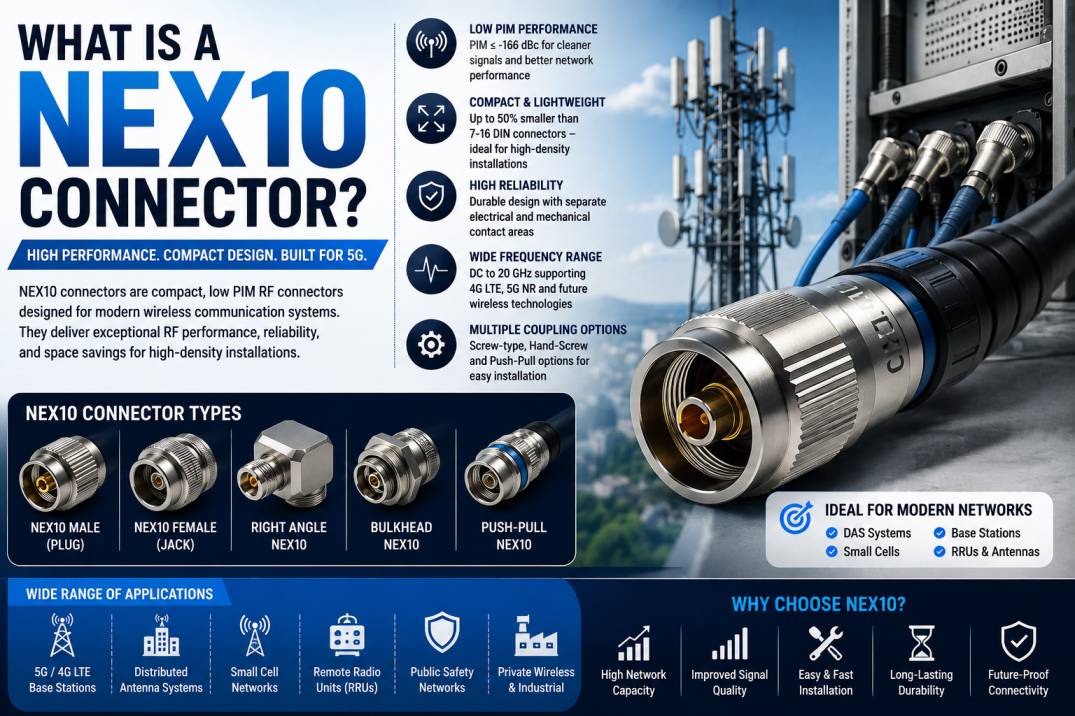
A NEX10 Connector is a compact RF coaxial connector designed for low Passive Intermodulation (PIM) performance, high-frequency operation, and high-density telecommunications installations.
The connector was jointly developed by leading RF connectivity manufacturers to meet the growing demands of:
- Mobile network infrastructure
- Distributed Antenna Systems (DAS)
- Small cell deployments
- Remote Radio Units (RRUs)
- Base stations
- Indoor wireless coverage systems
The NEX10 combines excellent RF performance with a significantly smaller footprint than traditional 7-16 DIN connectors while maintaining superior mechanical stability.
Why Was the NEX10 Connector Developed?
As cellular networks evolved from 2G and 3G to 4G LTE and 5G, network equipment became:
- More compact
- More complex
- Higher frequency
- Higher power
Traditional connectors often created challenges such as:
- Limited installation space
- Higher PIM levels
- Increased cable congestion
- Difficult maintenance
The NEX10 connector was developed to solve these issues by offering:
- Smaller size
- Excellent PIM performance
- Easier installation
- Improved reliability
This makes it particularly suitable for modern telecom infrastructure.
Understanding Passive Intermodulation (PIM)
To understand the importance of NEX10 connectors, it’s essential to understand Passive Intermodulation.
What Is PIM?
Passive Intermodulation occurs when two or more RF signals interact within passive components such as:
- Connectors
- Adapters
- Cables
- Antennas
These interactions create unwanted frequencies that interfere with communication systems.
Problems Caused by High PIM
- Reduced network capacity
- Poor call quality
- Lower data throughput
- Increased dropped calls
- Signal interference
The NEX10 connector is specifically designed to minimize PIM, making it ideal for modern LTE and 5G networks.
Key Features of the NEX10 Connector
Compact Design
One of the biggest advantages of the NEX10 connector is its small size.
Compared with traditional connectors:
- Approximately 50% smaller than 7-16 DIN connectors
- Reduced installation space
- Improved cable management
This enables higher equipment density in telecom cabinets and base stations.
Low PIM Performance
The NEX10 connector delivers exceptional passive intermodulation performance.
Typical values:
- Better than -166 dBc
- High network reliability
- Enhanced signal quality
This is critical for high-capacity cellular networks.
Excellent RF Performance
The connector supports frequencies up to:
- 20 GHz in many applications
Benefits include:
- Wide frequency compatibility
- Future-proof design
- Support for multiple technologies
Separate Electrical and Mechanical Contact Areas
A unique design feature of NEX10 connectors is the separation of electrical and mechanical interfaces.
Advantages:
- Improved reliability
- Consistent RF performance
- Reduced wear on electrical contacts
This enhances long-term performance.
Multiple Coupling Mechanisms
NEX10 connectors support various coupling options.
Screw-Type Coupling
Provides maximum security and stability.
Hand-Screw Coupling
Allows quick installation without special tools.
Push-Pull Coupling
Enables rapid deployment and maintenance.
This flexibility simplifies installation across different environments.
Construction of a NEX10 Connector
The NEX10 connector consists of several precision-engineered components.
Center Contact
The center contact carries RF signals.
Manufactured using:
- High-conductivity copper alloys
- Silver plating
- Gold plating
Benefits:
- Low resistance
- Excellent conductivity
- Reduced signal loss
Dielectric Insulator
Maintains electrical separation between conductors.
Functions:
- Impedance control
- Signal stability
- Electrical insulation
Materials commonly include PTFE (Teflon).
Outer Conductor
Provides:
- Grounding
- Shielding
- Mechanical support
The outer conductor helps minimize electromagnetic interference.
Coupling Mechanism
The coupling system secures the connector to mating equipment.
Provides:
- Stable connection
- Vibration resistance
- Long-term reliability
Technical Specifications of NEX10 Connectors
Although specifications vary by manufacturer, typical characteristics include:
| Parameter | Specification |
|---|---|
| Impedance | 50 Ohms |
| Frequency Range | DC to 20 GHz |
| Return Loss | Excellent |
| PIM Performance | ≤ -166 dBc |
| Operating Temperature | -55°C to +85°C |
| Coupling Options | Screw, Hand-Screw, Push-Pull |
| Application | Indoor and Outdoor |
These specifications make the connector suitable for demanding telecom applications.
Types of NEX10 Connectors
NEX10 Male Connector
Contains the center pin.
Typically installed on:
- RF cables
- Jumper assemblies
- Feeder cables
NEX10 Female Connector
Receives the male center pin.
Used on:
- Equipment ports
- Antennas
- RF devices
Straight NEX10 Connectors
Most common configuration.
Applications:
- Base stations
- DAS systems
- Antenna connections
Right-Angle NEX10 Connectors
Used where installation space is limited.
Benefits:
- Improved cable routing
- Reduced cable strain
- Compact installation
Advantages of NEX10 Connectors
Reduced Space Requirements
Modern telecom equipment often has limited space.
NEX10 connectors allow:
- Higher port density
- Better cable organization
- Compact system design
Improved Network Performance
Low PIM performance helps maintain:
- Better signal quality
- Higher data rates
- Improved network capacity
Easier Installation
Multiple coupling options reduce installation time.
Technicians can install connectors quickly and efficiently.
High Reliability
Designed for long service life in demanding environments.
Suitable for:
- Outdoor installations
- Telecom towers
- Harsh weather conditions
Future-Proof Technology
Supports:
- LTE
- LTE-Advanced
- 5G NR
- Private wireless networks
Applications of NEX10 Connectors
Cellular Base Stations
Widely used in modern macro and small cell deployments.
Supports:
- 4G LTE
- 5G infrastructure
- Massive MIMO systems
Distributed Antenna Systems (DAS)
Ideal for indoor coverage networks.
Common locations include:
- Airports
- Stadiums
- Shopping malls
- Hospitals
Small Cell Networks
The compact design is perfect for dense urban deployments.
Applications:
- Smart cities
- Enterprise networks
- Street-level wireless infrastructure
Remote Radio Units (RRUs)
NEX10 connectors are commonly found in:
- Radio heads
- Telecom cabinets
- Outdoor wireless equipment
Public Safety Networks
Used in communication systems for:
- Police departments
- Fire services
- Emergency responders
NEX10 Connector vs 7-16 DIN Connector
| Feature | NEX10 | 7-16 DIN |
|---|---|---|
| Size | Compact | Large |
| PIM Performance | Excellent | Excellent |
| Weight | Lower | Higher |
| Installation Density | High | Moderate |
| Installation Flexibility | Superior | Standard |
| Future 5G Deployment | Excellent | Limited |
NEX10 offers comparable performance with significantly smaller dimensions.
NEX10 Connector vs 4.3-10 Connector
| Feature | NEX10 | 4.3-10 |
|---|---|---|
| Physical Size | Smaller | Larger |
| Weight | Lower | Higher |
| High Density Applications | Excellent | Good |
| Small Cell Installations | Ideal | Suitable |
| PIM Performance | Excellent | Excellent |
For ultra-compact telecom installations, NEX10 often becomes the preferred choice.
Best Practices for NEX10 Connector Installation
Maintain Connector Cleanliness
Dust and contamination can affect RF performance.
Always use protective caps during storage.
Follow Proper Torque Specifications
Correct tightening ensures:
- Optimal electrical contact
- Low PIM performance
- Reliable operation
Avoid Excessive Cable Stress
Proper cable routing helps prevent mechanical damage.
Use Quality Cable Assemblies
Premium cable assemblies improve overall system performance.
Conduct PIM Testing
Verify connector performance after installation.
This helps identify installation issues before network activation.
Future of NEX10 Connector Technology
The demand for NEX10 connectors is expected to grow rapidly due to:
5G Expansion
5G deployments require:
- Compact hardware
- Low PIM performance
- High-frequency support
Smart Cities
Dense wireless infrastructure benefits from smaller connector footprints.
Private LTE and 5G Networks
Industrial communication systems increasingly adopt NEX10 solutions.
Edge Computing Infrastructure
Next-generation wireless networks require high-density RF connectivity.
Conclusion
The NEX10 Connector represents a major advancement in RF connectivity technology. Designed specifically for modern telecommunications infrastructure, it combines compact dimensions, excellent RF performance, low passive intermodulation, and exceptional reliability.
Its ability to support high-density installations while maintaining superior signal integrity makes it an ideal solution for LTE, 5G, DAS, small cell networks, remote radio units, and public safety communication systems.
As wireless networks continue evolving toward higher capacity, greater density, and more demanding performance requirements, NEX10 connectors will play an increasingly important role in enabling efficient, reliable, and future-ready communication infrastructure.