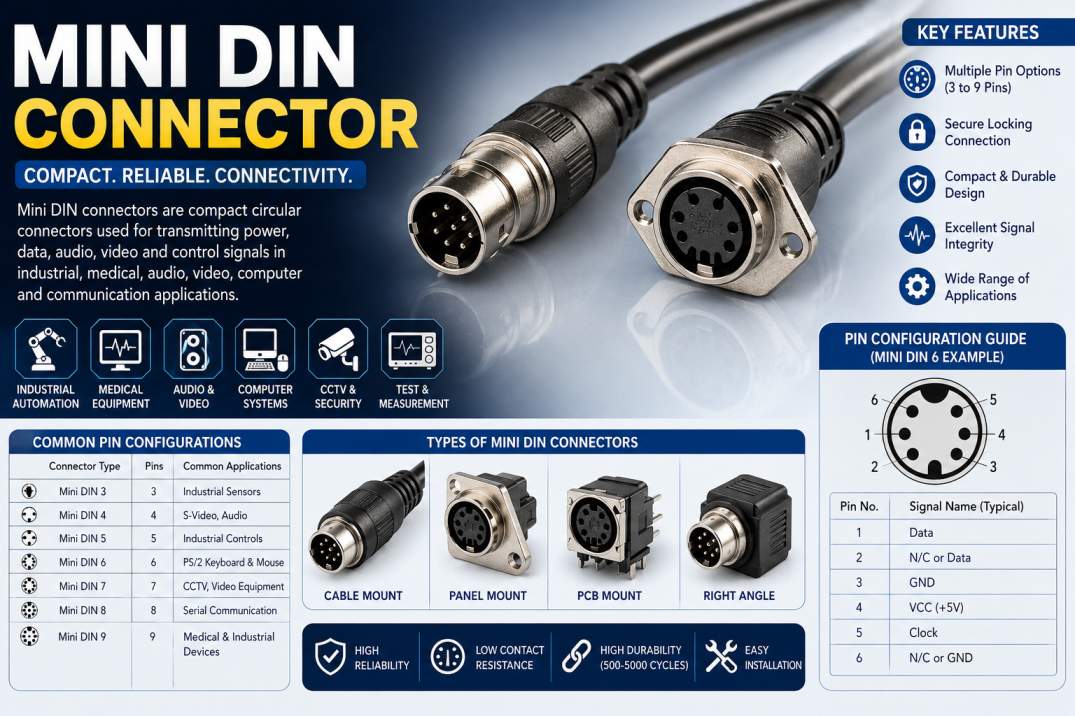
Mini DIN connectors are compact circular electrical connectors widely used for transmitting power, analog signals, digital data, audio, and video between electronic devices. Designed as a smaller version of the standard DIN connector, Mini DIN connectors became popular with the rapid growth of computers, telecommunications, industrial automation, consumer electronics, and medical equipment.
Although USB, HDMI, and USB-C have replaced Mini DIN connectors in many consumer devices, they remain widely used in industrial systems, legacy equipment, laboratory instruments, KVM switches, audio devices, CCTV systems, and medical electronics due to their reliability, secure locking mechanism, and compact design.
Mini DIN connectors are available with different pin configurations ranging from 3 to 9 pins, allowing engineers to transmit multiple electrical signals simultaneously through a single connector. Their standardized dimensions ensure compatibility between devices manufactured by different companies.
This comprehensive guide explains everything you need to know about Mini DIN connectors, including their construction, working principle, types, pin configurations, applications, specifications, advantages, and selection criteria.
What Is a Mini DIN Connector?
A Mini DIN Connector is a circular multi-pin electrical connector standardized under the German Deutsches Institut für Normung (DIN) specifications. It is a compact version of the traditional DIN connector designed for applications requiring reliable signal transmission in limited installation spaces.
Mini DIN connectors consist of precision metal contacts enclosed within a circular housing featuring a keyed design that prevents incorrect insertion. The connector securely locks into its mating socket, ensuring reliable electrical contact even in environments exposed to vibration.
Mini DIN connectors are commonly used for transmitting:
- Digital signals
- Analog signals
- Audio signals
- Video signals
- Control signals
- Power supply
- Data communication
How Does a Mini DIN Connector Work?
A Mini DIN connector works by establishing electrical contact between matching male and female connectors.
Each pin carries a dedicated electrical signal or power line. When the connector is inserted into the matching socket, every pin aligns precisely with its corresponding terminal, creating a secure electrical connection.
The keyed circular housing prevents incorrect orientation during installation, minimizing the risk of damaged pins or incorrect wiring.
Depending on the application, individual pins may carry:
- Power
- Ground
- Clock signals
- Data transmission
- Video signals
- Audio channels
- Control commands
- Sensor outputs
Construction of a Mini DIN Connector
Metal Contacts
The internal pins are manufactured using high-conductivity materials such as:
- Brass
- Copper alloy
- Phosphor bronze
- Gold-plated contacts
- Nickel-plated contacts
Gold plating provides excellent corrosion resistance and lower contact resistance.
Insulator
A molded plastic insulator separates individual contacts and prevents electrical short circuits.
Common materials include:
- Nylon
- PBT
- High-temperature thermoplastics
Connector Housing
The outer shell protects internal contacts and ensures mechanical stability.
Housing materials include:
- Nickel-plated steel
- Stainless steel
- High-strength plastic
- Aluminum alloy
Keying Slot
The keyed design allows insertion in only one orientation, preventing wiring errors.
Strain Relief
Many cable-mounted Mini DIN connectors include strain relief mechanisms that reduce cable stress during movement.
Mini DIN Connector Pin Configurations
Common Pin Configurations
| Connector Type | Number of Pins | Common Applications |
|---|---|---|
| Mini DIN 3 | 3 Pins | Industrial sensors |
| Mini DIN 4 | 4 Pins | S-Video, Audio |
| Mini DIN 5 | 5 Pins | Industrial controls |
| Mini DIN 6 | 6 Pins | PS/2 Keyboard & Mouse |
| Mini DIN 7 | 7 Pins | CCTV, Video equipment |
| Mini DIN 8 | 8 Pins | Serial communication |
| Mini DIN 9 | 9 Pins | Medical and industrial devices |
Most Popular Mini DIN Connectors
Mini DIN 4
Applications include:
- DVD players
- Televisions
- Video cameras
- Projectors
Mini DIN 6
Commonly used for:
- PS/2 keyboards
- PS/2 mouse
- Industrial controllers
- Legacy computer systems
Mini DIN 8
Frequently used in:
- Serial communication
- Industrial automation
- Laboratory equipment
- Medical electronics
Mini DIN Connector Specifications
| Specification | Typical Value |
|---|---|
| Contact Resistance | Less than 30 mΩ |
| Insulation Resistance | Greater than 1000 MΩ |
| Voltage Rating | 30V–250V |
| Current Rating | 1A–3A |
| Operating Temperature | -25°C to +85°C |
| Industrial Temperature | -55°C to +125°C |
| Mating Cycles | 500–5000 |
Mini DIN Connector Types
- Cable Mount
- Panel Mount
- PCB Mount
- Right Angle Connector
Applications of Mini DIN Connectors
Mini DIN connectors are widely used in:
- Computer systems
- Industrial automation
- Medical equipment
- Audio devices
- Video systems
- Telecommunications
- Test and measurement instruments
- Robotics
- Security systems
Advantages of Mini DIN Connectors
- Compact design
- Secure locking mechanism
- Reliable electrical connection
- Excellent durability
- Multiple pin configurations
- Low contact resistance
- High insulation resistance
- Cost-effective
- Long service life
- Easy installation
Limitations of Mini DIN Connectors
- Limited power handling
- Standard versions are not waterproof
- Replaced by USB-C in many consumer devices
- Requires correct alignment during insertion
How to Choose the Right Mini DIN Connector
When selecting a Mini DIN connector, consider:
- Number of pins
- Voltage rating
- Current rating
- Connector orientation
- Mounting type
- Cable diameter
- Shielding requirements
- Environmental conditions
- Operating temperature
- Mating cycle durability
Mini DIN Connector vs Standard DIN Connector
| Feature | Mini DIN Connector | Standard DIN Connector |
|---|---|---|
| Size | Compact | Larger |
| Pin Count | 3–9 Pins | 3–14 Pins |
| Applications | Computers, Medical, Industrial | Audio, Industrial |
| Installation Space | Small | Larger |
| Weight | Lightweight | Heavier |
| Consumer Electronics | Common | Less Common |
Mini DIN Connector Pin Configuration Chart
| Pin Count | Typical Use | Signal Type |
|---|---|---|
| 3 Pin | Sensors | Power & Signal |
| 4 Pin | S-Video | Video |
| 5 Pin | Industrial Controls | Signal |
| 6 Pin | PS/2 Devices | Data |
| 7 Pin | CCTV | Video |
| 8 Pin | Serial Communication | Data |
| 9 Pin | Medical Equipment | Mixed Signals |
Comparison Chart of Common Mini DIN Connectors
| Connector | Main Application | Advantages |
|---|---|---|
| Mini DIN 4 | S-Video | High-quality analog video |
| Mini DIN 6 | Keyboard & Mouse | Reliable data communication |
| Mini DIN 8 | Serial Devices | Multiple signal transmission |
| Mini DIN 9 | Medical Equipment | Supports complex signal routing |
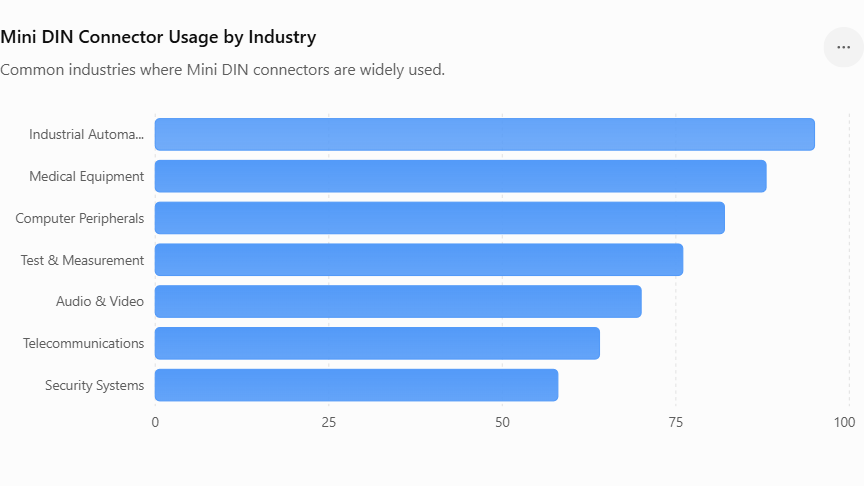
Mini DIN Connector Applications by Industry
Future Trends of Mini DIN Connectors
Although USB-C and Ethernet-based interfaces dominate many modern consumer applications, Mini DIN connectors continue to maintain a strong presence in industrial automation, medical electronics, laboratory instruments, aerospace systems, and legacy communication equipment. Future Mini DIN designs focus on higher durability, improved shielding, compact footprints, enhanced corrosion resistance, and ruggedized versions for harsh industrial environments.
Conclusion
Mini DIN connectors remain an essential solution for reliable signal and power transmission in industrial, medical, communication, and electronic systems. Their compact design, multiple pin configurations, standardized dimensions, secure locking mechanism, and excellent electrical performance make them ideal for applications where dependable connectivity is critical. Selecting the appropriate connector based on pin count, mounting style, voltage rating, current capacity, and environmental conditions ensures long-term reliability and optimal system performance.
Frequently Asked Questions (FAQs)
1. What is a Mini DIN connector?
A Mini DIN connector is a compact circular multi-pin connector used for transmitting power, data, audio, video, and control signals between electronic devices.
2. What are Mini DIN connectors used for?
They are commonly used in PS/2 keyboards, computer mice, S-Video devices, industrial automation, medical equipment, laboratory instruments, and communication systems.
3. How many pins can a Mini DIN connector have?
Mini DIN connectors are commonly available with 3, 4, 5, 6, 7, 8, and 9 pins.
4. What is the difference between DIN and Mini DIN connectors?
Mini DIN connectors are smaller versions of standard DIN connectors while providing similar functionality in a more compact size.
5. What is the most common Mini DIN connector?
The 6-pin Mini DIN connector is the most popular because it was widely used for PS/2 keyboards and mice.
6. Are Mini DIN connectors waterproof?
Standard Mini DIN connectors are not waterproof, but IP-rated sealed versions are available for industrial applications.
7. What materials are used in Mini DIN connector contacts?
Most contacts are made from brass, phosphor bronze, or copper alloy with gold or nickel plating.
8. How long do Mini DIN connectors last?
High-quality Mini DIN connectors are typically rated for 500 to 5,000 mating cycles.
9. Can Mini DIN connectors carry power?
Yes. Many Mini DIN connectors transmit low-voltage power along with data or control signals.
10. How do I choose the right Mini DIN connector?
Select a connector based on the required pin count, voltage rating, current capacity, mounting type, operating environment, shielding requirements, and durability.