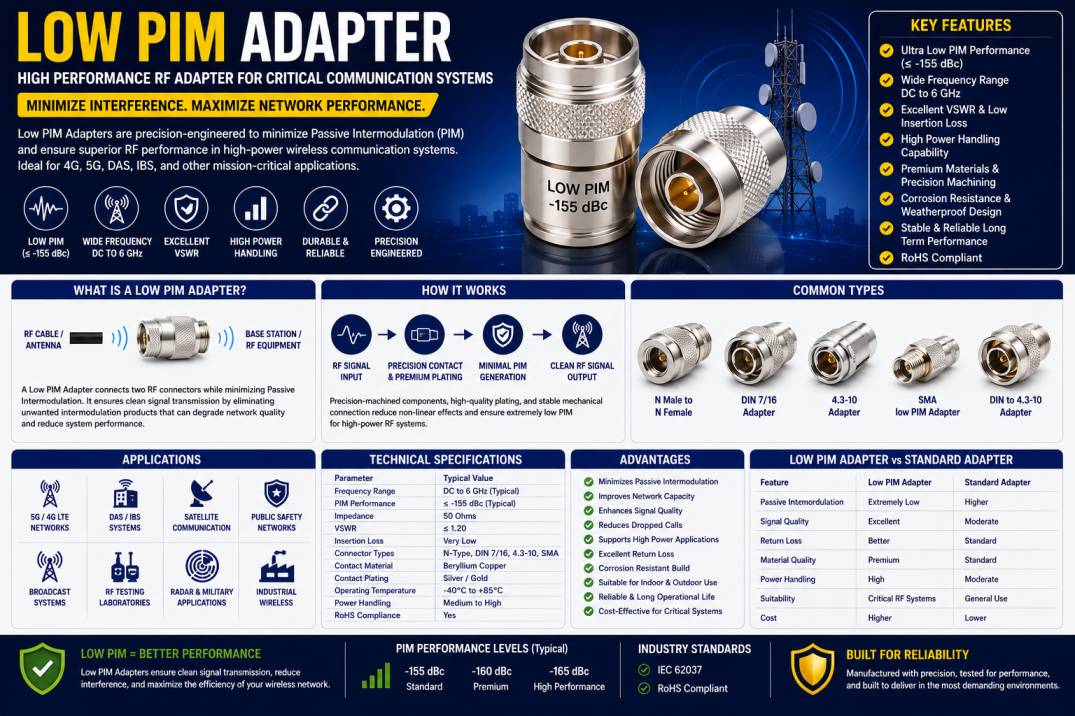
A Low PIM Adapter is a specialized RF (Radio Frequency) connector adapter engineered to minimize Passive Intermodulation (PIM) in high-frequency communication systems. As modern wireless networks such as 4G LTE, 5G, DAS (Distributed Antenna Systems), IBS (In-Building Solutions), public safety networks, and satellite communication continue to demand higher signal quality and network capacity, Low PIM adapters have become essential components for maintaining reliable RF performance.
Passive Intermodulation occurs when high-power RF signals interact with imperfect metallic contacts, contaminated connectors, or poor-quality materials, generating unwanted interference frequencies. These unwanted signals can significantly reduce network efficiency, lower data speeds, increase dropped calls, and degrade overall communication quality.
Low PIM Adapters are precision-manufactured using premium materials, high-quality plating, and advanced machining techniques to reduce nonlinear electrical effects and maintain outstanding signal integrity. They are widely used by telecom operators, system integrators, RF engineers, and network installers in critical communication infrastructure.
This comprehensive guide explains everything about Low PIM Adapters, including their construction, working principle, specifications, applications, advantages, and selection criteria.
What Is a Low PIM Adapter?
A Low PIM Adapter is a precision RF adapter designed to connect two different RF connectors while generating extremely low levels of passive intermodulation. It ensures high-quality RF signal transmission by minimizing unwanted nonlinear signal distortion caused by poor electrical contact or inferior connector materials.
These adapters are commonly used between antennas, RF cables, base stations, distributed antenna systems, and wireless communication equipment where maintaining low signal interference is critical.
Most Low PIM adapters are tested according to industry standards and offer PIM performance values better than -155 dBc, with premium models achieving -160 dBc or lower.
What Is Passive Intermodulation (PIM)?
Passive Intermodulation (PIM) is unwanted signal interference created when two or more high-power RF signals pass through passive components with nonlinear electrical characteristics.
PIM can be caused by:
- Loose RF connectors
- Poor-quality metal surfaces
- Corrosion
- Dirt or contamination
- Damaged connectors
- Inconsistent plating
- Mechanical stress
- Poor manufacturing quality
These nonlinearities generate additional frequencies that interfere with the desired communication signals.
How Does a Low PIM Adapter Work?
A Low PIM Adapter creates a highly stable electrical connection between two RF interfaces while minimizing nonlinear signal generation.
The operation includes:
- RF signal enters the adapter.
- Precision-machined contacts maintain uniform conductivity.
- High-quality plating reduces electrical resistance.
- Stable impedance minimizes reflections.
- The RF signal exits with extremely low PIM generation.
By eliminating microscopic electrical discontinuities, the adapter significantly improves network performance.
Construction of a Low PIM Adapter
Connector Body
The connector body is manufactured from precision-machined materials such as:
- Brass
- Stainless Steel
- Beryllium Copper
These materials provide excellent conductivity and long-term mechanical stability.
Center Contact
The center conductor carries the RF signal.
Common materials include:
- Beryllium Copper
- Phosphor Bronze
- Brass
The contact is usually gold-plated or silver-plated to reduce resistance.
Dielectric Insulator
The dielectric separates the center conductor from the outer conductor.
Common materials include:
- PTFE
- Teflon
- High-performance polymers
These materials provide stable electrical insulation across a wide temperature range.
Precision Plating
Premium plating materials include:
- Silver
- Gold
- Tri-metal plating
These finishes reduce oxidation and improve electrical conductivity.
Threaded Coupling
Most Low PIM adapters use precision-threaded interfaces to ensure consistent mechanical pressure and stable electrical contact.
Technical Specifications
| Specification | Typical Value |
|---|---|
| Characteristic Impedance | 50 Ohms |
| Frequency Range | DC to 6 GHz (Typical) |
| PIM Performance | ≤ -155 dBc |
| VSWR | ≤ 1.20 |
| Insertion Loss | Very Low |
| Connector Types | DIN 7/16, 4.3-10, N-Type, SMA |
| Contact Material | Beryllium Copper |
| Contact Plating | Silver / Gold |
| Operating Temperature | -40°C to +85°C |
| RoHS Compliance | Yes |
Key Features of Low PIM Adapters
- Extremely low passive intermodulation
- Precision machining
- Excellent impedance matching
- Low insertion loss
- High power handling
- Stable RF performance
- Corrosion-resistant construction
- High-quality plating
- Excellent return loss
- Weather-resistant design
- Long service life
- Reliable mechanical connection
Common Types of Low PIM Adapters
N Male to N Female Adapter
Used for extending N-Type RF connections.
DIN 7/16 Adapter
Commonly used in macro cellular base stations.
4.3-10 Adapter
Designed for modern LTE and 5G infrastructure.
SMA Low PIM Adapter
Suitable for laboratory testing and compact RF systems.
DIN to 4.3-10 Adapter
Provides compatibility between legacy and modern telecom equipment.
Custom Low PIM Adapter
Manufactured for specialized RF connector combinations.
Applications of Low PIM Adapters
Cellular Base Stations
Supports LTE, 5G, and future wireless communication networks.
Distributed Antenna Systems (DAS)
Improves indoor wireless coverage while minimizing signal interference.
In-Building Solutions (IBS)
Provides reliable RF connections inside commercial buildings.
5G Infrastructure
Supports high-capacity wireless communication equipment.
Public Safety Networks
Ensures reliable communication for emergency services.
Satellite Communication
Maintains clean RF transmission in satellite ground stations.
Broadcast Systems
Supports radio and television transmission equipment.
RF Laboratories
Used in:
- Network analyzers
- Spectrum analyzers
- RF measurement systems
Military Communication
Supports secure communication and radar systems.
Industrial Wireless Networks
Provides stable RF performance for industrial communication systems.
Advantages of Low PIM Adapters
- Minimizes passive intermodulation
- Improves network capacity
- Enhances signal quality
- Reduces dropped calls
- Supports high-power RF systems
- Excellent mechanical durability
- Stable long-term performance
- Low maintenance
- High corrosion resistance
- Better return loss
- Increased network efficiency
- Long operational life
Limitations of Low PIM Adapters
- Higher cost than standard adapters
- Requires proper installation torque
- Performance depends on connector cleanliness
- Damaged connectors may increase PIM
- Premium materials increase manufacturing cost
How to Choose the Right Low PIM Adapter
When selecting a Low PIM Adapter, consider the following:
- Connector type
- Frequency range
- PIM rating
- Characteristic impedance
- VSWR
- Power handling
- Environmental conditions
- Material quality
- Connector plating
- Industry certifications
Low PIM Adapter vs Standard RF Adapter
| Feature | Low PIM Adapter | Standard RF Adapter |
|---|---|---|
| Passive Intermodulation | Extremely Low | Higher |
| Signal Quality | Excellent | Moderate |
| Return Loss | Better | Standard |
| Material Quality | Premium | Standard |
| Cost | Higher | Lower |
| Telecom Performance | Excellent | General Purpose |
Industries Using Low PIM Adapters
Low PIM Adapters are widely used in:
- Telecommunications
- 5G Infrastructure
- Cellular Networks
- Satellite Communication
- Broadcasting
- Defense
- Public Safety
- Industrial Automation
- RF Laboratories
- Transportation Networks
Maintenance Tips
To maximize performance:
- Keep connectors clean and free from dust.
- Use the recommended torque during installation.
- Avoid over-tightening.
- Inspect connectors for corrosion.
- Replace damaged adapters immediately.
- Protect outdoor installations from moisture.
- Periodically test PIM performance.
Future Trends of Low PIM Adapters
The deployment of 5G Advanced, Open RAN, private 5G, and future 6G networks is driving the demand for increasingly lower PIM performance. Manufacturers are developing adapters with advanced alloys, precision CNC machining, superior plating technologies, and enhanced weatherproof designs. Future Low PIM Adapters will support higher frequencies, improved environmental durability, and stricter network performance requirements to meet the needs of next-generation wireless communication systems.
Conclusion
Low PIM Adapters are critical components in modern RF communication systems where minimizing passive intermodulation is essential for maintaining signal quality and network efficiency. Their precision construction, premium materials, excellent impedance matching, and extremely low PIM performance make them indispensable in 4G LTE, 5G, DAS, IBS, satellite communication, broadcasting, and defense applications. Selecting the right Low PIM Adapter based on connector type, frequency range, PIM rating, and installation environment ensures reliable RF performance and long-term network stability.
Frequently Asked Questions (FAQs)
1. What is a Low PIM Adapter?
A Low PIM Adapter is a precision RF connector adapter designed to minimize passive intermodulation while connecting two RF interfaces in high-frequency communication systems.
2. What does Low PIM mean?
Low PIM refers to passive RF components that generate extremely low levels of passive intermodulation, reducing unwanted signal interference in wireless networks.
3. Why is a Low PIM Adapter important?
It improves signal quality, reduces interference, increases network capacity, minimizes dropped calls, and enhances the performance of LTE and 5G communication systems.
4. What causes Passive Intermodulation (PIM)?
PIM is caused by loose connectors, poor-quality materials, corrosion, contamination, damaged contacts, inconsistent plating, and nonlinear electrical junctions.
5. What is a typical PIM rating for a Low PIM Adapter?
Most high-quality Low PIM Adapters provide a PIM rating of -155 dBc or better, while premium models can achieve -160 dBc or lower.
6. Which connector types are available in Low PIM Adapters?
Common connector types include N-Type, DIN 7/16, 4.3-10, SMA, and custom RF connector combinations.
7. Where are Low PIM Adapters commonly used?
They are widely used in cellular base stations, 5G infrastructure, distributed antenna systems (DAS), in-building solutions (IBS), satellite communication, broadcasting, defense, and RF laboratories.
8. What are the advantages of using a Low PIM Adapter?
They offer low passive intermodulation, excellent RF performance, high power handling, low insertion loss, improved return loss, corrosion resistance, and long service life.
9. Can Low PIM Adapters be used outdoors?
Yes. Many Low PIM Adapters are manufactured with weather-resistant materials and corrosion-resistant plating, making them suitable for outdoor telecom installations.
10. How do I choose the right Low PIM Adapter?
Choose a Low PIM Adapter based on connector type, operating frequency, PIM rating, impedance, VSWR, power handling, environmental conditions, material quality, and compatibility with your RF communication system.