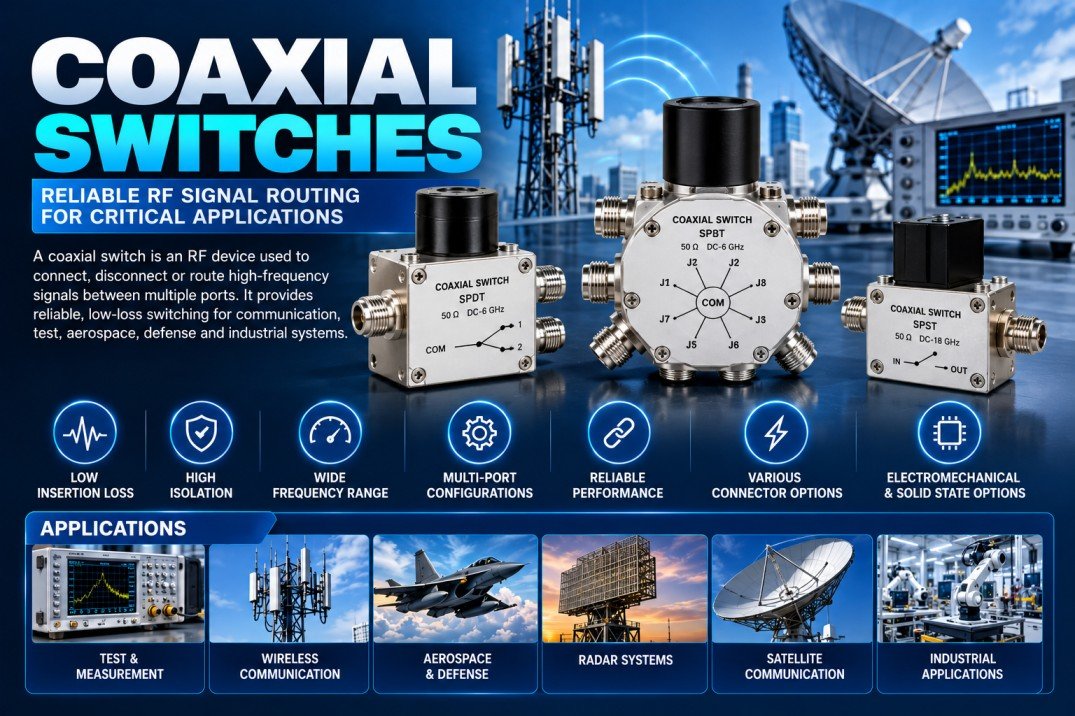
A coaxial switch is an RF and microwave switching device used to control the path of high-frequency signals between multiple ports. It allows an RF signal to be connected, disconnected, or redirected from one transmission path to another without manually changing cables or connectors.
Coaxial switches are widely used in RF communication systems, test and measurement equipment, antenna systems, radar, aerospace, defense, wireless networks, and laboratory applications. They are designed to maintain signal integrity while providing reliable switching between different RF circuits.
What Is a Coaxial Switch?
A coaxial switch is an electromechanical or solid-state RF device that changes the connection between coaxial ports according to a control signal. Unlike a conventional electrical switch, an RF coaxial switch must maintain controlled impedance and minimize unwanted signal loss and reflection.
A typical coaxial switch includes:
- RF input and output ports
- Internal switching mechanism
- RF contacts
- Control interface
- Housing or enclosure
- Actuation mechanism
- Coaxial transmission path
The switch can be configured to connect one RF signal to another path, select between multiple signal sources, or route signals toward different loads.
How Does a Coaxial Switch Work?
The basic operating principle of a coaxial switch is signal routing. When a control command is applied, the internal switching mechanism changes the electrical connection between the RF ports.
For example, in a simple SPDT configuration, one common RF port can be connected to either Port 1 or Port 2.
When the switch is in one position:
Common Port → Port 1
After switching:
Common Port → Port 2
The switching mechanism must maintain the RF transmission characteristics of the system. This means the switch should provide low insertion loss, good isolation, controlled impedance, and low VSWR.
Types of Coaxial Switches
Coaxial switches are available in different configurations depending on the number of RF ports and switching requirements.
SPST Coaxial Switch
A Single Pole Single Throw switch provides a basic ON/OFF switching function. It can connect or disconnect an RF transmission path.
SPDT Coaxial Switch
A Single Pole Double Throw switch has one common port and two selectable ports. It is commonly used when an RF signal needs to be routed between two different paths.
DPDT Coaxial Switch
A Double Pole Double Throw configuration allows two independent RF paths to be switched between different connections. It can be useful in more complex RF routing systems.
Multi-Throw Coaxial Switch
Multi-throw switches provide one common port with multiple selectable RF outputs. They are useful for selecting different antennas, test devices, signal paths, or RF sources.
Multi-Port Coaxial Switch
Multi-port configurations are designed for systems requiring multiple RF routing combinations. These switches are frequently used in automated RF test systems and switching matrices.
Electromechanical Coaxial Switch
Electromechanical coaxial switches use physical contacts to establish the RF connection. An actuator moves the internal mechanism between switching positions.
Their major advantages include:
- High isolation
- Low insertion loss
- Excellent RF performance
- Reliable signal routing
- Broad frequency capability depending on design
Electromechanical switches are particularly useful in test and measurement systems where accurate RF switching is required.
Solid-State Coaxial Switch
Solid-state RF switches use semiconductor technology instead of mechanical contacts. They can provide extremely fast switching speeds and are useful in applications requiring rapid signal routing.
However, the appropriate switch technology depends on the required frequency, power handling, isolation, insertion loss, switching speed, and system architecture.
Key Specifications of Coaxial Switches
Selecting a coaxial switch requires evaluating several RF and mechanical specifications.
| Specification | Importance |
|---|---|
| Frequency Range | Determines the supported RF operating range |
| Impedance | Usually 50 Ohms in RF systems |
| Insertion Loss | Indicates signal loss through the switch |
| Isolation | Indicates unwanted signal separation between ports |
| VSWR | Indicates impedance matching |
| Return Loss | Indicates reflected signal performance |
| Power Handling | Defines maximum RF power capability |
| Switching Speed | Determines how quickly the RF path changes |
| Switching Life | Indicates expected switching cycles |
| Connector Type | Determines system integration |
| Control Voltage | Defines electrical control requirements |
Actual specifications vary according to the switch design and manufacturer.
Why Is Insertion Loss Important?
Insertion loss is one of the most important characteristics of an RF coaxial switch. It represents the amount of signal power lost when the RF signal passes through the switch.
Lower insertion loss is generally preferred because excessive loss can reduce system efficiency and signal strength.
In applications involving sensitive RF measurements, even a small amount of additional loss can influence measurement accuracy. Therefore, the switch should be selected according to the frequency and signal-level requirements of the system.
Importance of Isolation
Isolation describes how effectively the switch prevents an RF signal from leaking from one inactive port into another active or isolated port.
High isolation is particularly important when multiple RF sources or receivers operate within the same switching system.
Poor isolation can result in:
- Signal interference
- Crosstalk
- Measurement errors
- Unwanted RF coupling
- Reduced system performance
For high-performance RF switching applications, isolation should therefore be considered alongside insertion loss and VSWR.
Coaxial Switch Connectors
Coaxial switches are available with different connector interfaces depending on the application and frequency range.
Common connector options include:
- SMA
- N Type
- BNC
- TNC
- 2.92 mm
- 2.4 mm
- 1.85 mm
- 7/16 DIN
- Other specialized RF interfaces
The connector should be selected based on frequency, power, mechanical requirements, and compatibility with the existing RF infrastructure.
Applications of Coaxial Switches
RF Test and Measurement
Coaxial switches are extensively used in automated test equipment. They allow test systems to route signals between multiple devices without manually reconnecting cables.
Antenna Testing
An RF switch can select different antennas or antenna ports during testing. This is useful for antenna characterization and communication-system testing.
Wireless Communication
Coaxial switches are used in wireless communication equipment to route RF signals between different circuits, antennas, filters, and radio modules.
Aerospace and Defense
Radar, electronic warfare, satellite communication, and defense electronics can require highly reliable RF signal routing. Coaxial switches help automate and control these signal paths.
Radar Systems
Radar systems may use RF switches to control signal routing between transmit, receive, test, and monitoring circuits.
Satellite Communication
RF switching components can be used in satellite communication equipment for signal routing, redundancy, testing, and subsystem control.
RF Laboratories
Research and development laboratories use coaxial switches to simplify complex RF test setups and automate measurement sequences.
Manufacturing Test Systems
Automated production testing can use RF switching matrices to test multiple devices with a common RF test platform.
Advantages of Coaxial Switches
A properly selected coaxial switch provides several benefits:
- Automated RF signal routing
- Reduced need for manual cable changes
- Compact system integration
- Reliable switching operation
- Low insertion loss options
- High isolation options
- Multiple-port configurations
- Improved test-system automation
- Reduced setup time
- Consistent RF connections
How to Select the Right Coaxial Switch
Choosing the right coaxial switch requires matching its specifications with the requirements of the RF system.
1. Determine Frequency
First identify the highest operating frequency. The selected switch should support the complete frequency range of the application.
2. Check RF Power
Verify the maximum RF power that the switch must handle. Power capability can vary considerably between switch models.
3. Select the Configuration
Determine whether the application requires SPST, SPDT, DPDT, multi-throw, or multi-port switching.
4. Evaluate RF Performance
Check insertion loss, isolation, VSWR, and return loss to ensure the switch meets system performance requirements.
5. Consider Switching Speed
For automated or fast-switching systems, switching speed and settling time may be important.
6. Check Switching Life
For systems that operate continuously or switch frequently, mechanical switching life should be considered.
7. Verify Connector Compatibility
Ensure the switch connectors match the RF cables, adapters, and equipment used in the system.
Coaxial Switch vs Conventional Electrical Switch
A conventional electrical switch is not necessarily suitable for high-frequency RF signals. RF systems require controlled impedance, shielding, low reflection, and predictable transmission characteristics.
A coaxial switch is specifically engineered to maintain the RF transmission path and minimize signal degradation.
This makes coaxial switches particularly valuable in high-frequency communication, microwave, and measurement systems.
Conclusion
A coaxial switch is an essential RF component for controlling and routing high-frequency signals between multiple transmission paths. It provides a practical way to automate RF connections while maintaining important characteristics such as impedance, insertion loss, isolation, and VSWR.
From wireless communication and antenna testing to aerospace, defense, radar, satellite communication, and automated test equipment, coaxial switches provide reliable and flexible RF signal management.
When selecting a coaxial switch, always consider frequency range, RF power handling, switching configuration, insertion loss, isolation, VSWR, switching speed, connector type, and switching life. Choosing the correct specifications ensures dependable RF performance and long-term system reliability.
FAQs About Coaxial Switches
1. What is a coaxial switch?
A coaxial switch is an RF component used to connect, disconnect, or redirect high-frequency signals between different coaxial ports.
2. What is the main purpose of a coaxial switch?
Its main purpose is to control RF signal routing between multiple transmission paths without manually changing cables.
3. What is an SPDT coaxial switch?
An SPDT coaxial switch has one common port and two selectable ports, allowing one RF signal path to be switched between two destinations.
4. Where are coaxial switches used?
They are used in RF test equipment, wireless communication, radar, antenna systems, aerospace, defense, satellite communication, and automated manufacturing test systems.
5. What is insertion loss in a coaxial switch?
Insertion loss is the amount of RF signal power lost when the signal passes through the switch.
6. Why is isolation important in an RF switch?
High isolation helps prevent unwanted RF signals from leaking between inactive and active ports, reducing interference and crosstalk.
7. Are coaxial switches available for different frequencies?
Yes. Coaxial switches are designed for different frequency ranges, from lower RF frequencies to microwave and higher-frequency applications.
8. What connectors are available for coaxial switches?
Depending on the design, coaxial switches can be available with SMA, N Type, BNC, TNC, 2.92 mm, 2.4 mm, 1.85 mm, and other RF connectors.
9. What factors should be considered when selecting a coaxial switch?
Important factors include frequency range, impedance, power handling, insertion loss, isolation, VSWR, switching speed, switching life, configuration, and connector type.
10. What is the difference between an RF coaxial switch and a normal switch?
An RF coaxial switch is specifically designed to maintain controlled impedance and RF signal integrity at high frequencies, while a conventional electrical switch may not provide suitable RF performance.