
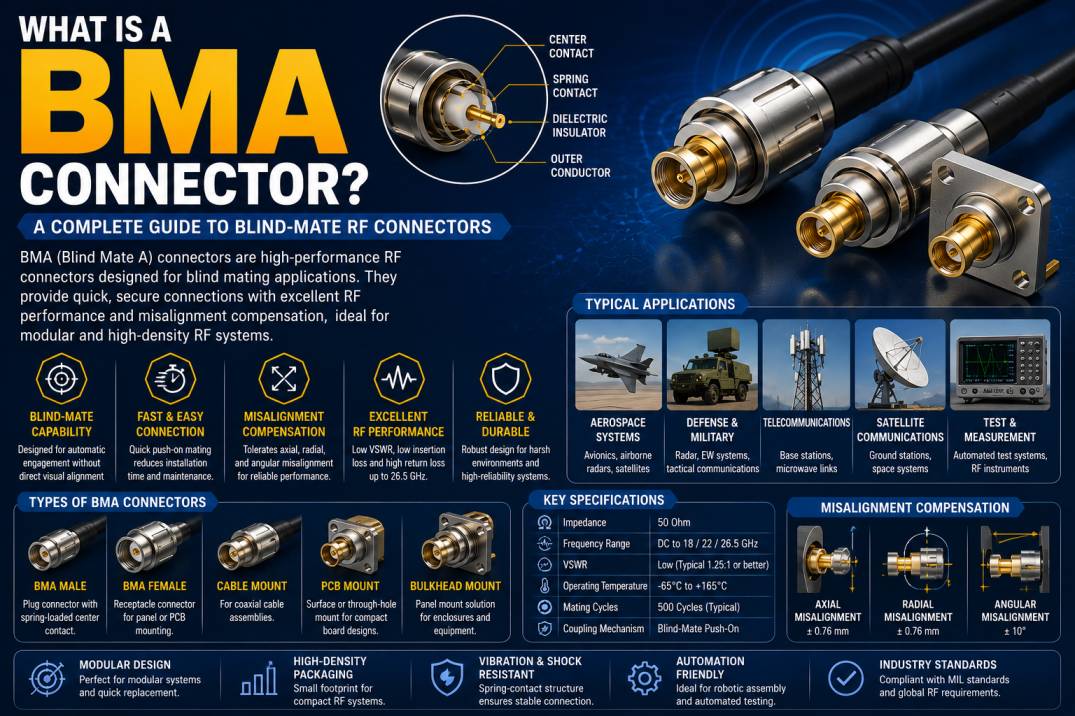
As RF and microwave communication systems become increasingly compact and sophisticated, the need for high-performance connectors that support quick installation, reliable electrical performance, and automated assembly has grown significantly. Industries such as telecommunications, aerospace, defense, satellite communications, radar systems, and test & measurement equipment require RF interconnect solutions that can maintain signal integrity while simplifying installation and maintenance.
One such solution is the BMA Connector.
The BMA (Blind Mate A) Connector is a specialized RF coaxial connector designed for applications where direct visual alignment during mating is difficult or impossible. Unlike traditional threaded connectors such as SMA or TNC, BMA connectors feature a blind-mate coupling mechanism that allows fast and reliable connections without requiring manual alignment.
Because of their compact size, excellent RF performance, and ability to compensate for mechanical misalignment, BMA connectors have become widely used in modular RF systems, military electronics, telecommunications infrastructure, and aerospace equipment.
In this comprehensive guide, we will explore what a BMA connector is, how it works, its construction, types, specifications, advantages, applications, and how to select the right BMA connector for your RF system.
What Is a BMA Connector?
A BMA Connector is a miniature RF coaxial connector specifically designed for blind mating applications, where connectors must engage automatically without direct operator visibility.
The term BMA stands for:
Blind Mate A Connector
Unlike threaded connectors that require manual tightening, BMA connectors use a spring-loaded coupling system that enables quick connection and disconnection while maintaining excellent RF performance.
These connectors are commonly used in systems where equipment modules need to be inserted, removed, or replaced quickly without requiring access to the rear of the assembly.
BMA connectors are widely found in:
- Aerospace systems
- Defense electronics
- Radar equipment
- Satellite communication systems
- Telecommunications infrastructure
- RF testing equipment
- Modular microwave assemblies
Their ability to support high-frequency operation while allowing blind mating makes them highly valuable in modern RF system design.
History and Development of BMA Connectors
Traditional RF connectors such as:
- SMA
- TNC
- N-Type
- BNC
offer excellent electrical performance but require precise alignment and manual engagement.
As military, aerospace, and telecommunications systems became more modular, engineers needed a connector capable of:
- Fast connection
- Blind mating capability
- Misalignment compensation
- Reliable RF performance
The BMA connector was developed to address these challenges.
Its innovative spring-contact design enables connectors to mate successfully even when small alignment variations exist.
Today, BMA connectors remain an important solution for modular RF and microwave systems.
How Does a BMA Connector Work?
A BMA connector utilizes a spring-loaded blind-mate mechanism.
Signal Transmission
The center conductor carries RF signals between connected devices.
Blind Mating
The connector automatically aligns during insertion.
Misalignment Compensation
The design tolerates:
- Axial misalignment
- Radial misalignment
- Angular misalignment
Secure Electrical Contact
Spring-loaded contacts maintain consistent RF performance.
This unique design enables reliable connections without direct visual access.
Construction of a BMA Connector
BMA connectors are manufactured using precision RF engineering techniques.
Center Contact
The center conductor transmits RF energy.
Common materials include:
- Beryllium copper
- Gold-plated copper alloys
Benefits include:
- High conductivity
- Corrosion resistance
- Long-term reliability
Dielectric Insulator
The dielectric separates conductive elements.
Common materials:
- PTFE (Teflon)
- High-performance polymers
Functions:
- Electrical insulation
- Impedance control
- Signal stability
Outer Conductor
Provides:
- RF shielding
- Mechanical support
- Ground continuity
Manufactured from:
- Brass
- Stainless steel
- Gold-plated alloys
Spring Mechanism
One of the defining features of BMA connectors.
Advantages include:
- Blind mating capability
- Misalignment compensation
- Reliable electrical contact
Key Features of BMA Connectors
Blind Mate Capability
The primary advantage of BMA connectors.
Allows equipment modules to connect automatically during installation.
Compact Size
Suitable for high-density RF systems.
Benefits include:
- Reduced space requirements
- Lightweight assemblies
- Increased equipment density
High Frequency Performance
Most BMA connectors support frequencies up to:
- 18 GHz
- 22 GHz
- 26.5 GHz
Depending on design and manufacturer specifications.
Quick Connect and Disconnect
No threaded coupling is required.
Benefits:
- Faster maintenance
- Reduced installation time
- Improved serviceability
Misalignment Compensation
Supports:
- Radial movement
- Angular offset
- Axial tolerance
This significantly simplifies equipment integration.
Electrical Specifications of BMA Connectors
Specifications vary by manufacturer, but typical values include:
| Parameter | Typical Value |
|---|---|
| Impedance | 50 Ohm |
| Frequency Range | DC to 18 GHz+ |
| Coupling Method | Blind Mate |
| VSWR | Low |
| Return Loss | Excellent |
| Operating Temperature | -65°C to +165°C |
These characteristics make BMA connectors suitable for demanding RF and microwave applications.
Types of BMA Connectors
BMA Male Connector
Features:
- Male contact interface
- Spring-loaded design
Used in cable assemblies and RF modules.
BMA Female Connector
Provides the mating receptacle.
Commonly found in:
- RF equipment
- Microwave systems
- Telecommunications hardware
Cable Mount BMA Connector
Designed for coaxial cable termination.
Applications include:
- RF cable assemblies
- Test systems
- Communication equipment
PCB Mount BMA Connector
Used directly on printed circuit boards.
Benefits:
- Space efficiency
- Reliable PCB integration
Bulkhead BMA Connector
Allows mounting through panels and enclosures.
Applications include:
- RF cabinets
- Communication shelters
- Modular equipment
Advantages of BMA Connectors
Fast Installation
Blind mating significantly reduces installation time.
Simplified Maintenance
Modules can be replaced quickly without connector adjustments.
Excellent RF Performance
Provides:
- Low insertion loss
- Stable impedance
- High return loss
High Reliability
Designed for demanding environments.
Supports Modular Design
Ideal for modern equipment architectures.
Reduced Human Error
Automatic alignment reduces installation mistakes.
Applications of BMA Connectors
Aerospace Industry
Used extensively in:
- Aircraft communication systems
- Avionics equipment
- Satellite payloads
Their compact size and blind-mate capability make them ideal for aerospace platforms.
Defense and Military
Critical applications include:
- Radar systems
- Electronic warfare equipment
- Tactical communication systems
Military systems often require quick module replacement in field environments.
Telecommunications
Used in:
- Base station equipment
- Microwave communication systems
- RF distribution networks
Satellite Communication
Applications include:
- Ground stations
- Satellite modules
- Communication payloads
Test and Measurement
Commonly used in:
- RF test systems
- Network analyzers
- Automated testing equipment
Industrial RF Systems
Found in:
- Communication infrastructure
- Industrial automation
- Monitoring systems
BMA Connector vs SMA Connector
| Feature | BMA Connector | SMA Connector |
|---|---|---|
| Coupling Method | Blind Mate | Threaded |
| Installation Speed | Fast | Moderate |
| Blind Mating | Yes | No |
| Misalignment Tolerance | Excellent | Limited |
| Frequency Range | High | High |
| Maintenance | Easier | Standard |
BMA connectors are preferred where rapid installation and modularity are priorities.
BMA Connector vs SMP Connector
| Feature | BMA | SMP |
|---|---|---|
| Blind Mating | Excellent | Good |
| Mechanical Tolerance | High | Moderate |
| Installation Speed | Fast | Fast |
| Modular Systems | Excellent | Excellent |
| Frequency Capability | Up to 26.5 GHz | Up to 40 GHz+ |
Both connectors support advanced RF systems but serve slightly different application requirements.
How to Choose the Right BMA Connector
Determine Frequency Requirements
Select a connector rated for your operating frequency.
Examples:
- 18 GHz
- 22 GHz
- 26.5 GHz
Evaluate Mechanical Tolerances
Consider expected misalignment during installation.
Verify Mounting Requirements
Options include:
- Cable mount
- PCB mount
- Bulkhead mount
Consider Environmental Conditions
Applications may require:
- Corrosion resistance
- Temperature stability
- Vibration tolerance
Ensure System Compatibility
Confirm compatibility with:
- RF modules
- Test equipment
- Existing connector interfaces
Installation Best Practices
Maintain Clean Interfaces
Dust and contamination can affect RF performance.
Avoid Excessive Mechanical Stress
Protect connectors from unnecessary force.
Inspect Regularly
Check for:
- Contact wear
- Mechanical damage
- Corrosion
Follow Manufacturer Guidelines
Use recommended mating procedures.
Verify Electrical Performance
Perform RF testing after installation.
Future Trends in BMA Connector Technology
Growth of Modular RF Systems
Modern communication equipment increasingly uses modular architectures.
Expansion of Aerospace Programs
Advanced aircraft and satellite systems continue driving demand.
Development of 5G and 6G Networks
Telecommunications infrastructure requires compact RF interconnect solutions.
Increasing Automation
Blind-mate connectors support automated manufacturing and maintenance.
Miniaturization of Electronics
Smaller devices continue increasing demand for compact RF connectivity.
Key Takeaways
- BMA stands for Blind Mate A Connector.
- Designed specifically for blind-mating RF applications.
- Supports fast installation and module replacement.
- Provides excellent RF performance.
- Compensates for alignment variations.
- Commonly used in aerospace, defense, telecom, and satellite systems.
- Supports frequencies up to 18 GHz, 22 GHz, and 26.5 GHz.
- Ideal for modular RF architectures.
Conclusion
The BMA Connector is a highly specialized RF interconnect solution engineered for blind-mate applications where speed, reliability, and installation simplicity are essential. By combining excellent RF performance with automatic alignment and misalignment compensation capabilities, BMA connectors enable modern communication systems to achieve greater modularity, maintainability, and operational efficiency.
From aerospace and defense systems to telecommunications infrastructure, radar platforms, satellite communication networks, and automated testing equipment, BMA connectors continue to play a vital role in supporting advanced RF and microwave technologies.
As industries increasingly adopt modular system architectures and automated assembly processes, the demand for BMA connectors will continue to grow, making them a critical component of next-generation RF infrastructure.
FAQ About BMA Connectors
What does BMA stand for?
BMA stands for Blind Mate A Connector.
What is the main advantage of a BMA connector?
Its ability to connect automatically without requiring direct visual alignment.
What frequency range do BMA connectors support?
Most BMA connectors support frequencies up to 18 GHz, 22 GHz, or 26.5 GHz depending on design.
Where are BMA connectors commonly used?
They are widely used in aerospace, defense, telecommunications, radar systems, and satellite communications.
Are BMA connectors suitable for modular equipment?
Yes. They are specifically designed for modular systems requiring quick installation and maintenance.
SEO Meta Title
What Is a BMA Connector? Complete Guide to Blind Mate RF Connectors
SEO Meta Description
Learn everything about BMA Connectors, including blind mating technology, applications, specifications, advantages, RF performance, aerospace systems, and telecommunications infrastructure.
Focus Keywords
- BMA Connector
- Blind Mate RF Connector
- BMA RF Connector
- Blind Mate Coaxial Connector
- RF Blind Mate Connector
- Aerospace RF Connector
- Microwave Connector
- Telecom RF Connector
- Modular RF Connector
- High Frequency RF Connector