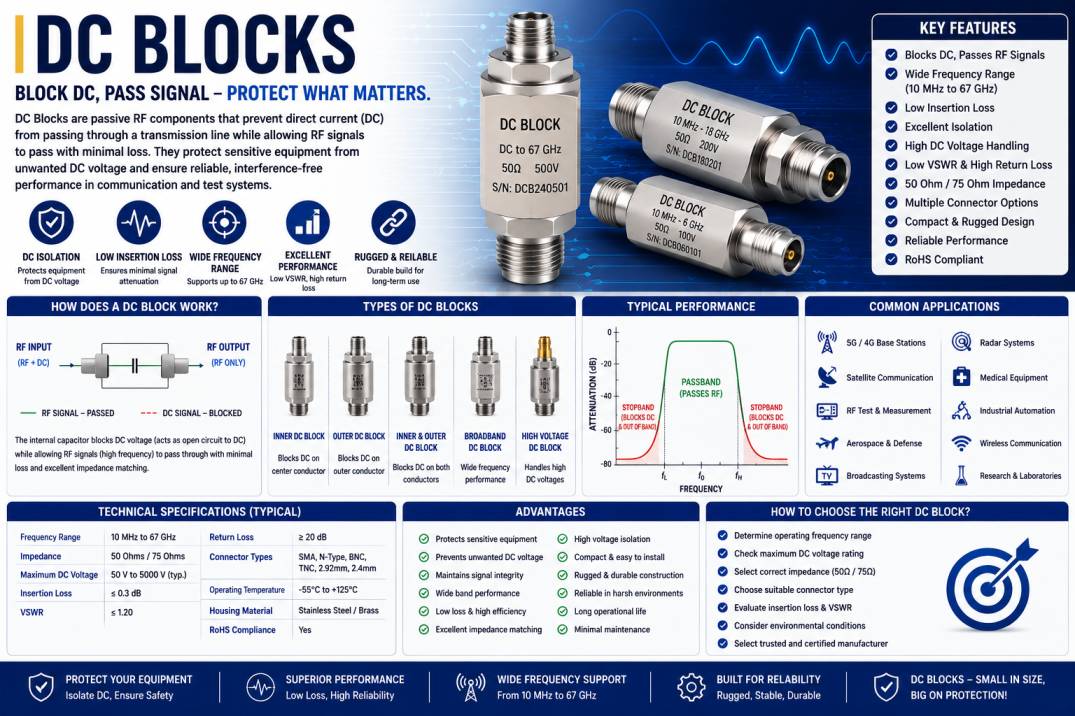
A DC Block is a passive radio frequency (RF) and microwave component designed to prevent direct current (DC) from passing through a transmission line while allowing alternating current (AC) and RF signals to pass with minimal loss. DC Blocks are essential in RF systems because they protect sensitive equipment from unwanted DC voltages without affecting high-frequency signal transmission.
DC Blocks are widely used in telecommunications, satellite communication, military electronics, aerospace, radar systems, wireless communication, laboratory testing, medical equipment, broadcasting, and 5G infrastructure. They help isolate DC bias voltages between connected devices, improve equipment reliability, and prevent costly damage to RF components such as amplifiers, mixers, receivers, oscillators, and spectrum analyzers.
Modern RF systems often require DC power to operate active components while simultaneously transmitting RF signals through the same transmission path. A properly selected DC Block ensures safe operation by blocking DC voltage while maintaining low insertion loss, excellent return loss, and stable impedance across a wide frequency range.
This comprehensive guide explains everything about DC Blocks, including their working principle, construction, types, specifications, applications, advantages, and selection criteria.
What Is a DC Block?
A DC Block is an RF component that blocks direct current (DC) while allowing radio frequency and microwave signals to pass through a transmission line with very little attenuation.
Internally, a DC Block primarily uses a high-quality capacitor that acts as an open circuit to DC signals and a low-impedance path to RF signals.
Most RF DC Blocks are designed with a characteristic impedance of 50 Ohms, although 75 Ohm versions are also available for television broadcasting and other specialized applications.
DC Blocks are commonly installed between RF equipment to isolate bias voltages and protect sensitive electronic circuits from unwanted DC current.
How Does a DC Block Work?
A DC Block operates using the electrical properties of a capacitor.
The operating process includes:
- RF signal enters the input connector.
- The internal capacitor blocks direct current.
- High-frequency RF signals pass through the capacitor with minimal loss.
- DC voltage is completely isolated.
- The filtered RF signal exits through the output connector.
This allows RF communication systems to operate normally while preventing DC voltages from reaching sensitive equipment.
Construction of a DC Block
RF Connectors
DC Blocks are available with various connector interfaces, including:
- SMA
- N-Type
- BNC
- TNC
- 2.92 mm
- 2.4 mm
- 1.85 mm
- 7/16 DIN
Connector selection depends on frequency range and application.
Capacitive Element
The capacitor is the most important component inside a DC Block.
It provides:
- DC isolation
- Low RF insertion loss
- Wide frequency response
- Excellent signal integrity
High-performance ceramic or microwave capacitors are commonly used.
Inner Conductor
The center conductor carries the RF signal through the capacitor.
It is typically manufactured from:
- Gold-plated brass
- Beryllium copper
- Silver-plated copper
Outer Housing
The housing provides mechanical protection and electromagnetic shielding.
Common materials include:
- Stainless Steel
- Brass
- Aluminum Alloy
Insulating Material
Dielectric materials maintain electrical insulation and mechanical stability.
Common materials include:
- PTFE
- Ceramic
- Air dielectric
Working Principle of a DC Block
The DC Block separates DC voltage from RF energy.
The process includes:
- RF energy reaches the capacitor.
- DC current encounters infinite impedance and stops.
- High-frequency RF signals experience very low impedance.
- RF energy continues toward the output.
- Connected equipment remains electrically isolated from DC voltage.
This simple but effective operation protects expensive RF equipment from accidental DC exposure.
Types of DC Blocks
Inner DC Block
Blocks DC voltage only on the center conductor.
Most commonly used in RF communication systems.
Outer DC Block
Blocks DC on the outer conductor while allowing center conductor continuity.
Used in specialized grounding applications.
Inner and Outer DC Block
Blocks DC on both conductors simultaneously.
Provides maximum electrical isolation.
Broadband DC Block
Supports a very wide frequency range from kilohertz to microwave frequencies.
Suitable for laboratory testing and multi-band communication systems.
High Voltage DC Block
Designed to withstand high DC voltages while maintaining excellent RF performance.
Technical Specifications
| Specification | Typical Value |
|---|---|
| Characteristic Impedance | 50 Ohms / 75 Ohms |
| Frequency Range | 10 MHz to 67 GHz (depending on model) |
| Maximum DC Voltage | 50 V to 5000 V |
| Insertion Loss | ≤ 0.3 dB |
| VSWR | ≤ 1.20 |
| Return Loss | Excellent |
| Connector Types | SMA, N-Type, BNC, TNC, 2.92 mm |
| Operating Temperature | -55°C to +125°C |
| Housing Material | Stainless Steel / Brass |
| RoHS Compliance | Yes |
Key Features of DC Blocks
- Complete DC isolation
- Low insertion loss
- Wide frequency coverage
- Excellent return loss
- Low VSWR
- High voltage protection
- Stable impedance
- Compact design
- High reliability
- Rugged construction
- Long operational life
- Easy installation
Applications of DC Blocks
RF Test Laboratories
Protects:
- Spectrum analyzers
- Vector network analyzers
- Signal generators
- RF calibration equipment
Satellite Communication
Prevents unwanted DC voltage from damaging sensitive microwave receivers.
5G Infrastructure
Provides DC isolation in base stations, repeaters, and distributed antenna systems.
Aerospace
Protects avionics and airborne communication equipment.
Military Communication
Used in radar systems, electronic warfare, and secure communication equipment.
Broadcasting
Provides DC isolation in television and radio transmission systems.
Medical Equipment
Used in MRI systems, RF imaging devices, and diagnostic equipment.
Wireless Communication
Supports Wi-Fi, cellular communication, Bluetooth, and microwave links.
Industrial Automation
Protects RF monitoring systems and industrial wireless equipment.
Scientific Research
Used in microwave laboratories and university research facilities.
Advantages of DC Blocks
- Prevents unwanted DC voltage
- Protects expensive RF equipment
- Maintains signal integrity
- Low insertion loss
- Excellent impedance matching
- Wide operating frequency
- Easy installation
- Compact size
- Long service life
- Reliable operation
- Minimal maintenance
- High voltage isolation capability
Limitations of DC Blocks
- Cannot pass DC power intentionally
- Frequency range depends on design
- Premium microwave models are more expensive
- Incorrect selection may increase insertion loss
- Precision connectors require careful handling
How to Choose the Right DC Block
When selecting a DC Block, consider:
- Operating frequency
- Maximum DC voltage
- Connector type
- Characteristic impedance
- Insertion loss
- VSWR
- Return loss
- Mechanical size
- Environmental conditions
- Application requirements
DC Block vs Bias Tee
| Feature | DC Block | Bias Tee |
|---|---|---|
| DC Transmission | Blocks DC | Injects or Extracts DC |
| RF Signal | Passes RF | Passes RF |
| Main Purpose | Equipment Protection | RF + DC Combination |
| Internal Components | Capacitor | Capacitor + Inductor |
| Common Applications | RF Isolation | Active RF Devices |
Industries Using DC Blocks
DC Blocks are widely used in:
- Telecommunications
- Aerospace
- Defense
- Satellite Communication
- Broadcasting
- Medical Electronics
- Scientific Research
- Industrial Automation
- Semiconductor Manufacturing
- RF Test Laboratories
Maintenance Tips
To maximize DC Block performance:
- Keep connectors clean and protected.
- Use the recommended connector torque.
- Avoid exceeding the maximum DC voltage rating.
- Inspect for physical damage regularly.
- Store in a dry, dust-free environment.
- Verify insertion loss during routine maintenance.
- Replace damaged connectors immediately.
Future Trends of DC Blocks
The expansion of 5G Advanced, 6G, satellite internet, autonomous systems, aerospace communication, and millimeter-wave technologies is increasing the demand for high-performance DC Blocks. Future designs will support wider frequency ranges beyond 67 GHz, lower insertion loss, higher voltage isolation, and compact form factors suitable for miniaturized RF systems. Manufacturers are also developing advanced dielectric materials and precision connector technologies to improve reliability, thermal stability, and overall RF performance in next-generation communication networks.
Conclusion
DC Blocks are essential RF components that provide reliable DC isolation while allowing RF and microwave signals to pass with minimal loss. Their ability to protect sensitive equipment, maintain signal quality, and prevent unwanted DC voltages makes them indispensable in telecommunications, satellite communication, aerospace, defense, broadcasting, medical electronics, industrial automation, and laboratory testing. Selecting the appropriate DC Block based on frequency range, voltage rating, impedance, connector type, and insertion loss ensures long-term reliability, equipment protection, and optimal RF system performance.
Frequently Asked Questions (FAQs)
1. What is a DC Block?
A DC Block is a passive RF component that prevents direct current (DC) from passing through a transmission line while allowing RF and microwave signals to pass with minimal attenuation.
2. What is a DC Block used for?
DC Blocks are used to protect RF equipment from unwanted DC voltage and provide electrical isolation between connected devices.
3. How does a DC Block work?
A DC Block uses an internal capacitor to block DC current while allowing high-frequency RF signals to pass through with low insertion loss.
4. What are the different types of DC Blocks?
The main types include Inner DC Blocks, Outer DC Blocks, Inner & Outer DC Blocks, Broadband DC Blocks, and High Voltage DC Blocks.
5. What frequency range does a DC Block support?
Depending on the model, DC Blocks typically operate from 10 MHz to 67 GHz, with some specialized versions supporting even higher frequencies.
6. What impedance options are available?
Most DC Blocks are available in 50 Ohm and 75 Ohm impedance versions.
7. What are the advantages of a DC Block?
They provide complete DC isolation, protect sensitive RF equipment, maintain signal integrity, offer low insertion loss, and support a wide operating frequency range.
8. Which industries commonly use DC Blocks?
DC Blocks are widely used in telecommunications, aerospace, defense, satellite communication, broadcasting, medical electronics, industrial automation, semiconductor manufacturing, and RF testing laboratories.
9. What is the difference between a DC Block and a Bias Tee?
A DC Block blocks DC voltage while passing RF signals, whereas a Bias Tee combines or separates DC power and RF signals on the same transmission line.
10. How do I choose the right DC Block?
Choose a DC Block based on operating frequency, maximum DC voltage, impedance, connector type, insertion loss, VSWR, return loss, environmental conditions, and the specific requirements of your RF application.