A Log Periodic Dipole Array antenna, commonly known as an LPDA antenna, is a broadband directional antenna designed to operate across a wide range of frequencies. Unlike narrowband antennas that are optimized for a relatively small frequency range, an LPDA antenna can maintain useful RF performance across multiple frequency bands.
LPDA antennas are widely used in telecommunications, RF testing, spectrum monitoring, broadcasting, military communication, cellular systems, electronic warfare, signal measurement, and wireless infrastructure.
The distinctive structure of an LPDA consists of multiple dipole elements arranged along a boom. The lengths and spacing of these elements follow a geometric progression, allowing the antenna to operate over a broad frequency range.
Because of their broadband characteristics, LPDA antennas are particularly useful when multiple frequencies need to be transmitted or received using a single antenna.
What Is an LPDA Antenna?
LPDA stands for Log Periodic Dipole Array.
An LPDA antenna is a directional antenna consisting of multiple dipole elements whose dimensions and spacing vary according to a logarithmic relationship.
Each dipole element is designed to contribute to antenna operation at different portions of the overall frequency range.
The result is a broadband antenna with relatively consistent characteristics across a wide frequency spectrum.
An LPDA antenna typically consists of:
- Conductive dipole elements
- Parallel or crossed booms
- Feed structure
- Supporting insulators
- Mounting hardware
- RF connector
- Optional balun or matching structure
How Does an LPDA Antenna Work?
The operating principle of an LPDA antenna is based on the frequency-dependent behavior of its dipole elements.
At a particular operating frequency, only a portion of the dipole elements is electrically active. As the frequency changes, the active region shifts along the antenna array.
This allows the antenna to maintain useful radiation characteristics over a broad frequency range.
The larger elements generally operate at lower frequencies, while smaller elements contribute more significantly at higher frequencies.
This frequency-dependent active region is one of the primary reasons LPDA antennas can provide broadband operation.
Why Is It Called Log Periodic?
The term “log periodic” comes from the geometric relationship between the dimensions of the antenna elements.
Important parameters such as:
- Element length
- Element spacing
- Element diameter
- Active region
change according to a logarithmic scaling relationship.
Two important design parameters are commonly represented by τ (tau) and σ (sigma).
Tau
Tau represents the ratio between the lengths of successive elements.
Sigma
Sigma represents the normalized spacing between successive elements.
These parameters strongly influence the antenna’s:
- Frequency range
- Gain
- Beamwidth
- Front-to-back ratio
- Impedance
- Overall physical dimensions
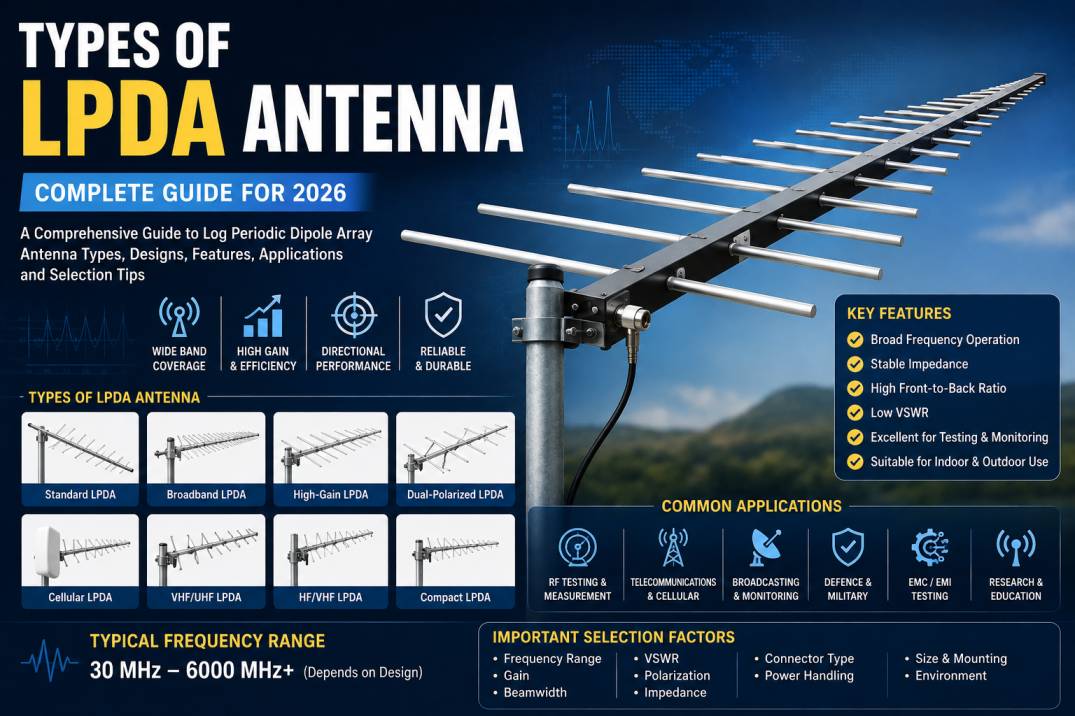
Main Types of LPDA Antennas
LPDA antennas can be classified according to their structure, frequency range, polarization, application, and mechanical configuration.
Common types include:
- Standard LPDA Antenna
- Broadband LPDA Antenna
- High-Gain LPDA Antenna
- Dual-Polarized LPDA Antenna
- Log-Periodic Dipole Array for RF Testing
- Cellular LPDA Antenna
- VHF/UHF LPDA Antenna
- HF/VHF LPDA Antenna
- Wideband Directional LPDA Antenna
- Compact LPDA Antenna
- Outdoor Ruggedized LPDA Antenna
- EMC/EMI Measurement LPDA Antenna
- Dual-Band or Multi-Band LPDA Antenna
- High-Power LPDA Antenna
1. Standard LPDA Antenna
A standard LPDA antenna uses a series of dipole elements arranged along a boom according to a logarithmic design.
It is designed to provide broadband directional performance across its specified frequency range.
Features
- Broadband operation
- Directional radiation pattern
- Stable impedance
- Moderate gain
- Relatively consistent performance
- Simple mechanical structure
Applications
- RF measurement
- Communication systems
- Signal monitoring
- Cellular testing
- Laboratory applications
2. Broadband LPDA Antenna
A broadband LPDA antenna is designed to cover a particularly wide frequency range.
These antennas are useful when several frequency bands must be monitored or communicated through a single antenna.
Applications
- Spectrum monitoring
- RF testing
- EMC measurements
- Wireless communications
- Military systems
- Signal intelligence
Advantages
- Wide frequency coverage
- Reduced need for multiple antennas
- Flexible testing
- Broadband signal reception
- Multi-band operation
3. High-Gain LPDA Antenna
High-gain LPDA antennas are optimized to provide stronger directional performance.
Increasing gain generally involves optimization of element geometry, boom structure, aperture, and overall antenna dimensions.
Applications
- Long-distance communication
- RF monitoring
- Cellular infrastructure
- Directional signal reception
- Defense applications
Advantages
- Higher directional gain
- Improved link performance
- Better signal discrimination
- Greater front-to-back ratio in suitable designs
High gain must be balanced against beamwidth, physical size, bandwidth, and mechanical requirements.
4. Dual-Polarized LPDA Antenna
A dual-polarized LPDA antenna incorporates two orthogonal polarization configurations.
This type of design can be useful in modern wireless systems where polarization diversity or MIMO operation is required.
Applications
- Cellular communication
- MIMO systems
- Wireless testing
- Research laboratories
- Advanced communication systems
Benefits
- Polarization diversity
- Multiple signal paths
- Improved system flexibility
- Suitable for advanced wireless measurements
5. LPDA Antenna for RF Testing
LPDA antennas are widely used in RF laboratories because of their broadband characteristics.
A single antenna can cover multiple frequency ranges, reducing the need to change antennas during testing.
Applications
- RF measurements
- Antenna testing
- Transmitter testing
- Receiver testing
- Spectrum analysis
- Field strength measurement
Important Specifications
For RF testing, engineers often evaluate:
- Frequency range
- Gain
- VSWR
- Radiation pattern
- Polarization
- Antenna factor
- Calibration data
- Connector type
6. Cellular LPDA Antenna
Cellular LPDA antennas are designed to cover multiple cellular frequency bands.
They can be used for directional cellular signal reception and transmission in appropriate applications.
Applications
- LTE
- Cellular testing
- Fixed wireless systems
- Rural connectivity
- Cellular monitoring
- RF surveying
Advantages
- Multi-band capability
- Directional coverage
- Wide frequency response
- Suitable for field measurements
7. VHF/UHF LPDA Antenna
VHF/UHF LPDA antennas are designed to cover frequencies in the Very High Frequency and Ultra High Frequency ranges.
These antennas are widely used in:
- Broadcasting
- Public safety
- RF testing
- Communication systems
- Spectrum monitoring
- Antenna measurements
The exact frequency range depends on the antenna design.
8. HF/VHF LPDA Antenna
Large LPDA structures can be designed for lower-frequency applications including portions of the HF and VHF spectrum.
Because lower frequencies require larger electrical dimensions, HF LPDA antennas can become physically large.
Applications
- Military communications
- Long-range radio
- HF monitoring
- Broadcasting
- Amateur radio
- Government communication
9. Wideband Directional LPDA Antenna
Wideband directional LPDAs are designed to maintain directional characteristics across a broad operating frequency range.
They are especially useful when both frequency flexibility and directional discrimination are required.
Applications
- RF surveillance
- Spectrum monitoring
- Wireless testing
- Defense systems
- EMC measurements
10. Compact LPDA Antenna
Compact LPDA antennas are designed to reduce physical size while maintaining broadband performance.
They may use optimized element spacing, element geometry, and mechanical structures to achieve smaller dimensions.
Applications
- Portable RF equipment
- Handheld measurement systems
- Compact communication equipment
- Field testing
- Drone payloads
- Mobile monitoring systems
The primary trade-off in compact designs can involve gain, efficiency, bandwidth, or mechanical robustness.
11. Outdoor Ruggedized LPDA Antenna
Outdoor LPDA antennas are designed for field installation and environmental exposure.
They may incorporate:
- Weather-resistant materials
- UV-resistant components
- Corrosion-resistant hardware
- Rugged mounting systems
- Sealed RF connections
Applications
- Outdoor RF monitoring
- Cellular surveys
- Broadcasting
- Defense
- Public safety
- Industrial communication
12. EMC/EMI Measurement LPDA Antenna
LPDA antennas are widely used for electromagnetic compatibility measurements because they provide broadband directional operation.
They can be used to detect or measure electromagnetic radiation across a specified frequency range.
Applications
- EMC testing
- EMI testing
- Radiated emissions testing
- Pre-compliance testing
- Compliance laboratories
- Product certification
For measurement applications, antenna calibration and antenna-factor data are particularly important.
13. Multi-Band LPDA Antenna
A multi-band LPDA antenna is designed to operate across multiple frequency bands using a single broadband structure.
This can be particularly useful when the equipment needs to monitor several communication services.
Benefits
- Multi-band coverage
- Reduced equipment complexity
- Flexible operation
- Fewer antenna changes
- Broadband signal reception
14. High-Power LPDA Antenna
High-power LPDA antennas are designed to withstand higher RF power levels than standard measurement or receiving antennas.
They require careful consideration of:
- Element construction
- Feed design
- Insulation
- Thermal performance
- Connector rating
- Mechanical strength
- VSWR
Applications
- High-power communication
- RF research
- Broadcasting
- Specialized test systems
- Defense communication
LPDA Antenna Design Parameters
Several parameters determine LPDA antenna performance.
Frequency Range
The frequency range defines the lowest and highest frequencies over which the antenna is designed to operate.
A wider frequency range generally requires a larger number of elements or more aggressive geometric scaling.
Gain
Gain indicates how effectively the antenna concentrates RF energy in a particular direction.
Typical LPDA gain varies significantly according to design.
Beamwidth
Beamwidth indicates the angular width of the main radiation lobe.
Higher gain generally results in a narrower beamwidth.
Front-to-Back Ratio
Front-to-back ratio indicates how much stronger the forward radiation is compared with radiation in the opposite direction.
A high front-to-back ratio can be useful when signals from unwanted directions need to be reduced.
VSWR
VSWR indicates impedance matching between the antenna and transmission line.
A lower VSWR generally indicates better matching within the specified operating range.
Polarization
LPDA antennas can be designed with different polarization configurations depending on application requirements.
LPDA Antenna Frequency Range
One of the biggest advantages of an LPDA antenna is its broadband frequency coverage.
Depending on the design, LPDA antennas may cover:
- HF
- VHF
- UHF
- Cellular frequencies
- Microwave-adjacent lower-frequency ranges
Examples of application-specific ranges may include:
- 30–300 MHz
- 100–1000 MHz
- 300–3000 MHz
- 400–6000 MHz
These are examples of possible design categories rather than universal specifications. The exact frequency range must always be taken from the manufacturer’s antenna specifications.
LPDA Antenna Gain
LPDA antenna gain depends on several factors:
- Number of elements
- Element dimensions
- Boom length
- Element spacing
- Operating frequency
- Design constants
- Aperture size
- Loading
- Construction
Typical LPDA gain may range from moderate gain to higher-gain configurations.
A high-gain LPDA generally requires a larger physical aperture and carefully optimized element geometry.
LPDA Radiation Pattern
LPDA antennas typically produce a directional radiation pattern.
The main beam points toward the smaller-element end or according to the specific feed and structural orientation of the antenna design.
The radiation pattern normally includes:
- Main lobe
- Side lobes
- Back radiation
- Beamwidth
- Front-to-back ratio
The exact pattern varies with frequency.
LPDA Antenna Polarization
Most conventional LPDA antennas use linear polarization.
Depending on the mechanical orientation, the polarization can be:
- Vertical
- Horizontal
Specialized designs can provide dual-polarized operation.
Polarization should be selected according to the transmitting or receiving system.
LPDA Antenna Impedance
LPDA antennas are typically designed to operate with a nominal impedance compatible with common RF transmission systems.
Many commercial LPDA antennas use a 50-ohm impedance, making them suitable for standard RF test equipment and coaxial cable systems.
Impedance matching is important for minimizing reflections and maximizing power transfer.
LPDA Antenna Connectors
Depending on frequency and application, LPDA antennas may use:
- N-Type
- SMA
- TNC
- 7/16 DIN
- BNC
- Other specialized RF connectors
The connector should be selected based on frequency, power, environmental requirements, and equipment compatibility.
LPDA Antenna Materials
LPDA antennas are typically constructed using conductive metals such as:
- Aluminum
- Copper
- Brass
- Stainless steel
Aluminum is frequently used because it provides a useful combination of conductivity, low weight, corrosion resistance, and mechanical strength.
Outdoor antennas may use protective coatings and corrosion-resistant hardware.
LPDA Antenna Applications
LPDA antennas are used in a wide range of RF and wireless applications.
1. RF Testing
LPDA antennas are frequently used for broadband RF measurements.
2. EMC and EMI Testing
They are commonly used for radiated emissions measurements over specified frequency ranges.
3. Cellular Testing
LPDA antennas can be used for cellular signal measurement and field surveys.
4. Spectrum Monitoring
Their wide frequency coverage makes them useful for monitoring multiple signals.
5. Defense and Aerospace
LPDA antennas can be used in communication, surveillance, testing, and electronic support systems.
6. Broadcasting
Broadband directional antennas can be used in specialized broadcasting and receiving systems.
7. Telecommunications
LPDAs are useful for testing and monitoring cellular and wireless networks.
8. Research and Development
Engineers use LPDA antennas during antenna characterization, propagation studies, and RF system development.
9. Field Strength Measurements
Directional broadband antennas can be used for measuring RF field strength.
10. Wireless Surveys
LPDA antennas can support site surveys and signal investigation across broad frequency ranges.
LPDA Antenna for RF Site Surveys
RF site surveys often require measurement across multiple frequency bands.
An LPDA antenna can simplify the process because one antenna can cover a wide frequency range.
Site survey engineers can use LPDA antennas to evaluate:
- Signal strength
- Interference
- Cellular coverage
- RF emissions
- Frequency occupancy
- Direction of arrival
LPDA Antenna for EMC Testing
Electromagnetic compatibility testing often requires broadband antennas.
An LPDA can cover multiple frequency ranges without changing the antenna for every measurement.
Typical measurements may involve:
- Radiated emissions
- Electromagnetic interference
- Field strength
- Equipment emissions
For formal compliance testing, the antenna must meet the applicable measurement standards and calibration requirements.
LPDA vs Yagi Antenna
LPDA and Yagi antennas can both be directional, but their designs and frequency characteristics differ.
| Feature | LPDA | Yagi |
|---|---|---|
| Frequency Range | Wide | Usually narrower |
| Bandwidth | Broadband | Narrow to moderate |
| Elements | Multiple varying lengths | Driven, reflector and directors |
| Gain | Moderate to high | Moderate to high |
| Directionality | High | High |
| Multi-Band Use | Excellent | Limited depending on design |
| RF Testing | Excellent | Application-dependent |
| Cellular Testing | Excellent | Band-specific |
An LPDA is generally preferred when broad frequency coverage is required, while a Yagi can be advantageous when a specific frequency band needs optimized directional performance.
LPDA vs Dipole Antenna
| Feature | LPDA | Dipole |
|---|---|---|
| Bandwidth | Wide | Relatively narrow |
| Directionality | Directional | Broad/bidirectional depending on configuration |
| Gain | Moderate/high | Moderate |
| Frequency Flexibility | High | Lower |
| Physical Size | Larger | Simpler |
| Testing Applications | Excellent | Frequency-specific |
| Multi-Band Operation | Excellent | Limited |
Advantages of LPDA Antennas
LPDA antennas offer several advantages.
Wide Frequency Coverage
A single antenna can cover a broad range of frequencies.
Directional Performance
The directional pattern helps concentrate RF energy and reduce signals arriving from unwanted directions.
Multi-Band Operation
One antenna can support multiple frequency services.
Consistent Performance
A properly designed LPDA can maintain relatively stable impedance and radiation characteristics across its operating range.
Useful for RF Testing
Broadband operation makes LPDAs highly practical for laboratory and field measurements.
Flexible Applications
They can be used across communications, testing, monitoring, defense, broadcasting, and industrial RF applications.
Limitations of LPDA Antennas
Despite their advantages, LPDAs also have limitations.
Large Physical Size
Broadband designs can become physically large, especially at lower frequencies.
Moderate Gain
LPDAs generally offer moderate gain compared with some narrowband high-gain antennas.
Mechanical Complexity
The multiple-element structure requires careful mechanical construction.
Installation Requirements
Outdoor installations require appropriate mounting, grounding, and environmental protection.
Frequency-Dependent Radiation Pattern
Radiation characteristics can change across the operating frequency range.
LPDA Antenna Selection Guide
When selecting an LPDA antenna, consider the following parameters.
Frequency Range
Ensure that the antenna covers the entire required frequency range.
Gain
Select gain according to the required communication or measurement distance.
Beamwidth
Determine whether the required application needs a narrow or wider beam.
Polarization
Choose the correct polarization for the RF system.
VSWR
Check VSWR across the entire operating frequency range.
Impedance
Verify that the antenna impedance matches the transmission system.
Connector
Select the appropriate RF connector for the equipment.
Power Handling
For transmitting applications, verify the maximum continuous and peak RF power ratings.
Environmental Protection
For outdoor applications, consider:
- IP rating
- Temperature range
- UV resistance
- Corrosion resistance
- Wind loading
Mechanical Dimensions
Ensure that the available mounting location can accommodate the antenna.
LPDA Antenna Installation
Proper installation is important for achieving the expected performance.
Mounting Height
For outdoor applications, increasing antenna height can sometimes improve line-of-sight conditions.
Orientation
The antenna should be pointed toward the desired signal source for directional applications.
Polarization
Maintain the appropriate polarization orientation.
Cable Routing
Avoid unnecessary cable length and sharp bends.
Connector Protection
Outdoor connectors should be appropriately weatherproofed.
Grounding
Proper grounding and lightning protection should be considered for outdoor installations.
LPDA Antenna Maintenance
Regular maintenance can help preserve antenna performance.
Inspect:
- Element connections
- Boom structure
- Mounting hardware
- RF connectors
- Coaxial cable
- Weather seals
- Corrosion
- Antenna alignment
Any damaged or corroded components should be inspected and replaced as necessary.
LPDA Antennas for Modern Wireless Networks
Although LPDA antennas have existed for decades, their broadband architecture remains relevant to modern RF engineering.
They can be used for:
- 4G LTE testing
- 5G sub-6 GHz testing
- Spectrum monitoring
- RF site surveys
- EMC measurements
- Wireless infrastructure testing
- Defense applications
- Antenna research
Their ability to cover multiple frequencies makes them valuable in environments where wireless standards and operating frequencies vary.
Future Trends in LPDA Antenna Technology
LPDA antenna development continues to focus on improving:
- Broadband performance
- Gain
- Size reduction
- Mechanical durability
- Multi-polarization capability
- Measurement accuracy
- Frequency coverage
- Power handling
- Lightweight construction
Modern simulation tools also allow engineers to optimize element dimensions, spacing, impedance, gain, and radiation patterns more precisely than traditional design methods.
Conclusion
LPDA antennas are among the most useful broadband directional antennas in RF engineering. Their logarithmically scaled dipole elements allow them to operate across a wide frequency range while maintaining useful directional characteristics.
Different LPDA antenna configurations are designed for different applications, including RF testing, EMC measurements, cellular surveys, spectrum monitoring, defense, telecommunications, broadcasting, and research.
When selecting an LPDA antenna, engineers should consider frequency range, gain, beamwidth, polarization, VSWR, impedance, connector type, power handling, mechanical construction, and environmental requirements.
The combination of broadband frequency coverage and directional performance makes the LPDA antenna a versatile solution for modern RF measurement, communication, and monitoring applications.
Frequently Asked Questions
1. What is an LPDA antenna?
LPDA stands for Log Periodic Dipole Array. It is a broadband directional antenna consisting of multiple dipole elements with systematically varying lengths and spacing.
2. What are the main types of LPDA antennas?
Common types include standard, broadband, high-gain, dual-polarized, cellular, VHF/UHF, HF/VHF, compact, ruggedized outdoor, EMC/EMI, multi-band, and high-power LPDA antennas.
3. What is the main advantage of an LPDA antenna?
The main advantage is its ability to operate across a wide frequency range while maintaining useful directional radiation characteristics.
4. Is an LPDA antenna directional?
Yes. Most LPDA antennas are directional and concentrate RF energy toward a primary direction.
5. What is the difference between LPDA and Yagi antennas?
An LPDA is generally designed for broadband operation, while a Yagi is typically optimized for a narrower frequency range. Both can provide directional gain.
6. What frequencies can an LPDA antenna cover?
The frequency range depends on the design. Commercial LPDAs can be designed for HF, VHF, UHF, cellular, and other RF frequency ranges.
7. What is LPDA antenna gain?
LPDA gain varies by design, element count, frequency, boom length, and antenna geometry. Broadband LPDAs commonly provide moderate to high directional gain.
8. What is the impedance of an LPDA antenna?
Many commercial LPDA antennas are designed for a nominal 50-ohm impedance, although the exact specification depends on the manufacturer and application.
9. Where are LPDA antennas used?
LPDA antennas are used for RF testing, EMC/EMI testing, cellular measurements, spectrum monitoring, telecommunications, defense, broadcasting, research, and wireless site surveys.
10. Can an LPDA antenna be used for 4G and 5G?
Yes, an appropriately designed LPDA can be used for 4G LTE and sub-6 GHz 5G applications when its specified frequency range covers the required bands.
11. Is an LPDA antenna suitable for RF testing?
Yes. Its broadband frequency coverage makes it particularly useful for RF measurements, spectrum monitoring, antenna testing, and field surveys.
12. What is the difference between a broadband LPDA and a standard LPDA?
A broadband LPDA is specifically optimized to cover a wide frequency range. In practice, the terms can overlap because LPDA antennas are inherently broadband, but manufacturers may use the terminology to distinguish different performance ranges.
13. Does an LPDA antenna have high gain?
LPDA antennas generally provide moderate to high directional gain depending on their size, number of elements, and design parameters.
14. Can LPDA antennas be used outdoors?
Yes. Outdoor LPDA antennas are available with weather-resistant construction, corrosion-resistant materials, and rugged mounting systems.
15. What should I consider when buying an LPDA antenna?
Important factors include frequency range, gain, beamwidth, VSWR, impedance, polarization, connector, power handling, dimensions, mounting method, and environmental protection.
16. Why are LPDA antennas useful for spectrum monitoring?
Their broadband design allows them to receive signals across a wide frequency range without requiring frequent antenna changes.
17. What materials are used to manufacture LPDA antennas?
Common materials include aluminum, copper, brass, stainless steel, and other conductive or corrosion-resistant materials selected according to frequency and environmental requirements.
18. Can LPDA antennas support dual polarization?
Yes. Specialized LPDA designs can provide dual-polarized operation for applications requiring polarization diversity or multiple signal paths.
19. What is the role of tau in LPDA antenna design?
Tau represents a scaling factor between successive antenna elements. It is one of the key parameters used to establish the geometric relationship of an LPDA structure.
20. Why is LPDA antenna technology still important?
LPDA antennas remain important because they provide a practical combination of broadband frequency coverage, directional performance, and relatively stable RF characteristics for testing, monitoring, communications, and measurement applications.