GSM antennas are essential components of wireless communication systems because they enable mobile devices, base stations, repeaters, and telecom infrastructure to transmit and receive radio-frequency signals. The right GSM antenna helps improve coverage, signal strength, network reliability, data performance, and communication quality.
GSM, or Global System for Mobile Communications, operates across different frequency bands depending on the region and network deployment. Common GSM frequency ranges include 850 MHz, 900 MHz, 1800 MHz, and 1900 MHz. Modern telecom networks may also use multi-band antennas that support GSM alongside technologies such as 3G, 4G LTE, and 5G.
There are several types of GSM antennas, and each type is designed for a specific coverage pattern, mounting environment, frequency range, gain requirement, and application. Understanding these antenna types is important when designing telecom networks, industrial wireless systems, vehicle communication systems, remote monitoring installations, and in-building coverage solutions.
What Is a GSM Antenna?
A GSM antenna is an RF antenna designed to transmit and receive electromagnetic signals used by GSM cellular communication networks. It converts electrical signals into radio waves during transmission and converts received radio waves back into electrical signals during reception.
GSM antennas are used in both fixed and mobile communication systems. They can be installed on telecom towers, rooftops, poles, buildings, vehicles, industrial equipment, communication cabinets, and indoor locations.
The performance of a GSM antenna depends on several parameters, including frequency range, antenna gain, radiation pattern, polarization, impedance, VSWR, return loss, connector type, power handling capability, and mechanical construction.
Why GSM Antennas Are Important
A cellular network can only provide reliable communication when RF signals are transmitted and received efficiently. The antenna plays a major role in determining the effective coverage area and signal quality.
A properly selected GSM antenna can provide:
Improved cellular coverage
Better signal strength
Reliable voice communication
Improved data connectivity
Reduced signal losses
Better network availability
Stable RF performance
Efficient transmission and reception
Improved coverage in remote areas
Reliable communication for industrial and M2M applications
Major Types of GSM Antennas
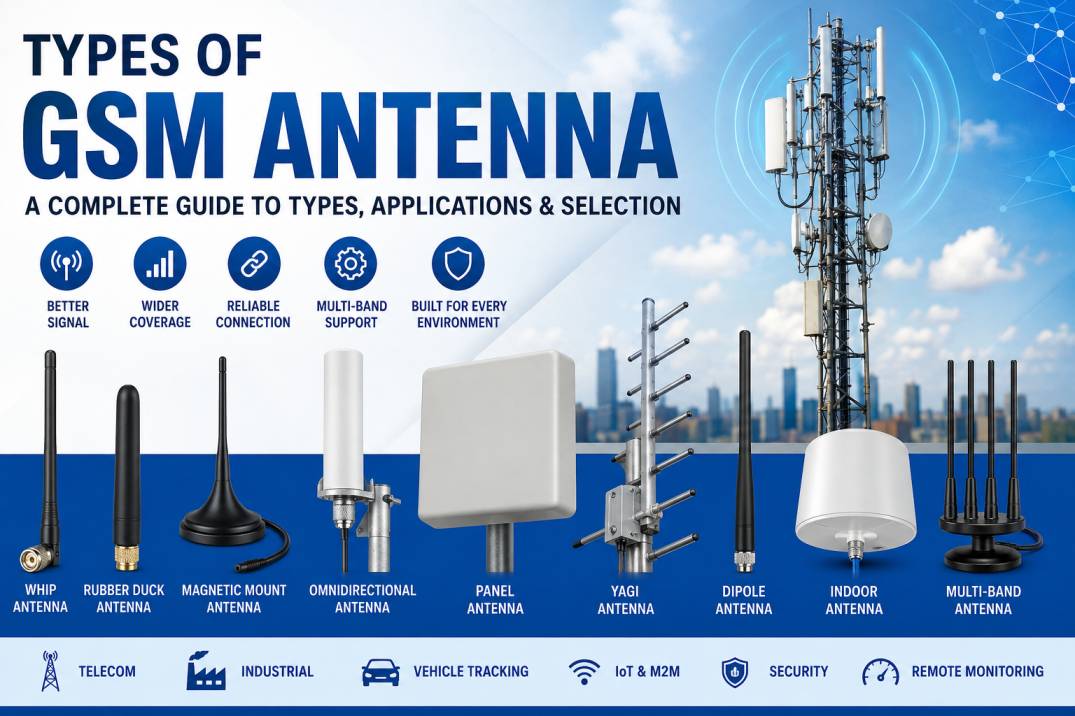
GSM antennas are available in many configurations. The most common types include omnidirectional antennas, directional antennas, panel antennas, Yagi antennas, whip antennas, rubber duck antennas, magnetic-mount antennas, dipole antennas, fiberglass antennas, log-periodic antennas, and multi-band antennas.
1. GSM Omnidirectional Antenna
An omnidirectional GSM antenna radiates RF energy in approximately 360 degrees around the antenna’s vertical axis. This makes it suitable when coverage is required in multiple directions.
Omnidirectional GSM antennas are commonly used at base stations, repeater systems, industrial facilities, buildings, transportation systems, and wireless communication installations.
The antenna typically has a vertically oriented radiation pattern. Most of the transmitted energy is concentrated around the horizontal plane rather than directly above or below the antenna.
Advantages of Omnidirectional GSM Antennas
360-degree horizontal coverage
Suitable for general-area coverage
Simple installation
Useful for mobile and fixed communication
Available in different gains and frequency ranges
Suitable for telecom repeaters and wireless systems
Applications
Telecom towers
GSM repeaters
Industrial communication
Rural communication
Fleet communication
M2M systems
Remote monitoring
Public safety communication
2. GSM Directional Antenna
A directional GSM antenna concentrates RF energy toward a specific direction. Unlike an omnidirectional antenna, it does not distribute the signal equally in all directions.
Directional antennas are useful when the objective is to establish communication over a longer distance or focus RF coverage toward a particular area.
They can provide higher gain than many omnidirectional antenna designs because RF energy is concentrated into a narrower beam.
Advantages
Higher directional gain
Long-distance communication capability
Reduced unwanted radiation in other directions
Useful for point-to-point and point-to-area applications
Improved signal concentration
Applications
Remote telecom links
Rural cellular coverage
Industrial sites
Railway communication
Large campuses
Remote monitoring
Cellular signal enhancement
3. GSM Panel Antenna
A GSM panel antenna is a flat, directional antenna commonly used for cellular network coverage. Panel antennas are widely deployed on telecom towers and building rooftops.
The antenna generally provides a sectorized radiation pattern, allowing operators to divide a coverage area into multiple sectors.
Panel antennas can be designed for single-band or multi-band operation and may support GSM, UMTS, LTE, and other cellular technologies.
Key Features
Directional radiation pattern
High gain
Sector coverage
Compact construction
Multiple frequency options
Vertical or dual polarization configurations
Applications
Base stations
Cellular towers
Rooftop installations
In-building cellular systems
Telecom infrastructure
Private mobile networks
4. GSM Yagi Antenna
A Yagi antenna is a directional antenna consisting of a driven element and multiple parasitic elements, usually including reflectors and directors.
Yagi GSM antennas are commonly used where a stronger signal is required from a specific direction. Their directional characteristics make them suitable for rural locations and areas where the nearest cellular tower is relatively far away.
Benefits
Directional signal reception
Good gain
Relatively lightweight design
Suitable for outdoor installation
Useful for weak-signal areas
Applications
Rural GSM coverage
Cellular signal boosters
Remote buildings
Agricultural facilities
Industrial sites
Remote monitoring systems
5. GSM Whip Antenna
A GSM whip antenna is a simple rod-style antenna commonly used in mobile and wireless equipment.
Whip antennas are usually vertically mounted and can provide omnidirectional coverage. Their compact design makes them suitable for equipment where space is limited.
They are available in different lengths depending on the operating frequency and antenna design.
Applications
GSM modems
Routers
Telemetry equipment
Vehicle communication systems
Industrial controllers
GPS/GSM tracking systems
IoT devices
Wireless terminals
6. GSM Rubber Duck Antenna
A rubber duck antenna is a compact flexible antenna commonly used with portable communication equipment.
The antenna normally consists of a flexible radiating element enclosed within a protective rubber or polymer housing. It is designed for convenience and durability rather than maximum long-distance gain.
Applications
Portable GSM equipment
Wireless terminals
Modems
Routers
Industrial communication devices
Handheld equipment
IoT gateways
7. GSM Magnetic Mount Antenna
A magnetic-mount GSM antenna uses a magnetic base for installation on metallic surfaces. It is particularly useful for temporary or semi-permanent installations.
The magnetic base provides mechanical stability while allowing the antenna to be removed or repositioned easily.
Magnetic-mount antennas are frequently supplied with coaxial cable and an RF connector suitable for the target device.
Applications
Vehicles
Fleet tracking
Mobile communication systems
Temporary installations
GSM routers
Industrial equipment
Telemetry systems
Remote monitoring
8. GSM Dipole Antenna
The dipole antenna is one of the fundamental antenna configurations used in RF communication.
A GSM dipole can be designed for specific cellular frequency bands and may provide an omnidirectional radiation pattern when installed appropriately.
Dipole antennas are commonly used in wireless communication equipment, test systems, repeaters, and cellular infrastructure.
Advantages
Simple construction
Reliable RF performance
Omnidirectional characteristics
Easy installation
Suitable for multiple mounting configurations
9. GSM Fiberglass Antenna
Fiberglass GSM antennas are typically designed for outdoor applications where mechanical durability and weather resistance are important.
The radiating elements are enclosed inside a fiberglass radome that protects the antenna from environmental conditions such as rain, dust, humidity, and sunlight.
These antennas are commonly available in omnidirectional configurations with different gains.
Applications
Telecom towers
Outdoor GSM systems
Industrial communication
Rural networks
Utility communication
Remote monitoring
Railway communication
10. GSM Multi-Band Antenna
A multi-band GSM antenna is designed to operate across more than one cellular frequency band.
Instead of using separate antennas for each frequency range, a multi-band antenna can support multiple bands within a single antenna assembly.
Common combinations can include GSM 850/900 and GSM 1800/1900, depending on the antenna design.
Modern cellular antennas may also combine GSM with 3G, 4G LTE, and other frequency bands.
Advantages
Supports multiple frequency bands
Reduces installation complexity
Saves space
Can reduce the number of antennas required
Suitable for modern cellular infrastructure
Useful for multi-operator environments
11. GSM Log-Periodic Antenna
A log-periodic antenna is a broadband directional antenna designed to operate across a wide frequency range.
Because cellular networks may use multiple frequency bands, broadband antennas can be useful when several bands need to be covered by a single antenna.
Log-periodic antennas are particularly useful for testing, monitoring, and broadband RF applications.
Applications
RF testing
Signal monitoring
Cellular coverage testing
Research laboratories
Telecom measurements
Broadband communication systems
12. GSM Indoor Antenna
Indoor GSM antennas are designed to distribute cellular signals inside buildings where outdoor signals may be weak or blocked.
They are frequently used as part of Distributed Antenna Systems and in-building solutions.
Indoor antennas can be ceiling-mounted, wall-mounted, or integrated into specific indoor RF distribution systems.
Applications
Offices
Shopping malls
Hotels
Hospitals
Warehouses
Factories
Parking structures
Airports
Large commercial buildings
13. GSM Ceiling-Mount Antenna
A ceiling-mount GSM antenna is designed to provide indoor cellular coverage from a ceiling-mounted position.
These antennas are commonly used in Distributed Antenna Systems where RF signals are distributed through coaxial cables from a central source to multiple antennas.
Their radiation pattern is generally designed to provide broad coverage across the indoor floor area.
14. GSM Ground-Plane Antenna
A ground-plane antenna uses a conductive surface or radial arrangement to provide the required RF electrical characteristics.
Ground-plane antennas can be used in mobile and fixed cellular communication systems, especially where a conventional ground plane is unavailable.
They are frequently used in outdoor installations and equipment-mounted applications.
15. GSM Stubby Antenna
A stubby antenna is a short, compact antenna designed for portable wireless equipment.
Its small size makes it suitable for applications where physical space is limited.
Stubby antennas are commonly used with GSM modems, routers, tracking equipment, industrial devices, and wireless terminals.
16. GSM Vehicle Antenna
Vehicle GSM antennas are specifically designed for automotive and transportation applications.
They may be installed on vehicle roofs, dashboards, windows, or other suitable locations depending on the design.
Vehicle antennas can use magnetic mounts, adhesive mounts, permanent mounts, or other mechanical configurations.
Applications
Fleet management
Vehicle tracking
Public transportation
Emergency vehicles
Commercial vehicles
Logistics
Connected vehicle systems
Transportation monitoring
17. GSM MIMO Antenna
Modern cellular systems increasingly use multiple-input multiple-output technology. A GSM/LTE multi-element antenna may contain multiple radiating elements within a single housing.
MIMO antenna assemblies are particularly common in modern broadband cellular equipment and routers.
They can support multiple RF channels and help improve data performance under appropriate network conditions.
Applications
4G routers
Industrial routers
Cellular gateways
IoT gateways
Fixed wireless access
Telecom equipment
GSM Antenna Frequency Bands
GSM antennas are available for different frequency ranges depending on the network.
Common GSM bands include:
GSM 850
GSM 900
GSM 1800
GSM 1900
The actual frequency range required depends on the country, operator, network infrastructure, and equipment.
A dual-band or multi-band antenna can be selected when equipment needs to operate across multiple cellular bands.
GSM Antenna Gain
Antenna gain describes how effectively an antenna concentrates RF energy in a particular direction compared with a reference antenna.
Gain is commonly specified in dBi.
Higher gain does not automatically mean that an antenna is better for every application. High-gain antennas typically have a more focused radiation pattern, while lower-gain antennas can provide broader coverage.
For example, an omnidirectional antenna with moderate gain may be more suitable for general-area coverage, while a high-gain directional antenna may be better for a long-distance link.
GSM Antenna Radiation Pattern
The radiation pattern shows how an antenna distributes RF energy around itself.
The two common categories are:
Omnidirectional radiation
Directional radiation
An omnidirectional antenna provides approximately 360-degree horizontal coverage, while a directional antenna concentrates energy toward a specific direction.
Selecting the correct radiation pattern is critical when designing a GSM communication system.
GSM Antenna Polarization
Polarization describes the orientation of the electric field of the transmitted RF signal.
Common configurations include vertical polarization, horizontal polarization, and dual polarization.
Many cellular systems use polarization strategies designed to improve capacity and signal reliability.
The antenna polarization should match the requirements of the RF system for optimum performance.
GSM Antenna Impedance
Most cellular RF systems use a nominal impedance of 50 ohms.
Maintaining proper impedance matching between the antenna, coaxial cable, connectors, and RF equipment helps reduce reflections and signal losses.
A mismatch can result in increased VSWR and reduced RF efficiency.
GSM Antenna VSWR
Voltage Standing Wave Ratio, or VSWR, is an important parameter used to evaluate impedance matching.
A lower VSWR generally indicates better impedance matching between the antenna and the connected RF system.
A GSM antenna with good VSWR performance can help minimize reflected power and improve RF system efficiency.
GSM Antenna Return Loss
Return loss indicates how much RF energy is reflected back toward the source because of impedance mismatch.
Higher return loss generally indicates better matching.
Antenna manufacturers often specify return loss or VSWR over the antenna’s operating frequency range.
GSM Antenna Connector Types
GSM antennas may use different RF connectors depending on the application.
Common connector types include:
SMA
N Type
TNC
BNC
FME
MMCX
MCX
U.FL/IPEX
T-SMA
RP-SMA
The connector should match the RF equipment and cable assembly. Mechanical compatibility alone is not enough; the connector must also support the required frequency, impedance, environmental conditions, and power level.
GSM Antenna Cable
A coaxial cable connects the GSM antenna to the radio, modem, router, repeater, or base station.
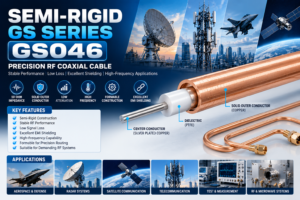
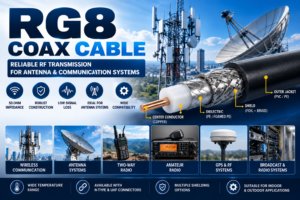
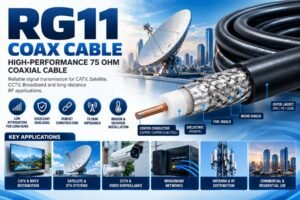
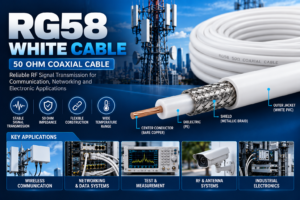
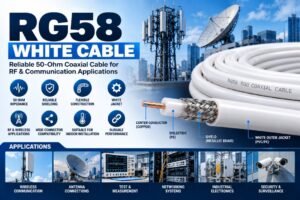
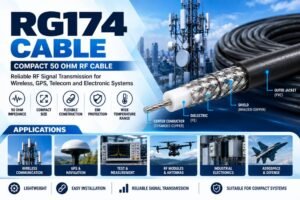
Common cable types include RG-58, RG-174, RG-213, LMR-type cables, and specialized low-loss RF cables.
Cable selection is important because cable loss increases with frequency and cable length.
For long cable runs, a low-loss coaxial cable is generally preferred to minimize signal attenuation.
How to Select the Right GSM Antenna
Selecting the correct GSM antenna requires consideration of the complete RF system.
1. Identify the Frequency Band
Determine whether the application requires GSM 850, GSM 900, GSM 1800, GSM 1900, or multiple bands.
2. Determine the Required Coverage
Decide whether coverage is required in all directions or toward a specific location.
Choose an omnidirectional antenna for broad-area coverage or a directional antenna when the signal needs to be focused.
3. Check Antenna Gain
Select gain according to the required coverage and radiation pattern.
Do not select the highest available gain without considering the actual installation.
4. Check Impedance
Most GSM systems use 50-ohm RF interfaces.
Ensure the antenna, cable, and RF equipment have compatible impedance.
5. Check VSWR and Return Loss
Select an antenna with suitable impedance-matching performance across the required operating band.
6. Consider Installation Location
Outdoor antennas require suitable mechanical and environmental protection.
Indoor antennas may prioritize compact dimensions and attractive mounting configurations.
Vehicle antennas need suitable mounting and vibration resistance.
7. Select the Correct Connector
Confirm that the antenna connector matches the RF equipment or cable assembly.
8. Consider Cable Length
Longer cable runs can introduce significant RF losses. Use a suitable low-loss coaxial cable when the antenna is installed far from the radio equipment.
9. Check Environmental Requirements
For outdoor installations, consider:
IP rating
UV resistance
Weather resistance
Operating temperature
Humidity
Wind loading
Corrosion resistance
Mechanical strength
GSM Antenna Applications
GSM antennas are used across numerous industries and communication systems.
Telecom Networks
GSM antennas are fundamental components of cellular infrastructure used for transmitting and receiving mobile communication signals.
Industrial Automation
Factories use GSM communication for remote monitoring, machine connectivity, telemetry, and industrial IoT.
Fleet Management
Vehicle-mounted GSM antennas support tracking, communication, and fleet monitoring systems.
Smart Metering
GSM communication can connect electricity, water, gas, and other utility meters with remote monitoring platforms.
Security Systems
GSM antennas are used in alarm panels, surveillance systems, access control systems, and remote security equipment.
IoT Applications
GSM and cellular antennas provide wireless connectivity for sensors, gateways, trackers, and machine-to-machine systems.
Agriculture
Remote agricultural equipment can use cellular connectivity for monitoring environmental conditions, irrigation systems, equipment, and livestock-related applications.
Transportation
Railways, buses, trucks, logistics fleets, and other transportation systems use cellular communication for monitoring and connectivity.
GSM Antenna for Rural Areas
Rural areas can present challenges because cellular towers may be located far away and terrain can affect signal propagation.
Directional GSM antennas such as Yagi and panel antennas can be useful when the desired signal comes predominantly from one direction.
The antenna should be installed at an appropriate height and positioned toward the desired cellular source when using a directional design.
GSM Antenna for Industrial Applications
Industrial environments can contain metal structures, machinery, electrical equipment, and other sources of RF obstruction or interference.
Industrial GSM antennas should therefore be selected based on:
Frequency range
Gain
Radiation pattern
Environmental protection
Mechanical strength
Cable type
Connector type
Temperature range
Mounting method
For outdoor industrial installations, rugged fiberglass or weather-resistant antenna designs can be particularly useful.
GSM Antenna for IoT Devices
Cellular IoT devices often require compact antennas with reliable RF performance.
The antenna may be integrated directly into the device or connected externally through an RF connector.
Compact whip, stubby, PCB, flexible, magnetic-mount, and external cellular antennas are commonly considered depending on the application.
GSM Antenna vs LTE Antenna
GSM and LTE operate using different cellular technologies, but modern antennas can support multiple technologies and frequency bands.
A multi-band cellular antenna may support GSM, 3G, LTE, and other services when its frequency range and electrical characteristics are suitable.
Therefore, antenna selection should be based primarily on the required frequency bands and RF performance rather than simply the network technology name.
GSM Antenna Manufacturer and Supplier
A reliable GSM antenna manufacturer should provide antennas with verified electrical and mechanical specifications.
Important specifications to review include:
Frequency range
Gain
Impedance
VSWR
Polarization
Radiation pattern
Connector type
Cable type
Cable length
Power handling
Operating temperature
Environmental rating
Mounting arrangement
Mechanical dimensions
For telecom and industrial applications, antennas should also be evaluated for consistency, durability, and long-term RF performance.
SRFS Teleinfra provides RF and telecom components, antennas, RF cable assemblies, connectors, and related communication infrastructure solutions for industrial and telecom applications.
GSM Antenna Installation Best Practices
Correct installation can significantly affect antenna performance.
Install outdoor antennas as high as practical within the application’s safety and structural requirements.
Keep the antenna away from large metallic obstructions where possible.
Use suitable low-loss coaxial cable.
Minimize unnecessary cable length.
Use appropriate RF connectors.
Ensure connectors are properly terminated.
Weatherproof outdoor connections.
Maintain appropriate antenna polarization.
For directional antennas, accurately orient the antenna toward the intended signal source.
Follow the manufacturer’s recommended mounting and grounding practices.
Common GSM Antenna Problems
Weak GSM Signal
Weak signals can result from distance, obstructions, poor antenna positioning, excessive cable loss, or an unsuitable antenna.
High VSWR
High VSWR may be caused by impedance mismatch, damaged cables, incorrect connectors, poor termination, or antenna damage.
High Cable Loss
Long or unsuitable coaxial cables can introduce significant signal attenuation.
Poor Antenna Orientation
Directional antennas require proper alignment. Incorrect orientation can significantly reduce received signal strength.
Environmental Damage
Outdoor antennas can experience degradation due to UV exposure, moisture, corrosion, wind, and temperature changes.
Future of GSM and Cellular Antennas
Although newer cellular technologies such as LTE and 5G are increasingly important, antenna engineering continues to evolve toward multi-band and multi-technology solutions.
Modern cellular antennas increasingly support several frequency ranges in a single assembly. Advanced antenna systems can also incorporate multiple elements, polarization diversity, MIMO capabilities, and compact designs.
The growing adoption of IoT, industrial automation, smart infrastructure, connected vehicles, and private wireless networks continues to create demand for reliable cellular antenna solutions.
Conclusion
GSM antennas are available in many different configurations, including omnidirectional, directional, panel, Yagi, whip, rubber duck, magnetic-mount, dipole, fiberglass, multi-band, log-periodic, indoor, vehicle, and multi-element antenna designs.
The best GSM antenna depends on the frequency band, required coverage area, gain, radiation pattern, installation environment, cable length, connector, impedance, and environmental requirements.
For telecom networks, industrial communication, IoT, vehicle tracking, remote monitoring, smart metering, and cellular connectivity applications, selecting the correct GSM antenna can improve signal reliability and overall RF system performance.
When choosing a GSM antenna, it is important to evaluate the complete RF system rather than selecting an antenna based only on gain or physical size. Proper antenna selection, cable selection, installation, positioning, and impedance matching all contribute to reliable cellular communication.
Frequently Asked Questions About GSM Antennas
What is a GSM antenna?
A GSM antenna is an RF antenna designed to transmit and receive cellular signals used by GSM communication systems. It is used in mobile networks, routers, modems, repeaters, tracking systems, IoT devices, and industrial communication equipment.
What are the main types of GSM antennas?
The main types include omnidirectional GSM antennas, directional antennas, panel antennas, Yagi antennas, whip antennas, rubber duck antennas, magnetic-mount antennas, dipole antennas, fiberglass antennas, multi-band antennas, indoor antennas, vehicle antennas, and log-periodic antennas.
Which GSM antenna is best for long-distance communication?
A directional antenna such as a Yagi or high-gain panel antenna can be suitable for long-distance communication when the desired signal originates from a known direction.
Which GSM antenna provides 360-degree coverage?
An omnidirectional GSM antenna is designed to provide approximately 360-degree horizontal coverage.
What frequency does a GSM antenna use?
Common GSM frequency bands include 850 MHz, 900 MHz, 1800 MHz, and 1900 MHz. The required frequency depends on the network and geographic region.
What is GSM antenna gain?
Antenna gain describes how effectively an antenna concentrates RF energy compared with a reference antenna. It is commonly expressed in dBi.
What is the impedance of a GSM antenna?
Most GSM RF systems use a nominal 50-ohm impedance. The antenna, coaxial cable, connectors, and RF equipment should be properly matched.
Can one antenna support multiple GSM bands?
Yes. Multi-band GSM antennas are designed to operate across multiple frequency bands, such as combinations of GSM 850/900 and GSM 1800/1900, depending on the antenna design.
What connector is commonly used with GSM antennas?
SMA, N Type, TNC, FME, MMCX, MCX, U.FL/IPEX, and other RF connectors are commonly used. The correct connector depends on the application and connected equipment.
How do I choose the right GSM antenna?
Consider the required frequency band, coverage area, antenna gain, radiation pattern, polarization, impedance, VSWR, connector type, cable length, mounting method, and environmental conditions.
Is a high-gain GSM antenna always better?
No. High gain usually means the antenna concentrates energy into a narrower radiation pattern. A lower-gain omnidirectional antenna may be more suitable when coverage is required in multiple directions.
Can GSM antennas be used for 4G LTE?
Some multi-band cellular antennas can support GSM and LTE simultaneously if their specified frequency range covers the required LTE bands. The antenna specifications should always be checked before installation.
Where are GSM antennas commonly used?
GSM antennas are used in telecom networks, industrial automation, IoT devices, vehicle tracking systems, smart meters, security systems, remote monitoring, agricultural systems, routers, modems, and cellular repeaters.
What causes poor GSM antenna performance?
Poor performance can result from incorrect antenna selection, weak signal conditions, improper positioning, excessive cable loss, high VSWR, damaged connectors, environmental damage, or nearby obstructions.