A GPS antenna is a critical component of a Global Positioning System receiver because it captures radio-frequency signals transmitted by navigation satellites and delivers those signals to the receiver for positioning, navigation, and timing calculations. Although GPS receivers often receive most of the attention in a navigation system, the antenna has a major influence on signal quality, positioning accuracy, reliability, and performance in challenging environments.
Modern satellite navigation systems are no longer limited to traditional GPS. GNSS technologies can receive signals from multiple satellite constellations, including GPS, GLONASS, Galileo, and BeiDou. As a result, many modern GPS antennas are designed as multi-constellation GNSS antennas capable of supporting several frequency bands.
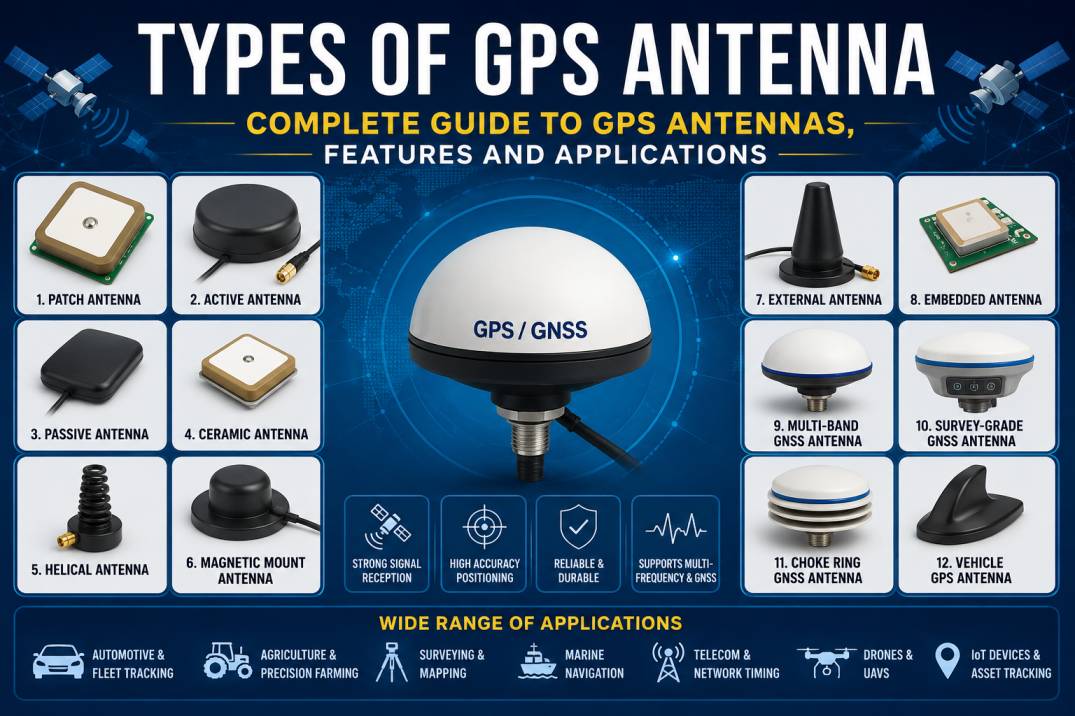
GPS antennas are available in several designs, including active GPS antennas, passive GPS antennas, patch antennas, helical antennas, ceramic antennas, embedded antennas, external antennas, magnetic-mount antennas, and high-precision survey antennas. Each type is designed for different operating conditions and applications.
Selecting the right GPS antenna depends on factors such as frequency, gain, polarization, impedance, radiation pattern, antenna size, cable length, environmental conditions, multipath rejection, and whether an active low-noise amplifier is required.
What Is a GPS Antenna?
A GPS antenna is an RF antenna designed to receive electromagnetic signals from navigation satellites operating in the L-band frequency range. GPS satellites transmit navigation signals toward Earth, where they are received by GPS or GNSS antennas.
The antenna converts the electromagnetic energy of the satellite signal into an electrical RF signal. This signal is then transferred through a coaxial cable or RF interconnection to a GNSS receiver.
A typical GPS antenna system consists of:
- Antenna element
- Ground plane
- Low-noise amplifier in active designs
- RF filter
- Connector
- Coaxial cable
- Protective housing
- Mounting mechanism
The antenna must be capable of receiving very weak satellite signals while minimizing interference and unwanted noise.
How Does a GPS Antenna Work?
GPS antennas receive signals transmitted by satellites orbiting Earth. These signals contain information required by the receiver to determine satellite position and timing.
The basic process is:
- GPS or GNSS satellites transmit navigation signals.
- The antenna receives the satellite RF signals.
- The antenna element converts RF energy into an electrical signal.
- In an active antenna, an integrated low-noise amplifier strengthens the received signal.
- Filters reduce unwanted interference outside the required frequency band.
- The RF signal travels through the coaxial cable.
- The GNSS receiver processes signals from multiple satellites.
- The receiver calculates position, velocity, and timing information.
The quality of the antenna can significantly affect the receiver’s ability to maintain satellite lock, particularly in urban environments, under foliage, or where signals are obstructed.
Major Types of GPS Antennas
There are several types of GPS antennas available for commercial, industrial, automotive, telecom, surveying, aerospace, and defense applications.
1. GPS Patch Antenna
Patch antennas are among the most widely used GPS antenna types. A typical patch antenna consists of a flat conductive patch mounted over a ground plane with a dielectric substrate between them.
Ceramic patch antennas are especially common in compact GPS and GNSS devices.
Features of GPS Patch Antennas
- Compact construction
- Low-profile design
- Good directional characteristics
- Suitable for PCB integration
- Available for single and multi-band applications
- Can provide circular polarization
- Suitable for embedded GNSS products
Patch antennas are frequently used in navigation devices, vehicle trackers, IoT equipment, telematics systems, drones, and portable GPS products.
2. Active GPS Antenna
An active GPS antenna contains an integrated Low Noise Amplifier (LNA). The LNA amplifies the weak signal received by the antenna before it travels through the coaxial cable.
Active GPS antennas are particularly useful when the antenna is installed away from the GNSS receiver.
Advantages of Active GPS Antennas
- Improved signal strength
- Compensation for cable losses
- Better performance with longer coaxial cables
- Suitable for external installations
- Improved receiver sensitivity in appropriate system designs
Active antennas require DC power for the internal LNA. This power is commonly supplied through the RF coaxial cable using bias circuitry.
3. Passive GPS Antenna
A passive GPS antenna does not contain an integrated amplifier. It simply receives and transfers the RF signal to the GNSS receiver.
Passive antennas are suitable when the antenna is located close to the receiver and cable loss is low.
Advantages of Passive GPS Antennas
- Simple design
- No separate LNA power requirement
- Lower component complexity
- Low power consumption
- Suitable for compact embedded systems
Passive antennas are commonly used in devices where the RF cable is short and the receiver has sufficient sensitivity.
4. Ceramic GPS Antenna
Ceramic GPS antennas use a ceramic dielectric material to create a compact resonant antenna structure. They are commonly manufactured as small rectangular components for PCB mounting.
Ceramic antennas are popular in compact electronic equipment because they provide a good balance between size and RF performance.
Applications
Ceramic GPS antennas are widely used in:
- GPS trackers
- IoT devices
- Wearable equipment
- Automotive electronics
- Navigation systems
- Asset tracking devices
- Smart devices
- Industrial monitoring equipment
5. Helical GPS Antenna
Helical antennas use a helical conductor to receive satellite navigation signals. They can provide useful performance where compact size and wide-angle reception are important.
Compared with some patch antenna designs, helical antennas can provide different radiation characteristics and may perform well in applications where the antenna orientation changes frequently.
Applications
- Portable navigation devices
- Drones
- Tracking equipment
- Handheld GNSS systems
- Automotive electronics
- Industrial equipment
6. Magnetic Mount GPS Antenna
A magnetic mount GPS antenna includes a magnetic base that allows the antenna to be attached to a metal surface without permanent installation.
This type of antenna is particularly useful for temporary installations and vehicles.
A typical magnetic GPS antenna includes:
- GPS/GNSS antenna element
- Magnetic mounting base
- Coaxial cable
- RF connector
- Protective enclosure
Applications
- Fleet tracking
- Vehicle GPS systems
- Temporary field installations
- Asset tracking
- Industrial vehicles
- Survey equipment
The metal mounting surface can also contribute to the antenna’s effective ground plane, depending on the antenna design.
7. External GPS Antenna
External GPS antennas are installed outside the main electronic device and connected to the receiver through an RF cable.
External antennas are useful when the receiver is located inside an enclosure or vehicle where satellite visibility is limited.
Advantages
- Better antenna placement
- Improved sky visibility
- Greater flexibility in installation
- Reduced obstruction from electronic equipment
- Suitable for harsh operating environments when properly enclosed
External GPS antennas are widely used in automotive, telecom, industrial, transportation, and tracking applications.
8. Embedded GPS Antenna
An embedded GPS antenna is designed to be installed inside an electronic product.
These antennas are commonly integrated directly onto a PCB or installed as a compact internal component.
Applications
Embedded GPS antennas are commonly found in:
- Smartphones
- IoT gateways
- GPS trackers
- Wearable devices
- Drones
- Smart meters
- Automotive electronics
- Portable navigation equipment
The major challenge with embedded antennas is that nearby electronic components, batteries, displays, metal structures, and PCB materials can affect antenna performance.
9. Multi-Band GPS/GNSS Antenna
Modern GNSS receivers can support multiple frequency bands and satellite constellations. Multi-band antennas are therefore increasingly important in high-accuracy positioning applications.
A multi-band GNSS antenna may support combinations of GPS L1, L2, and L5 along with corresponding signals from other GNSS constellations.
Benefits
- Access to multiple GNSS signals
- Improved positioning reliability
- Better performance in challenging environments
- Support for high-precision applications
- Improved resistance to some sources of positioning error
Multi-band antennas are particularly important for professional surveying, precision agriculture, autonomous systems, scientific applications, and advanced positioning equipment.
10. High-Gain GPS Antenna
High-gain GPS antennas are designed to provide stronger reception in the desired radiation direction.
However, higher gain does not automatically mean better GPS performance. Antenna gain must be considered together with radiation pattern, polarization, impedance, noise figure, multipath rejection, and installation conditions.
High-gain antenna designs can be useful in specialized applications where signal reception requirements justify their directional characteristics.
11. Survey-Grade GNSS Antenna
Survey-grade GNSS antennas are designed for high-precision positioning applications.
These antennas typically focus not only on signal gain but also on phase-center stability, multipath suppression, calibration characteristics, and consistent RF performance.
Applications
- Land surveying
- Construction
- Geodesy
- Precision agriculture
- Mapping
- Machine control
- Infrastructure monitoring
- Reference stations
Professional survey antennas can support multi-constellation and multi-frequency GNSS signals.
12. Choke Ring GNSS Antenna
A choke ring antenna is a specialized high-precision GNSS antenna that uses concentric conductive rings around the antenna element.
The structure helps suppress multipath signals arriving from low elevation angles and improves antenna performance for precise positioning.
Applications
- GNSS reference stations
- Geodetic monitoring
- Scientific research
- Permanent GNSS stations
- High-precision positioning
Choke ring antennas are generally larger and more expensive than compact GPS antennas but provide significant advantages in professional GNSS infrastructure.
13. Vehicle GPS Antenna
Vehicle GPS antennas are designed for installation on cars, trucks, buses, emergency vehicles, fleet vehicles, and other transportation platforms.
They are typically available in external, magnetic-mount, adhesive-mount, or integrated configurations.
Important Features
- Wide operating temperature range
- Weather-resistant housing
- Vibration resistance
- Compact construction
- Strong cable assembly
- Reliable RF connector
- GPS/GNSS multi-band support
Vehicle GPS antennas are widely used in fleet management, telematics, navigation, vehicle tracking, and transportation systems.
14. Marine GPS Antenna
Marine GPS antennas are designed for boats, ships, offshore platforms, and marine navigation equipment.
Because marine installations can experience water exposure, salt spray, vibration, wind, and temperature changes, marine antennas generally require robust environmental protection.
Applications
- Marine navigation
- Ship tracking
- Offshore monitoring
- Maritime communication
- Vessel management
- Marine safety systems
15. GPS Antenna with LNA and SAW Filter
Some active GPS antennas combine a low-noise amplifier with a Surface Acoustic Wave (SAW) filter.
The LNA provides signal amplification while the filter helps reject unwanted signals outside the desired frequency range.
This combination can be useful in environments where strong nearby RF transmissions could interfere with GNSS reception.
Typical Applications
- Cellular infrastructure
- Vehicle tracking
- Industrial IoT
- Telecom equipment
- Navigation systems
- Timing systems
GPS Antenna Frequency Bands
The frequency range is one of the most important specifications when selecting a GPS antenna.
Traditional GPS systems commonly use the L1 band around 1575.42 MHz. Modern GNSS equipment may also support additional bands such as L2 around 1227.60 MHz and L5 around 1176.45 MHz.
A multi-constellation antenna may additionally support frequencies used by Galileo, BeiDou, GLONASS, and other satellite navigation systems.
Before selecting an antenna, the required GNSS bands should be checked against the antenna’s specified frequency range.
GPS Antenna Polarization
GPS and GNSS satellite signals are generally received using circularly polarized antennas. Right-Hand Circular Polarization (RHCP) is commonly used for GNSS reception.
Circular polarization helps the antenna receive satellite signals while reducing sensitivity to certain signal orientation effects.
Polarization performance is therefore an important specification when comparing GPS antennas.
GPS Antenna Gain
Antenna gain indicates how effectively an antenna receives signals in a particular direction compared with a reference antenna.
GPS antenna gain should not be evaluated independently. A good GPS antenna should provide appropriate gain across the intended frequency range while maintaining a suitable radiation pattern and polarization.
Excessive gain in an unsuitable radiation pattern can sometimes be less useful than a balanced antenna optimized for satellite reception.
GPS Antenna Impedance
Most GPS and GNSS RF systems use a nominal impedance of 50 ohms.
Maintaining a 50-ohm RF path helps reduce signal reflections and supports proper impedance matching between the antenna, cable, connector, and receiver.
Poor impedance matching can increase return loss and reduce overall RF system efficiency.
GPS Antenna VSWR
Voltage Standing Wave Ratio, or VSWR, is a measurement associated with impedance matching.
A lower VSWR generally indicates better impedance matching over the specified frequency range.
GPS antenna specifications commonly provide maximum VSWR values at one or more GNSS frequency bands.
GPS Antenna Noise Figure
For active GPS antennas, the LNA noise figure is an important specification.
A low-noise amplifier with a low noise figure can amplify weak satellite signals while introducing relatively little additional noise.
The antenna’s LNA gain and noise figure should be considered together rather than evaluating gain alone.
GPS Antenna Cable and Connector
The RF cable connects the GPS antenna to the receiver. Cable selection becomes particularly important when the antenna is installed far from the receiver.
Common considerations include:
- Cable length
- Insertion loss
- Operating frequency
- Flexibility
- Environmental protection
- Shielding effectiveness
- Connector type
Common GPS antenna connectors include SMA, TNC, SMB, MCX, MMCX, FAKRA, and other RF connector interfaces.
Factors to Consider When Choosing a GPS Antenna
Selecting the correct GPS antenna requires consideration of the complete RF system.
Frequency Compatibility
Verify that the antenna supports the required GPS or GNSS frequency bands.
Active or Passive Design
Choose an active antenna when amplification is required, particularly with longer cable runs. Choose a passive antenna when the antenna is close to the receiver and cable losses are minimal.
Antenna Gain
Select gain according to the application and installation environment rather than simply choosing the highest available gain.
Polarization
For most GPS/GNSS applications, appropriate circular polarization performance is important.
Cable Length
Longer cables create greater insertion loss. Active antennas can help compensate for cable losses when properly powered and designed.
Environmental Protection
Outdoor installations require protection against:
- Water
- Dust
- UV exposure
- Temperature variation
- Corrosion
- Mechanical vibration
Mounting Method
The installation may require magnetic mounting, screw mounting, adhesive mounting, pole mounting, PCB mounting, or another mounting method.
Multipath Rejection
Multipath occurs when satellite signals reflect from buildings, vehicles, ground surfaces, or other objects before reaching the antenna. High-quality GNSS antennas can incorporate design features that improve multipath performance.
GPS Antenna Applications
GPS and GNSS antennas are used across many industries.
Automotive
GPS antennas support navigation, telematics, emergency services, fleet management, and connected vehicle systems.
Telecom
Telecom networks use GNSS antennas for timing and synchronization applications.
Aerospace
Aircraft, unmanned aerial vehicles, and aerospace systems use GNSS antennas for navigation and positioning.
Defense
GNSS antennas are used in various navigation, positioning, timing, and tracking systems.
Agriculture
Precision agriculture uses GNSS positioning for automated guidance, mapping, machinery control, and field surveying.
Surveying
Survey-grade GNSS antennas enable highly accurate positioning and measurement.
IoT
IoT tracking devices use compact GPS antennas for asset monitoring, logistics, fleet tracking, and location-based services.
Railways
GNSS antennas can support railway tracking, positioning, monitoring, and infrastructure applications.
Marine
Marine navigation and vessel tracking systems rely on GPS/GNSS antennas for positioning information.
Construction
GNSS technology is used for machine control, surveying, construction layout, and site positioning.
GPS Antenna vs GNSS Antenna
The terms GPS antenna and GNSS antenna are often used interchangeably, but they can have different meanings.
A GPS antenna may be designed specifically around GPS signals, while a GNSS antenna is generally designed to support multiple global navigation satellite systems.
A modern GNSS antenna can potentially receive signals from GPS, Galileo, GLONASS, BeiDou, and other compatible navigation systems.
For new high-performance applications, a multi-constellation GNSS antenna can provide greater flexibility than a GPS-only antenna.
Advantages of High-Quality GPS Antennas
A properly designed GPS antenna can provide:
- Reliable satellite signal reception
- Stable positioning
- Improved tracking performance
- Better signal-to-noise ratio
- Lower susceptibility to interference
- Improved multipath performance
- Stable RF characteristics
- Long operating life
- Compatibility with modern GNSS receivers
The antenna should always be evaluated as part of the complete RF system rather than as an isolated component.
Common GPS Antenna Problems
Poor GPS performance does not always indicate a defective receiver. The antenna or installation can also be responsible.
Common problems include:
Poor Antenna Placement
Installing the antenna inside a metal enclosure or beneath an obstruction can reduce satellite visibility.
Excessive Cable Loss
Long or low-quality coaxial cables can introduce significant RF loss.
Incorrect Connector
A connector that does not properly match the receiver interface can cause installation problems and signal loss.
Insufficient Ground Plane
Some antenna designs require an appropriate ground plane for optimum performance.
RF Interference
Nearby cellular transmitters, switching electronics, computers, and other RF sources can interfere with GNSS reception.
Water Ingress
Outdoor antennas without adequate environmental sealing may experience performance degradation due to moisture.
GPS Antenna Installation Best Practices
For optimum performance, install the antenna with a clear view of the sky whenever practical.
Avoid placing the antenna close to large metal obstructions, high-power transmitters, or electronic devices that may generate interference.
For vehicle applications, the roof is often a favorable mounting location because it can provide better sky visibility and a useful ground plane for suitable antenna designs.
Keep RF cables as short as practical and use low-loss coaxial cable for longer runs.
Ensure that connectors are correctly installed and protected against moisture in outdoor environments.
For active antennas, verify that the receiver or bias system supplies the required DC voltage and current to the antenna LNA.
GPS Antenna Maintenance
GPS antennas generally require limited maintenance, but outdoor systems should be inspected periodically.
Check for:
- Damaged antenna housing
- Loose mounting hardware
- Corroded connectors
- Cable damage
- Water ingress
- Broken cable jackets
- Changes in signal performance
Preventive inspection can help identify installation problems before they result in complete signal loss.
Why GPS Antenna Quality Matters
The antenna is the first component in the GNSS signal chain. If weak satellite signals are poorly received, the receiver cannot recover information that was never captured effectively.
A high-quality antenna can improve the consistency and reliability of the received signal, especially when combined with appropriate filtering, low-noise amplification, proper cable selection, and optimized installation.
For professional applications, antenna specifications such as gain, phase-center stability, axial ratio, multipath rejection, noise figure, filtering, VSWR, and environmental performance may be more important than physical size alone.
How to Select the Right GPS Antenna for Your Application
A simple selection process can be followed:
- Identify the required GPS/GNSS frequency bands.
- Determine whether single-band or multi-band operation is required.
- Decide whether the antenna should be active or passive.
- Calculate the expected coaxial cable loss.
- Select the required connector.
- Check gain and polarization specifications.
- Consider multipath and interference conditions.
- Select an appropriate mounting method.
- Check environmental requirements.
- Verify compatibility with the GNSS receiver.
For high-precision applications, additional parameters such as phase-center variation, calibration data, multipath rejection, and multi-frequency support should also be considered.
GPS Antennas from SRFS Teleinfra
SRFS Teleinfra provides RF and telecom components and antenna solutions for demanding communication, navigation, and infrastructure applications. GPS and GNSS antenna requirements can vary significantly depending on the receiver, operating frequency, installation environment, cable length, connector interface, and required positioning accuracy.
For applications involving GPS antennas, GNSS antennas, RF cable assemblies, connectors, and related RF components, selecting specifications based on the complete system requirement is essential for reliable performance.
Conclusion
GPS antennas are available in many configurations, and each antenna type is designed to solve a particular RF or installation requirement. Patch antennas and ceramic antennas are popular for compact electronic products, while active GPS antennas are useful where signal amplification and longer cable runs are required. Magnetic-mount and external antennas are suitable for vehicle and field installations, while survey-grade and choke ring GNSS antennas are designed for high-precision positioning applications.
Modern GNSS systems increasingly require multi-band and multi-constellation antennas capable of receiving signals from several satellite navigation systems. When choosing a GPS antenna, frequency compatibility, gain, polarization, impedance, VSWR, noise figure, cable loss, environmental protection, mounting method, and multipath performance should all be evaluated.
The right GPS antenna, combined with a properly designed RF signal path and suitable GNSS receiver, can provide reliable satellite reception and consistent positioning performance across automotive, telecom, industrial, aerospace, agriculture, surveying, IoT, transportation, and navigation applications.
Frequently Asked Questions About GPS Antennas
1. What is a GPS antenna?
A GPS antenna is an RF antenna designed to receive signals transmitted by GPS satellites and provide those signals to a GPS or GNSS receiver for positioning, navigation, and timing.
2. What are the main types of GPS antennas?
Common GPS antenna types include patch antennas, active antennas, passive antennas, ceramic antennas, helical antennas, magnetic-mount antennas, embedded antennas, external antennas, multi-band GNSS antennas, survey antennas, and choke ring antennas.
3. What is an active GPS antenna?
An active GPS antenna includes an integrated low-noise amplifier that amplifies received satellite signals. It is particularly useful when there is significant cable loss between the antenna and receiver.
4. What is a passive GPS antenna?
A passive GPS antenna does not contain an integrated amplifier. It is generally suitable when the antenna is installed close to the GNSS receiver and RF cable losses are low.
5. Which GPS antenna is best for vehicles?
External or magnetic-mount GPS antennas are commonly suitable for vehicles because they can be positioned where satellite visibility is better. The exact choice depends on the vehicle, receiver, mounting location, and required frequency bands.
6. What frequency does a GPS antenna use?
Traditional GPS L1 operates at approximately 1575.42 MHz. Modern GNSS antennas may also support additional bands such as GPS L2 at approximately 1227.60 MHz and GPS L5 at approximately 1176.45 MHz.
7. What is a ceramic GPS antenna?
A ceramic GPS antenna is a compact antenna typically made using a ceramic dielectric material. It is widely used in GPS trackers, IoT devices, automotive electronics, and embedded navigation systems.
8. What is the difference between GPS and GNSS antennas?
A GPS antenna may be designed primarily for GPS signals, while a GNSS antenna can support multiple satellite navigation constellations and frequency bands, depending on its design.
9. Why is GPS antenna gain important?
Antenna gain describes how effectively an antenna receives signals in a particular direction. Appropriate gain can improve reception, but gain must be evaluated together with radiation pattern, polarization, filtering, and installation conditions.
10. What connector is commonly used for GPS antennas?
SMA, TNC, SMB, MCX, MMCX, FAKRA, and other RF connectors can be used depending on the antenna and receiver. The connector must match the required RF interface.
11. Can a GPS antenna be installed inside a vehicle?
Yes, but performance depends heavily on the antenna location and vehicle construction. An external roof-mounted antenna can often provide better satellite visibility than an antenna installed inside a metal-obstructed area.
12. How does cable length affect GPS antenna performance?
Longer RF cables introduce additional insertion loss. In applications with long cable runs, a properly powered active antenna and low-loss coaxial cable can help maintain adequate signal levels.
13. What is a choke ring GPS antenna?
A choke ring antenna is a high-precision GNSS antenna that uses concentric conductive structures to reduce multipath effects and improve positioning performance. It is commonly used at professional GNSS reference stations.
14. What is a multi-band GNSS antenna?
A multi-band GNSS antenna is designed to receive signals across multiple navigation frequency bands. It can support advanced positioning applications that use multiple frequencies and satellite constellations.
15. How do I choose the right GPS antenna?
Consider the required GNSS frequency bands, active or passive configuration, gain, polarization, cable length, connector, mounting method, environmental conditions, multipath performance, and compatibility with the GNSS receiver.