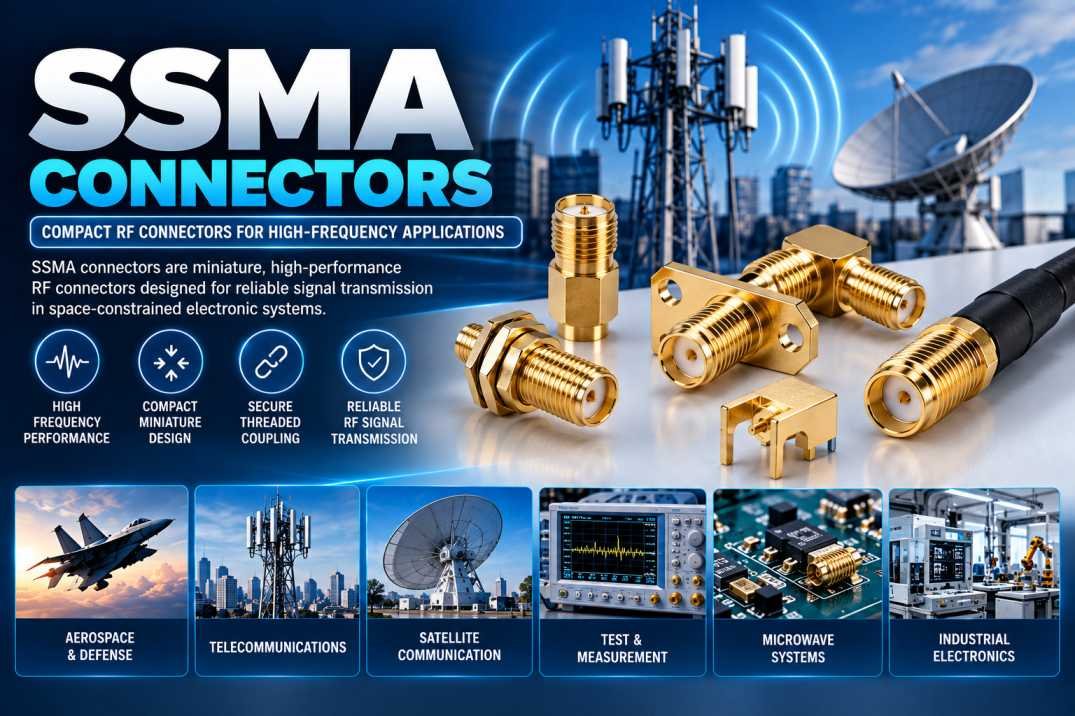
SSMA connectors are compact, high-frequency coaxial connectors designed for RF and microwave applications where space, reliable electrical performance, and secure connections are important. The SSMA connector is a smaller version of the SMA connector family and is particularly useful in systems where a miniature RF interface is required.
Because of their compact construction and threaded coupling mechanism, SSMA connectors are commonly used in aerospace, defense, telecommunications, wireless communication, test and measurement, satellite systems, and electronic equipment. They are suitable for applications that require dependable signal transmission at high frequencies while maintaining a small installation footprint.
What Are SSMA Connectors?
SSMA connectors are miniature coaxial RF connectors designed to provide a controlled impedance connection between RF cables, electronic circuits, antennas, and microwave equipment. The connector typically uses a threaded coupling mechanism that provides secure mating and helps maintain mechanical stability during operation.
SSMA connectors are commonly associated with 50-ohm RF systems and are available in male and female configurations. Depending on the design, they can be supplied as cable connectors, PCB-mounted connectors, bulkhead connectors, right-angle connectors, and other specialized configurations.
The smaller physical size of SSMA connectors makes them useful when conventional SMA connectors may occupy too much space.
SSMA Connector Construction
The construction of an SSMA connector is engineered to maintain electrical continuity and mechanical reliability at high frequencies. Although construction can vary according to the manufacturer and connector type, the main components generally include a center contact, dielectric insulator, outer conductor, coupling mechanism, and connector body.
Center Contact
The center contact carries the RF signal through the connector. It is manufactured from conductive materials and may feature plating selected for conductivity, durability, and corrosion resistance.
Dielectric Insulator
The dielectric separates the center conductor from the outer conductor. Its characteristics influence impedance control, signal propagation, insertion loss, and high-frequency performance.
Outer Conductor
The outer conductor provides the return path for the RF signal and contributes to electromagnetic shielding. Proper construction helps reduce unwanted interference and maintain signal integrity.
Connector Body
The connector body provides mechanical support and protects the internal components. Materials and plating are selected according to electrical, environmental, and mechanical requirements.
Threaded Coupling
SSMA connectors generally use a threaded coupling interface. This arrangement provides a secure connection and helps prevent accidental disconnection caused by vibration or movement.
Key Features of SSMA Connectors
SSMA connectors offer several characteristics that make them suitable for demanding RF and microwave applications:
- Compact miniature construction
- High-frequency RF capability
- Typically designed for 50-ohm systems
- Threaded coupling mechanism
- Reliable mechanical connection
- Low-profile installation options
- Good RF signal integrity
- Male and female configurations
- Cable, PCB, bulkhead, and right-angle versions
- Suitable for space-constrained electronic systems
- Available in different materials and plating options
- Useful for RF and microwave cable assemblies
SSMA Connectors and High-Frequency Performance
High-frequency systems are sensitive to impedance discontinuities, reflections, insertion loss, and connector geometry. SSMA connectors are designed with controlled internal dimensions to support consistent RF transmission.
Important performance parameters include VSWR, return loss, insertion loss, impedance, operating frequency, power handling, and mechanical durability.
The actual frequency capability of an SSMA connector depends on its specific construction and manufacturer. Therefore, the connector’s datasheet should always be reviewed before using it in a particular RF or microwave system.
Types of SSMA Connectors
SSMA connectors are available in several configurations to accommodate different installation requirements.
SSMA Male Connector
An SSMA male connector generally has a pin-style center contact and threaded coupling interface. It can be used with compatible SSMA female interfaces in RF systems.
SSMA Female Connector
The SSMA female connector provides the corresponding mating interface for an SSMA male connector. It is available in cable, panel, PCB, and other configurations.
SSMA Right-Angle Connector
A right-angle SSMA connector changes the direction of the cable connection by approximately 90 degrees. It is useful in compact equipment where straight cable routing is difficult.
SSMA Bulkhead Connector
Bulkhead SSMA connectors are designed to pass an RF connection through an equipment panel or enclosure. They provide a convenient interface between internal and external RF circuits.
SSMA PCB Connector
PCB-mounted SSMA connectors provide a direct RF interface between a printed circuit board and an external cable or RF component.
Applications of SSMA Connectors
SSMA connectors are used in a wide range of RF, microwave, communication, and electronic systems.
Aerospace and Defense
Their compact construction makes SSMA connectors suitable for aerospace electronics, radar systems, navigation equipment, avionics, and defense communication systems where equipment size and RF performance are important.
Wireless Communication
SSMA connectors can be used in wireless communication equipment, RF modules, radio systems, antennas, and compact communication devices.
Test and Measurement
RF test equipment often requires reliable high-frequency connections. SSMA connectors can be integrated into measurement instruments, RF test fixtures, signal generators, spectrum-analysis equipment, and laboratory systems.
Satellite Communication
Satellite and space-related systems frequently require compact RF components. SSMA connectors can provide miniature interfaces for RF and microwave assemblies where size and signal integrity are critical.
Microwave Systems
SSMA connectors are useful in microwave circuits, amplifiers, filters, attenuators, frequency converters, and other high-frequency components.
Industrial Electronics
Industrial RF equipment, instrumentation, sensors, control systems, and specialized electronic devices may use SSMA connectors where a compact RF interface is required.
Advantages of SSMA Connectors
One of the biggest advantages of SSMA connectors is their compact size. They provide an RF interface while occupying less physical space than many larger connector types.
Their threaded coupling provides a secure mechanical connection, while the coaxial construction supports controlled RF signal transmission. The availability of multiple configurations also allows engineers to select connectors according to cable routing, PCB layout, panel mounting, and equipment requirements.
SSMA connectors can therefore be particularly valuable in applications where miniaturization, high-frequency operation, mechanical stability, and reliable RF performance are required.
SSMA vs SMA Connectors
SSMA and SMA connectors share similar RF connector principles, but SSMA connectors are generally smaller and intended for applications where space is limited.
| Feature | SSMA Connector | SMA Connector |
|---|---|---|
| Size | Miniature | Compact |
| RF Application | High-frequency RF/microwave | RF/microwave |
| Coupling | Threaded | Threaded |
| Typical Impedance | 50 Ohms | 50 Ohms |
| Space Requirement | Very low | Low |
| Applications | Compact RF systems | Broad RF systems |
| Configurations | Cable, PCB, bulkhead, right-angle | Cable, PCB, bulkhead, right-angle |
The correct choice depends on the required frequency, available space, mechanical configuration, cable type, and electrical specifications.
How to Select the Right SSMA Connector
Before selecting an SSMA connector, engineers should evaluate several technical factors.
1. Frequency Range
Choose a connector rated for the required operating frequency. Higher-frequency systems require carefully controlled connector geometry.
2. Impedance
For most RF applications, a 50-ohm impedance is commonly used. The connector impedance should match the complete RF transmission system.
3. Connector Gender
Select male or female according to the mating interface of the cable, equipment, or RF component.
4. Mounting Configuration
Determine whether a straight cable connector, right-angle connector, bulkhead connector, or PCB-mounted version is required.
5. Cable Compatibility
For cable assemblies, verify conductor size, dielectric dimensions, cable outer diameter, shielding structure, and termination requirements.
6. RF Performance
Check VSWR, return loss, insertion loss, frequency range, and power-handling specifications where applicable.
7. Environmental Requirements
For outdoor, aerospace, defense, or industrial applications, consider temperature, vibration, moisture, corrosion, and material requirements.
Installation and Maintenance
Proper installation is important for maintaining SSMA connector performance. The mating surfaces should be clean and free from contamination. The connector should be aligned correctly before tightening to avoid damaging the threads or center contact.
Over-tightening should also be avoided because excessive mechanical force can damage the connector. For demanding RF applications, appropriate torque specifications and assembly procedures should be followed.
Regular inspection can help identify damaged threads, worn contacts, corrosion, contamination, or loose connections before they affect system performance.
Conclusion
SSMA connectors are compact RF and microwave connectors designed for applications requiring reliable high-frequency connections in limited spaces. Their miniature construction, threaded coupling, controlled RF interface, and availability in multiple configurations make them useful for aerospace, defense, telecommunications, satellite communication, wireless systems, test equipment, microwave circuits, and industrial electronics.
When selecting an SSMA connector, engineers should consider frequency range, impedance, connector gender, mounting configuration, cable compatibility, VSWR, insertion loss, environmental conditions, and mechanical requirements. Selecting the correct connector and using proper installation practices can help maintain reliable RF performance throughout the system.
FAQs About SSMA Connectors
1. What is an SSMA connector?
An SSMA connector is a miniature coaxial RF connector designed for high-frequency and microwave applications where compact size and reliable signal transmission are required.
2. What is the typical impedance of an SSMA connector?
SSMA connectors are commonly designed for 50-ohm RF systems, although the exact impedance should always be verified from the manufacturer’s specifications.
3. What is the difference between SSMA and SMA connectors?
SSMA connectors are generally smaller than SMA connectors. Both are used for RF and microwave applications and commonly use threaded coupling.
4. Are SSMA connectors suitable for high-frequency applications?
Yes. SSMA connectors are designed for high-frequency RF and microwave applications, subject to the frequency rating of the specific connector model.
5. Are SSMA connectors available in male and female versions?
Yes. SSMA connectors are available in male and female configurations along with various cable, PCB, bulkhead, and right-angle designs.
6. Where are SSMA connectors used?
They are used in aerospace, defense, wireless communication, satellite systems, microwave equipment, RF testing, telecommunications, and industrial electronics.
7. Can SSMA connectors be used for PCB applications?
Yes. PCB-mounted SSMA connectors are available for providing compact RF interfaces between printed circuit boards and external RF cables or equipment.
8. What factors should be considered when selecting an SSMA connector?
Frequency range, impedance, gender, mounting style, cable compatibility, VSWR, insertion loss, power handling, materials, and environmental requirements should be considered.
9. Why are SSMA connectors useful in compact equipment?
Their miniature form factor allows engineers to integrate RF connections into systems where board space and equipment dimensions are limited.
10. Are SSMA connectors suitable for RF cable assemblies?
Yes. SSMA connectors can be terminated to compatible RF cables to create cable assemblies for high-frequency communication, measurement, microwave, and electronic systems.