RG8 Coax Cable is a 50-ohm RF coaxial cable widely used for antenna systems, radio communication, wireless transmission, and RF signal distribution. Its relatively large conductor size and robust construction make it suitable for applications where dependable signal transmission and controlled RF losses are important.
RG8 cable is available in different constructions depending on the manufacturer, including solid or stranded conductors, PE or foamed PE dielectric, and different shielding configurations. Therefore, electrical performance should always be verified against the specific cable datasheet before selecting it for a critical RF system.
What Is RG8 Coax Cable?
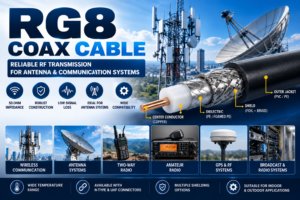
RG8 Coax Cable is a large-diameter 50-ohm coaxial cable designed for RF and wireless transmission systems. It generally consists of a central conductor, dielectric insulation, an outer conductive shield, and a protective jacket.
The 50-ohm impedance makes RG8 suitable for many radio-frequency systems, particularly antenna feeder and wireless communication applications. Commercial RG8 variants are used for point-to-point and point-to-multipoint wireless antenna communication, two-way radio, amateur radio, GPS, RFID, and related systems.
RG8 Coax Cable Construction
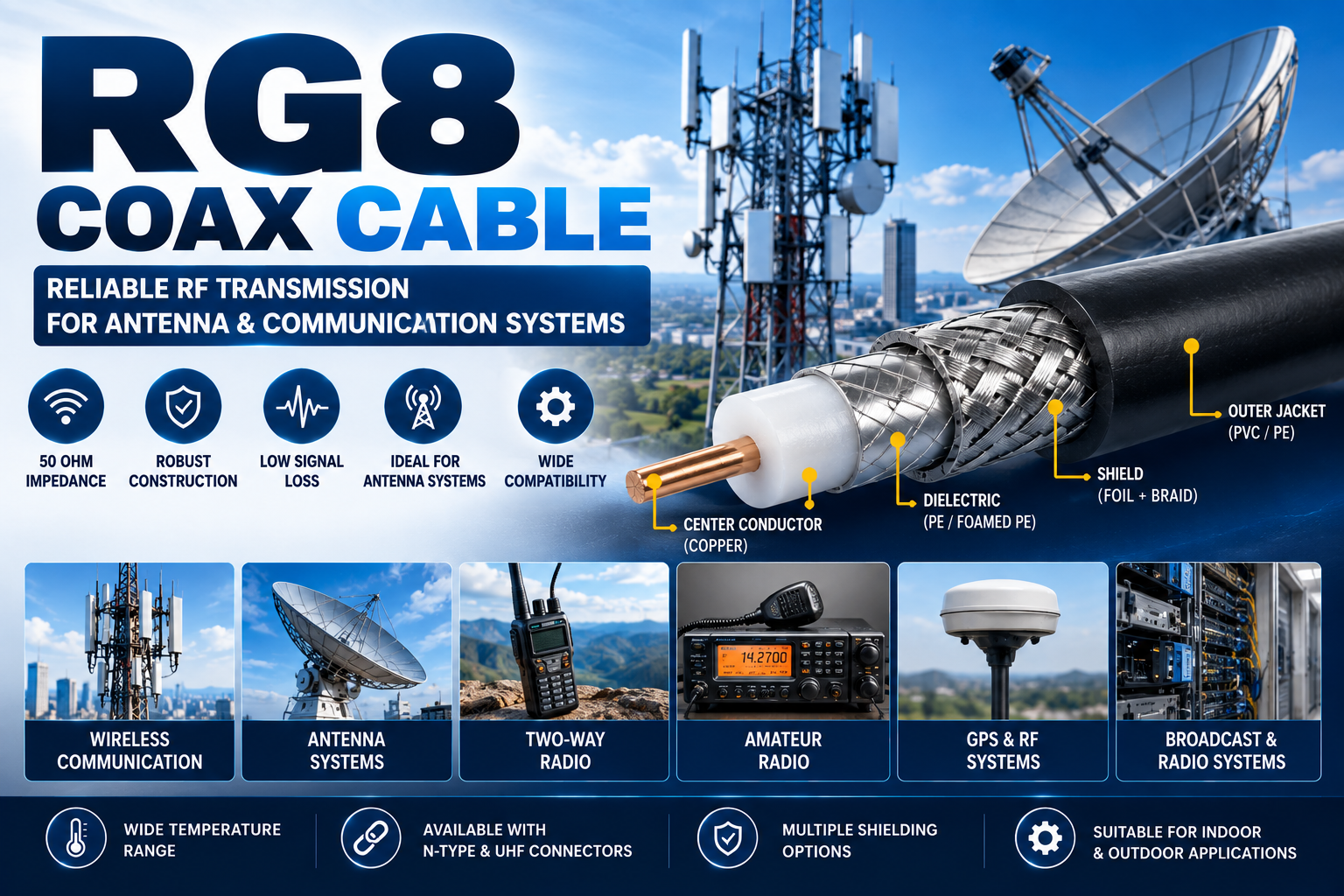
The performance of RG8 depends heavily on its construction. A typical RG8 design contains four main layers:
Center Conductor
The center conductor carries the RF signal. Depending on the cable version, it may use bare copper, tinned copper, copper-clad materials, or stranded copper construction.
Dielectric
The dielectric separates the center conductor from the shield and helps maintain the required impedance. Polyethylene and foamed polyethylene are commonly found in RG8-type constructions.
Shield
The outer conductor provides electrical shielding and serves as the return path for the RF signal. Some modern RG8 variants combine foil and braided shielding to improve shielding effectiveness.
Outer Jacket
The jacket protects the internal construction from mechanical damage and environmental exposure. Jacket materials vary according to whether the cable is designed for indoor, outdoor, flexible, direct-burial, or specialized installations.
RG8 Coax Cable Specifications
Specifications vary between manufacturers and RG8 variants, so the following should be considered general characteristics rather than universal values.
| Parameter | Typical RG8 Characteristics |
|---|---|
| Cable Type | RG8 Coaxial Cable |
| Impedance | 50 Ohms |
| Conductor | Copper or copper-based construction |
| Dielectric | PE / Foamed PE |
| Shield | Braid, foil + braid, depending on version |
| Application | RF, antenna and wireless systems |
| Construction | Large-diameter coaxial cable |
| Jacket | PVC, PE or specialized materials |
| Connector Options | N-Type, UHF and other RF connectors |
For example, commercially available RG8 products are specified as 50-ohm cables and are offered for wireless antenna communication and radio applications.
Key Features of RG8 Coax Cable
50-Ohm RF Performance
RG8 is designed around a 50-ohm impedance, making it compatible with many transmitters, receivers, antennas, and RF communication systems.
Robust Construction
Its larger physical construction provides mechanical strength and makes it suitable for feeder and antenna applications where smaller coaxial cables may not provide the desired performance.
Reliable Shielding
Depending on the design, RG8 can incorporate foil and braided shielding. Shielding helps reduce unwanted electromagnetic interference and limits RF leakage.
Antenna Feeder Capability
RG8 is commonly selected for connecting RF equipment to antennas, particularly in radio and wireless communication installations.
Multiple Construction Options
RG8 is not a single universal construction. Different manufacturers offer variations optimized for flexibility, environmental resistance, shielding, attenuation, or installation requirements.
Applications of RG8 Coax Cable
RG8 Coax Cable is commonly used in a variety of RF and communication systems.
Wireless Communication
RG8 can be used as an RF transmission cable between wireless equipment and antennas.
Two-Way Radio
Its 50-ohm configuration makes it suitable for many two-way radio and communication installations.
Amateur Radio
RG8 is widely associated with amateur radio antenna feeder systems where reliable RF transmission is required.
Antenna Systems
The cable can connect transmitters, receivers, RF equipment, and external antennas.
GPS and RF Systems
Certain RG8 variants are used in RF-related positioning, wireless and instrumentation applications.
Broadcast and Radio Systems
RG8-type cables can also be used in radio transmission and related RF distribution systems, depending on required frequency and attenuation characteristics.
RG8 Coax Cable vs RG188 Cable
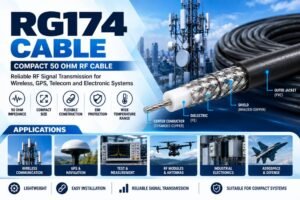
RG8 and RG 188 Cable are both 50-ohm RF cable families, but their physical designs are significantly different.
RG8 is a relatively large cable commonly used for antenna feeders and wireless transmission. RG188 is a much smaller, flexible cable generally designed for compact RF assemblies and precision applications. RG188 variants commonly use PTFE dielectric and plated conductors and can be specified for applications up to several GHz.
Therefore, RG8 is generally considered when cable size, antenna connection, and feeder requirements are important, while RG 188 Cable can be more appropriate where compact dimensions, flexibility, and high-temperature performance are required.
How to Select the Right RG8 Coax Cable
Before purchasing RG8 Coax Cable, evaluate:
- Required operating frequency
- Cable attenuation
- Impedance
- Shielding configuration
- Cable length
- Minimum bending radius
- Indoor or outdoor installation
- Temperature requirements
- Connector type
- Transmitter power
- Environmental exposure
A cable that performs well at one frequency may have significantly different attenuation at another frequency. Therefore, frequency-specific attenuation and maximum operating ratings should be checked using the manufacturer’s datasheet.
RG8 Cable Connectors
RG8 cables can be terminated using different RF connector types depending on equipment requirements. Common choices include N-Type and UHF connectors, while specialized assemblies may use other compatible RF interfaces.
Connector selection should consider impedance, frequency rating, power handling, environmental requirements, and cable diameter.
Benefits of Using RG8 Coax Cable
RG8 offers a combination of:
- 50-ohm RF compatibility
- Robust physical construction
- Reliable RF transmission
- Availability in different shielding configurations
- Suitability for antenna systems
- Compatibility with radio communication equipment
- Multiple jacket and conductor options
The exact performance depends on the selected manufacturer’s construction, so comparing datasheets is important when designing a high-performance RF system.
Conclusion
RG8 Coax Cable remains a practical choice for 50-ohm RF transmission, antenna feeder systems, radio communication, and wireless applications. Its robust construction and availability in multiple configurations allow engineers to select a version suited to specific installation and performance requirements.
For compact RF assemblies where smaller dimensions and PTFE-based construction are preferred, RG 188 Cable represents a different cable class and should be evaluated according to frequency, temperature, flexibility, and attenuation requirements.
FAQs About RG8 Coax Cable
1. What is RG8 Coax Cable?
RG8 Coax Cable is a 50-ohm RF coaxial cable commonly used for antenna, radio, wireless communication, and RF transmission systems.
2. Is RG8 cable 50 ohms?
Yes. RG8-type cables are generally designed as 50-ohm coaxial cables.
3. What is RG8 cable used for?
RG8 is commonly used for antenna feeders, two-way radio, amateur radio, wireless communication, RF transmission, and related systems.
4. What connectors are used with RG8 cable?
N-Type and UHF connectors are commonly used, although the appropriate connector depends on the equipment and cable construction.
5. Is RG8 suitable for outdoor applications?
Some RG8 variants are designed for outdoor use. The specific jacket, environmental rating, and installation requirements should be checked before outdoor deployment.
6. What is the difference between RG8 and RG188 Cable?
RG8 is a larger cable commonly used for antenna and feeder applications, while RG188 is a much smaller RF cable often used for compact assemblies and precision applications.
7. Does RG8 have low signal loss?
RG8 can provide suitable RF transmission performance, but attenuation depends on the specific construction, frequency, cable length, and manufacturer.
8. Can RG8 be used for wireless communication?
Yes. RG8 variants are widely specified for wireless antenna communication and radio transmission applications.
9. Is RG8 suitable for amateur radio?
Yes. RG8-type cables are commonly used as antenna feeder cables in amateur radio systems.
10. How do I choose RG8 Coax Cable?
Consider impedance, operating frequency, attenuation, cable length, shielding, power requirements, environment, bending radius, and connector compatibility.