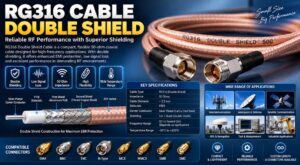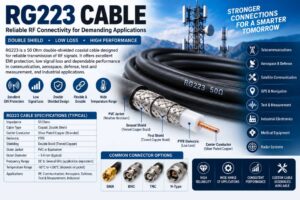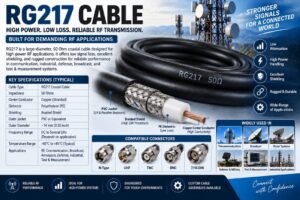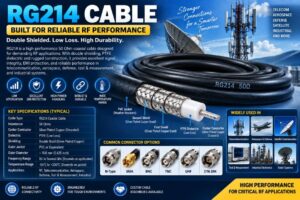
In today’s fast-paced telecommunications and electronics industry, RF cable assemblies play a critical role in ensuring reliable signal transmission across various systems and devices. From wireless communication networks and broadcasting equipment to military systems and medical devices, RF cable assemblies are essential components that support high-frequency signal transfer with minimal loss and interference.
As the demand for faster communication, higher bandwidth, and advanced connectivity solutions continues to grow, understanding RF cable assemblies becomes increasingly important for engineers, procurement professionals, and system integrators. This comprehensive guide explores the overview, key features, benefits, types, and applications of RF cable assemblies while highlighting their significance in modern technology.
What is an RF Cable Assembly?
An RF (Radio Frequency) cable assembly is a specialized cable system designed to transmit radio frequency signals between electronic devices. It typically consists of a coaxial cable fitted with RF connectors at one or both ends, creating a complete assembly ready for installation.
RF cable assemblies are engineered to carry high-frequency electrical signals with minimal attenuation, distortion, and electromagnetic interference (EMI). These assemblies are widely used in communication systems, antennas, test equipment, satellite systems, and various industrial applications.
The primary purpose of an RF cable assembly is to maintain signal integrity while ensuring efficient connectivity between components operating within radio frequency ranges.
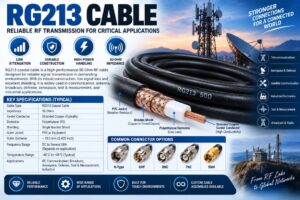
Components of an RF Cable Assembly
Understanding the structure of an RF cable assembly helps in selecting the right solution for specific applications.
1. Center Conductor
The center conductor carries the RF signal. It is typically made of copper, silver-plated copper, or other conductive materials that offer excellent electrical performance.
2. Dielectric Insulation
The dielectric layer surrounds the center conductor and maintains proper spacing between the conductor and shield. Materials such as PTFE (Polytetrafluoroethylene) are commonly used due to their low dielectric loss.
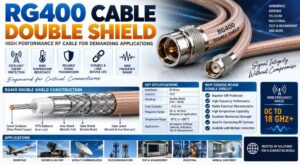
3. Shielding Layer
The shielding layer protects the signal from external electromagnetic interference. It may consist of braided copper, aluminum foil, or a combination of both.
4. Outer Jacket
The outer jacket provides mechanical protection and environmental resistance. Depending on the application, it may be constructed from PVC, polyurethane, fluoropolymers, or other durable materials.
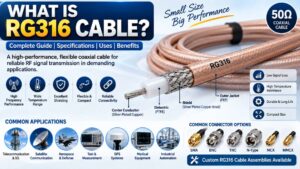
5. RF Connectors
Connectors are attached to the cable ends and enable secure connections between devices. Common RF connector types include:
- SMA Connectors
- BNC Connectors
- N-Type Connectors
- TNC Connectors
- MCX Connectors
- MMCX Connectors
- UHF Connectors
- F-Type Connectors
How RF Cable Assemblies Work
RF cable assemblies function by transmitting high-frequency signals through a coaxial structure. The central conductor carries the signal while the surrounding shield prevents external noise from interfering with signal quality.
The coaxial design ensures consistent impedance throughout the cable, which is crucial for minimizing signal reflections and maintaining efficient power transfer. Proper impedance matching, typically 50 ohms or 75 ohms, helps optimize system performance.
As signals travel through the cable, high-quality materials and precision manufacturing techniques help reduce losses and maintain signal strength over longer distances.
Key Features of RF Cable Assemblies
High-Frequency Signal Transmission
RF cable assemblies are specifically designed to support frequencies ranging from a few megahertz (MHz) to several gigahertz (GHz), making them suitable for modern communication technologies.
Low Signal Loss
One of the most important features is low insertion loss. High-quality assemblies minimize attenuation, ensuring signals reach their destination with maximum strength.
Excellent Shielding Performance
Advanced shielding protects against electromagnetic interference (EMI) and radio frequency interference (RFI), which is essential in environments with multiple electronic devices.
Impedance Stability
RF cable assemblies maintain consistent impedance throughout the signal path, reducing reflections and signal degradation.
Durability and Reliability
These assemblies are built to withstand challenging operating conditions, including vibration, temperature fluctuations, moisture, and mechanical stress.
Flexible Design Options
Manufacturers offer RF cable assemblies in various lengths, connector configurations, and cable types to meet diverse application requirements.
High Power Handling Capability
Certain RF cable assemblies are engineered to handle high-power RF signals without compromising performance or safety.
Customization Capabilities
Customized RF cable assemblies can be designed based on:
- Cable type
- Connector selection
- Length requirements
- Environmental specifications
- Frequency range
- Power handling needs
Benefits of Using RF Cable Assemblies
Improved Signal Integrity
High-quality RF cable assemblies ensure accurate signal transmission with minimal distortion and noise.
Reduced Installation Time
Pre-assembled and tested cable assemblies simplify installation and reduce labor costs.
Enhanced System Performance
Properly designed assemblies contribute to better network efficiency, communication quality, and equipment reliability.
Cost-Effective Solution
Ready-to-install assemblies eliminate the need for on-site connector termination, reducing errors and maintenance costs.
Greater Reliability
Factory-tested assemblies provide consistent performance and reduce the likelihood of connection failures.
Compliance with Industry Standards
Many RF cable assemblies are manufactured according to international quality and performance standards, ensuring compatibility and reliability.
Types of RF Cable Assemblies
Flexible RF Cable Assemblies
Flexible assemblies are ideal for applications requiring frequent movement or routing through tight spaces.
Advantages:
- Easy installation
- Excellent flexibility
- Lightweight construction
Applications:
- Wireless equipment
- Test systems
- Medical devices
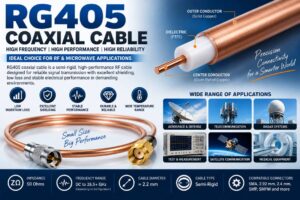
Semi-Rigid RF Cable Assemblies
Semi-rigid cables offer superior electrical performance and shielding effectiveness.
Advantages:
- Low signal loss
- Excellent shielding
- Stable performance
Applications:
- Aerospace systems
- Military equipment
- Satellite communications
Hand-Formable RF Cable Assemblies
These assemblies combine flexibility with the performance advantages of semi-rigid cables.
Advantages:
- Easy shaping
- Stable routing
- High-frequency performance
Armored RF Cable Assemblies
Armored assemblies include additional protective layers for harsh environments.
Advantages:
- Enhanced durability
- Mechanical protection
- Long service life
Applications:
- Industrial environments
- Defense systems
- Outdoor installations
Common RF Connector Types
SMA Connectors
SMA connectors are widely used in microwave applications due to their compact size and excellent frequency performance.
BNC Connectors
BNC connectors provide quick-connect functionality and are commonly used in test equipment and video systems.
N-Type Connectors
N-Type connectors offer reliable performance in outdoor and high-power applications.
TNC Connectors
TNC connectors provide improved environmental resistance compared to BNC connectors.
MCX and MMCX Connectors
These miniature connectors are ideal for compact electronic devices and wireless communication equipment.
Applications of RF Cable Assemblies
RF cable assemblies serve a wide range of industries and applications.
Telecommunications Industry
The telecommunications sector relies heavily on RF cable assemblies for signal transmission in:
- Cellular networks
- 4G LTE systems
- 5G infrastructure
- Base stations
- Antenna connections
- Distributed antenna systems (DAS)
RF cable assemblies help maintain high-speed connectivity and support modern communication requirements.
Wireless Communication Systems
Wireless devices require dependable RF connections to ensure seamless communication.
Common applications include:
- Wi-Fi routers
- Access points
- Wireless modules
- IoT devices
- Bluetooth systems
Aerospace and Defense
Aerospace and military systems demand exceptional reliability and performance.
RF cable assemblies are used in:
- Radar systems
- Electronic warfare systems
- Navigation equipment
- Aircraft communication systems
- Satellite communications
- Missile guidance systems
These applications require assemblies capable of operating under extreme environmental conditions.
Broadcasting and Media
Broadcasting equipment depends on RF cable assemblies for signal distribution and transmission.
Applications include:
- Television broadcasting
- Radio broadcasting
- Studio equipment
- Transmission towers
- Audio-video systems
Medical Equipment
Modern healthcare technologies use RF cable assemblies in various diagnostic and treatment devices.
Examples include:
- MRI machines
- Medical imaging systems
- Patient monitoring equipment
- Surgical systems
- Wireless healthcare devices
Reliable signal transmission is essential for accurate diagnostics and patient safety.
Satellite Communication
Satellite systems require high-performance RF assemblies capable of operating at extremely high frequencies.
Applications include:
- Ground stations
- Satellite terminals
- VSAT systems
- Space communication networks
Industrial Automation
Industrial facilities use RF cable assemblies for communication and control systems.
Applications include:
- Factory automation
- Robotics
- Remote monitoring systems
- Industrial wireless networks
Test and Measurement Equipment
Laboratories and research facilities utilize RF cable assemblies in:
- Spectrum analyzers
- Signal generators
- Network analyzers
- Oscilloscopes
- RF testing platforms
Precision signal transmission is critical for accurate measurement results.
Automotive Industry
Modern vehicles incorporate RF cable assemblies in:
- GPS systems
- Vehicle communication modules
- Advanced driver assistance systems (ADAS)
- Infotainment systems
- Telematics solutions
Renewable Energy Systems
Renewable energy infrastructure increasingly relies on RF communication technologies.
Applications include:
- Solar monitoring systems
- Wind turbine communication networks
- Smart grid infrastructure
- Remote sensing equipment
Factors to Consider When Selecting RF Cable Assemblies
Frequency Range
Ensure the assembly supports the operating frequency required by your application.
Cable Loss
Lower loss cables are preferred for long-distance signal transmission and high-frequency applications.
Connector Compatibility
Choose connectors that match existing equipment and performance requirements.
Environmental Conditions
Consider factors such as:
- Temperature range
- Humidity
- UV exposure
- Chemical resistance
- Mechanical stress
Flexibility Requirements
Determine whether the installation requires flexible, semi-rigid, or armored cable assemblies.
Power Handling Capacity
Select an assembly capable of safely handling the required RF power levels.
Shielding Effectiveness
Applications in electrically noisy environments require superior shielding performance.
Importance of Quality Manufacturing
The performance of an RF cable assembly depends significantly on manufacturing quality. Precision assembly techniques help ensure:
- Consistent impedance
- Reliable connector attachment
- Low insertion loss
- High return loss performance
- Long-term reliability
Leading manufacturers perform extensive testing, including:
- Continuity testing
- VSWR testing
- Insertion loss measurement
- Environmental testing
- Mechanical durability testing
These quality assurance procedures help guarantee optimal performance and compliance with industry standards.
Future Trends in RF Cable Assembly Technology
The rapid advancement of wireless technologies continues to drive innovation in RF cable assembly design.
Growth of 5G Networks
The global rollout of 5G infrastructure requires advanced RF assemblies capable of supporting higher frequencies and increased bandwidth.
Expansion of IoT Devices
The Internet of Things (IoT) is creating new demand for compact, high-performance RF connectivity solutions.
Increased Satellite Deployments
The growth of satellite internet services and space exploration projects is driving demand for specialized RF cable assemblies.
Miniaturization
Manufacturers are developing smaller, lighter assemblies to support compact electronic devices and wearable technologies.
Improved Materials
Advanced materials are enhancing signal performance, durability, and environmental resistance.
Conclusion
RF cable assemblies are indispensable components in modern communication and electronic systems. Designed to transmit high-frequency signals with exceptional reliability, they provide the foundation for telecommunications, aerospace, defense, medical equipment, broadcasting, industrial automation, and many other applications.
Key features such as low signal loss, excellent shielding, impedance stability, durability, and customization make RF cable assemblies essential for maintaining optimal system performance. As technologies such as 5G, IoT, satellite communications, and advanced wireless networks continue to evolve, the importance of high-quality RF cable assemblies will only increase.
Organizations seeking reliable signal transmission solutions should prioritize quality manufacturing, proper cable selection, and application-specific requirements to maximize performance and long-term reliability. By choosing the right RF cable assembly, businesses can ensure efficient communication, reduced downtime, and superior operational performance in an increasingly connected world.