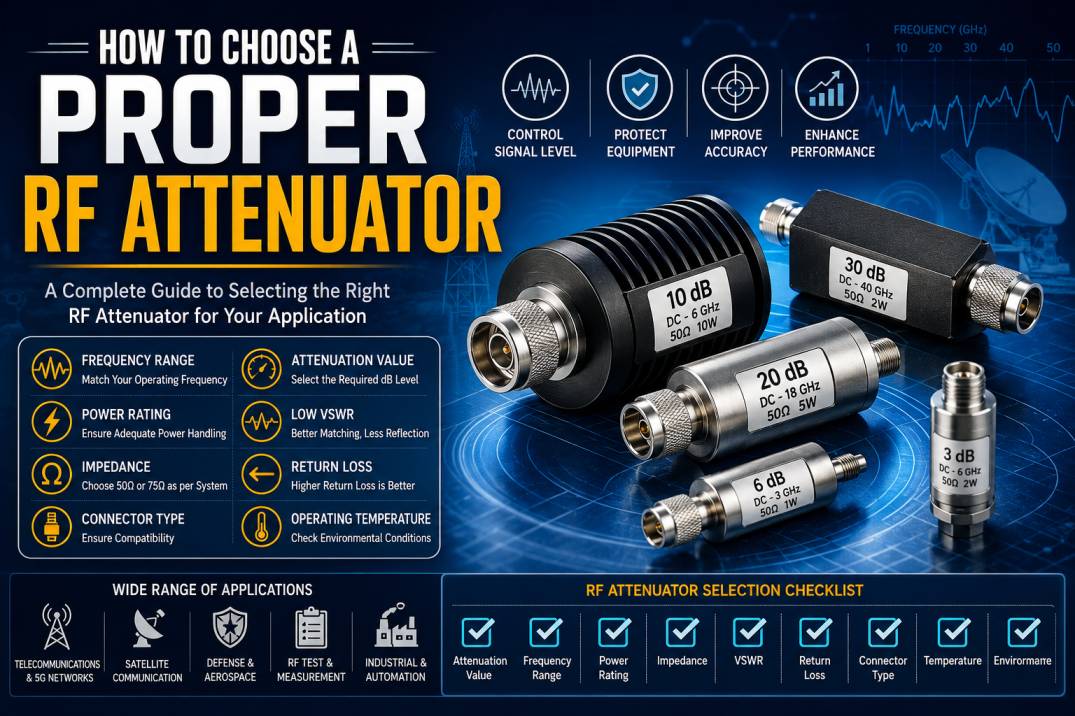
Selecting the right RF Attenuator is essential for maintaining signal integrity, protecting sensitive RF equipment, and ensuring accurate measurements in communication systems. Whether you’re working with wireless networks, defense electronics, satellite communications, laboratory testing, or 5G infrastructure, choosing the correct attenuator can significantly improve system performance.
An RF attenuator reduces signal power without introducing significant distortion. However, selecting the wrong attenuation value, power rating, or frequency range can result in poor performance, inaccurate measurements, and even equipment damage.
This guide explains everything you need to know before purchasing an RF attenuator.
What is an RF Attenuator?
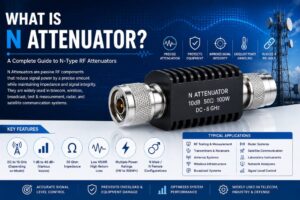
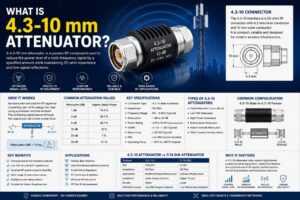
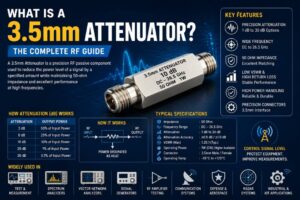
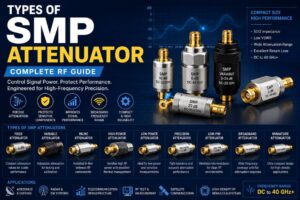
An RF Attenuator is a passive electronic component designed to reduce the amplitude of RF or microwave signals while maintaining the signal waveform. It is commonly installed between RF devices to control signal levels and improve impedance matching.
RF attenuators are available in various connector types, power ratings, attenuation values, and frequency ranges to meet different application requirements.
Why Choosing the Right RF Attenuator Matters
Choosing the proper RF attenuator provides several advantages:
- Protects expensive RF instruments
- Prevents signal overload
- Improves measurement accuracy
- Maintains impedance matching
- Reduces unwanted reflections
- Enhances signal stability
- Improves system reliability
- Increases equipment lifespan
A properly selected attenuator ensures that your RF system performs efficiently under all operating conditions.
Factors to Consider When Choosing an RF Attenuator
1. Determine the Required Attenuation Value
The first step is deciding how much signal reduction is required.
Attenuation is measured in decibels (dB).
Common attenuation values include:
| Attenuation | Typical Use |
|---|---|
| 1 dB | Fine signal adjustment |
| 2 dB | Minor signal reduction |
| 3 dB | Half power reduction |
| 6 dB | Quarter power reduction |
| 10 dB | General testing |
| 20 dB | Equipment protection |
| 30 dB | High signal reduction |
| 40 dB | Laboratory applications |
Selecting too little attenuation may overload equipment, while too much attenuation can weaken the signal excessively.
2. Frequency Range
Every RF attenuator is designed for a specific frequency range.
Typical frequency ranges include:
- DC to 3 GHz
- DC to 6 GHz
- DC to 18 GHz
- DC to 26.5 GHz
- DC to 40 GHz
- DC to 50 GHz
- DC to 67 GHz
- DC to 110 GHz
Always choose an attenuator whose frequency rating exceeds your system’s operating frequency.
Higher-frequency applications demand precision-engineered attenuators with excellent electrical performance.
3. Power Rating
The attenuator must safely dissipate the RF power passing through it.
Typical power ratings include:
- 0.5 Watt
- 1 Watt
- 2 Watt
- 5 Watt
- 10 Watt
- 20 Watt
- 50 Watt
- 100 Watt
- 250 Watt
- 500 Watt
Never operate an attenuator above its maximum power rating.
Exceeding the power limit can permanently damage the device.
4. Impedance
Most RF systems use either:
- 50 Ohm
- 75 Ohm
Selecting the wrong impedance causes:
- Signal reflections
- Poor return loss
- High VSWR
- Reduced system efficiency
For wireless communication, defense, aerospace, and laboratory equipment, 50 Ohm attenuators are the industry standard.
5. VSWR Performance
VSWR (Voltage Standing Wave Ratio) measures impedance matching quality.
Lower VSWR means:
- Better matching
- Lower reflections
- Better transmission
- Higher efficiency
Typical specifications:
- 1.05:1 Excellent
- 1.10:1 Very Good
- 1.20:1 Good
- 1.30:1 Acceptable
Choose the lowest possible VSWR for precision applications.
6. Return Loss
Return Loss indicates how much signal reflects back toward the source.
Higher return loss means:
- Better impedance matching
- Reduced reflections
- Improved measurement accuracy
Typical values:
- 20 dB Good
- 25 dB Better
- 30 dB Excellent
7. Connector Type
Connector compatibility is critical.
Popular RF connector types include:
- SMA
- N Type
- TNC
- BNC
- 2.92mm
- 2.4mm
- 1.85mm
- 1.0mm
- SMP
- SMPM
- SSMA
- MCX
- MMCX
- QMA
Always ensure the connector matches your existing RF system.
8. Operating Temperature
Industrial and military applications often require wider operating temperatures.
Typical range:
- -55°C to +125°C
For outdoor installations, select attenuators designed for harsh environments.
9. Environmental Conditions
Consider the installation environment.
Factors include:
- Dust
- Moisture
- Vibration
- Corrosion
- Salt fog
- High humidity
- Temperature fluctuations
Outdoor RF systems require rugged, weather-resistant attenuators.
10. Fixed or Variable RF Attenuator
Fixed RF Attenuator
Provides one constant attenuation value.
Advantages:
- High accuracy
- Better stability
- Lower cost
- Reliable performance
Best for:
- Communication systems
- Base stations
- Production testing
- Satellite equipment
Variable RF Attenuator
Allows adjustable attenuation.
Advantages:
- Flexible operation
- Suitable for laboratories
- Ideal for R&D
Best for:
- RF testing
- Calibration
- Research laboratories
- Development work
Common Applications of RF Attenuators
5G Communication Networks
RF attenuators regulate signal levels between:
- Base stations
- Small cells
- Distributed antenna systems
- Massive MIMO equipment
Defense Systems
Used in:
- Radar systems
- Electronic warfare
- Secure communication
- Missile guidance
- Military communication equipment
Satellite Communication
RF attenuators improve signal control in:
- Ground stations
- Satellite payload testing
- VSAT systems
- Earth stations
Aerospace
Applications include:
- Flight communication
- Navigation systems
- Avionics
- Radar testing
RF Test Laboratories
Widely used with:
- Vector Network Analyzers
- Spectrum Analyzers
- Signal Generators
- Power Meters
- Oscilloscopes
Broadcasting
Used in:
- FM stations
- Television broadcasting
- Cable television
- RF distribution networks
Medical Equipment
Medical RF systems use attenuators for:
- MRI machines
- Imaging equipment
- Diagnostic systems
- RF calibration
Industrial Automation
Applications include:
- Wireless monitoring
- Factory communication
- IoT systems
- Remote sensing
Mistakes to Avoid When Selecting an RF Attenuator
Many users make common selection errors.
Avoid these mistakes:
- Ignoring frequency specifications
- Selecting the wrong connector
- Choosing insufficient power handling
- Using incorrect impedance
- Ignoring VSWR values
- Overlooking return loss
- Buying low-quality products
- Not considering future system upgrades
Quick RF Attenuator Selection Checklist
Before purchasing, verify the following:
- Required attenuation value
- Operating frequency
- Maximum RF power
- Connector type
- Impedance (50Ω or 75Ω)
- VSWR specification
- Return loss
- Operating temperature
- Environmental requirements
- Fixed or variable type
- Mechanical dimensions
- Manufacturer quality standards
Why Buy a High-Quality RF Attenuator?
A premium RF attenuator offers:
- Stable attenuation
- Excellent repeatability
- Low insertion error
- High power handling
- Superior return loss
- Low VSWR
- Long operational life
- Precision machining
- Reliable performance in demanding environments
High-quality attenuators reduce maintenance costs and improve long-term system reliability.
Conclusion
Choosing the proper RF Attenuator involves more than selecting an attenuation value. Factors such as frequency range, power rating, impedance, VSWR, return loss, connector compatibility, and environmental conditions all influence performance. A carefully selected attenuator protects valuable RF equipment, improves signal quality, and ensures accurate system operation across telecommunications, aerospace, defense, medical, industrial, and laboratory applications.
Investing in a precision-engineered RF attenuator ensures long-term reliability, lower maintenance costs, and optimal RF system performance.
Frequently Asked Questions (FAQs)
1. What is the purpose of an RF attenuator?
An RF attenuator reduces signal power while preserving signal quality and protecting sensitive RF equipment from excessive input levels.
2. How do I choose the correct attenuation value?
Choose the attenuation based on your desired signal reduction. Common values include 3 dB, 6 dB, 10 dB, 20 dB, and 30 dB, depending on the application.
3. What impedance should I choose?
Most RF communication systems use 50 Ohm attenuators, while television and some broadcast applications commonly use 75 Ohm models.
4. Why is power rating important?
The power rating determines how much RF energy the attenuator can safely dissipate. Selecting a lower-rated attenuator than required can lead to overheating and permanent damage.
5. What is VSWR in an RF attenuator?
VSWR measures impedance matching. A lower VSWR indicates better performance, reduced signal reflections, and improved efficiency.
6. Can I use the same RF attenuator for all frequencies?
No. Always select an RF attenuator with a frequency range that covers or exceeds your operating frequency.
7. What is the difference between a fixed and variable RF attenuator?
A fixed RF attenuator provides a constant attenuation value, while a variable RF attenuator allows the attenuation level to be adjusted as needed.
8. Which industries commonly use RF attenuators?
RF attenuators are widely used in telecommunications, 5G infrastructure, aerospace, defense, satellite communications, medical equipment, broadcasting, industrial automation, and RF testing laboratories.
9. Which connector types are available for RF attenuators?
Common connector options include SMA, N Type, TNC, BNC, 2.92mm, 2.4mm, 1.85mm, SMP, SMPM, MCX, MMCX, and QMA.
10. Why should I buy a high-quality RF attenuator?
A high-quality RF attenuator offers better signal accuracy, low VSWR, excellent return loss, consistent attenuation, greater durability, and reliable performance in demanding RF and microwave applications.