RF cable assemblies are critical components in modern communication systems, ensuring reliable transmission of radio frequency and microwave signals with minimal loss. They are widely used in telecommunications, aerospace, defense, medical equipment, satellite communications, radar systems, broadcasting, and RF testing laboratories. Selecting the right RF cable assembly directly impacts signal quality, system efficiency, and long-term reliability.
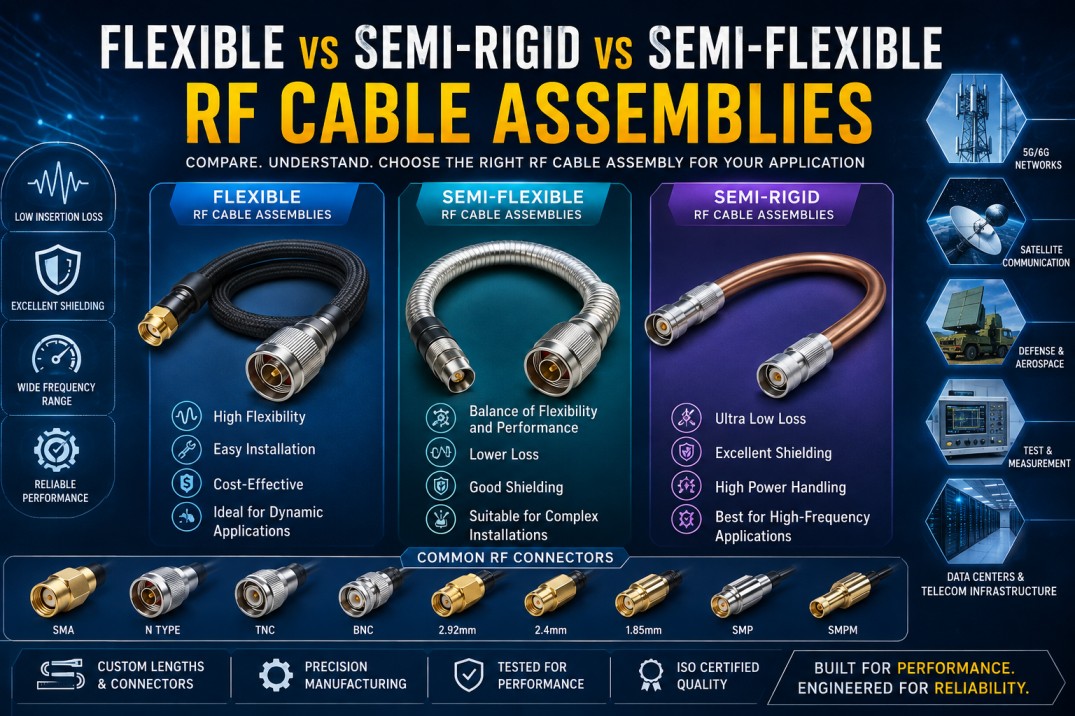
Among the most commonly used RF cable assemblies are Flexible RF Cable Assemblies, Semi-Rigid RF Cable Assemblies, and Semi-Flexible RF Cable Assemblies. Each type is designed to meet specific mechanical and electrical requirements. Understanding their differences helps engineers and buyers choose the most suitable cable for their application.
This comprehensive guide compares flexible, semi-rigid, and semi-flexible RF cable assemblies in terms of construction, performance, advantages, disadvantages, frequency range, applications, and selection criteria.
What is an RF Cable Assembly?
An RF cable assembly is a complete cable solution consisting of a coaxial cable terminated with RF connectors on one or both ends. These assemblies are engineered to transmit high-frequency electrical signals while maintaining impedance, minimizing insertion loss, and reducing electromagnetic interference.
RF cable assemblies are available in numerous connector combinations such as SMA, N Type, TNC, BNC, 2.92mm, 2.4mm, 1.85mm, SMP, SMPM, MCX, MMCX, QMA, and many others.
Types of RF Cable Assemblies
The three primary categories include:
- Flexible RF Cable Assemblies
- Semi-Rigid RF Cable Assemblies
- Semi-Flexible RF Cable Assemblies
Each offers unique advantages depending on the application’s mechanical and electrical requirements.
What are Flexible RF Cable Assemblies?
Flexible RF cable assemblies are designed using braided outer conductors and flexible dielectric materials, allowing the cable to bend repeatedly without performance degradation.
These cables are ideal for installations where routing around equipment, movement, vibration, or maintenance is required.
Construction
- Multi-strand center conductor
- PTFE or Foam dielectric
- Braided copper shielding
- Flexible PVC, FEP, or TPE outer jacket
Key Features
- Excellent flexibility
- Easy installation
- Good vibration resistance
- Lightweight construction
- Available in numerous connector options
Advantages
- Easy to install in confined spaces
- Suitable for repeated bending
- Cost-effective
- Simple replacement and maintenance
- Excellent for portable equipment
Limitations
- Higher insertion loss than semi-rigid cables
- Slightly lower shielding effectiveness
- Reduced phase stability
- Moderate power handling capability
What are Semi-Rigid RF Cable Assemblies?
Semi-rigid RF cable assemblies use a solid metal outer conductor, typically seamless copper tubing, providing outstanding electrical performance.
These cables maintain their shape after bending and offer extremely low signal loss.
Construction
- Solid silver-plated center conductor
- PTFE dielectric
- Seamless copper outer conductor
- No external jacket
Key Features
- Ultra-low insertion loss
- Superior shielding
- Excellent phase stability
- High frequency capability
- Extremely low VSWR
Advantages
- Outstanding microwave performance
- Excellent return loss
- High shielding effectiveness
- Stable electrical characteristics
- Minimal signal leakage
Limitations
- Difficult to install
- Cannot tolerate repeated bending
- Requires special forming tools
- Higher installation cost
What are Semi-Flexible RF Cable Assemblies?
Semi-flexible RF cable assemblies bridge the gap between flexible and semi-rigid cables.
They feature a corrugated or specially designed outer conductor that allows limited bending while maintaining excellent RF performance.
Construction
- Solid or stranded center conductor
- PTFE dielectric
- Corrugated copper outer conductor
- Protective outer jacket
Key Features
- Better flexibility than semi-rigid
- Lower loss than flexible cables
- Good shielding
- Excellent mechanical durability
Advantages
- Easier routing
- Improved electrical performance
- Better durability
- High frequency capability
- Suitable for complex installations
Limitations
- More expensive than flexible cables
- Less flexible than braided cables
- Limited repeated bending capability
Flexible vs Semi-Rigid vs Semi-Flexible RF Cable Assemblies
Mechanical Flexibility
Flexible RF cable assemblies offer the highest bending capability and are designed for applications requiring frequent movement.
Semi-rigid cables retain their shape after forming and should not be repeatedly bent.
Semi-flexible cables provide moderate flexibility while maintaining better electrical performance.
Electrical Performance
Semi-rigid cables provide the best electrical characteristics with the lowest insertion loss, highest shielding effectiveness, and lowest VSWR.
Semi-flexible cables closely follow, making them ideal for demanding RF systems.
Flexible cables offer reliable performance for general-purpose RF applications but exhibit slightly higher attenuation.
Frequency Capability
Flexible cables typically support frequencies up to 18 GHz, although premium versions can exceed 40 GHz.
Semi-flexible cables commonly operate up to 50 GHz.
Semi-rigid cables are available for frequencies reaching 67 GHz, 110 GHz, and beyond depending on cable size.
Installation
Flexible assemblies are easiest to install.
Semi-flexible assemblies require moderate handling.
Semi-rigid assemblies require experienced installation and precision forming.
Durability
Flexible cables excel under continuous motion.
Semi-flexible cables provide excellent durability in fixed installations with occasional movement.
Semi-rigid cables offer exceptional long-term stability in permanent installations.
Comparison Table
| Feature | Flexible | Semi-Flexible | Semi-Rigid |
|---|---|---|---|
| Flexibility | Excellent | Good | Low |
| Insertion Loss | Moderate | Low | Very Low |
| Shielding | Good | Excellent | Outstanding |
| Phase Stability | Good | Excellent | Outstanding |
| Power Handling | Moderate | High | Very High |
| Installation | Easy | Moderate | Difficult |
| Mechanical Stability | Good | Excellent | Outstanding |
| Repeated Bending | Excellent | Limited | Not Recommended |
| Frequency Range | Up to 40 GHz | Up to 50 GHz | Up to 110 GHz |
| Cost | Low | Medium | High |
Flexible RF Cable Assembly Applications
Flexible cable assemblies are widely used in:
- Wireless communication systems
- Mobile base stations
- Test laboratories
- Portable RF equipment
- Medical equipment
- Broadcasting
- GPS systems
- Wi-Fi infrastructure
- Industrial automation
- Consumer electronics
Semi-Rigid RF Cable Assembly Applications
Semi-rigid cable assemblies are preferred for:
- Aerospace systems
- Satellite communication
- Defense electronics
- Radar systems
- Electronic warfare
- Microwave equipment
- High-frequency testing
- Laboratory instrumentation
- Space technology
- Military communication
Semi-Flexible RF Cable Assembly Applications
Semi-flexible cable assemblies are commonly used in:
- Telecom infrastructure
- RF modules
- Antenna systems
- Microwave assemblies
- Data centers
- Automotive radar
- Industrial control systems
- High-performance communication equipment
Factors to Consider Before Selecting an RF Cable Assembly
Operating Frequency
Higher frequencies demand lower insertion loss and better shielding. Semi-rigid cables are ideal for millimeter-wave applications.
Flexibility Requirements
Applications involving movement should use flexible cable assemblies.
Installation Environment
Outdoor installations may require weather-resistant jackets and rugged connectors.
Power Handling
High-power RF systems benefit from semi-rigid or semi-flexible cable assemblies.
Mechanical Stress
Systems exposed to vibration require cables with strong mechanical durability.
Connector Compatibility
Ensure the assembly supports compatible connectors including SMA, N Type, BNC, TNC, 2.92mm, SMP, SMPM, and others.
Cost
Flexible assemblies provide the most economical solution for general-purpose installations, while semi-rigid cables deliver premium performance at higher cost.
How to Choose the Right RF Cable Assembly
Choose Flexible RF Cable Assemblies if:
- Frequent movement is expected
- Easy installation is important
- Budget is limited
- Moderate frequency operation is acceptable
Choose Semi-Flexible RF Cable Assemblies if:
- Better RF performance is needed
- Limited flexibility is sufficient
- Mechanical durability is important
- Medium to high frequency operation is required
Choose Semi-Rigid RF Cable Assemblies if:
- Maximum RF performance is critical
- Lowest insertion loss is required
- Highest shielding effectiveness is necessary
- Installation is permanent
- Microwave or millimeter-wave frequencies are used
Future Trends in RF Cable Assemblies
The rapid growth of 5G Advanced, 6G research, satellite internet, AI data centers, autonomous vehicles, aerospace, and quantum communication is driving demand for advanced RF cable assemblies.
Manufacturers are focusing on:
- Ultra-low loss dielectric materials
- High-frequency cables exceeding 110 GHz
- Phase-stable designs
- Lightweight aerospace cables
- Low PIM cable assemblies
- Cryogenic RF cable assemblies
- Flexible millimeter-wave solutions
- Environmentally resistant materials
These innovations are enabling faster, more reliable communication systems across modern industries.
Conclusion
Flexible, semi-rigid, and semi-flexible RF cable assemblies each serve a unique role in RF and microwave communication systems. Flexible cables offer exceptional routing convenience and durability for dynamic environments. Semi-rigid cables provide unmatched electrical performance for precision microwave applications. Semi-flexible cables deliver an ideal balance of flexibility and RF performance, making them suitable for demanding industrial and telecom installations.
Selecting the right cable assembly depends on frequency, insertion loss, flexibility, installation environment, power handling, and long-term reliability. By understanding the strengths of each cable type, engineers and procurement teams can optimize system performance while ensuring dependable signal transmission.
Frequently Asked Questions (FAQs)
1. What is the difference between flexible and semi-rigid RF cable assemblies?
Flexible RF cable assemblies are designed for repeated bending and easy installation, while semi-rigid cable assemblies provide superior electrical performance with minimal signal loss but are intended for fixed installations.
2. Which RF cable assembly has the lowest insertion loss?
Semi-rigid RF cable assemblies offer the lowest insertion loss due to their solid outer conductor and stable construction.
3. Are semi-flexible RF cable assemblies suitable for high-frequency applications?
Yes. Semi-flexible RF cable assemblies support high-frequency applications, often up to 50 GHz, while offering better flexibility than semi-rigid cables.
4. Which RF cable assembly is best for 5G applications?
The choice depends on the application. Flexible assemblies are common for base stations, while semi-flexible and semi-rigid assemblies are preferred for high-frequency 5G and mmWave equipment.
5. Can flexible RF cable assemblies be used outdoors?
Yes. Outdoor-rated flexible RF cable assemblies with weather-resistant jackets are widely used in telecom and antenna installations.
6. Which cable offers the best shielding effectiveness?
Semi-rigid RF cable assemblies provide the highest shielding effectiveness, minimizing electromagnetic interference and signal leakage.
7. What connectors are commonly used with RF cable assemblies?
Common connectors include SMA, N Type, TNC, BNC, 2.92mm, 2.4mm, 1.85mm, SMP, SMPM, MCX, MMCX, QMA, and many other RF connector interfaces.
8. How long do RF cable assemblies typically last?
With proper installation and environmental protection, high-quality RF cable assemblies can operate reliably for many years, depending on usage conditions and maintenance.
9. Are custom RF cable assemblies available?
Yes. Manufacturers offer custom RF cable assemblies with specific cable types, connector combinations, lengths, impedance, and performance characteristics for specialized applications.
10. Which RF cable assembly is best for aerospace and defense?
Semi-rigid RF cable assemblies are generally preferred for aerospace and defense because of their excellent phase stability, low insertion loss, high shielding effectiveness, and ability to operate at very high frequencies.