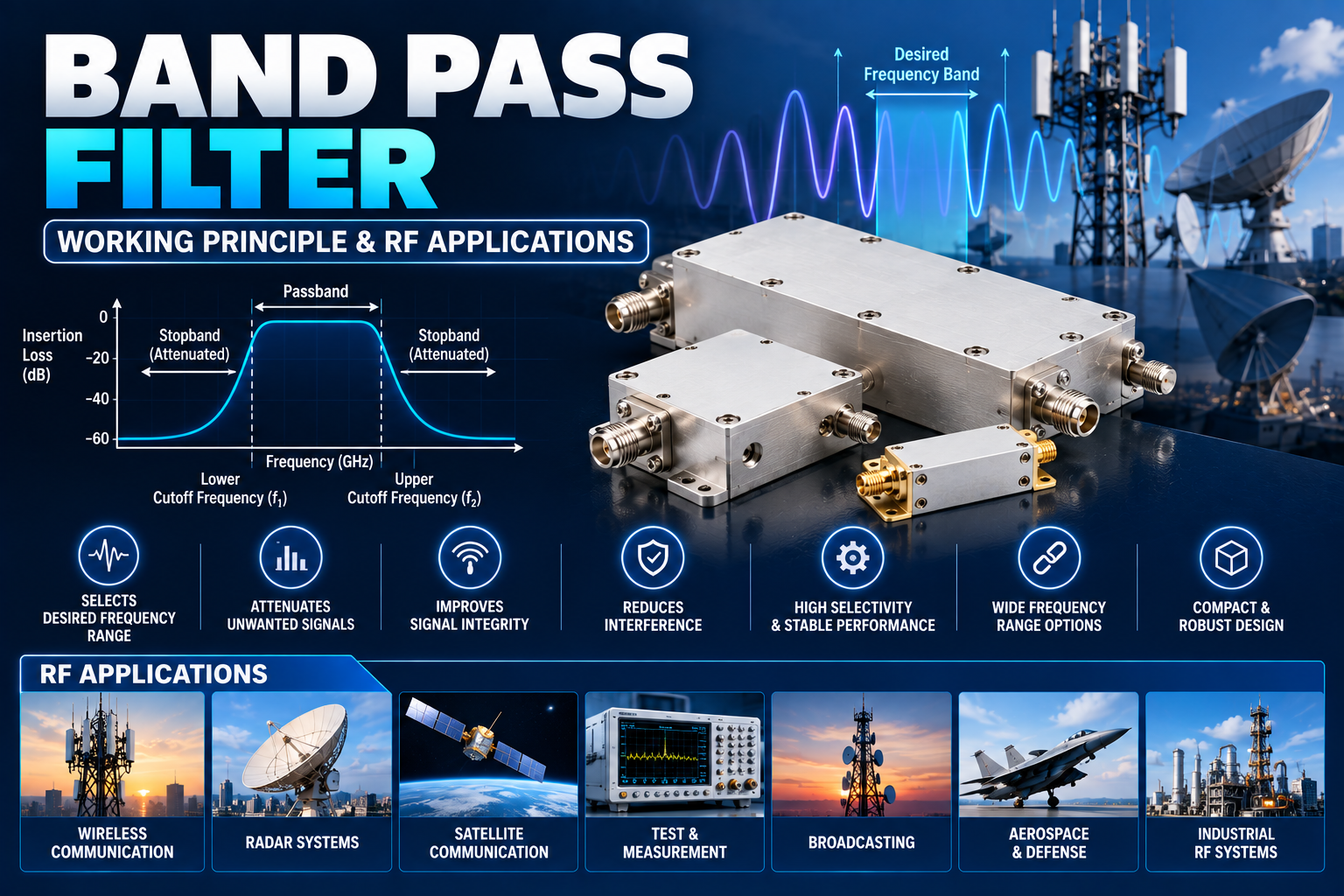
A Band Pass Filter is an important RF and microwave component designed to allow a specific range of frequencies to pass while attenuating frequencies below and above that range. It is widely used in wireless communication, RF systems, radar, satellite communication, test equipment, broadcasting, and electronic circuits where frequency selection and signal integrity are critical.
By controlling the desired frequency band, a Band Pass Filter helps reduce unwanted signals, interference, and noise, allowing RF systems to operate more efficiently and reliably.
What Is a Band Pass Filter?
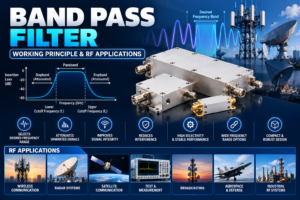
A Band Pass Filter is an electronic or RF filter that passes frequencies within a defined frequency range and rejects frequencies outside that range. The frequency range allowed through the filter is known as the passband.
A typical Band Pass Filter has two important cutoff frequencies:
- Lower Cutoff Frequency: The lowest frequency that can pass through the filter.
- Upper Cutoff Frequency: The highest frequency that can pass through the filter.
Frequencies between these two points form the passband, while frequencies below the lower cutoff and above the upper cutoff are increasingly attenuated.
How Does a Band Pass Filter Work?
The working principle of a Band Pass Filter is based on frequency-dependent electrical characteristics. Depending on the design, inductors, capacitors, resonators, transmission lines, or cavity structures can be used to create the required frequency response.
When an RF signal enters the filter, frequencies within the designed passband experience relatively low attenuation and are transmitted to the output. Signals outside the passband experience higher attenuation and are suppressed.
The effectiveness of a Band Pass Filter depends on parameters such as insertion loss, bandwidth, return loss, rejection, selectivity, and impedance matching.
Important Band Pass Filter Parameters
Understanding the main specifications is essential when selecting a Band Pass Filter for an RF application.
Center Frequency
The center frequency represents the nominal frequency around which the filter’s passband is positioned. It is an important parameter for matching the filter with the operating frequency of an RF system.
Bandwidth
Bandwidth defines the range of frequencies that the filter is designed to pass. It is commonly determined from the lower and upper cutoff frequencies.
Insertion Loss
Insertion loss indicates how much signal power is lost when the RF signal passes through the filter. Lower insertion loss is generally important in systems where maintaining signal strength is critical.
Return Loss
Return loss describes the amount of reflected signal caused by impedance mismatch. Good impedance matching helps improve signal transfer between connected RF components.
Rejection
Rejection indicates how effectively the filter suppresses unwanted frequencies outside the passband. High rejection can be particularly important in environments with strong interfering signals.
VSWR
Voltage Standing Wave Ratio, or VSWR, is another important RF parameter that indicates impedance matching between the filter and the connected system.
Types of Band Pass Filters
Band Pass Filters can be manufactured using different technologies depending on the required frequency range, bandwidth, power handling, size, and performance.
LC Band Pass Filter
LC filters use inductors and capacitors to create frequency-selective behavior. They are commonly used in electronic and RF circuits where compact filtering is required.
Cavity Band Pass Filter
Cavity filters use resonant metallic structures and are suitable for applications requiring high selectivity, low loss, and strong out-of-band rejection.
Ceramic Band Pass Filter
Ceramic filters use resonant ceramic materials to achieve frequency-selective performance in compact packages.
SAW Band Pass Filter
Surface Acoustic Wave filters are commonly used in wireless and communication equipment where compact size and frequency selectivity are required.
Microstrip Band Pass Filter
Microstrip filters are implemented on printed circuit boards and are widely used in RF and microwave circuits.
RF Applications of Band Pass Filter
A Band Pass Filter is used in numerous RF and microwave systems because frequency selection is essential for reliable communication.
Wireless Communication
Band Pass Filters help isolate required communication channels while reducing unwanted signals and interference. They can be integrated into radio systems, cellular infrastructure, wireless modules, and RF front ends.
Radar Systems
Radar systems operate within specific frequency bands. Band Pass Filters help control the RF spectrum and suppress unwanted signals that could affect receiver performance.
Satellite Communication
Satellite communication equipment requires precise frequency management. Band Pass Filters can be used in transmit and receive chains to select desired frequency ranges.
Test and Measurement
RF test equipment uses filters to isolate signals and remove unwanted frequency components during measurements. They can be incorporated into signal generators, spectrum-analysis systems, and RF test setups.
Broadcasting
Broadcasting systems use Band Pass Filters to manage designated frequency channels and reduce interference between different signals.
Aerospace and Defense
RF filtering is important in aerospace and defense electronics where multiple RF systems may operate within complex electromagnetic environments. Band Pass Filters can provide frequency selection and unwanted-signal suppression.
Benefits of Using a Band Pass Filter
A Band Pass Filter provides several advantages in RF systems:
- Selects the required frequency range
- Reduces unwanted RF signals
- Helps minimize interference
- Improves receiver selectivity
- Supports better signal integrity
- Enables controlled RF spectrum usage
- Available in compact and high-power configurations
- Suitable for RF and microwave applications
How to Select the Right Band Pass Filter
Selecting the appropriate Band Pass Filter requires consideration of the complete RF system. Important factors include center frequency, lower and upper cutoff frequencies, bandwidth, insertion loss, return loss, VSWR, rejection level, impedance, power handling, connector type, physical dimensions, and operating environment.
For high-frequency systems, the filter should be evaluated across the complete operating band rather than selecting it based only on center frequency. Mechanical configuration and connector compatibility should also be considered when integrating the filter into an RF assembly.
Conclusion
A Band Pass Filter is a fundamental RF component used to select desired frequencies while suppressing unwanted signals outside the required passband. Its working principle relies on frequency-selective circuits or resonant structures that provide controlled transmission over a defined frequency range.
From wireless communication and radar to satellite, broadcasting, aerospace, defense, and RF test equipment, Band Pass Filters play an important role in maintaining signal quality and controlling interference. Selecting the correct filter requires careful evaluation of frequency, bandwidth, insertion loss, rejection, impedance, power handling, and environmental requirements.
FAQs About Band Pass Filter
1. What is a Band Pass Filter?
A Band Pass Filter is an RF or electronic filter that allows frequencies within a specified range to pass while attenuating frequencies outside that range.
2. What are the cutoff frequencies of a Band Pass Filter?
A Band Pass Filter has a lower cutoff frequency and an upper cutoff frequency. The frequencies between these two points form the passband.
3. What is the purpose of a Band Pass Filter?
Its primary purpose is to select the required frequency range and reduce unwanted frequencies, interference, and noise.
4. Where are Band Pass Filters used?
They are used in wireless communication, radar, satellite communication, broadcasting, aerospace, defense, RF test equipment, and microwave systems.
5. What is insertion loss in a Band Pass Filter?
Insertion loss represents the reduction in signal power caused by the filter when the signal passes through it.
6. What is filter bandwidth?
Bandwidth is the frequency range between the lower and upper cutoff frequencies over which the filter provides its intended transmission characteristics.
7. Are Band Pass Filters available for microwave frequencies?
Yes. Band Pass Filters can be designed for a wide range of RF and microwave frequencies using technologies such as cavity, microstrip, ceramic, and other resonant structures.