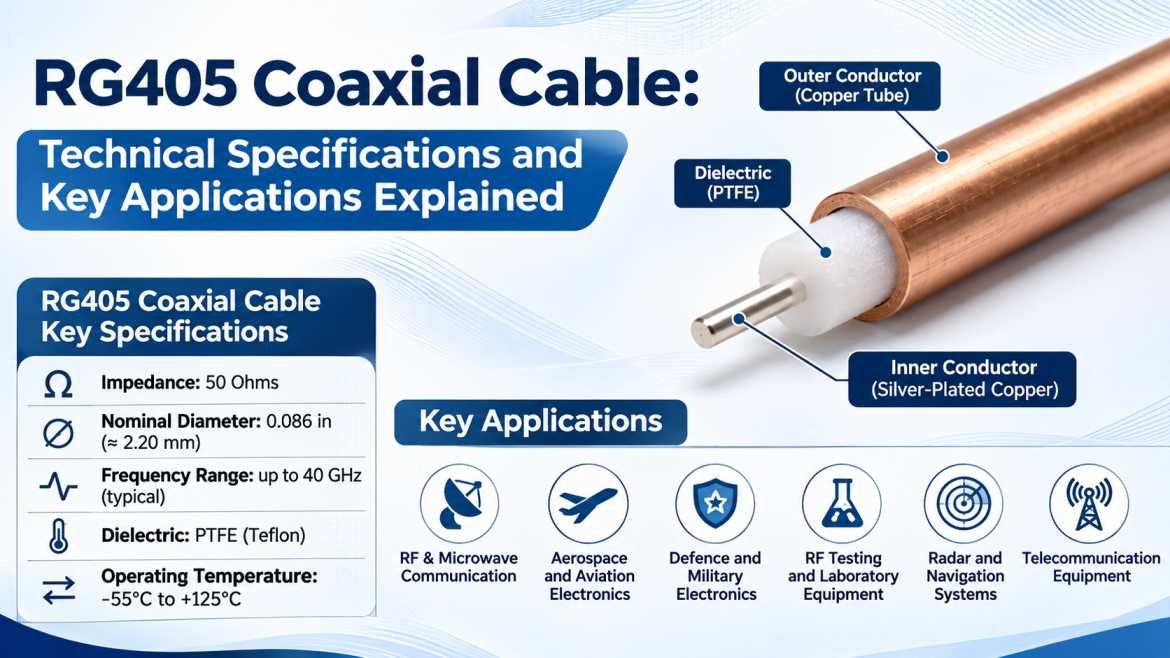
RG405 Coaxial Cable is a high-performance semi-rigid coaxial cable designed for applications that require reliable RF signal transmission, excellent shielding effectiveness, and consistent electrical performance. It is widely used in microwave communication systems, aerospace electronics, defence equipment, laboratory testing instruments, and high-frequency electronic assemblies.
Unlike conventional flexible coaxial cables, RG405 Coaxial Cable features a solid outer metallic conductor that provides excellent electromagnetic shielding and maintains a stable cable structure. Its compact dimensions make it suitable for electronic equipment where space is limited and precise cable routing is essential.
RG405 is particularly valuable in applications where signal integrity, impedance stability, and repeatable electrical characteristics are important. Its semi-rigid construction allows the cable to be formed into a specific shape during installation, helping engineers create compact and organised RF interconnections.
For engineers, RF system designers, and electronics manufacturers, understanding the technical specifications and applications of RG405 Coaxial Cable is essential for selecting the right transmission solution.
What Is RG405 Coaxial Cable?
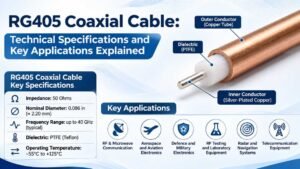
RG405 Coaxial Cable is a 50-ohm semi-rigid RF coaxial cable generally manufactured with a solid copper inner conductor, dielectric insulation, and a seamless copper or silver-plated copper outer conductor, depending on the construction.
The cable uses a coaxial structure in which the centre conductor carries the RF signal, while the surrounding metallic shield acts as the return conductor and provides electromagnetic protection.
Its semi-rigid construction offers several advantages over conventional flexible RF cables. It can maintain a predefined shape after forming, minimise unwanted movement, and provide consistent electrical characteristics in carefully designed microwave assemblies.
RG405 is commonly associated with a nominal outer diameter of approximately 0.086 inches (2.2 mm), making it suitable for compact RF and microwave applications.
Technical Specifications of RG405 Coaxial Cable
The technical specifications of RG405 Coaxial Cable determine its suitability for different RF and microwave applications. Although exact specifications depend on the manufacturer, conductor material, dielectric construction, and product series, the following table outlines commonly associated characteristics.
| Parameter | Typical Specification |
|---|---|
| Cable Type | Semi-rigid / RG405-type coaxial cable |
| Characteristic Impedance | 50 Ohms |
| Nominal Cable Diameter | 0.086 inches (2.18–2.20 mm) |
| Inner Conductor | Silver-plated copper-clad steel or silver-plated copper |
| Inner Conductor Diameter | Approximately 0.51 mm |
| Dielectric Material | PTFE (Teflon) |
| Dielectric Diameter | Approximately 1.68 mm |
| Outer Conductor | Copper tube or copper-based shielding |
| Frequency Range | Depends on construction; commonly 18–40 GHz, with specialised versions rated higher |
| Velocity of Propagation | Approximately 70% |
| Capacitance | Approximately 95–104 pF/m |
| Operating Temperature | Depends on construction; commonly -55°C to +125°C |
| Characteristic Application | RF and microwave signal transmission |
Note: These are representative values, not universal ratings. RG405-type braided cable and MIL-DTL-17/133 semi-rigid cable have different constructions and performance limits. Always verify the manufacturer’s datasheet before specifying a cable. Powertec Information Portal+3
Construction of RG405 Coaxial Cable
The construction of RG405 Coaxial Cable plays an important role in its electrical performance, shielding effectiveness, and mechanical stability. Each layer serves a specific purpose in maintaining reliable RF signal transmission.
1. Inner Conductor
The inner conductor carries the electrical signal through the cable. It is commonly manufactured using silver-plated copper-clad steel or silver-plated copper.
Its main functions include:
- Providing a reliable path for RF signal transmission.
- Maintaining consistent electrical conductivity.
- Supporting stable impedance characteristics.
- Reducing conductor-related signal losses.
The solid centre conductor also helps maintain the dimensional stability required for precision RF applications.
2. Dielectric Insulation
The dielectric layer surrounds the centre conductor and electrically separates it from the outer conductor. RG405 commonly uses PTFE (Polytetrafluoroethylene), also known as Teflon.
PTFE is widely used in high-performance RF cables because of its excellent electrical insulation, low dielectric loss, and thermal stability.
Key benefits include:
- Low dielectric losses.
- Stable electrical properties.
- High insulation resistance.
- Good thermal performance.
- Reliable operation in demanding environments.
3. Outer Conductor and Shielding
The outer conductor is responsible for providing the return path for electrical signals and protecting the cable from external electromagnetic interference.
In conventional semi-rigid RG405, the outer conductor is generally a solid metallic tube. Depending on the cable design, copper, tin-plated copper, or silver-plated copper may be used.
This construction provides excellent shielding and helps minimise unwanted signal leakage.
4. Protective Jacket
A protective jacket is not necessarily present in traditional solid-tube semi-rigid RG405 cable. However, some RG405-type flexible or braided constructions include an additional outer jacket.
Materials such as FEP may be used to provide insulation and environmental protection.
The exact cable construction should always be checked before selecting an RG405 cable for a specific installation.
Key Features and Benefits of RG405 Coaxial Cable
RG405 Coaxial Cable offers several performance advantages that make it suitable for demanding RF and microwave applications.
1. Excellent Signal Integrity
Signal integrity is essential in RF communication, microwave electronics, and precision measurement systems.
RG405 provides controlled impedance and a well-defined coaxial structure that helps minimise unwanted signal reflections and transmission inconsistencies.
Its design makes it suitable for applications where accurate and reliable signal transmission is important.
2. High Shielding Effectiveness
Electromagnetic interference can affect the performance of sensitive electronic equipment.
The solid metallic outer conductor used in traditional semi-rigid RG405 provides excellent shielding effectiveness. It helps prevent external interference from entering the cable and reduces unwanted RF radiation.
This makes RG405 useful in sensitive laboratory equipment, radar systems, and defence electronics.
3. Low Signal Attenuation
Attenuation refers to the reduction in signal strength as an electrical signal travels through a cable.
RG405 is designed for RF and microwave transmission, where controlling signal loss is important.
Its carefully engineered conductor and dielectric structure helps provide predictable attenuation characteristics across its specified operating frequency range.
4. Compact and Space-Saving Design
With a nominal diameter of approximately 0.086 inches, RG405 Coaxial Cable is suitable for compact electronic assemblies.
Its small dimensions allow engineers to integrate RF connections into equipment with limited internal space.
It is particularly useful in:
- Compact microwave modules.
- PCB-level RF interconnections.
- Aerospace electronic assemblies.
- High-density communication equipment.
- Laboratory testing instruments.
5. Stable Mechanical Structure
Traditional semi-rigid RG405 cable can be formed into specific shapes using appropriate bending tools.
Once properly formed, it maintains its installed configuration without the spring-back behaviour commonly associated with flexible coaxial cables.
This helps create organised and repeatable cable routing inside electronic equipment.
6. Wide Operating Temperature Capability
RG405 commonly uses PTFE dielectric insulation, which provides good thermal stability.
Depending on the specific construction, RG405 cable products can support different operating temperature ranges.
This makes them suitable for industrial electronics, laboratory equipment, aerospace systems, and other applications where temperature variations must be considered.
Key Applications of RG405 Coaxial Cable
RG405 Coaxial Cable is used across several industries because of its compact design, controlled impedance, and reliable RF performance.
1. RF and Microwave Communication Systems
RF and microwave communication systems require reliable transmission paths to maintain signal quality.
RG405 is commonly used for internal RF connections, microwave modules, and signal-routing applications.
Its compact dimensions and shielding characteristics make it suitable for connecting different RF components within communication equipment.
2. Aerospace and Aviation Electronics
Aerospace electronic systems require components that offer reliable electrical performance and compact construction.
RG405 is used in selected aerospace RF assemblies, navigation equipment, communication systems, and electronic subsystems.
Its stable electrical characteristics and semi-rigid construction make it suitable for carefully engineered equipment interconnections.
3. Defence and Military Electronics
Defence electronic equipment often operates in demanding environments where signal reliability is essential.
RG405 Coaxial Cable can be used in:
- Radar equipment.
- Electronic warfare systems.
- Military communication devices.
- RF monitoring systems.
- Microwave signal-processing units.
Its metallic shielding and controlled impedance support reliable RF connections in sensitive electronic systems.
4. RF Testing and Laboratory Equipment
Testing laboratories use precision RF cables to connect measurement instruments and electronic devices.
RG405 is suitable for internal instrument connections, test fixtures, and preformed RF cable assemblies.
It can be used in equipment such as:
- Spectrum analysers.
- Network analysers.
- RF signal generators.
- Microwave measurement systems.
- Laboratory calibration equipment.
For high-precision measurements, the cable’s frequency rating, connector compatibility, and insertion loss must be considered.
5. Radar and Navigation Systems
Radar systems transmit and receive high-frequency electromagnetic signals to detect objects and determine their position.
RG405 can be used in internal RF signal paths and microwave connections within radar-related electronic equipment.
Its shielding and controlled electrical characteristics help support consistent signal transmission.
6. Telecommunications Equipment
Telecommunication infrastructure uses RF cables to connect different electronic components and communication modules.
RG405 may be used in selected high-frequency assemblies, compact communication devices, and RF testing equipment.
It is particularly useful where small cable dimensions and reliable electrical connections are required.
7. Electronic Instrumentation
Precision electronic instruments require stable signal transmission to produce accurate measurement results.
RG405 is suitable for connecting internal RF modules, signal-processing circuits, and measurement components.
Its compact construction makes it useful for equipment with limited installation space.
RG405 Coaxial Cable vs RG316 Coaxial Cable
RG405 and RG316 are both used in RF and microwave applications, but their construction and mechanical properties are different.
| Parameter | RG405 | RG316 |
|---|---|---|
| Cable Type | Typically semi-rigid | Flexible |
| Nominal Diameter | 0.086 inch | Approximately 0.100 inch |
| Impedance | 50 Ohms | 50 Ohms |
| Dielectric | PTFE | PTFE |
| Outer Shield | Solid tube in conventional semi-rigid version | Flexible braided shielding |
| Flexibility | Limited | High |
| Shape Retention | Excellent after forming | Does not retain a formed shape |
| Typical Applications | Microwave assemblies and precision RF connections | Flexible RF jumpers and equipment connections |
The choice depends on installation requirements. RG405 is preferable when a stable, preformed RF connection is required, whereas RG316 is suitable when flexibility and repeated movement are important.
RG405 Coaxial Cable vs RG402 Coaxial Cable
RG405 and RG402 are commonly used semi-rigid coaxial cables. Both typically feature 50-ohm impedance and PTFE dielectric insulation.
However, their dimensions and mechanical characteristics differ.
| Parameter | RG405 | RG402 |
|---|---|---|
| Nominal Diameter | 0.086 inch | 0.141 inch |
| Approximate Outer Diameter | 2.20 mm | 3.58 mm |
| Impedance | 50 Ohms | 50 Ohms |
| Dielectric | PTFE | PTFE |
| Construction | Semi-rigid | Semi-rigid |
| Space Requirement | Lower | Higher |
| Typical Use | Compact RF assemblies | Larger RF and microwave assemblies |
RG405 is generally preferred for compact installations, while RG402 is suitable for applications that can accommodate a larger cable diameter and require different power-handling or attenuation characteristics.
Factors to Consider When Selecting RG405 Coaxial Cable
Selecting the correct RG405 Coaxial Cable requires evaluating several technical and installation-related factors.
1. Frequency Range
Determine the maximum operating frequency of your RF system before selecting the cable.
Different RG405 constructions have different frequency ratings. Make sure the selected cable supports the complete operating frequency range of your application.
2. Characteristic Impedance
Most RG405 configurations are designed for 50-ohm RF systems.
Ensure that the cable impedance matches the connected equipment, connectors, and transmission components to minimise signal reflections.
3. Attenuation
Cable attenuation increases with frequency and cable length.
Review the manufacturer’s attenuation specifications at the intended operating frequencies to determine whether the cable meets your signal-loss requirements.
4. Connector Compatibility
Connector compatibility is another important consideration.
RG405 cable assemblies can be manufactured with suitable RF connector interfaces depending on the cable construction and assembly requirements.
Common connector options in compatible 0.086-inch RF cable assembly designs include:
- SMA connectors.
- 2.92mm connectors.
- SMP connectors.
- Other compatible microwave connector interfaces.
The connector’s cable attachment dimensions must match the exact cable design.
5. Temperature Requirements
Evaluate the operating temperature range of your application.
Different dielectric materials, outer conductor materials, and protective jackets can affect the cable’s thermal performance.
6. Mechanical Installation
Traditional semi-rigid RG405 cable requires proper bending tools for accurate installation.
Incorrect bending can damage the outer conductor, distort the dielectric, and affect electrical performance.
Therefore, consider preformed cable assemblies when accurate routing and repeatable installation are important.
Importance of RG405 Cable Assemblies
RG405 cable assemblies combine the cable with compatible RF connectors to provide ready-to-install interconnection solutions.
A properly manufactured RG405 cable assembly helps simplify equipment integration and ensures consistent electrical and mechanical connections.
Important considerations when selecting RG405 cable assemblies include:
- Correct cable length.
- Compatible connector interfaces.
- Accurate impedance matching.
- Proper connector termination.
- Low insertion loss.
- Reliable shielding.
- Mechanical dimensional accuracy.
- Suitable operating temperature.
Custom RG405 cable assemblies can be designed according to specific equipment layouts and RF system requirements.
Common Challenges and Installation Considerations
Although RG405 offers excellent electrical performance, proper installation is necessary to maintain its characteristics.
Avoid Excessive Bending
Semi-rigid RG405 cables should not be bent beyond their recommended minimum bend radius. Excessive bending can deform the outer conductor and affect impedance stability.
Use Appropriate Bending Tools
Specialised forming tools help maintain the cable’s circular cross-section during installation.
Avoid repeated bending or reshaping because it can damage the cable structure.
Maintain Proper Connector Termination
Incorrect connector installation can increase insertion loss and signal reflections.
Use compatible connectors and follow the manufacturer’s recommended stripping, soldering, and assembly procedures.
Consider Cable Length
Longer cable assemblies generally introduce greater insertion loss. Select an appropriate cable length to minimise unnecessary signal attenuation.
Verify Electrical Specifications
Always review the manufacturer’s datasheet for impedance, frequency range, attenuation, voltage rating, shielding effectiveness, and temperature limits before installation.
Why Choose RG405 Coaxial Cable for High-Frequency Applications?
RG405 Coaxial Cable is a practical choice for engineers who require compact, reliable, and precisely engineered RF interconnections.
Its major advantages include controlled 50-ohm impedance, PTFE dielectric insulation, excellent shielding in conventional semi-rigid construction, and suitability for high-frequency electronic assemblies.
The cable is particularly useful in applications where installation space is limited and stable electrical performance is required.
For high-performance RF systems, selecting the correct RG405 construction and compatible connectors is essential to achieving the desired transmission performance.
Frequently Asked Questions About RG405 Coaxial Cable
1. What is RG405 Coaxial Cable?
RG405 Coaxial Cable is a compact 50-ohm RF cable commonly associated with a 0.086-inch diameter. Its conventional semi-rigid construction uses a metallic outer tube and PTFE dielectric for reliable RF and microwave signal transmission.
2. What is the impedance of RG405 Coaxial Cable?
RG405 Coaxial Cable typically has a characteristic impedance of 50 ohms, making it suitable for standard 50-ohm RF and microwave systems.
3. What is the frequency range of RG405 Cable?
The frequency range depends on the specific cable construction and manufacturer. Some RG405-type products are rated up to 18 GHz or 40 GHz, while specialised semi-rigid versions can support higher frequencies.
4. What material is used in RG405 Coaxial Cable?
Common materials include silver-plated copper-clad steel or silver-plated copper for the centre conductor, PTFE for dielectric insulation, and copper or plated copper for the outer conductor.
5. Is RG405 Coaxial Cable flexible?
Traditional RG405 is a semi-rigid cable. It can be formed into a specific shape during installation but is not designed for continuous movement or repeated flexing.
6. What are the main applications of RG405 Cable?
RG405 is commonly used in RF and microwave assemblies, aerospace electronics, defence equipment, radar systems, laboratory instruments, telecommunications equipment, and precision electronic devices.
7. What is the difference between RG405 and RG316?
RG405 is generally a semi-rigid cable with a solid metallic outer conductor, whereas RG316 is a flexible coaxial cable with braided shielding. RG405 is suitable for stable, preformed RF connections, while RG316 is better for applications requiring flexibility.
8. Can RG405 Coaxial Cable be used for microwave applications?
Yes. RG405 is designed for RF and microwave applications. However, the maximum operating frequency and attenuation must be verified against the specific manufacturer’s datasheet.
9. What connectors are compatible with RG405 Cable?
Compatible connector options depend on the exact cable construction. SMA and other suitable microwave connector interfaces can be used in appropriately designed RG405 cable assemblies.
10. How do I select the right RG405 Cable?
Consider the required frequency range, impedance, attenuation, cable length, operating temperature, connector compatibility, and mechanical installation requirements.
Conclusion
RG405 Coaxial Cable is an important component in modern RF and microwave engineering because of its compact dimensions, controlled impedance, and reliable electrical performance. Its conventional semi-rigid construction provides excellent shielding and mechanical stability, making it suitable for precision electronic assemblies and demanding communication applications.
From aerospace and defence electronics to laboratory testing equipment and microwave communication systems, RG405 offers a dependable solution for specialised RF interconnections.
When selecting RG405 Coaxial Cable, engineers should carefully evaluate its technical specifications, frequency requirements, attenuation, dielectric material, and connector compatibility to ensure optimal system performance.
SRFS Teleinfra provides RF and microwave cable solutions for professional communication and electronic applications. Explore the available cable options and identify the right solution for your project requirements.