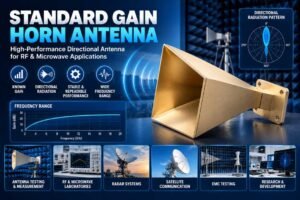
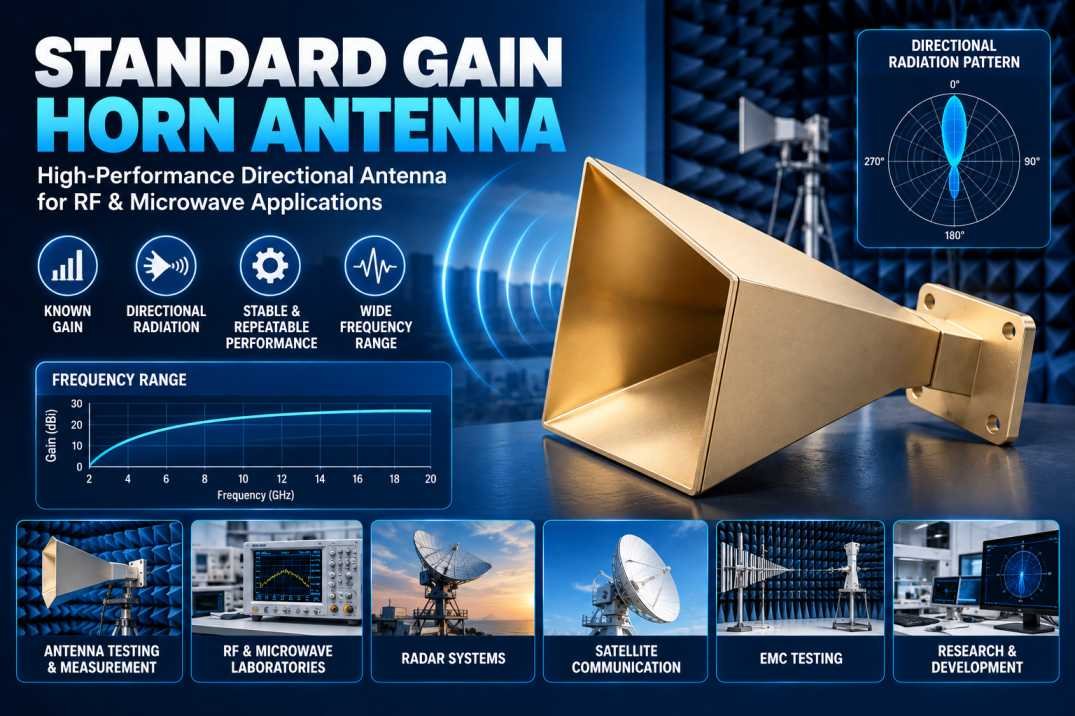
A Standard Gain Horn Antenna is a directional microwave antenna designed to provide a predictable level of gain, beamwidth, and radiation performance across a specified frequency range. It is widely used in RF and microwave laboratories, antenna measurement systems, radar, communication systems, satellite applications, electromagnetic testing, and calibration environments.
Unlike many complex antenna designs, a horn antenna has a relatively simple structure. It consists of a waveguide section that gradually expands into a flared opening called the horn. This gradual transition allows electromagnetic energy to radiate efficiently into free space while producing a directional radiation pattern.
Standard gain horn antennas are particularly valuable in engineering and testing because their electrical characteristics are well controlled and repeatable. They can be used as transmitting antennas, receiving antennas, reference antennas, and measurement antennas.
What Is a Standard Gain Horn Antenna?
A Standard Gain Horn Antenna is a type of microwave horn antenna engineered to provide a known and relatively consistent gain over a defined frequency band.
The term “standard gain” refers to the controlled antenna characteristics rather than simply indicating that the antenna has a particular gain value. Different standard gain horn models are manufactured for different frequency ranges and gain levels.
These antennas are commonly designed around rectangular waveguide structures. The waveguide carries the microwave signal toward the flared section, where the electromagnetic field expands and radiates outward.
Because of their predictable performance, Standard Gain Horn Antennas are frequently used as reference antennas for antenna measurements and RF testing.
How Does a Standard Gain Horn Antenna Work?
The operating principle of a Standard Gain Horn Antenna is based on the propagation of electromagnetic waves through a waveguide and their controlled radiation through a flared aperture.
The RF signal enters the waveguide portion of the antenna. Inside the waveguide, electromagnetic energy propagates according to the supported waveguide mode. As the waveguide reaches the horn section, its cross-sectional area gradually increases.
This gradual flare reduces the abrupt transition between the confined waveguide field and free-space radiation. The electromagnetic energy is therefore launched efficiently from the aperture.
The resulting radiation pattern is generally directional, with the strongest radiation concentrated along the antenna’s main beam.
Construction of Standard Gain Horn Antenna
A Standard Gain Horn Antenna generally consists of several important sections.
Waveguide Section
The waveguide provides the transmission path for microwave energy. Its dimensions are selected according to the required frequency range and operating mode.
Flared Horn
The horn is the expanded portion of the antenna. Its dimensions influence gain, beamwidth, impedance characteristics, and radiation pattern.
Aperture
The aperture is the open end of the horn through which electromagnetic energy is transmitted or received. Aperture dimensions have a significant effect on antenna directivity.
RF Input
The input is connected to the appropriate waveguide or RF interface depending on the antenna configuration. The input arrangement must be compatible with the associated microwave system.
Key Features of Standard Gain Horn Antenna
Standard Gain Horn Antennas are popular because they offer a combination of simple construction and predictable RF performance.
Important features include:
- Directional radiation pattern
- Controlled antenna gain
- High measurement repeatability
- Wide range of microwave frequency options
- Low-loss metallic construction
- Stable mechanical structure
- High power-handling capability in suitable designs
- Relatively low VSWR
- Well-defined radiation characteristics
- Suitable for laboratory and field measurements
- Useful as a reference antenna
- Compatible with various microwave test systems
Standard Gain Horn Antenna Specifications
The exact specifications depend on the model and operating frequency. Common parameters considered when selecting a Standard Gain Horn Antenna include:
| Parameter | Description |
|---|---|
| Frequency Range | Defines the microwave operating band |
| Antenna Gain | Determines directional signal concentration |
| Beamwidth | Defines the angular width of the main radiation beam |
| Polarization | Determines the electric-field orientation |
| Impedance | Typically designed around standard RF/microwave systems |
| VSWR | Indicates impedance matching performance |
| Aperture Size | Influences gain and beamwidth |
| Waveguide Size | Determines frequency compatibility |
| Radiation Pattern | Describes directional energy distribution |
| Material | Commonly metallic for low-loss operation |
| Connector/Interface | Determines system compatibility |
Exact values should always be selected according to the manufacturer’s model-specific specifications.
Gain of a Standard Gain Horn Antenna
Gain is one of the most important characteristics of a Standard Gain Horn Antenna. It describes the antenna’s ability to concentrate electromagnetic energy in a particular direction compared with an isotropic radiator.
As horn aperture dimensions increase relative to the wavelength, the antenna can generally achieve higher directivity.
Different Standard Gain Horn Antennas are therefore available with different gain levels. The appropriate gain depends on the application, required measurement distance, frequency, beamwidth, and test environment.
Radiation Pattern and Beamwidth
A Standard Gain Horn Antenna produces a directional radiation pattern. Most of the transmitted energy is concentrated in the main beam, while significantly less energy is radiated outside the primary direction.
Beamwidth is an important measurement parameter because it describes how wide the main radiation beam is. Higher-gain antennas generally have narrower beams, while lower-gain designs tend to provide wider coverage.
This predictable radiation pattern makes horn antennas useful for antenna characterization and microwave measurements.
Polarization
Standard Gain Horn Antennas can be designed to provide a specific polarization, commonly linear polarization.
Polarization compatibility is important when using two horn antennas in a measurement system. The transmitting and receiving antennas should generally have compatible polarization orientations to achieve efficient signal coupling.
Incorrect polarization alignment can introduce additional signal loss and affect measurement accuracy.
Applications of Standard Gain Horn Antenna
Antenna Testing and Measurement
One of the most important applications is antenna measurement. Standard gain horns can be used as reference antennas for evaluating gain, radiation patterns, polarization, and other antenna characteristics.
RF and Microwave Laboratories
They are widely used in laboratories for microwave experiments, electromagnetic measurements, propagation studies, and RF system development.
Radar Systems
Horn antennas are used in radar-related systems and test environments because of their directional radiation characteristics and predictable performance.
Satellite Communication
Standard Gain Horn Antennas can be used in satellite and microwave communication testing, particularly where directional microwave transmission and reception are required.
Electromagnetic Compatibility Testing
Horn antennas are useful in electromagnetic testing environments for transmitting or receiving controlled microwave signals.
Antenna Calibration
Their stable and repeatable characteristics make them useful as reference antennas during calibration and measurement procedures.
Research and Development
Universities, research organizations, RF laboratories, and engineering teams use standard gain horns for experimental microwave systems and antenna development.
Advantages of Standard Gain Horn Antenna
A major advantage of a Standard Gain Horn Antenna is its predictable performance. Engineers can select a model based on its frequency, gain, beamwidth, and waveguide characteristics.
Other benefits include:
- Simple and robust construction
- Good directional performance
- Repeatable measurements
- Low-loss metallic structure
- Reliable microwave operation
- Easy integration into test setups
- Suitable for calibration applications
- Useful across many microwave frequency bands
- Good mechanical durability
- Straightforward maintenance
Standard Gain Horn Antenna vs Other Antennas
Compared with omnidirectional antennas, a Standard Gain Horn Antenna provides significantly more directional radiation.
Compared with complex phased-array systems, horn antennas are simpler and easier to operate. However, they generally provide a fixed radiation pattern and do not offer electronic beam steering.
For laboratory and reference measurements, this simplicity can be a major advantage because fewer variables are involved in the measurement setup.
How to Select a Standard Gain Horn Antenna
Selecting the correct antenna requires consideration of several technical parameters.
1. Operating Frequency
The first consideration should be the required frequency range. The waveguide and horn dimensions must be compatible with the desired frequency.
2. Required Gain
Select the gain according to the required signal concentration and measurement distance.
3. Beamwidth
Consider the required coverage angle and measurement geometry.
4. Polarization
Ensure that the antenna polarization matches the transmitting or receiving system.
5. VSWR
A suitable VSWR specification helps minimize impedance mismatch and reflected power.
6. Mechanical Requirements
Consider mounting arrangements, dimensions, weight, environmental conditions, and installation requirements.
7. Measurement Accuracy
For calibration and antenna measurement applications, choose a model with suitable repeatability and documented RF characteristics.
Conclusion
A Standard Gain Horn Antenna is an important RF and microwave antenna used when predictable gain, directional radiation, stable polarization, and repeatable performance are required. Its waveguide-based construction and gradually flared aperture provide an efficient transition from guided electromagnetic energy to free-space radiation.
Because of its controlled characteristics, the Standard Gain Horn Antenna is widely used in antenna testing, calibration, microwave laboratories, radar, satellite communication, electromagnetic testing, and research applications.
When selecting a horn antenna, engineers should carefully evaluate operating frequency, gain, beamwidth, polarization, VSWR, aperture dimensions, waveguide compatibility, and mechanical requirements. Choosing the correct specifications helps ensure accurate measurements and reliable microwave performance.
FAQs About Standard Gain Horn Antenna
1. What is a Standard Gain Horn Antenna?
A Standard Gain Horn Antenna is a directional microwave antenna designed to provide predictable gain, beamwidth, polarization, and radiation characteristics over a specified frequency range.
2. How does a Standard Gain Horn Antenna work?
It guides microwave energy through a waveguide and gradually expands the electromagnetic field through a flared horn aperture, producing directional radiation.
3. Where are Standard Gain Horn Antennas used?
They are used in antenna measurement, RF laboratories, radar, satellite communication, calibration, electromagnetic testing, and microwave research.
4. What is the main advantage of a Standard Gain Horn Antenna?
Its primary advantage is predictable and repeatable RF performance, making it particularly useful for testing and measurement applications.
5. Is a Standard Gain Horn Antenna directional?
Yes. A Standard Gain Horn Antenna produces a directional radiation pattern with most of its energy concentrated along the main beam.
6. What factors determine horn antenna gain?
Gain is influenced by operating frequency, aperture dimensions, horn geometry, wavelength, and overall antenna design.
7. What is beamwidth in a horn antenna?
Beamwidth represents the angular width of the antenna’s main radiation beam. It is an important parameter for understanding antenna coverage and directivity.
8. Can horn antennas be used for antenna calibration?
Yes. Their predictable and repeatable characteristics make suitable Standard Gain Horn Antennas useful as reference antennas in calibration and measurement systems.
9. What frequency range does a Standard Gain Horn Antenna support?
The frequency range depends on the specific waveguide size and antenna model. A suitable model should be selected according to the required microwave frequency band.
10. How should I choose a Standard Gain Horn Antenna?
Consider operating frequency, gain, beamwidth, polarization, VSWR, aperture size, waveguide compatibility, mounting requirements, and the intended application.