
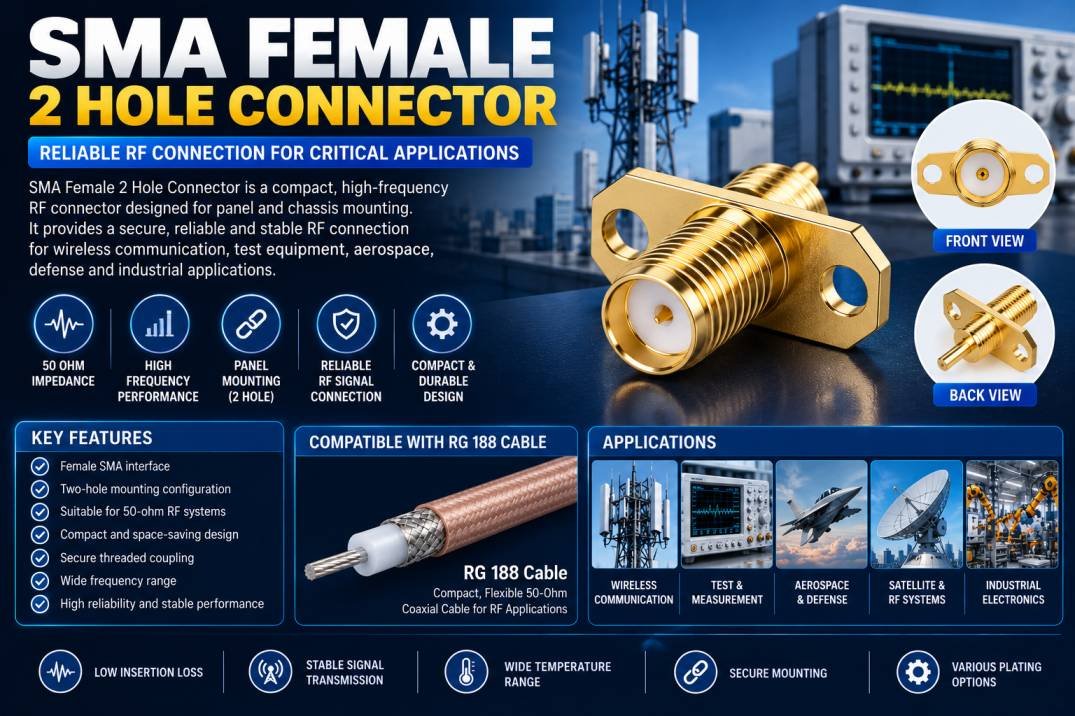
An SMA Female 2 Hole Connector is a compact, high-frequency coaxial connector designed to provide a reliable RF connection between coaxial cables and electronic or microwave equipment. The connector features a female SMA interface and a two-hole mounting flange, allowing it to be securely installed on panels, enclosures, PCBs, and other RF assemblies.
SMA connectors are widely used in RF, microwave, wireless communication, test and measurement, aerospace, defense, and electronic systems. Their compact size, threaded coupling mechanism, and reliable electrical performance make them suitable for applications where space and signal integrity are important.
What Is an SMA Female 2 Hole Connector?
An SMA Female 2 Hole Connector is an SMA-type RF connector with a female interface and two mounting holes. The two-hole configuration provides mechanical support and allows the connector to be firmly attached to an equipment panel or mounting surface.
The connector is generally designed for 50-ohm RF systems, although exact electrical specifications depend on the connector design and manufacturer. Its threaded SMA coupling provides a secure connection and helps maintain consistent RF performance during operation.
Construction of SMA Female 2 Hole Connector
The construction of an SMA Female 2 Hole Connector typically consists of several important components:
Female SMA Interface
The female interface is designed to mate with a corresponding SMA male connector. The threaded coupling mechanism helps maintain a secure mechanical connection.
Center Contact
The center contact carries the RF signal between the connector and the connected transmission line. Contact material and plating can vary depending on the connector design.
Dielectric Insulator
An insulating dielectric separates the center contact from the outer conductor. Proper dielectric construction helps maintain the required impedance and electrical performance.
Outer Conductor
The outer conductor provides shielding and forms part of the RF transmission path. It also contributes to the connector’s electromagnetic shielding performance.
Two-Hole Mounting Flange
The two-hole mounting arrangement allows the connector to be securely fixed to a panel or equipment enclosure. It is particularly useful for chassis-mounted RF interfaces.
Key Features of SMA Female 2 Hole Connector
The SMA Female 2 Hole Connector offers several features that make it suitable for RF and microwave applications:
- Female SMA interface
- Two-hole mounting configuration
- Compact and space-saving design
- Secure threaded coupling
- Suitable for 50-ohm RF systems
- Good mechanical stability
- Reliable RF signal connection
- Suitable for panel and chassis mounting
- Available with different plating and material options
- Compatible with various RF cable assemblies depending on connector design
SMA Female 2 Hole Connector and RG 188 Cable
The RG 188 Cable is a small-diameter coaxial cable commonly used in compact RF and electronic applications. Depending on the connector configuration and termination requirements, an SMA connector can be used as part of an RG 188 Cable assembly.
When selecting an SMA Female 2 Hole Connector for RG 188 Cable, it is important to verify the cable’s outer diameter, dielectric construction, center conductor dimensions, and termination method. The connector should be specifically designed or qualified for the selected cable to achieve reliable mechanical and electrical performance.
Electrical Performance
SMA connectors are designed for high-frequency RF applications where maintaining signal integrity is important. Performance depends on connector construction, cable type, frequency range, mating quality, and assembly technique.
Important parameters to consider include:
| Parameter | Importance |
|---|---|
| Impedance | Usually 50 Ohms for RF SMA systems |
| Frequency Range | Determines suitable RF applications |
| VSWR | Indicates impedance matching performance |
| Insertion Loss | Indicates signal loss through the connector |
| Return Loss | Indicates reflected RF power |
| Mounting Type | Determines equipment integration |
| Connector Interface | Defines mating compatibility |
Actual specifications should always be checked against the manufacturer’s datasheet for the particular connector model.
Applications of SMA Female 2 Hole Connector
SMA Female 2 Hole Connectors are used across many RF and microwave applications.
RF and Microwave Equipment
They provide compact RF interfaces for microwave modules, RF circuits, amplifiers, filters, and signal-processing equipment.
Test and Measurement
The connector can be used in RF test equipment, measurement systems, laboratory setups, signal generators, spectrum analyzers, and other instrumentation.
Wireless Communication
SMA interfaces are commonly found in wireless communication equipment, antennas, RF modules, and radio systems.
Aerospace and Defense
Compact and mechanically secure RF connectors are important in aerospace and defense electronics where reliable signal connections are required.
Industrial Electronics
They can also be integrated into industrial RF equipment, control systems, communication devices, and electronic instrumentation.
Advantages of SMA Female 2 Hole Connector
The two-hole SMA connector configuration provides both electrical and mechanical benefits. Its compact form factor helps save installation space, while the threaded interface provides secure mating. The mounting flange allows the connector to be firmly attached to equipment panels.
For RF systems using cables such as RG 188 Cable, selecting a connector that properly matches the cable construction can help support reliable signal transmission and mechanical durability.
How to Select the Right SMA Female 2 Hole Connector
Before purchasing an SMA Female 2 Hole Connector, consider the following:
- Cable compatibility: Verify compatibility with the intended RF cable, including RG 188 Cable where applicable.
- Impedance: Select the appropriate impedance, typically 50 Ohms for SMA RF applications.
- Frequency: Confirm that the connector supports the required operating frequency.
- Mounting dimensions: Check the two-hole spacing and flange dimensions.
- Termination method: Confirm whether the connector requires soldering, crimping, or another termination method.
- Material and plating: Select suitable materials for the environmental and performance requirements.
- VSWR and insertion loss: Review RF performance specifications for high-frequency applications.
Conclusion
The SMA Female 2 Hole Connector is a compact and reliable RF interface designed for panel-mounted and chassis-mounted applications. Its female SMA interface, threaded coupling, and two-hole mounting configuration make it suitable for RF equipment, microwave systems, wireless communication, test instrumentation, aerospace, defense, and industrial electronics.
When used with an RG 188 Cable or other compatible RF cable, proper connector selection and termination are essential for achieving dependable mechanical and electrical performance. Always verify the connector’s exact dimensions, frequency range, impedance, and cable compatibility before integration.
FAQs About SMA Female 2 Hole Connector
1. What is an SMA Female 2 Hole Connector?
It is an SMA RF connector with a female interface and two mounting holes for secure panel or chassis installation.
2. What is the impedance of an SMA connector?
Most standard SMA RF connectors are designed for 50-ohm systems, although the exact specification should be confirmed from the product datasheet.
3. Can an SMA Female 2 Hole Connector be used with RG 188 Cable?
Yes, where the specific connector is designed or qualified for RG 188 Cable and its dimensions and termination requirements.
4. What is the purpose of the two mounting holes?
The two holes allow the connector to be mechanically secured to a panel, enclosure, or equipment chassis.
5. Where are SMA Female 2 Hole Connectors used?
They are used in RF and microwave equipment, wireless communication, test and measurement systems, aerospace, defense, and industrial electronics.
6. What should I check before selecting an SMA connector?
Check impedance, frequency range, cable compatibility, mounting dimensions, termination method, VSWR, insertion loss, and material specifications.
7. Why are SMA connectors widely used in RF systems?
Their compact size, threaded coupling, and suitability for high-frequency RF applications make them useful in many electronic and communication systems.