RG178 Coaxial Cable is a compact, lightweight RF coaxial cable designed for high-frequency signal transmission where space, flexibility, and reliable electrical performance are important. Its small diameter makes it suitable for compact electronic systems, communication equipment, aerospace applications, instrumentation, and RF assemblies.
RG178 is commonly used as a 50-ohm coaxial cable and is available with different conductor, shielding, and jacket configurations depending on the manufacturer and application requirements. Its compact construction allows engineers to route RF signals through areas where larger coaxial cables may not fit.
What Is RG178 Coaxial Cable?
RG178 Coaxial Cable is a miniature RF cable consisting of a central conductor, dielectric insulation, metallic shielding, and an outer protective jacket. The coaxial structure keeps the signal conductor and electromagnetic return path closely coupled, helping control impedance and reduce unwanted electromagnetic interference.
The cable’s small size makes it particularly useful for applications requiring high-density wiring and tight routing. Compared with larger RF cables, RG178 can provide greater installation flexibility while maintaining the controlled impedance required by many RF systems.
RG178 Cable Construction
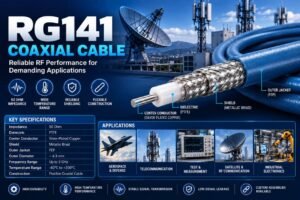
The performance of an RG178 cable depends heavily on its internal construction. The main components include:
Center Conductor
The center conductor carries the RF signal. Depending on the cable design, it may use silver-plated copper or another suitable conductive material. The conductor construction affects conductivity, flexibility, attenuation, and mechanical durability.
Dielectric
The dielectric surrounds the center conductor and maintains the required spacing between the conductor and shield. PTFE is commonly associated with miniature high-frequency RF cable designs because of its electrical characteristics and temperature capability.
Shielding
The metallic shield surrounds the dielectric and provides the return path while helping protect the signal from external electromagnetic interference. Shield configuration can vary between manufacturers, so shielding construction should be checked against the required application.
Outer Jacket
The outer jacket provides mechanical and environmental protection. Depending on the cable specification, jacket materials can be selected for flexibility, temperature resistance, chemical resistance, or other environmental requirements.
Key Features of RG178 Coaxial Cable
RG178 Coaxial Cable is selected for several practical engineering advantages:
- Compact miniature construction
- 50-ohm RF impedance in common configurations
- Lightweight design
- High flexibility for compact assemblies
- Suitable for high-frequency RF applications
- Easy routing through limited spaces
- Available with multiple connector configurations
- Suitable for custom RF cable assemblies
The exact electrical and mechanical specifications can vary by manufacturer, so engineers should verify attenuation, maximum frequency, temperature range, shielding effectiveness, and dimensions before selecting a particular cable.
RG178 Cable Electrical Performance
For RF systems, impedance control is essential. A properly designed 50-ohm RG178 cable helps maintain impedance continuity between RF equipment, connectors, antennas, and other components.
Important parameters when evaluating RG178 include:
| Parameter | Importance |
|---|---|
| Impedance | Maintains RF system compatibility |
| Frequency Range | Determines usable operating spectrum |
| Attenuation | Indicates signal loss through the cable |
| VSWR | Shows impedance mismatch performance |
| Return Loss | Indicates reflected RF power |
| Shielding | Helps reduce EMI and RF interference |
| Capacitance | Affects RF signal behavior |
| Temperature Range | Determines environmental suitability |
Actual values should always be confirmed from the manufacturer’s datasheet because RG178 specifications can differ between constructions.
Applications of RG178 Coaxial Cable
The compact form factor of RG178 makes it useful in systems where conventional larger RF cables would be difficult to install.
Aerospace and Defense
RG178 can be used in compact RF equipment, avionics systems, navigation equipment, communication electronics, and instrumentation where low weight and limited installation space are important.
Telecommunications
The cable can be incorporated into RF communication equipment, wireless modules, antennas, and compact communication assemblies.
Test and Measurement
RG178 cable assemblies can connect instruments and RF components where controlled impedance and flexible routing are required.
Industrial Electronics
Compact RF cables can be used inside electronic equipment, control systems, sensors, and instrumentation where space is limited.
Wireless and RF Systems
RG178 is suitable for connecting RF modules, antennas, transceivers, and other high-frequency components.
RG178 Cable Assembly and Connectors
RG178 can be manufactured as a complete cable assembly with connectors installed according to equipment requirements. Connector selection depends on operating frequency, mechanical configuration, installation space, and interface requirements.
Common RF connector families used with miniature coaxial cable assemblies may include SMA, SMB, MMCX, MCX, and other miniature RF connectors.
A properly manufactured assembly should maintain electrical continuity, controlled impedance, mechanical strength, and appropriate shielding from the cable through the connector interface.
RG178 vs RG188 Cable
RG178 and RG 188 Cable are both associated with miniature RF coaxial cable applications, but they should not automatically be treated as interchangeable. Their dimensions, dielectric construction, electrical characteristics, temperature performance, attenuation, and mechanical properties can differ.
When selecting between RG178 and RG 188 Cable, compare the manufacturer’s datasheets for:
- Cable diameter
- Impedance
- Operating frequency
- Attenuation
- Temperature range
- Shield construction
- Minimum bend radius
- Connector compatibility
- Required cable assembly length
The correct choice depends on the electrical and mechanical requirements of the specific RF system.
How to Select RG178 Coaxial Cable
Before purchasing RG178 Coaxial Cable, evaluate the complete system rather than selecting only by cable name. Confirm the required impedance and frequency range first. Then evaluate insertion loss, shielding, temperature capability, flexibility, bend radius, and connector requirements.
For demanding RF applications, the finished cable assembly should also be evaluated because connector installation and cable routing can influence overall RF performance.
Conclusion
RG178 Coaxial Cable is a compact RF cable designed for applications where controlled impedance, flexibility, lightweight construction, and space-efficient routing are important. Its miniature form makes it valuable for aerospace, defense, telecommunications, test and measurement, wireless communication, and industrial electronics.
For reliable selection, engineers should compare the complete technical specifications of the cable and assembly. When comparing RG178 with alternatives such as RG 188 Cable, factors such as frequency, attenuation, shielding, dimensions, temperature rating, and connector compatibility should be considered.
FAQs About RG178 Coaxial Cable
1. What is RG178 Coaxial Cable?
RG178 Coaxial Cable is a miniature RF coaxial cable designed for high-frequency signal transmission in compact electronic and communication systems.
2. Is RG178 a 50-ohm cable?
RG178 is commonly available in a 50-ohm configuration, but the exact impedance should be confirmed from the manufacturer’s datasheet.
3. Where is RG178 Cable used?
It can be used in aerospace, defense, telecommunications, wireless communication, test equipment, instrumentation, and compact RF electronics.
4. What makes RG178 suitable for compact equipment?
Its small diameter and flexible construction allow it to be routed through confined spaces and densely packed electronic assemblies.
5. Can RG178 be supplied with connectors?
Yes. RG178 can be supplied as a custom RF cable assembly with connectors selected according to the equipment interface and application.
6. Is RG178 suitable for high-frequency applications?
RG178 is designed for RF applications, but its usable frequency and attenuation depend on the specific construction and manufacturer specification.
7. What should I check before buying RG178 Cable?
Check impedance, frequency range, attenuation, shielding, cable diameter, temperature rating, bend radius, and connector compatibility.
8. Is RG178 the same as RG 188 Cable?
No. RG178 and RG 188 Cable are different cable types and may have different electrical, mechanical, and environmental characteristics.
9. Can RG178 be used for aerospace applications?
Its compact and lightweight construction makes it suitable for various aerospace and defense RF applications, subject to the required system specifications.
10. Why is shielding important in RG178 Cable?
Shielding helps provide the RF return path and reduces susceptibility to external electromagnetic interference.