Radio Frequency Identification (RFID) is an important wireless identification technology used for tracking, authentication, inventory management, access control, logistics, manufacturing, healthcare, retail, and asset management. At the heart of every RFID system is the RFID antenna, which enables communication between the RFID reader and RFID tag.
An RFID antenna does not simply transmit radio signals. Its frequency, polarization, radiation pattern, gain, impedance, read zone, physical dimensions, and installation environment directly influence RFID system performance.
Different RFID applications require different antenna designs. A warehouse portal may require a high-performance circularly polarized antenna, while a conveyor system may use a near-field or specialized directional antenna. Compact RFID readers can use embedded antennas, while handheld devices may use small patch or linear-polarized antenna designs.
Understanding the different types of RFID antennas is therefore essential for selecting the right solution for a specific RFID deployment.
This guide explains the major types of RFID antennas, their working principles, frequency ranges, polarization, applications, advantages, limitations, and important selection parameters.
What Is an RFID Antenna?
An RFID antenna is an RF component that transmits electromagnetic energy from an RFID reader and receives RF signals returned or backscattered by RFID tags.
In a typical RFID system, three primary components work together:
- RFID reader
- RFID antenna
- RFID tag
The reader generates an RF signal and sends it through the antenna. The antenna creates an electromagnetic field in the surrounding area. When an RFID tag enters this field, it receives energy and communicates information back to the reader.
The antenna therefore determines where and how the RFID system can detect tags.
How Does an RFID Antenna Work?
RFID antenna operation depends on the RFID frequency band and communication technology.
In passive UHF RFID systems, the reader sends RF energy through the antenna. The tag receives energy from the RF field and uses it to power its integrated circuit. The tag then communicates information back to the reader using backscatter modulation.
The antenna affects:
- Read distance
- Read zone
- Tag orientation sensitivity
- Polarization
- Signal strength
- Interference behavior
- Reader coverage
- Overall system reliability
For this reason, antenna selection is a critical part of RFID system design.
RFID Frequency Bands
RFID antennas are designed for specific frequency ranges.
The major RFID frequency categories are:
| RFID Frequency | Typical Range | Common Applications |
|---|---|---|
| LF | 125–134 kHz | Access control, animal identification |
| HF | 13.56 MHz | NFC, smart cards, libraries |
| UHF | Around 860–960 MHz | Logistics, retail, inventory |
| Microwave | 2.45 GHz and other ranges | Specialized applications |
The exact frequency allocation for UHF RFID varies by region, so antenna selection should consider the applicable regulatory requirements.
Main Types of RFID Antennas
RFID antennas can be categorized according to polarization, frequency, radiation pattern, field behavior, physical design, and application.
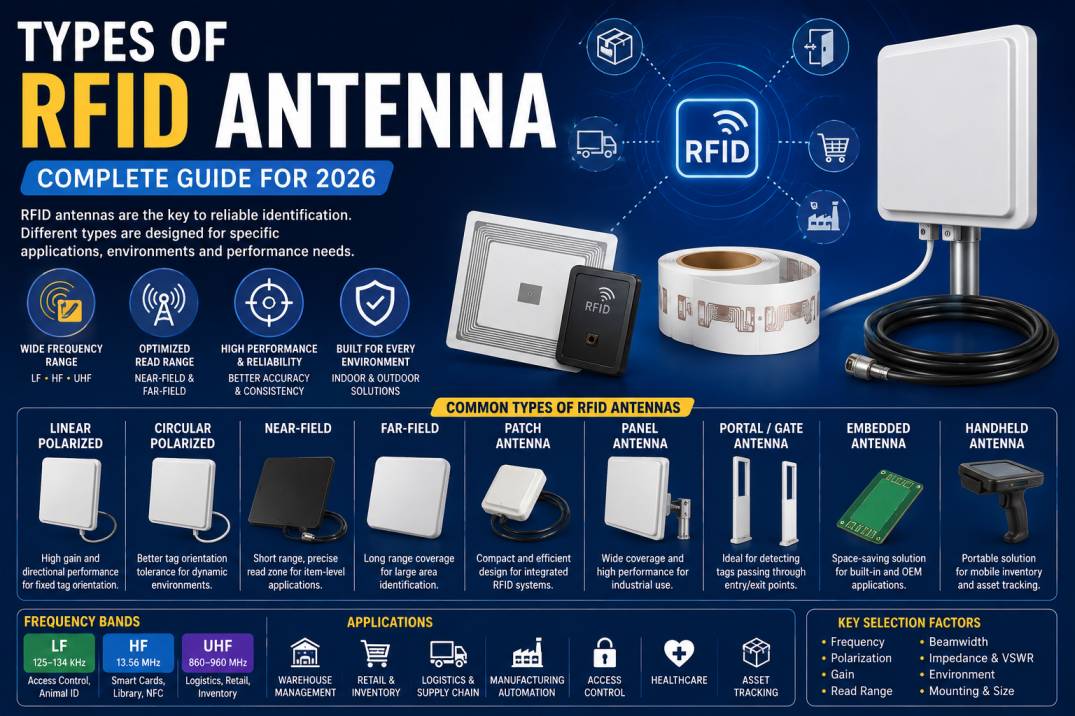
Common types include:
- Linear Polarized RFID Antenna
- Circular Polarized RFID Antenna
- Near-Field RFID Antenna
- Far-Field RFID Antenna
- Patch RFID Antenna
- Panel RFID Antenna
- Portal RFID Antenna
- Gate RFID Antenna
- Embedded RFID Antenna
- Handheld RFID Antenna
- Omnidirectional RFID Antenna
- Directional RFID Antenna
- High-Gain RFID Antenna
- Compact RFID Antenna
- UHF RFID Antenna
- HF RFID Antenna
- LF RFID Antenna
- Custom RFID Antenna
1. Linear Polarized RFID Antenna
A linear polarized RFID antenna generates an electromagnetic field with a predominantly linear polarization.
The electric field has a defined orientation, such as vertical or horizontal.
Advantages
- High gain potential
- Focused radiation pattern
- Good read performance when tag orientation is controlled
- Suitable for fixed tag orientations
- Effective for directional RFID applications
Applications
Linear polarized antennas are commonly used in:
- Conveyor systems
- Vehicle identification
- Manufacturing
- Fixed asset tracking
- Industrial automation
- Retail applications with controlled tag orientation
Limitation
The main limitation is sensitivity to tag orientation.
If a linearly polarized RFID antenna is vertically polarized and the RFID tag is oriented horizontally, the coupling can be significantly reduced.
2. Circular Polarized RFID Antenna
Circularly polarized RFID antennas are widely used in applications where RFID tags may appear in different orientations.
The electromagnetic field rotates as it propagates, providing greater tolerance to tag orientation compared with a single linear polarization.
Advantages
- Better orientation tolerance
- Suitable for moving tags
- Wide read-zone coverage
- Useful for portal applications
Applications
- Warehouses
- Retail stores
- Logistics
- Vehicle tracking
- Pallet tracking
- Asset management
- Automated inventory systems
Circular polarization is especially useful when tags cannot be reliably aligned with the antenna.
3. Near-Field RFID Antenna
Near-field RFID antennas operate primarily within the electromagnetic near field of the antenna.
They are designed for short-range applications where controlled tag positioning is possible.
Near-field RFID systems can use magnetic coupling or localized electromagnetic fields depending on the frequency and system architecture.
Applications
- Item-level identification
- Smart shelves
- Point-of-sale systems
- Document tracking
- Jewelry tracking
- Pharmaceutical packaging
- Small asset identification
Advantages
- Controlled read zone
- Reduced unintended reads
- Suitable for closely spaced objects
- Useful for small items
4. Far-Field RFID Antenna
Far-field RFID antennas are designed for applications where RFID tags are located at greater distances from the reader antenna.
They are especially common in UHF RFID systems.
Applications
- Warehouse inventory
- Pallet tracking
- Supply chain management
- Retail inventory
- Vehicle identification
- Logistics
- Industrial automation
Advantages
- Longer read range
- Large coverage area
- Suitable for moving tags
- Supports automated tracking
5. Patch RFID Antenna
A patch antenna is a planar antenna structure that can be designed for RFID frequency bands.
Patch antennas are commonly used in fixed UHF RFID readers.
Features
- Flat construction
- Compact profile
- Directional radiation
- Controlled beamwidth
- Suitable for wall or pole mounting
Applications
- Warehouse RFID
- Conveyor systems
- Access control
- Retail
- Industrial tracking
- Asset monitoring
6. Panel RFID Antenna
Panel RFID antennas are typically housed in a rectangular enclosure and are designed to provide controlled RF coverage.
They are widely used for fixed RFID reader installations.
Applications
- Warehouses
- Distribution centers
- Manufacturing facilities
- Retail stores
- Logistics centers
- Automated tracking systems
Advantages
- Rugged construction
- Easy mounting
- Directional coverage
- Suitable for industrial environments
- Available in different polarization configurations
7. Portal RFID Antenna
Portal RFID antennas are designed for RFID gates or portals where tagged objects pass through a defined entry or exit point.
Multiple antennas can be installed around a portal to create a controlled read zone.
Applications
- Warehouse entrances
- Shipping and receiving areas
- Retail exits
- Vehicle gates
- Logistics facilities
- Asset movement tracking
Advantages
- Automated identification
- Large read zones
- Multi-tag detection
- Suitable for high-throughput environments
8. Gate RFID Antenna
Gate antennas are similar to portal systems and are used to identify tagged objects as they move through a designated gateway.
A typical gate may use antennas positioned on both sides of an entrance.
Applications
- Inventory movement
- Access control
- Library systems
- Warehouse management
- Industrial tracking
- Vehicle monitoring
Gate antenna systems can be configured according to the size and geometry of the passage.
9. Embedded RFID Antenna
Embedded RFID antennas are integrated directly into equipment, machinery, cabinets, shelves, readers, or other structures.
They are useful when a low-profile RFID solution is required.
Applications
- Smart shelves
- Vending machines
- Industrial equipment
- Medical devices
- Embedded readers
- Automated storage systems
Advantages
- Compact design
- Clean integration
- Reduced external components
- Customized form factor
10. Handheld RFID Antenna
Handheld RFID readers commonly incorporate a compact directional antenna.
The antenna is integrated into the handheld reader or connected as part of the reader assembly.
Applications
- Warehouse inventory
- Retail stock management
- Asset tracking
- Field service
- Healthcare inventory
- Library management
Advantages
- Portable
- Flexible scanning
- Easy deployment
- Suitable for item-level identification
11. Omnidirectional RFID Antenna
Omnidirectional RFID antennas are designed to provide broad coverage around the antenna.
They can be useful when tagged objects may approach from multiple directions.
Applications
- Asset monitoring
- Industrial environments
- RFID sensor networks
- Specialized tracking applications
- Access control
Omnidirectional antennas are not always the best choice for UHF RFID because controlled directional coverage can provide better read-zone management in many fixed installations.
12. Directional RFID Antenna
Directional RFID antennas concentrate RF energy toward a particular direction.
They are among the most commonly used antenna configurations for fixed UHF RFID readers.
Advantages
- High forward gain
- Controlled read zone
- Reduced unwanted coverage
- Better range
- Improved spatial control
Applications
- Conveyor tracking
- Warehouse inventory
- Portal systems
- Vehicle identification
- Manufacturing
13. High-Gain RFID Antenna
High-gain RFID antennas concentrate RF energy into a narrower radiation pattern.
Higher gain can increase the effective coverage in the intended direction, provided that regulatory power limits and system requirements are respected.
Applications
- Long read-range systems
- Warehouse tracking
- Outdoor asset monitoring
- Vehicle identification
- Large-area inventory systems
Important Consideration
Higher antenna gain does not automatically mean better RFID performance.
An antenna with excessive gain may produce a coverage pattern that is too narrow for the application.
14. Compact RFID Antenna
Compact RFID antennas are designed for applications where space is limited.
They are commonly integrated into:
- Handheld readers
- Embedded readers
- Smart shelves
- Small industrial devices
- Point-of-sale equipment
- Compact tracking systems
The primary engineering challenge is achieving acceptable efficiency and radiation performance within a limited physical area.
15. UHF RFID Antenna
UHF RFID antennas are widely used for long-range passive RFID applications.
UHF RFID is particularly important for supply chain, logistics, retail, manufacturing, and inventory management.
Applications
- Pallet tracking
- Carton tracking
- Warehouse inventory
- Retail stock management
- Vehicle identification
- Industrial automation
- Supply chain management
Common UHF Antenna Characteristics
- High-frequency operation
- Directional or circular polarization
- Moderate to high gain
- Wide read zone
- Multi-tag capability
16. HF RFID Antenna
HF RFID antennas operate around 13.56 MHz.
They are often based on loop or coil structures because HF RFID relies strongly on magnetic-field coupling.
Applications
- Smart cards
- Access control
- Library systems
- NFC
- Ticketing
- Pharmaceutical identification
- Secure identification
Advantages
- Good short-range performance
- Suitable for item-level identification
- Less dependent on long-distance propagation
- Useful for controlled read zones
17. LF RFID Antenna
LF RFID systems operate in the low-frequency range, commonly around 125 kHz or 134.2 kHz depending on the application.
LF antennas often use coils designed to generate magnetic fields for inductive coupling.
Applications
- Animal identification
- Access control
- Automotive immobilizers
- Industrial identification
- Specialized tracking
Characteristics
LF RFID generally provides shorter read distances than UHF RFID but can offer useful performance around certain materials and environments.
18. Custom RFID Antenna
Custom RFID antennas are designed according to specific application requirements.
A custom design may optimize:
- Frequency
- Gain
- Polarization
- Read zone
- Physical dimensions
- Mounting
- Impedance
- Connector
- Environmental protection
Custom RFID antennas are useful when standard commercial products cannot meet the application’s read-zone or mechanical requirements.
RFID Antenna Polarization
Polarization is one of the most important considerations when selecting a UHF RFID antenna.
The two most common types are:
- Linear polarization
- Circular polarization
Linear Polarization
Linear polarization is useful when tag orientation is predictable.
Circular Polarization
Circular polarization is useful when tag orientation can change.
The choice between them should be based on tag movement, mounting orientation, antenna placement, and read-zone requirements.
RFID Antenna Gain
Antenna gain is generally specified in dBi.
Gain describes the antenna’s ability to concentrate RF energy in a particular direction compared with an isotropic reference.
Higher gain generally results in a narrower radiation pattern.
Typical RFID antenna gain categories may include:
| Gain | General Characteristics |
|---|---|
| 5–7 dBi | Broad coverage |
| 7–9 dBi | General fixed RFID |
| 9–12 dBi | Higher directional performance |
| 12+ dBi | Specialized applications |
Actual gain should always be taken from the manufacturer’s tested specifications.
RFID Antenna Beamwidth
Beamwidth determines how broad the main radiation pattern is.
A wide beam can cover a larger area, while a narrow beam can concentrate RF energy into a more focused region.
Beamwidth is important for:
- Conveyor systems
- Portal systems
- Warehouse aisles
- Vehicle tracking
- Shelf-level RFID
- Outdoor asset tracking
RFID Antenna Impedance
RFID antennas are typically designed for a nominal 50-ohm impedance when connected to standard RFID readers.
Proper impedance matching reduces reflected power and improves energy transfer between the reader and antenna.
Important matching parameters include:
- Impedance
- VSWR
- Return loss
- Insertion loss
- Connector quality
RFID Antenna VSWR
VSWR, or Voltage Standing Wave Ratio, measures the impedance matching between the antenna and RF system.
A lower VSWR generally indicates a better impedance match.
RFID antenna performance should be evaluated across the complete operating frequency range rather than at only one frequency.
RFID Antenna Read Range
Read range refers to the distance over which the RFID system can reliably identify a tag.
Read range depends on multiple factors:
- Antenna gain
- Reader transmit power
- Tag sensitivity
- Tag antenna design
- Frequency
- Polarization
- Tag orientation
- Material surrounding the tag
- Cable loss
- Environmental interference
Therefore, antenna gain alone cannot be used to predict actual RFID read distance.
RFID Antenna Read Zone
The read zone is the physical area where tags can be reliably detected.
A good RFID system should have a controlled read zone appropriate for the application.
For example, a warehouse portal needs sufficient coverage to detect all tagged goods passing through the gate but should minimize reads from objects outside the intended area.
RFID Antenna for Warehouse Applications
Warehouses are among the most important applications for UHF RFID antennas.
RFID antennas can be installed at:
- Dock doors
- Conveyor lines
- Storage aisles
- Packing stations
- Shipping areas
- Receiving areas
- Inventory checkpoints
Benefits
- Automated inventory tracking
- Faster receiving
- Improved shipping accuracy
- Reduced manual scanning
- Real-time asset visibility
- Better inventory management
RFID Antenna for Retail
Retail RFID systems use antennas to track tagged products throughout stores and distribution centers.
Applications include:
- Inventory counting
- Product tracking
- Stock replenishment
- Loss prevention
- Automated checkout
- Supply chain management
Circularly polarized antennas are often useful where product tags can have different orientations.
RFID Antenna for Manufacturing
Manufacturing facilities use RFID to track:
- Components
- Work-in-progress
- Tools
- Finished goods
- Production containers
- Equipment
Directional panel antennas can provide controlled coverage at production stations and conveyor lines.
RFID Antenna for Logistics
Logistics operations use RFID antennas to identify goods as they move through distribution networks.
Applications include:
- Pallet tracking
- Carton tracking
- Shipment verification
- Dock-door monitoring
- Automated sorting
- Transportation management
Portal antennas can create automated read zones at warehouse entrances and exits.
RFID Antenna for Vehicle Tracking
RFID antennas can identify vehicles equipped with RFID tags as they pass through controlled areas.
Applications include:
- Parking systems
- Tolling
- Fleet management
- Industrial vehicle tracking
- Access control
- Automated gate systems
Directional antennas can be installed to focus coverage toward vehicle lanes.
RFID Antenna for Industrial IoT
RFID is increasingly integrated with industrial IoT systems.
RFID antenna systems can provide identification data to:
- Manufacturing execution systems
- Warehouse management systems
- Enterprise resource planning platforms
- Asset management systems
- Industrial IoT platforms
This allows organizations to connect physical assets with digital tracking systems.
RFID Antenna for Smart Shelves
Smart shelves can use near-field or localized RFID antenna designs to identify products placed within a defined area.
Applications
- Retail
- Healthcare
- Libraries
- Pharmaceutical storage
- Inventory management
The antenna must be designed carefully to prevent unwanted reads from nearby shelves.
RFID Antenna for Conveyor Systems
Conveyor RFID systems require antennas that can detect tags as they move rapidly through a defined zone.
Important design considerations include:
- Conveyor speed
- Tag orientation
- Antenna placement
- Read zone
- Reader power
- Item spacing
- RF reflections
Directional antennas are frequently used to create controlled read zones.
RFID Antenna for Access Control
RFID antennas are widely used in access-control systems.
Depending on the technology, systems may use:
- LF antennas
- HF loop antennas
- UHF directional antennas
The appropriate design depends on required read distance, credential type, security requirements, and installation environment.
Near-Field vs Far-Field RFID Antenna
| Feature | Near-Field | Far-Field |
|---|---|---|
| Read Distance | Short | Longer |
| Field | Localized | Radiating |
| Common Frequency | LF/HF/UHF | Primarily UHF |
| Read Zone | Controlled | Larger |
| Applications | Item-level | Logistics |
| Tag Orientation | Often controlled | More variable |
| Typical Use | Smart shelves | Warehouses |
Linear vs Circular Polarized RFID Antenna
| Feature | Linear Polarized | Circular Polarized |
|---|---|---|
| Polarization | Fixed orientation | Rotating field |
| Tag Orientation | More sensitive | More tolerant |
| Gain Potential | Often higher | Often moderate |
| Applications | Conveyor | Portals |
| Read Zone | Focused | Flexible |
| Best Use | Controlled orientation | Variable orientation |
RFID Antenna vs RFID Reader
An RFID antenna and RFID reader are different components.
The RFID reader generates and processes the RF communication signals.
The RFID antenna transmits those signals into the environment and receives signals from RFID tags.
A complete RFID system typically includes:
- RFID reader
- RFID antenna
- RFID tag
- Coaxial cable
- RF connectors
- Software or middleware
RFID Antenna Cable and Connector
The cable between the RFID reader and antenna can influence overall system performance.
Important cable parameters include:
- Characteristic impedance
- Insertion loss
- Operating frequency
- Cable length
- Connector type
- Shielding
- Flexibility
Common RF connectors used in RFID systems may include:
- SMA
- N-Type
- TNC
- RP-TNC
- Other application-specific connectors
Long cable runs can introduce RF losses, reducing the amount of power delivered to the antenna and potentially reducing read performance.
How to Choose the Right RFID Antenna
Selecting the correct RFID antenna requires understanding the application and RF environment.
Step 1: Select the RFID Frequency
Determine whether the system uses:
- LF
- HF
- UHF
- Microwave
Step 2: Determine the Required Read Range
Short-range applications may benefit from near-field antennas, while longer-range applications may require far-field UHF antennas.
Step 3: Select Polarization
Choose linear polarization when tag orientation is controlled.
Choose circular polarization when tag orientation varies.
Step 4: Determine Coverage Area
Define the required read zone and choose an antenna radiation pattern that covers the desired area without creating excessive unwanted reads.
Step 5: Check Gain
Select an appropriate gain level based on required coverage and regulatory limits.
Step 6: Check VSWR and Impedance
Verify compatibility with the RFID reader and RF cable.
Step 7: Evaluate Environmental Conditions
For outdoor and industrial installations, consider:
- Temperature
- Humidity
- Dust
- Water
- UV exposure
- Mechanical impact
Step 8: Check Mechanical Requirements
Consider:
- Antenna dimensions
- Mounting
- Weight
- Cable routing
- Enclosure
- Installation height
Common RFID Antenna Selection Mistakes
Choosing an Antenna Only by Gain
Higher gain does not automatically mean better RFID performance.
Ignoring Tag Orientation
A linear antenna may perform poorly if tags are randomly oriented.
Using the Wrong Frequency
The antenna must be designed for the frequency used by the RFID reader and tag.
Creating Excessive Read Zones
An overly broad radiation pattern can cause unwanted tag reads.
Ignoring Nearby Metal
Metal objects can significantly affect RFID antenna performance, especially at UHF frequencies.
Using Excessively Long RF Cables
Cable losses can reduce the power delivered to the antenna.
Ignoring Polarization
Polarization mismatch can reduce tag read performance.
RFID Antenna Testing
Professional RFID antenna testing can include:
- VSWR measurement
- Return loss
- Impedance measurement
- Gain measurement
- Radiation pattern
- Polarization
- Read range
- Read-zone testing
- Tag sensitivity testing
- Environmental testing
A Vector Network Analyzer can be used for RF impedance and S-parameter measurements.
However, actual RFID performance should also be tested with representative RFID readers and tags because antenna specifications alone cannot predict the complete system behavior.
RFID Antenna Radiation Pattern
The radiation pattern shows how the antenna distributes electromagnetic energy.
A directional RFID antenna typically has:
- Main lobe
- Side lobes
- Rear radiation
The main lobe represents the strongest coverage direction.
Controlling side and rear radiation can help reduce unwanted tag reads and improve system reliability.
RFID Antenna and Metal Objects
Metal can strongly influence RFID performance.
In UHF RFID systems, metal surfaces can reflect RF energy and change the antenna’s effective radiation environment.
Specialized on-metal RFID tags and appropriately designed antenna installations may be required for reliable identification of metallic assets.
RFID Antenna and Liquid
Liquids can also influence UHF RFID performance because water and other liquids can absorb or detune RF energy.
Applications involving:
- Bottles
- Food
- Beverages
- Chemicals
- Medical liquids
may require careful tag and antenna selection.
Advantages of RFID Antennas
RFID antenna systems provide several benefits:
- Automated identification
- Contactless communication
- Fast tag detection
- Multi-tag reading
- Reduced manual scanning
- Improved inventory visibility
- Flexible deployment
- Integration with IoT systems
Limitations of RFID Antennas
RFID antenna performance can be affected by:
- Metal
- Liquids
- Tag orientation
- Interference
- RF reflections
- Antenna placement
- Cable losses
- Reader power
- Environmental conditions
Therefore, successful RFID deployment requires system-level RF planning rather than selecting an antenna based only on its datasheet gain.
Future Trends in RFID Antenna Technology
RFID antenna development continues to evolve alongside automation, IoT, robotics, smart manufacturing, and supply-chain digitization.
Important trends include:
- Compact UHF RFID antennas
- High-efficiency antenna designs
- Multi-antenna reader systems
- Advanced circular polarization
- Near-field UHF antennas
- Embedded RFID antennas
- Smart shelf antennas
- Flexible RFID antennas
- Printed antennas
- On-metal RFID solutions
- Antenna arrays
- RFID and IoT integration
The increasing use of automated warehouses, robotic fulfillment, smart manufacturing, and real-time inventory systems is expected to drive continued demand for reliable RFID antenna solutions.
RFID Antenna Maintenance
Outdoor and industrial RFID antennas should be periodically inspected.
Maintenance checks can include:
- Connector condition
- Cable condition
- Mounting hardware
- Antenna enclosure
- Water ingress
- Corrosion
- Physical damage
- Antenna alignment
Regular inspection helps maintain consistent RF performance.
RFID Antenna Specifications Checklist
Before purchasing an RFID antenna, evaluate:
| Parameter | What to Check |
|---|---|
| Frequency | LF, HF, UHF or microwave |
| Polarization | Linear or circular |
| Gain | Required directional performance |
| Beamwidth | Coverage area |
| VSWR | Impedance matching |
| Impedance | Typically 50 ohms |
| Read Range | Required identification distance |
| Connector | Reader compatibility |
| Cable | Length and insertion loss |
| Environment | Indoor or outdoor |
| Mounting | Wall, ceiling, pole or embedded |
| Material | Plastic, metal or specialized housing |
| IP Rating | Outdoor protection |
| Dimensions | Available installation space |
Conclusion
RFID antennas are fundamental components of RFID identification and tracking systems. The correct antenna determines how efficiently RF energy is delivered to RFID tags and how reliably tag responses are received.
Different applications require different antenna technologies. Linear polarized antennas are suitable when tag orientation is controlled, while circularly polarized antennas provide greater flexibility when tag orientation varies. Near-field antennas provide localized read zones, whereas far-field antennas support longer-range RFID applications.
Patch, panel, portal, gate, embedded, handheld, omnidirectional, directional, and high-gain antennas address different installation and coverage requirements. UHF RFID antennas are widely used in logistics, retail, warehouses, manufacturing, and supply-chain applications, while HF and LF antennas remain important for short-range identification and access-control applications.
When selecting an RFID antenna, engineers should evaluate frequency, polarization, gain, beamwidth, read range, impedance, VSWR, environmental conditions, tag orientation, cable loss, connector type, and installation geometry.
A well-designed RFID antenna system can improve read reliability, automate identification, reduce manual processes, and provide a strong foundation for modern inventory, logistics, manufacturing, and IoT applications.
Frequently Asked Questions
1. What is an RFID antenna?
An RFID antenna is an RF component that transmits electromagnetic energy from an RFID reader and receives signals from RFID tags.
2. What are the main types of RFID antennas?
The main types include linear polarized, circular polarized, near-field, far-field, patch, panel, portal, gate, embedded, handheld, directional, omnidirectional, high-gain, UHF, HF, LF, and custom RFID antennas.
3. What is the most common RFID antenna type?
For fixed UHF RFID systems, directional panel or patch-style antennas are widely used. The best antenna type depends on the application and required read zone.
4. What is a circular polarized RFID antenna?
A circular polarized RFID antenna produces a rotating electromagnetic field and is useful when RFID tags can have different orientations.
5. What is a linear polarized RFID antenna?
A linear polarized RFID antenna produces an electromagnetic field with a defined orientation. It is particularly effective when tag orientation is predictable.
6. What is the difference between near-field and far-field RFID antennas?
Near-field antennas create a localized RF field for short-range identification, while far-field antennas are designed for longer-distance RF communication, particularly in UHF RFID systems.
7. Which RFID antenna is best for warehouses?
Directional UHF RFID antennas, including circularly polarized panel antennas, are commonly used in warehouses for dock doors, conveyors, portals, and inventory tracking.
8. What frequency does UHF RFID use?
UHF RFID operates in a frequency range around 860–960 MHz, with the exact operating band depending on regional regulations and system design.
9. What is RFID antenna gain?
RFID antenna gain indicates how effectively an antenna concentrates RF energy in a particular direction relative to an isotropic reference.
10. Does higher RFID antenna gain mean longer read range?
Higher gain can increase directional coverage, but actual RFID read range also depends on reader power, tag sensitivity, tag antenna design, polarization, frequency, cable loss, and environmental conditions.
11. What impedance is commonly used for RFID antennas?
Many RFID reader and antenna systems use a nominal 50-ohm impedance.
12. Why is polarization important in RFID?
Polarization affects how efficiently the antenna couples energy to the RFID tag. Circular polarization provides greater tolerance when tag orientation is unpredictable.
13. Can RFID antennas read multiple tags simultaneously?
Yes. Modern UHF RFID systems can identify multiple tags within an antenna’s read zone using appropriate reader protocols and anti-collision techniques.
14. Can RFID antennas work around metal?
RFID antennas can operate around metal, but metal can alter RF propagation and antenna performance. Specialized antenna installation methods and on-metal RFID tags may be required.
15. Can RFID antennas work with liquid products?
RFID can be used with liquid-containing products, but liquids can absorb or detune RF signals, particularly at UHF frequencies. Specialized tags and antenna placement may be necessary.
16. What connector is commonly used with RFID antennas?
RFID antennas may use SMA, N-Type, TNC, RP-TNC, or other RF connectors depending on the reader and antenna design.
17. What is an RFID portal antenna?
A portal antenna is installed around a gateway or passage to automatically identify tagged products, pallets, vehicles, or assets moving through the portal.
18. What is an RFID panel antenna?
A panel RFID antenna is a flat or enclosed directional antenna designed to provide controlled RF coverage for fixed RFID installations.
19. What is a UHF RFID antenna used for?
UHF RFID antennas are widely used for inventory tracking, logistics, retail, manufacturing, warehouse automation, pallet tracking, and supply-chain applications.
20. How do I choose the right RFID antenna?
Choose the antenna based on RFID frequency, read range, polarization, gain, beamwidth, tag orientation, reader power, environment, mounting configuration, impedance, VSWR, cable loss, and required read-zone coverage.