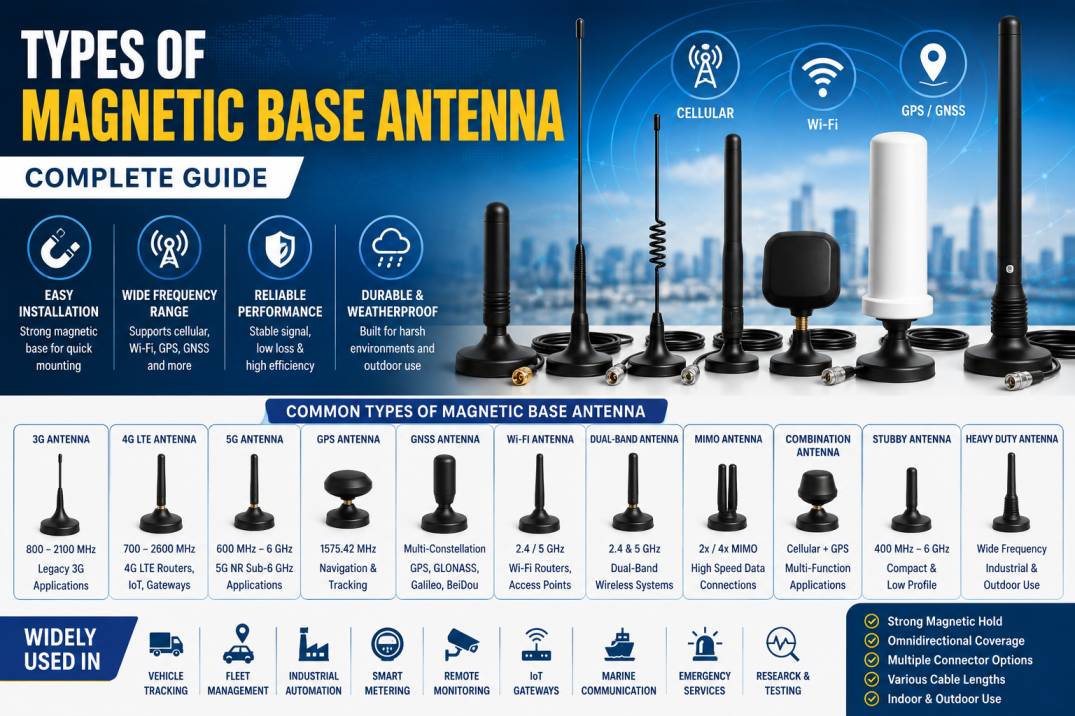
A Magnetic Base Antenna is an RF antenna equipped with a magnetic mounting base that allows it to be installed quickly on a ferromagnetic metal surface. These antennas are widely used in cellular communication, GPS, GNSS, Wi-Fi, telemetry, radio communication, vehicle tracking, IoT, industrial automation, and mobile wireless systems.
The major advantage of a magnetic base antenna is its simple installation. Instead of drilling holes or permanently modifying a vehicle, cabinet, equipment enclosure, or metal structure, the antenna can be attached using its magnetic base and connected to the RF equipment through a coaxial cable.
Magnetic base antennas are available in many configurations, including omnidirectional, cellular, 3G, 4G LTE, 5G, Wi-Fi, GPS/GNSS, dual-band, multi-band, whip, stubby, and combination antennas.
Selecting the right magnetic base antenna requires careful consideration of frequency range, gain, radiation pattern, impedance, VSWR, connector type, cable length, magnetic holding strength, environmental conditions, and application requirements.
What Is a Magnetic Base Antenna?
A magnetic base antenna is an RF antenna that uses a magnetic mounting mechanism to attach to a suitable metal surface.
The antenna assembly generally consists of:
- Antenna radiating element
- Magnetic base
- Coaxial cable
- RF connector
- Protective housing
- Ground coupling through the mounting surface
The magnetic base provides mechanical attachment and, depending on the antenna design and frequency, the metal mounting surface can also contribute to the antenna’s RF counterpoise or ground reference.
This makes magnetic base antennas particularly useful for mobile and temporary installations.
How Does a Magnetic Base Antenna Work?
A magnetic base antenna operates like other RF antennas, converting electrical RF energy into electromagnetic waves during transmission and electromagnetic waves into electrical signals during reception.
The magnetic base serves two important purposes.
First, it provides mechanical attachment to a metal surface.
Second, for many antenna designs, the conductive metal surface beneath the base can influence the antenna’s RF performance by acting as part of the antenna system or counterpoise.
This is why installation surface, mounting position, and ground-plane characteristics can affect antenna performance.
Main Types of Magnetic Base Antennas
Magnetic base antennas can be categorized according to their frequency, application, radiation pattern, antenna element, and number of supported wireless technologies.
The major types include:
- Magnetic Base 3G Antenna
- Magnetic Base 4G LTE Antenna
- Magnetic Base 5G Antenna
- Magnetic Base Cellular Antenna
- Magnetic Base GPS Antenna
- Magnetic Base GNSS Antenna
- Magnetic Base Wi-Fi Antenna
- Magnetic Base 2.4 GHz Antenna
- Magnetic Base 5 GHz Antenna
- Magnetic Base Dual-Band Antenna
- Magnetic Base Multi-Band Antenna
- Magnetic Base Whip Antenna
- Magnetic Base Stubby Antenna
- Magnetic Base MIMO Antenna
- Magnetic Base Combination Antenna
- Heavy-Duty Magnetic Base Antenna
- Low-Profile Magnetic Base Antenna
- Custom Magnetic Base Antenna
1. Magnetic Base 3G Antenna
A magnetic base 3G antenna is designed for third-generation cellular communication systems.
These antennas were widely used with older cellular modems, routers, telemetry devices, tracking systems, and industrial communication equipment.
Although many markets are transitioning away from 3G networks, legacy equipment may continue to require 3G-compatible antennas.
Applications
- Legacy cellular routers
- Industrial modems
- Telemetry systems
- Vehicle tracking
- Remote monitoring
- Machine-to-machine communication
2. Magnetic Base 4G LTE Antenna
A Magnetic Base 4G LTE Antenna is designed to support LTE cellular frequency bands.
4G LTE continues to be widely used in industrial IoT, cellular routers, fleet management, remote monitoring, smart infrastructure, and fixed wireless applications.
Features
- Easy installation
- Omnidirectional options
- Multi-band configurations
- Different gain options
- Multiple connector choices
- Available with various coaxial cable lengths
Applications
- 4G LTE routers
- Industrial gateways
- Fleet tracking
- Security systems
- Remote monitoring
- Smart meters
- IoT gateways
3. Magnetic Base 5G Antenna
Magnetic base 5G antennas are designed for compatible 5G frequency ranges.
Depending on the antenna design, they may support sub-6 GHz 5G bands or multiple cellular technologies.
Applications
- 5G routers
- Industrial 5G gateways
- Private wireless networks
- IoT equipment
- Connected vehicles
- Portable communication equipment
5G antenna selection requires careful attention to supported frequency bands because 5G networks operate across a broad range of frequencies.
4. Magnetic Base Cellular Antenna
A magnetic base cellular antenna is a general-purpose antenna designed for cellular communication.
It may support one or multiple cellular generations and frequency bands.
Advantages
- Flexible installation
- Easy repositioning
- Suitable for temporary systems
- No permanent drilling required
- Convenient for vehicles and equipment
5. Magnetic Base GPS Antenna
A magnetic base GPS antenna is designed to receive signals from GPS satellites.
These antennas are commonly used with navigation and positioning equipment.
Applications
- Vehicle tracking
- Fleet management
- Navigation systems
- Asset tracking
- Logistics
- Timing equipment
- Surveying equipment
GPS antennas can be passive or active.
An active GPS antenna typically contains a low-noise amplifier and requires DC power supplied through the RF cable.
6. Magnetic Base GNSS Antenna
GNSS stands for Global Navigation Satellite System.
A GNSS antenna may support multiple satellite navigation systems, such as GPS, Galileo, GLONASS, and BeiDou, depending on its design.
Applications
- Precision positioning
- Fleet tracking
- Surveying
- Agriculture
- Autonomous systems
- Timing
- Transportation
Multi-constellation GNSS antennas can provide broader satellite availability than GPS-only designs.
7. Magnetic Base Wi-Fi Antenna
Magnetic base Wi-Fi antennas are used for wireless networking applications.
They may be designed for:
- 2.4 GHz
- 5 GHz
- Dual-band Wi-Fi
Applications
- Industrial routers
- Outdoor wireless equipment
- Wireless gateways
- Mobile Wi-Fi systems
- Temporary network installations
The antenna should be matched to the frequency range supported by the Wi-Fi equipment.
8. Magnetic Base 2.4 GHz Antenna
2.4 GHz magnetic base antennas are used for various wireless technologies.
Applications can include:
- Wi-Fi
- Bluetooth
- Zigbee
- ISM communication
- Industrial wireless systems
The antenna’s radiation pattern and gain should be selected according to the required coverage area.
9. Magnetic Base 5 GHz Antenna
5 GHz magnetic base antennas are commonly used with Wi-Fi and other higher-frequency wireless systems.
They can provide a convenient solution for wireless equipment that requires an externally mounted antenna.
Applications
- Wi-Fi routers
- Wireless gateways
- Industrial wireless systems
- Wireless bridges
- Access points
10. Magnetic Base Dual-Band Antenna
A dual-band magnetic antenna is designed to support two frequency ranges.
A common configuration is:
- 2.4 GHz
- 5 GHz
Dual-band antennas are widely used with Wi-Fi equipment that operates across both bands.
Benefits
- One antenna supports multiple bands
- Simplified installation
- Reduced equipment footprint
- Flexible wireless deployment
11. Magnetic Base Multi-Band Antenna
Multi-band magnetic base antennas support multiple frequency ranges using a single antenna assembly.
They are particularly useful for cellular routers and gateways that need to operate across different network bands.
Applications
- Cellular routers
- IoT gateways
- Fleet tracking
- Industrial communication
- Connected vehicles
- Remote monitoring
Multi-band performance should always be verified across the complete operating frequency range.
12. Magnetic Base Whip Antenna
A whip antenna uses an elongated flexible or semi-flexible radiating element.
Magnetic base whip antennas are common in mobile and vehicle applications.
Advantages
- Simple construction
- Broad radiation pattern
- Easy installation
- Available in many frequency configurations
- Suitable for mobile applications
13. Magnetic Base Stubby Antenna
A stubby magnetic antenna uses a short radiating element to achieve a compact form factor.
Applications
- Portable equipment
- Vehicle systems
- Compact cellular routers
- Industrial equipment
- Temporary installations
Advantages
- Compact size
- Low-profile appearance
- Easy installation
- Reduced mechanical height
A shorter antenna may have different efficiency and gain characteristics than a longer whip antenna, so specifications should be compared before selection.
14. Magnetic Base MIMO Antenna
MIMO stands for Multiple Input Multiple Output.
MIMO magnetic antennas contain multiple antenna elements or multiple RF paths to support wireless systems that use spatial diversity or multiple spatial streams.
They are especially relevant to modern LTE and Wi-Fi equipment.
Benefits
- Multiple RF paths
- Improved wireless reliability
- Higher potential throughput
- Support for spatial diversity
- Suitable for modern wireless routers
Applications
- 4G LTE routers
- 5G equipment
- Wi-Fi routers
- Industrial gateways
- Mobile broadband systems
For MIMO systems, the antenna configuration should match the number of RF ports and spatial streams supported by the wireless equipment.
15. Magnetic Base Combination Antenna
A combination antenna integrates multiple wireless functions into one antenna assembly.
A single product may combine technologies such as:
- Cellular
- GPS/GNSS
- Wi-Fi
- Bluetooth
Combination antennas are useful when equipment requires several wireless technologies but has limited installation space.
Applications
- Fleet management
- Connected vehicles
- Industrial gateways
- Telematics
- Smart transportation
- IoT systems
16. Heavy-Duty Magnetic Base Antenna
Heavy-duty magnetic antennas are designed for applications where stronger mechanical attachment and greater environmental durability are required.
They may feature:
- Larger magnetic bases
- Rugged housings
- Durable coaxial cables
- Weather-resistant construction
- Strong mounting hardware
Applications
- Industrial equipment
- Utility vehicles
- Construction equipment
- Temporary field installations
- Outdoor monitoring
17. Low-Profile Magnetic Base Antenna
Low-profile antennas are designed to minimize overall height.
They are particularly useful where aerodynamic performance, compact dimensions, or low visual impact is important.
Applications
- Vehicles
- Portable equipment
- Industrial cabinets
- Compact wireless systems
- Transportation equipment
18. Custom Magnetic Base Antenna
Custom magnetic base antennas can be developed for specific frequency, gain, cable, connector, mounting, and environmental requirements.
Custom designs may be required when standard antennas do not satisfy the application’s mechanical or RF requirements.
Magnetic Base Antenna Types Comparison
| Antenna Type | Typical Application | Radiation Pattern |
|---|---|---|
| 3G Magnetic Antenna | Legacy cellular | Omnidirectional |
| 4G LTE Magnetic Antenna | LTE routers | Omnidirectional |
| 5G Magnetic Antenna | 5G equipment | Omni or directional |
| Cellular Magnetic Antenna | Mobile communication | Usually omni |
| GPS Magnetic Antenna | Navigation | Receive-only |
| GNSS Magnetic Antenna | Positioning | Receive-only |
| Wi-Fi Magnetic Antenna | WLAN | Omni or directional |
| 2.4 GHz Magnetic Antenna | Wi-Fi/ISM | Omni |
| 5 GHz Magnetic Antenna | Wi-Fi | Omni or directional |
| Dual-Band Magnetic Antenna | 2.4/5 GHz | Omni |
| Multi-Band Magnetic Antenna | Cellular | Usually omni |
| Whip Magnetic Antenna | Vehicles | Omni |
| Stubby Magnetic Antenna | Compact equipment | Omni |
| MIMO Magnetic Antenna | LTE/Wi-Fi | Multiple elements |
| Combination Antenna | Multi-function devices | Multi-element |
| Heavy-Duty Antenna | Industrial | Application dependent |
| Low-Profile Antenna | Vehicles/equipment | Usually omni |
Magnetic Base Antenna Frequency Range
Frequency compatibility is one of the most important factors when choosing a magnetic antenna.
Depending on the design, magnetic antennas can operate across frequency ranges such as:
- 315 MHz
- 433 MHz
- 470 MHz
- 700 MHz
- 800 MHz
- 850 MHz
- 900 MHz
- 1.8 GHz
- 1.9 GHz
- 2.1 GHz
- 2.3 GHz
- 2.4 GHz
- 2.5 GHz
- 2.6 GHz
- 3.3 GHz
- 3.5 GHz
- 5 GHz
- GNSS frequency bands
The exact frequency range depends on the antenna design.
Magnetic Base Antenna Gain
Antenna gain describes how effectively an antenna concentrates RF energy.
Magnetic base antennas are available in different gain configurations depending on frequency and application.
Typical categories may include:
| Gain Category | General Application |
|---|---|
| 1–2 dBi | Compact devices |
| 2–5 dBi | General wireless applications |
| 5–8 dBi | Extended coverage |
| 8–12 dBi | Directional/high-performance applications |
These are general categories and should not replace the manufacturer’s tested gain specification.
Higher gain does not always mean better performance. The radiation pattern and installation environment are equally important.
Magnetic Base Antenna Radiation Pattern
Most cellular and Wi-Fi magnetic base antennas are designed as omnidirectional antennas.
An omnidirectional antenna provides broad horizontal coverage around the antenna.
Directional magnetic base antennas are also possible for specialized applications.
Omnidirectional Magnetic Antenna
Suitable for:
- Vehicles
- Cellular routers
- IoT gateways
- Mobile equipment
- General wireless communication
Directional Magnetic Antenna
Suitable for:
- Fixed wireless links
- Point-to-point communication
- Specialized RF systems
- Remote communication
Magnetic Base Antenna Impedance
Most cellular, Wi-Fi, and other modern RF systems use a nominal 50-ohm impedance.
Maintaining impedance matching between the antenna, coaxial cable, connector, and RF equipment helps reduce signal reflections.
Important matching parameters include:
- VSWR
- Return loss
- Reflection coefficient
- Insertion loss
VSWR of Magnetic Base Antennas
VSWR stands for Voltage Standing Wave Ratio.
It indicates how well the antenna is matched to the RF system.
A lower VSWR generally indicates better impedance matching across the antenna’s operating range.
When comparing antennas, VSWR should be evaluated across the full required frequency band rather than at only one frequency.
Magnetic Base Antenna Connector Types
Magnetic base antennas are available with many RF connector options.
Common connectors include:
- SMA
- RP-SMA
- N-Type
- TNC
- BNC
- MMCX
- U.FL
- IPEX
- MHF series
The connector should be compatible with the RF port on the router, modem, radio, GPS receiver, or other wireless device.
Magnetic Base Antenna Cable
Most magnetic antennas are supplied with an integrated coaxial cable.
Common cable types include:
- RG174
- RG316
- RG58
- Low-loss coaxial cables
- Micro-coaxial cables
Cable length should be selected carefully because longer coaxial cables generally introduce greater RF loss.
For high-frequency applications, low-loss cable is particularly important.
Importance of the Ground Plane
The mounting surface can influence the performance of many magnetic base antennas.
A sufficiently large conductive metal surface can act as an RF counterpoise for certain antenna designs.
For vehicle-mounted antennas, the vehicle roof may provide a useful conductive mounting surface.
Installing a magnetic antenna on:
- Plastic
- Fiberglass
- Wood
- Glass
- Non-metallic surfaces
may not provide the same RF characteristics as mounting it on a suitable metal surface.
The antenna manufacturer’s installation instructions should always be followed.
Magnetic Base Antenna for Vehicles
Vehicle applications are among the most common uses for magnetic base antennas.
They are used for:
- Fleet tracking
- GPS navigation
- Cellular communication
- Telematics
- Vehicle monitoring
- Public transportation
- Emergency communication
- Connected vehicle systems
Benefits for Vehicles
- No drilling required
- Easy installation
- Easy removal
- Flexible positioning
- Suitable for temporary systems
The antenna should be installed where it has an unobstructed view or suitable RF environment and where the magnetic base can maintain secure attachment.
Magnetic Base Antenna for 4G LTE Routers
4G LTE routers often use external antennas to improve flexibility and accommodate installations where the internal antenna is not optimal.
A magnetic base LTE antenna can be positioned on a metal surface while the router remains indoors.
Applications
- Rural broadband
- Industrial internet
- Remote offices
- Construction sites
- Temporary connectivity
- IoT gateways
For MIMO LTE routers, a multi-element antenna system may be required rather than a single antenna.
Magnetic Base Antenna for IoT
IoT systems frequently require compact and reliable wireless connectivity.
Magnetic base antennas can be useful for gateways and field equipment.
Applications
- Smart meters
- Environmental sensors
- Industrial monitoring
- Asset tracking
- Agricultural monitoring
- Remote control systems
- Utility infrastructure
Magnetic Base Antenna for GPS and GNSS
GPS and GNSS magnetic antennas are frequently used for positioning applications.
A magnetic mounting base allows the antenna to be positioned on the roof or other metal surface of a vehicle.
Important GPS/GNSS Specifications
- Frequency support
- Antenna gain
- LNA gain for active antennas
- Noise figure
- Axial ratio
- VSWR
- Cable length
- Connector type
- Ground-plane requirements
Active vs Passive Magnetic Base Antennas
Magnetic base antennas can be active or passive depending on their function.
Passive Antenna
A passive antenna does not contain an internal amplifier.
Advantages include:
- Simple design
- No DC power requirement
- Lower power consumption
- Fewer electronic components
Active Antenna
An active antenna contains an integrated low-noise amplifier or other active circuitry.
It may require DC power through the coaxial cable.
Active GPS and GNSS antennas are common because the received satellite signals can be very weak.
Magnetic Base Antenna for Cellular Networks
Cellular magnetic antennas can be designed to support multiple generations and bands.
Depending on the model, they may support:
- 3G
- 4G LTE
- 5G
- Multiple cellular bands
When selecting an antenna, it is essential to verify compatibility with the actual frequency bands used by the network and modem.
Magnetic Base Antenna for Wi-Fi
Magnetic Wi-Fi antennas are available for:
- 2.4 GHz
- 5 GHz
- Dual-band systems
They can be used with wireless routers, gateways, access points, industrial computers, and other equipment.
The antenna gain and radiation pattern should be selected according to the desired coverage.
Magnetic Base Antenna for Industrial Applications
Industrial wireless equipment often operates in challenging environments.
Magnetic base antennas can be used for:
- Industrial routers
- PLC communication
- Machine monitoring
- Industrial IoT
- Remote telemetry
- Wireless sensors
- Automation systems
For industrial installations, important requirements may include:
- Temperature resistance
- Mechanical durability
- Cable flexibility
- Connector reliability
- Environmental protection
- Strong magnetic attachment
Magnetic Base Antenna for Temporary Installations
One of the biggest advantages of magnetic antennas is their suitability for temporary deployments.
Applications include:
- Field testing
- RF surveys
- Temporary communication
- Construction sites
- Events
- Emergency communication
- Research and development
The antenna can be repositioned or removed without permanently modifying the mounting surface.
Advantages of Magnetic Base Antennas
Easy Installation
Magnetic mounting eliminates the need for drilling in many applications.
Easy Removal
The antenna can be removed when the equipment is transported or stored.
Flexible Positioning
Users can reposition the antenna to optimize RF performance.
Low Installation Cost
Simple magnetic mounting can reduce mechanical installation requirements.
Suitable for Vehicles
Magnetic bases are particularly useful for temporary or mobile vehicle installations.
Wide Range of Designs
Magnetic antennas are available for cellular, Wi-Fi, GPS, GNSS, ISM, radio, and other RF systems.
Limitations of Magnetic Base Antennas
Magnetic Holding Strength
The antenna may move or detach if the magnetic force is insufficient for the application.
Metal Surface Requirement
The mounting surface can affect both mechanical attachment and RF performance.
Cable Movement
A long or heavy coaxial cable can place mechanical stress on the magnetic base.
Environmental Conditions
High wind, vibration, impact, and weather conditions can affect installation reliability.
RF Ground Plane
Some antenna designs require an appropriate conductive ground plane for optimal performance.
Magnetic Base Antenna vs Permanent Mount Antenna
| Feature | Magnetic Base | Permanent Mount |
|---|---|---|
| Installation | Quick | More involved |
| Drilling | Usually not required | Often required |
| Removal | Easy | Difficult |
| Mobility | Excellent | Limited |
| Vehicle Use | Excellent | Excellent |
| Temporary Installation | Excellent | Poor |
| Mechanical Security | Moderate to high | High |
| Grounding | Depends on design | Usually more controlled |
Magnetic Base Antenna vs Adhesive Mount Antenna
| Feature | Magnetic Base | Adhesive Mount |
|---|---|---|
| Metal Surface | Preferred | Not always required |
| Repositioning | Easy | Limited |
| Removal | Easy | Can be difficult |
| Installation | Very easy | Easy |
| Reuse | Excellent | Depends on adhesive |
| Vehicle Applications | Very common | Common |
How to Choose the Right Magnetic Base Antenna
1. Identify the Wireless Technology
Determine whether the antenna is intended for:
- Cellular
- LTE
- 5G
- Wi-Fi
- GPS
- GNSS
- ISM
- Radio
- Other RF applications
2. Identify the Frequency Range
Verify that the antenna covers the required frequency bands.
3. Determine Required Gain
Select an appropriate gain level according to the required coverage and installation.
4. Check Radiation Pattern
Determine whether an omnidirectional or directional pattern is appropriate.
5. Check Impedance
Most modern RF systems use 50-ohm impedance.
6. Check VSWR
Verify VSWR across the entire required frequency range.
7. Select the Connector
Ensure compatibility with the RF equipment.
8. Select Cable Length
Use the shortest practical cable length while maintaining installation flexibility.
9. Evaluate Magnetic Holding Force
The base should provide sufficient mechanical attachment for the application.
10. Check Environmental Requirements
For outdoor or mobile applications, consider:
- Temperature
- Rain
- UV exposure
- Vibration
- Wind
- Dust
- Corrosion
Common Magnetic Base Antenna Applications
Magnetic base antennas are used in:
- 4G LTE routers
- 5G routers
- GPS tracking systems
- GNSS receivers
- Fleet management
- Vehicle telematics
- Industrial IoT
- Wireless gateways
- Wi-Fi systems
- Smart meters
- Security equipment
- Remote monitoring
- Agriculture
- Transportation
- Utilities
- RF testing
Testing Magnetic Base Antennas
Professional RF testing may include:
- VSWR testing
- Return loss measurement
- Impedance measurement
- Gain measurement
- Radiation pattern testing
- Efficiency testing
- Cable loss measurement
- Connector inspection
- Environmental testing
A Vector Network Analyzer can be used to characterize impedance-related parameters such as S11, VSWR, and return loss.
Magnetic Base Antenna Maintenance
Magnetic base antennas require relatively little maintenance, but regular inspection is recommended for demanding applications.
Check:
- Magnetic base condition
- Coaxial cable damage
- Connector condition
- Corrosion
- Housing damage
- Mounting stability
- Cable strain
- Antenna alignment
For vehicle installations, inspect the antenna after extended driving, washing, severe weather, or mechanical impact.
Magnetic Base Antenna Installation Best Practices
Use a Suitable Metal Surface
When the antenna design requires a conductive ground plane, use an appropriate metal mounting surface.
Keep the Antenna Vertical When Required
Many omnidirectional antennas perform according to a specific polarization orientation.
Minimize Cable Loss
Use an appropriate low-loss coaxial cable and avoid unnecessarily long cable runs.
Avoid Nearby Obstructions
Metal structures and electronic equipment can influence RF performance.
Secure the Cable
Prevent excessive cable movement and mechanical stress on the antenna connector.
Protect Outdoor Connections
Weatherproof exposed RF connections where required.
Future Trends in Magnetic Base Antenna Technology
Wireless systems are becoming more compact and multi-functional, increasing demand for versatile antenna solutions.
Important trends include:
- Multi-band cellular antennas
- 4G and 5G combination antennas
- MIMO magnetic antennas
- Cellular plus GNSS combinations
- Cellular plus Wi-Fi combinations
- Compact low-profile designs
- Higher-efficiency antennas
- Rugged industrial antennas
- Multi-technology IoT antennas
- Lightweight magnetic mounting systems
Connected vehicles, industrial IoT, smart infrastructure, and portable wireless equipment will continue creating demand for flexible external antenna solutions.
Conclusion
Magnetic Base Antennas provide a convenient and flexible solution for many RF and wireless communication applications. Their magnetic mounting system makes installation significantly easier than permanent-mount alternatives, particularly for vehicles, temporary deployments, industrial equipment, routers, gateways, and field-testing systems.
Different types of magnetic base antennas are designed for different technologies and frequency ranges. Cellular, 4G LTE, 5G, GPS, GNSS, Wi-Fi, dual-band, multi-band, MIMO, whip, stubby, and combination antennas each serve specific application requirements.
When selecting a magnetic base antenna, engineers should evaluate frequency range, gain, radiation pattern, impedance, VSWR, polarization, connector type, cable length, magnetic holding force, ground-plane requirements, and environmental conditions.
The right antenna, correctly positioned and connected using a suitable RF cable assembly, can provide reliable wireless communication while maintaining a simple and flexible installation.
Frequently Asked Questions
1. What is a Magnetic Base Antenna?
A magnetic base antenna is an RF antenna equipped with a magnetic mounting base that allows it to attach to a suitable metal surface without permanent drilling or mechanical modification.
2. What are the main types of Magnetic Base Antennas?
Common types include cellular, 3G, 4G LTE, 5G, GPS, GNSS, Wi-Fi, dual-band, multi-band, MIMO, whip, stubby, combination, low-profile, and heavy-duty magnetic base antennas.
3. What is a Magnetic Base 4G LTE Antenna used for?
It is commonly used with 4G LTE routers, modems, industrial gateways, IoT devices, fleet tracking systems, remote monitoring equipment, and other cellular communication systems.
4. Can a Magnetic Base Antenna be used for 5G?
Yes. Magnetic base antennas can be designed for compatible 5G frequency bands, including certain sub-6 GHz applications. The antenna’s frequency specifications should be checked against the 5G equipment and network.
5. What is a Magnetic Base GPS Antenna?
A magnetic base GPS antenna is designed to receive GPS satellite signals and can be mounted on a metal surface, commonly on vehicles and tracking equipment.
6. What is the difference between active and passive GPS antennas?
A passive antenna contains only passive RF elements, while an active GPS antenna incorporates an amplifier and typically requires DC power to improve the received signal level.
7. Can a Magnetic Base Antenna be used on a car?
Yes. Vehicle applications are one of the most common uses for magnetic base antennas. They are used for cellular communication, GPS, GNSS, fleet tracking, telematics, and wireless data.
8. Does a Magnetic Base Antenna need a metal surface?
The mechanical attachment requires a suitable ferromagnetic surface. Additionally, some antenna designs benefit from a conductive metal ground plane for RF performance. Always follow the manufacturer’s mounting requirements.
9. What frequency bands can Magnetic Base Antennas support?
Depending on the design, magnetic antennas can support cellular, Wi-Fi, GNSS, ISM, radio, and other RF frequency bands. The exact frequency range varies by antenna model.
10. What is the typical impedance of a Magnetic Base Antenna?
Most cellular, Wi-Fi, GPS, and other modern RF magnetic antennas are designed for a nominal 50-ohm system.
11. Which connectors are used with Magnetic Base Antennas?
Common connectors include SMA, RP-SMA, N-Type, TNC, BNC, MMCX, U.FL, IPEX, and MHF-series connectors.
12. Does cable length affect Magnetic Base Antenna performance?
Yes. Longer coaxial cables generally introduce more RF loss. For higher-frequency systems, selecting an appropriate low-loss cable and minimizing cable length can be particularly important.
13. What is a Magnetic Base MIMO Antenna?
A Magnetic Base MIMO Antenna uses multiple antenna elements or RF paths to support MIMO wireless systems such as LTE, 5G, and Wi-Fi.
14. Can one Magnetic Base Antenna support multiple frequency bands?
Yes. Multi-band magnetic antennas are designed to operate across multiple frequency ranges and can support cellular, Wi-Fi, or other wireless technologies depending on their design.
15. What is the advantage of a Magnetic Base Antenna?
The primary advantages are easy installation, easy removal, flexible positioning, no drilling in many applications, and suitability for mobile and temporary installations.
16. What is the difference between a Magnetic Base Antenna and a permanent-mount antenna?
A magnetic base antenna can generally be installed and removed without permanently modifying the mounting surface, while a permanent-mount antenna usually requires a fixed mechanical installation.
17. Are Magnetic Base Antennas suitable for outdoor use?
Yes, provided the antenna is specifically designed and rated for outdoor conditions. Weather resistance, UV protection, temperature range, and connector protection should be checked.
18. What gain should I choose for a Magnetic Base Antenna?
The appropriate gain depends on the frequency, required coverage, radiation pattern, installation environment, and wireless system. Higher gain is not automatically better.
19. What is VSWR in a Magnetic Base Antenna?
VSWR, or Voltage Standing Wave Ratio, indicates how well the antenna is impedance-matched to the RF system. Lower VSWR generally indicates better matching across the specified frequency range.
20. How do I choose the best Magnetic Base Antenna?
Select the antenna based on wireless technology, frequency range, gain, radiation pattern, impedance, VSWR, polarization, connector, cable length, mounting surface, magnetic holding strength, environmental conditions, and application requirements.