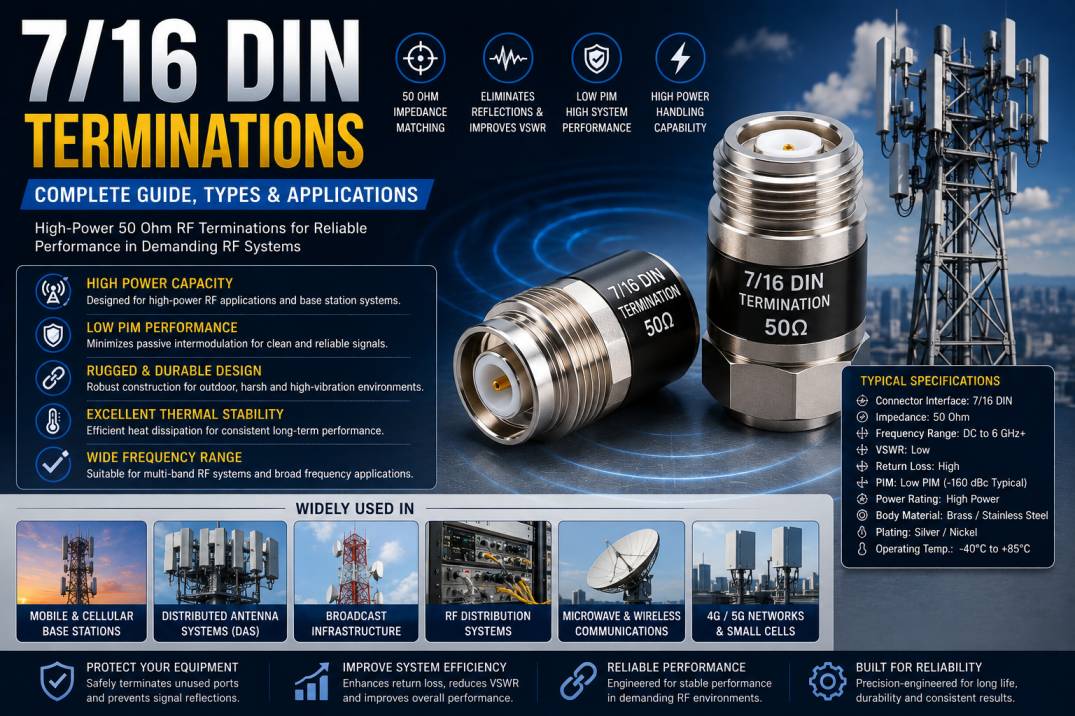
7/16 DIN Terminations are high-power RF termination components designed to provide a controlled 50 Ohm load at the end of RF transmission lines, unused ports, and signal paths. They are widely used in telecommunications, cellular base stations, distributed antenna systems, broadcast infrastructure, RF distribution networks, and other high-power RF applications where reliable impedance matching, low PIM, mechanical strength, and thermal stability are important.
The 7/16 DIN interface, commonly written as 7-16 DIN, is a rugged threaded coaxial RF connector developed for demanding communication infrastructure. Its large contact geometry and robust mechanical construction make it particularly suitable for high-power RF systems.
A 7/16 DIN termination absorbs RF energy rather than allowing it to reflect toward the source. By providing a controlled 50 Ohm load, it helps maintain impedance matching, reduce unwanted reflections, protect unused RF ports, and support stable RF system performance.
What Is a 7/16 DIN Termination?
A 7/16 DIN Termination is a precision RF load fitted with a 7/16 DIN connector interface. The termination is normally designed with a 50 Ohm impedance to match the characteristic impedance of most RF transmission systems.
When connected to an unused 7/16 DIN port, the termination presents a controlled electrical load to the RF system. Instead of leaving the port open, the termination absorbs the RF energy and minimizes reflections.
7/16 DIN terminations are especially useful where high RF power, low intermodulation distortion, outdoor exposure, vibration, and mechanical durability are important design requirements. Manufacturers such as Amphenol RF describe 7-16 terminators as high-power RF loads for robust 50 Ohm coaxial networks used in telecom, broadcast, and distributed antenna systems.
Why Are 7/16 DIN Terminations Important?
RF systems require proper impedance matching to transfer energy efficiently and minimize reflected power.
An unterminated or incorrectly terminated RF port can result in:
- Signal reflections
- Increased VSWR
- Reduced return loss
- Unwanted standing waves
- RF performance degradation
- Increased stress on RF equipment
- Potential interference in sensitive systems
A correctly selected 7/16 DIN termination provides a controlled load and helps maintain the intended electrical environment.
This is particularly important in high-power cellular and telecommunications infrastructure where RF signals may be distributed across multiple antennas, feeders, combiners, filters, and remote radio systems.
How Does a 7/16 DIN Termination Work?
The working principle of a 7/16 DIN termination is based on impedance matching.
Most RF transmission systems use a 50 Ohm characteristic impedance. A 7/16 DIN termination is designed to present a matching 50 Ohm load to the transmission line.
When an RF signal reaches the termination, the resistive load absorbs the incoming energy. Ideally, very little energy is reflected back toward the transmitter.
This helps:
- Maintain signal integrity
- Reduce reflected power
- Control VSWR
- Improve RF system stability
- Protect unused ports
- Prevent unwanted RF energy from propagating back through the network
The termination therefore acts as an RF endpoint that provides a predictable electrical load.
50 Ohm 7/16 DIN Terminations
50 Ohm is the standard impedance associated with most 7/16 DIN RF termination applications.
50 Ohm 7/16 DIN terminations are commonly used in:
- Cellular base stations
- Mobile communication networks
- RF feeder systems
- Antenna systems
- Distributed antenna systems
- Broadcast infrastructure
- RF combiners
- RF filters
- Power amplifiers
- Outdoor RF equipment
A 50 Ohm termination should be selected whenever the connected RF system is designed around a 50 Ohm characteristic impedance.
Key Features of 7/16 DIN Terminations
High-Power RF Capability
One of the major advantages of the 7/16 DIN interface is its suitability for high-power RF systems. Its robust construction and large contact geometry support demanding telecom and broadcast applications.
50 Ohm Impedance
The standard 50 Ohm impedance provides compatibility with most RF transmission infrastructure.
Low PIM Performance
Low Passive Intermodulation performance is important in cellular networks because unwanted intermodulation products can interfere with weak received signals. Many 7/16 DIN products are specifically designed for low-PIM applications.
Low VSWR
A well-designed termination provides a controlled load with low reflection characteristics, helping maintain stable RF performance.
High Mechanical Strength
The threaded 7/16 DIN interface provides a strong mechanical connection suitable for outdoor and high-vibration environments.
Thermal Stability
High-power RF systems generate heat, so terminations require appropriate thermal design and materials to maintain performance under operating conditions.
Rugged Construction
7/16 DIN terminations are commonly designed for demanding telecom, broadcast, and outdoor RF environments.
Construction of a 7/16 DIN Termination
A typical 7/16 DIN termination contains several precision-engineered components.
7/16 DIN Connector Body
The connector body provides mechanical support and maintains the coaxial geometry required for RF transmission.
Center Contact
The center contact carries RF current into the termination and is manufactured from a conductive material suitable for high-power operation.
Outer Conductor
The outer conductor provides the RF return path and contributes to shielding.
Precision Resistive Element
The resistive element provides the controlled load that absorbs RF energy.
Dielectric Insulator
The dielectric maintains the required spacing between the center and outer conductors.
Plating and Surface Finish
Conductive plating can improve electrical conductivity, corrosion resistance, and mechanical durability.
Sealing Components
Outdoor versions may incorporate sealing features to improve environmental resistance. However, environmental and IP ratings must be verified against the specific product datasheet rather than assumed from the connector family.
Technical Specifications of 7/16 DIN Terminations
Typical specifications for a 7/16 DIN termination may include:
Connector Interface: 7/16 DIN
Impedance: 50 Ohm
Application: High-power RF termination
Connector Gender: Male or Female depending on design
Frequency Range: Application dependent
VSWR: Low VSWR depending on design and frequency
Return Loss: Application dependent
PIM: Low-PIM versions available
Power Rating: Application dependent
Body Material: Brass or other RF-grade conductive materials
Contact Material: Copper alloys or other conductive materials
Plating: Silver, nickel, white bronze, or other suitable finishes
Insulator Material: PTFE or other RF-grade dielectric materials
Operating Temperature: Product dependent
Environmental Protection: Product dependent
Mating Mechanism: Threaded
Exact electrical, thermal, environmental, and power specifications should always be confirmed from the individual manufacturer’s datasheet. For example, Amphenol RF lists different frequency and temperature characteristics across its 7-16 connector products, demonstrating that specifications can vary substantially by part design.
Types of 7/16 DIN Terminations
7/16 DIN Male Termination
A male 7/16 DIN termination is designed to connect to a compatible female 7/16 DIN interface.
It can be used on:
- RF feeder equipment
- Base station equipment
- Antenna systems
- RF distribution systems
- Outdoor telecom equipment
7/16 DIN Female Termination
A female 7/16 DIN termination connects to a compatible male interface and can be used for terminating unused RF ports.
Low-PIM 7/16 DIN Termination
Low-PIM terminations are designed for cellular and wireless infrastructure where passive intermodulation must be minimized.
They are particularly useful in:
- 4G networks
- 5G networks
- Distributed antenna systems
- Macro-cell sites
- Small-cell installations
- RF distribution networks
High-Power 7/16 DIN Termination
High-power versions are designed for applications where the termination must dissipate significant RF energy.
Power handling depends on frequency, construction, ambient temperature, cooling conditions, and duration of operation.
Applications of 7/16 DIN Terminations
Cellular Base Stations
7/16 DIN terminations are widely used in cellular base station infrastructure to terminate unused RF ports and maintain proper system loading.
4G and 5G Networks
Modern mobile networks require reliable RF infrastructure with controlled impedance and low-PIM characteristics.
7/16 DIN components are used in feeder, antenna, distribution, and RF equipment applications.
Distributed Antenna Systems
DAS networks distribute RF signals across buildings, campuses, transportation facilities, stadiums, and other locations.
Unused ports and RF paths can be terminated using suitable 7/16 DIN loads.
Broadcast Systems
High-power broadcast infrastructure requires robust RF components capable of handling demanding operating conditions.
7/16 DIN terminations can be used in RF distribution and transmitter systems where the interface and power requirements are compatible.
RF Feeder Systems
Large coaxial feeder networks use high-power RF connectors to connect antennas, transmission lines, filters, combiners, and other components.
7/16 DIN terminations provide controlled loads for unused feeder ports.
RF Combiners and Splitters
Unused ports on RF combiners, splitters, and distribution networks may require appropriate terminations to maintain impedance matching.
Antenna Systems
7/16 DIN terminations can be used on antenna-related RF equipment where unused ports need to be safely and electrically terminated.
Outdoor RF Equipment
The rugged threaded interface is well suited to outdoor telecom installations where vibration and environmental exposure may be significant.
Benefits of 7/16 DIN Terminations
Improved RF Signal Integrity
Proper termination reduces unwanted signal reflections and helps maintain stable RF performance.
High-Power Handling
The 7/16 DIN interface is designed for demanding RF infrastructure and high-power applications.
Low PIM Performance
Low-PIM versions can help reduce passive intermodulation in cellular and wireless networks.
Mechanical Reliability
The threaded coupling mechanism provides a strong and stable connection.
Better Port Protection
A termination provides an electrical load and helps protect unused RF interfaces from exposure.
Reduced Reflections
Proper impedance matching minimizes reflected RF energy.
Outdoor Suitability
Appropriately specified versions can be used in demanding outdoor telecom environments.
Understanding VSWR in 7/16 DIN Terminations
VSWR, or Voltage Standing Wave Ratio, is an important parameter used to evaluate impedance matching.
A perfectly matched RF termination would theoretically have a VSWR of 1:1.
As the impedance mismatch increases, reflected power increases and VSWR rises.
For high-power RF networks, a low-VSWR termination helps maintain efficient power transfer and stable system operation.
When selecting a termination, engineers should evaluate VSWR across the complete operating frequency range rather than relying on a single frequency value.
Understanding Return Loss
Return loss describes the amount of reflected RF power relative to the incident power.
A higher return-loss value generally indicates better impedance matching.
For a high-performance 7/16 DIN termination, return loss should be evaluated across the intended frequency range.
This is especially important in broadband cellular and RF distribution systems where the termination may need to operate across multiple frequency bands.
Low PIM in 7/16 DIN Terminations
Passive Intermodulation is an important consideration in modern wireless networks.
PIM can be generated when multiple RF signals interact with nonlinear or poorly manufactured passive components.
Potential sources include:
- Connectors
- Terminations
- Adapters
- Antennas
- Cable assemblies
- Filters
- Combiners
- Mechanical joints
Low-PIM 7/16 DIN terminations are designed to minimize these unwanted intermodulation products.
This makes them particularly valuable in cellular base stations and distributed antenna systems.
Power Handling of 7/16 DIN Terminations
Power handling is one of the most important specifications when selecting a 7/16 DIN termination.
The actual power capacity depends on:
- Operating frequency
- Termination design
- Resistor technology
- Heat dissipation
- Ambient temperature
- Connector materials
- Duty cycle
- Installation environment
A termination that can handle a particular power level under one operating condition may have a different rating at another frequency or temperature.
Therefore, engineers should always use the manufacturer’s specified power rating and derating information.
Frequency Range of 7/16 DIN Terminations
The frequency range of a 7/16 DIN termination depends on its specific design.
The 7/16 DIN connector family is used across multi-GHz RF systems, but there is no single universal frequency rating for every termination.
For example, manufacturer catalogues show different maximum frequencies for different 7-16 connector configurations, demonstrating why the individual product datasheet should be checked before selection.
7/16 DIN Terminations in 4G and 5G Infrastructure
The growth of 4G and 5G networks has increased the importance of reliable RF infrastructure.
Cellular systems require:
- Low PIM
- Stable impedance
- High power handling
- Reliable mechanical connections
- Low VSWR
- Environmental durability
7/16 DIN terminations are suitable for many of these requirements and are commonly used in macro-cell and small-cell RF infrastructure.
7/16 DIN Termination vs N-Type Termination
7/16 DIN and N-Type terminations can both be used in RF systems, but they are designed for different application requirements.
7/16 DIN interfaces are generally preferred for higher-power telecom infrastructure because of their robust mechanical construction and suitability for low-PIM applications.
N-Type connectors are widely used across general RF, wireless, instrumentation, and outdoor applications.
The correct choice depends on:
- Power level
- Frequency
- PIM requirements
- Mechanical requirements
- Environmental conditions
- Equipment interface
7/16 DIN Termination vs 4.3-10 Termination
Both 7/16 DIN and 4.3-10 interfaces are widely used in modern telecommunications.
7/16 DIN is a rugged threaded interface with a long history in high-power cellular infrastructure.
4.3-10 connectors are increasingly used in modern wireless infrastructure and offer a different mechanical interface and coupling approach.
Selection should be based on equipment compatibility, PIM requirements, power, frequency, installation requirements, and system architecture.
How to Choose the Right 7/16 DIN Termination
Check the Impedance
Confirm that the termination is designed for the system’s 50 Ohm characteristic impedance.
Check the Frequency Range
Ensure the termination covers all operating frequency bands.
Verify Power Rating
Select a termination capable of safely dissipating the required RF power.
Check PIM Performance
For cellular and 5G applications, select a suitable low-PIM termination where required.
Select the Correct Connector Gender
Confirm whether the equipment requires a male or female 7/16 DIN interface.
Evaluate VSWR and Return Loss
Choose appropriate RF performance for the application.
Check Environmental Requirements
Outdoor installations may require suitable environmental protection, temperature capability, corrosion resistance, and sealing.
Consider Mechanical Requirements
Ensure the connector is suitable for the installation environment, including vibration and repeated servicing.
Common Mistakes When Using 7/16 DIN Terminations
Several installation mistakes can negatively affect RF performance.
Common errors include:
- Selecting the wrong connector gender
- Using the wrong impedance
- Exceeding the power rating
- Ignoring frequency limitations
- Using a non-low-PIM component in a low-PIM system
- Improper connector tightening
- Contaminating mating surfaces
- Installing damaged connectors
- Ignoring environmental specifications
- Failing to inspect the termination before installation
Installation and Maintenance Tips
Proper handling helps maintain RF performance and service life.
Keep the connector interface clean and free from dust, moisture, oil, and other contaminants.
Inspect the mating surfaces before installation.
Use the manufacturer’s recommended torque specifications when tightening threaded connections.
Avoid applying excessive mechanical force.
For outdoor installations, inspect sealing components and environmental protection regularly.
If the termination has been exposed to excessive RF power or abnormal heating, inspect or replace it according to the manufacturer’s recommendations.
Why Quality Matters in 7/16 DIN Terminations
High-quality RF terminations require precision manufacturing and controlled materials.
Manufacturing quality can directly influence:
- VSWR
- Return loss
- PIM performance
- Power handling
- Thermal stability
- Mechanical reliability
- Corrosion resistance
- Long-term RF performance
For telecom and high-power RF systems, a termination should be selected based on verified technical specifications rather than appearance alone.
Industries Using 7/16 DIN Terminations
7/16 DIN terminations are commonly associated with:
- Telecommunications
- Cellular networks
- 4G infrastructure
- 5G infrastructure
- Broadcast systems
- Distributed antenna systems
- RF distribution
- Base stations
- Wireless infrastructure
- Antenna systems
- Outdoor RF equipment
- Public safety communication systems
Why Choose Precision 7/16 DIN Terminations?
Precision 7/16 DIN Terminations provide a dependable solution for high-power RF systems requiring controlled impedance and robust mechanical performance.
Key advantages include:
- 50 Ohm impedance
- High-power capability
- Low-PIM options
- Low reflection characteristics
- Strong threaded coupling
- Durable construction
- Thermal stability
- Reliable RF performance
- Telecom-grade applications
- Outdoor infrastructure compatibility
The exact performance should always be selected according to the application and manufacturer datasheet.
Conclusion
7/16 DIN Terminations are rugged, high-power RF termination components designed primarily for 50 Ohm coaxial systems. Their robust threaded interface, mechanical strength, and availability in low-PIM configurations make them highly suitable for telecommunications, cellular base stations, distributed antenna systems, broadcast networks, RF feeder systems, and other demanding RF infrastructure.
A properly selected 7/16 DIN termination absorbs unwanted RF energy, reduces reflections, maintains impedance matching, and helps protect unused RF ports. For modern 4G and 5G infrastructure, low-PIM and high-power characteristics can be particularly important.
When selecting a 7/16 DIN Termination, engineers should carefully evaluate impedance, frequency range, power handling, VSWR, return loss, PIM performance, connector gender, environmental rating, and mechanical requirements.
Choosing a precision-engineered 7/16 DIN termination helps ensure reliable RF performance, improved system stability, and long-term operation in demanding communication environments.
Frequently Asked Questions About 7/16 DIN Terminations
What is a 7/16 DIN Termination?
A 7/16 DIN Termination is a 50 Ohm RF load designed to terminate unused RF ports or signal paths in high-power coaxial systems.
Why is it called 7/16 DIN?
The name refers to the approximate inner and outer contact dimensions associated with the connector interface and its DIN-standardized design.
What is the impedance of a 7/16 DIN Termination?
Most 7/16 DIN RF terminations are designed for 50 Ohm systems.
Where are 7/16 DIN Terminations used?
They are commonly used in cellular base stations, 4G and 5G networks, RF feeder systems, broadcast infrastructure, distributed antenna systems, and outdoor RF equipment.
Are 7/16 DIN Terminations suitable for high-power applications?
Yes. The 7/16 DIN interface is specifically known for its robust construction and suitability for high-power RF networks. However, the actual power rating depends on the specific termination design.
What is a Low-PIM 7/16 DIN Termination?
A Low-PIM 7/16 DIN Termination is designed to minimize passive intermodulation products and is commonly used in cellular and wireless infrastructure.
What frequency range does a 7/16 DIN Termination support?
The frequency range varies by product. Different 7/16 DIN components have different maximum frequency specifications, so the individual manufacturer’s datasheet should always be checked.
What is the difference between a 7/16 DIN Termination and an N-Type Termination?
7/16 DIN terminations are generally selected for more demanding high-power telecom infrastructure, while N-Type terminations are widely used in general RF and wireless applications.
Can 7/16 DIN Terminations be used in 5G networks?
Yes. Suitable 7/16 DIN terminations can be used in 5G infrastructure, particularly where 50 Ohm impedance, high power, mechanical durability, and low PIM are required.
How do I select a 7/16 DIN Termination?
Check the required impedance, frequency range, power rating, VSWR, return loss, PIM performance, connector gender, environmental requirements, and mechanical specifications.
Do 7/16 DIN Terminations reduce signal reflections?
Yes. A properly matched 50 Ohm termination absorbs RF energy and reduces the amount of energy reflected back toward the source.
Are 7/16 DIN Terminations suitable for outdoor use?
Suitable versions can be used in outdoor RF infrastructure, but environmental protection, temperature range, sealing, corrosion resistance, and IP rating must be verified for the specific product.