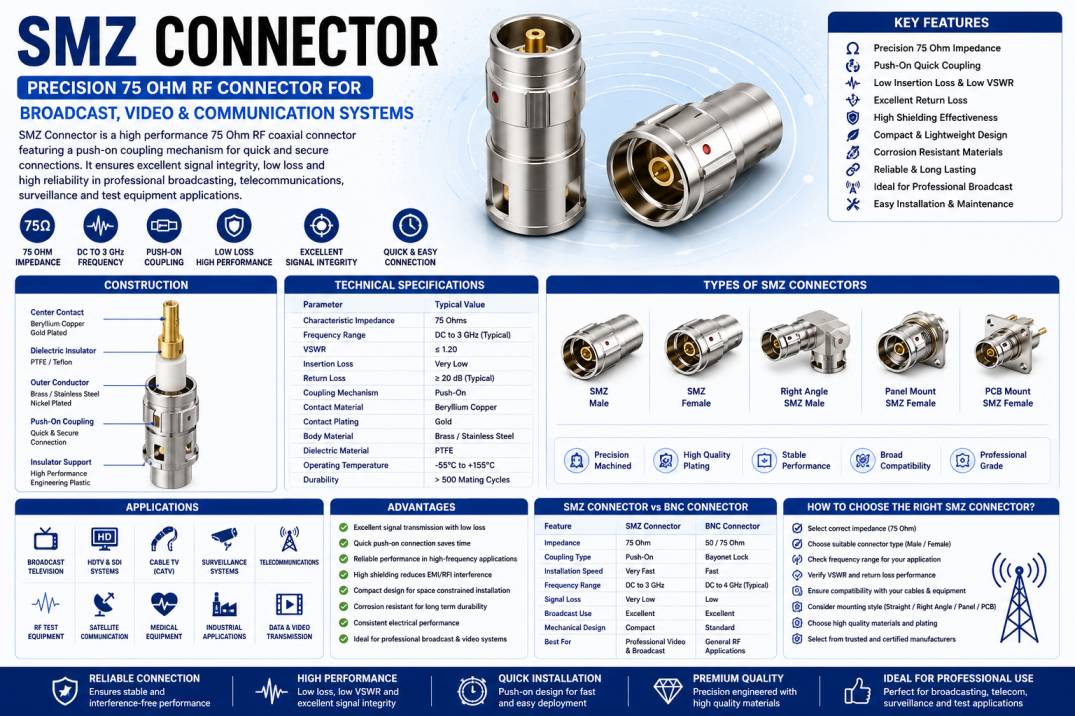
An SMZ Connector is a precision 75 Ohm radio frequency (RF) coaxial connector designed for high-performance video, broadcasting, telecommunications, and digital communication applications. It is widely recognized for its excellent electrical performance, compact size, quick-connect coupling mechanism, and ability to maintain low signal loss at high frequencies.
SMZ connectors are commonly used in broadcast studios, HDTV systems, digital video transmission, cable television (CATV), surveillance systems, telecommunications equipment, test instruments, and high-speed data communication networks. Their precision design ensures stable impedance, excellent return loss, and reliable signal transmission across a broad frequency range.
Unlike threaded RF connectors, SMZ connectors feature a push-on coupling mechanism that allows quick installation and removal without sacrificing electrical performance. This makes them particularly suitable for systems requiring frequent connections and maintenance.
As demand for high-definition broadcasting, digital communication, and advanced RF systems continues to grow, SMZ connectors remain an essential component in professional video and RF signal distribution.
This comprehensive guide explains everything about SMZ Connectors, including their construction, working principle, specifications, applications, advantages, and selection criteria.
What Is an SMZ Connector?
An SMZ Connector is a precision push-on coaxial RF connector designed with a 75 Ohm characteristic impedance for transmitting high-frequency RF and video signals with minimal loss and excellent impedance matching.
Originally developed for professional broadcasting and telecommunications, SMZ connectors are engineered to deliver reliable signal integrity while providing fast connection and disconnection through a snap-on coupling mechanism.
They are ideal for applications requiring compact size, repeatable electrical performance, and quick installation.
How Does an SMZ Connector Work?
An SMZ Connector provides a secure electrical connection between two coaxial transmission lines.
The operating process includes:
- RF signal enters the center contact.
- The center conductor carries the signal through the connector.
- The outer conductor provides shielding against electromagnetic interference.
- Precision dielectric maintains constant spacing.
- The push-on locking mechanism ensures stable electrical contact.
- The RF signal exits with minimal insertion loss.
This design maintains excellent signal quality while enabling rapid connector installation.
Construction of an SMZ Connector
Center Contact
The center contact transfers the RF signal between connected devices.
Common materials include:
- Beryllium Copper
- Brass
- Phosphor Bronze
The contact is typically gold-plated for improved conductivity and corrosion resistance.
Dielectric Insulator
The dielectric electrically separates the center conductor from the outer body.
Common materials include:
- PTFE
- Teflon
- High-performance engineering plastics
These materials maintain stable impedance and minimize dielectric loss.
Connector Body
The connector body provides mechanical strength and shielding.
Typical materials include:
- Brass
- Stainless Steel
Most connector bodies are nickel-plated or gold-plated for corrosion protection.
Push-On Coupling Mechanism
Unlike threaded RF connectors, the SMZ connector uses a precision push-on locking system that allows fast installation while maintaining excellent electrical performance.
Working Principle of an SMZ Connector
The SMZ connector functions by providing a controlled impedance transition between coaxial cables and RF equipment.
The operation includes:
- RF signal enters the connector.
- Center contact transfers the signal.
- Outer body provides shielding.
- Precision dielectric maintains impedance.
- Push-on coupling ensures stable mechanical contact.
- RF signal continues with minimal reflection.
The precision manufacturing minimizes return loss and insertion loss across the operating frequency range.
Technical Specifications
| Specification | Typical Value |
|---|---|
| Characteristic Impedance | 75 Ohms |
| Frequency Range | DC to 3 GHz (Typical) |
| VSWR | ≤ 1.20 |
| Insertion Loss | Very Low |
| Coupling Type | Push-On |
| Contact Material | Beryllium Copper |
| Contact Plating | Gold |
| Body Material | Brass / Stainless Steel |
| Dielectric Material | PTFE |
| Operating Temperature | -55°C to +155°C |
Key Features of SMZ Connectors
- Precision 75 Ohm impedance
- Quick push-on connection
- Low insertion loss
- Excellent return loss
- High shielding effectiveness
- Compact size
- Reliable mechanical connection
- Corrosion-resistant construction
- Stable RF performance
- Long service life
- Easy installation
- Suitable for professional broadcasting
Types of SMZ Connectors
SMZ Male Connector
Used to connect with SMZ female interfaces.
SMZ Female Connector
Provides the mating interface for male connectors.
Straight SMZ Connector
Suitable for direct cable-to-equipment connections.
Right-Angle SMZ Connector
Designed for compact installations with limited space.
PCB Mount SMZ Connector
Used in RF circuit boards and communication equipment.
Panel Mount SMZ Connector
Installed on equipment panels and enclosures.
Applications of SMZ Connectors
Broadcast Television
Supports professional SDI and digital video transmission.
Cable Television (CATV)
Used for reliable RF signal distribution.
HDTV Systems
Provides high-quality signal transmission for broadcast equipment.
Surveillance Systems
Connects cameras, video recorders, and monitoring equipment.
Telecommunications
Supports digital communication equipment and RF distribution.
Medical Equipment
Used in diagnostic and imaging systems requiring stable RF connectivity.
RF Test Equipment
Compatible with:
- Spectrum Analyzers
- Signal Generators
- Video Test Instruments
- RF Measurement Systems
Industrial Communication
Supports high-speed communication systems in industrial environments.
Data Transmission
Used in professional digital signal distribution systems.
Aerospace
Supports communication and testing equipment requiring precision RF connections.
Advantages of SMZ Connectors
- Excellent impedance stability
- Quick push-on installation
- Low insertion loss
- High shielding effectiveness
- Compact design
- Reliable signal transmission
- Corrosion resistance
- Long operational life
- Easy maintenance
- Professional broadcast quality
- Consistent electrical performance
- High mechanical durability
Limitations of SMZ Connectors
- Primarily designed for 75 Ohm systems
- Lower frequency capability than some precision microwave connectors
- Less common than BNC or SMA connectors
- Requires compatible mating connectors
- Limited use in very high-power RF applications
How to Choose the Right SMZ Connector
When selecting an SMZ Connector, consider the following:
- Characteristic impedance
- Operating frequency
- Connector gender
- Mounting style
- Cable compatibility
- Return loss
- Insertion loss
- Environmental conditions
- Material quality
- Application requirements
SMZ Connector vs BNC Connector
| Feature | SMZ Connector | BNC Connector |
|---|---|---|
| Impedance | 75 Ohms | 50 or 75 Ohms |
| Coupling Type | Push-On | Bayonet |
| Installation Speed | Very Fast | Fast |
| Frequency Range | Up to 3 GHz | Up to 4 GHz (Typical) |
| Broadcasting Applications | Excellent | Excellent |
| Mechanical Locking | Push-On | Bayonet Lock |
Industries Using SMZ Connectors
SMZ Connectors are widely used in:
- Broadcasting
- Telecommunications
- Cable Television
- Surveillance
- Medical Electronics
- Industrial Automation
- Scientific Research
- RF Testing
- Aerospace
- Digital Video Systems
Maintenance Tips
To maximize connector performance:
- Keep connector interfaces clean.
- Protect against dust and moisture.
- Avoid excessive mechanical stress.
- Inspect center contacts regularly.
- Replace worn connectors promptly.
- Verify connector alignment before installation.
- Store connectors in clean, dry environments.
Future Trends of SMZ Connectors
As broadcasting and digital communication technologies continue evolving toward higher resolutions and faster data transmission, SMZ connectors are expected to support improved shielding, lower insertion loss, and enhanced mechanical durability. Manufacturers are developing precision-machined connectors with advanced plating technologies and tighter impedance tolerances to meet the growing demands of HD, UHD, 4K, and emerging digital broadcasting standards while maintaining compatibility with professional RF communication systems.
Conclusion
SMZ Connectors provide an efficient and reliable solution for transmitting high-frequency RF and digital video signals in professional broadcasting and communication systems. Their precision 75 Ohm impedance, push-on coupling mechanism, low insertion loss, and excellent shielding make them an ideal choice for cable television, HDTV, surveillance, telecommunications, laboratory testing, and industrial communication applications. Selecting the appropriate SMZ connector based on frequency, cable type, mounting configuration, and operating environment ensures dependable signal integrity and long-term system performance.
Frequently Asked Questions (FAQs)
1. What is an SMZ Connector?
An SMZ Connector is a precision 75 Ohm RF coaxial connector with a push-on coupling mechanism designed for broadcasting, telecommunications, and digital video applications.
2. What is an SMZ Connector used for?
SMZ connectors are used in broadcast television, HDTV systems, cable television, surveillance equipment, telecommunications, RF testing, and digital video transmission.
3. What impedance does an SMZ Connector have?
Most SMZ Connectors are designed with a 75 Ohm characteristic impedance.
4. What frequency range does an SMZ Connector support?
Typical SMZ connectors support frequencies from DC up to 3 GHz, depending on the connector design.
5. What is the advantage of the push-on coupling mechanism?
The push-on design allows quick installation and removal while maintaining reliable electrical contact and minimizing signal loss.
6. What materials are commonly used in SMZ Connectors?
SMZ connectors are typically manufactured with brass or stainless-steel bodies, gold-plated beryllium copper contacts, and PTFE dielectric insulation.
7. Where are SMZ Connectors commonly used?
They are widely used in broadcasting, cable television, surveillance systems, telecommunications, medical electronics, aerospace, industrial communication, and RF testing.
8. What are the advantages of SMZ Connectors?
They offer low insertion loss, stable impedance, quick installation, excellent shielding, compact size, corrosion resistance, and long service life.
9. Can SMZ Connectors be used outdoors?
Yes. With appropriate weatherproof protection and compatible equipment, SMZ connector can be used in outdoor communication installations.
10. How do I choose the right SMZ Connector?
Choose an SMZ Connector based on impedance, operating frequency, connector type, cable compatibility, mounting style, insertion loss, environmental conditions, and the requirements of your RF or digital communication system.