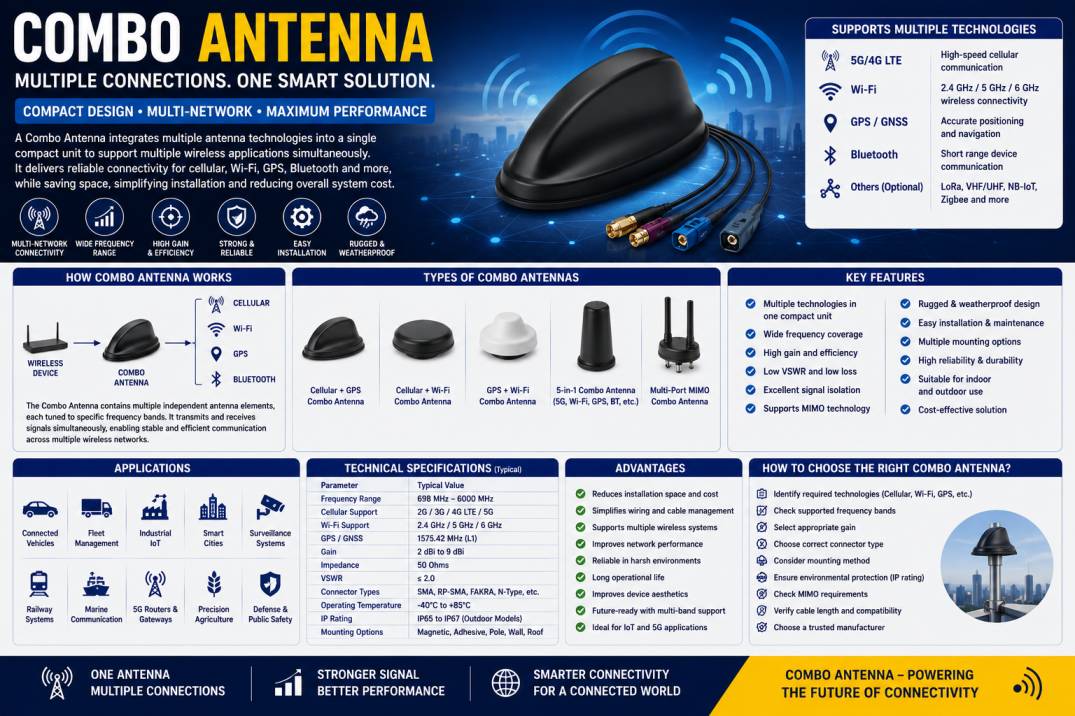
A Combo Antenna is a multi-functional antenna designed to support multiple wireless communication technologies through a single compact unit. Instead of installing separate antennas for cellular, Wi-Fi, GPS, Bluetooth, and other wireless services, a combo antenna integrates multiple antenna elements into one enclosure, reducing installation complexity while improving overall system performance.
As modern communication systems become increasingly connected, devices often require simultaneous access to multiple wireless networks. Applications such as 5G routers, connected vehicles, IoT gateways, industrial automation, smart transportation, telematics, fleet management, surveillance systems, and smart city infrastructure all benefit from combo antennas because they provide reliable multi-band communication while saving valuable installation space.
Combo antennas are engineered to deliver stable signal reception, high gain, wide frequency coverage, and excellent isolation between individual antenna elements. Their compact design makes them ideal for indoor and outdoor installations where performance, durability, and aesthetics are equally important.
This comprehensive guide explains everything you need to know about Combo Antennas, including their working principle, construction, types, specifications, applications, advantages, and selection criteria.
What Is a Combo Antenna?
A Combo Antenna is an integrated RF antenna that combines two or more antenna technologies into a single housing to support multiple wireless communication systems simultaneously.
Depending on the application, a combo antenna may integrate:
- Cellular (2G, 3G, 4G LTE, 5G)
- Wi-Fi
- GPS/GNSS
- Bluetooth
- LoRa
- Zigbee
- VHF/UHF
- NB-IoT
- LTE-M
Each antenna element operates independently while sharing the same enclosure, ensuring reliable communication across different wireless standards.
How Does a Combo Antenna Work?
A Combo Antenna contains multiple independent antenna elements, each tuned to operate within a specific frequency range.
When connected to a communication device:
- Cellular elements transmit and receive mobile network signals.
- GPS elements receive satellite positioning signals.
- Wi-Fi elements provide local wireless connectivity.
- Bluetooth antennas support short-range communication.
- Additional RF elements operate on their designated frequency bands.
Internal isolation between antenna elements minimizes interference, allowing simultaneous operation without degrading signal quality.
Construction of a Combo Antenna
Antenna Elements
The antenna contains multiple radiating elements, each designed for a specific wireless technology.
Common elements include:
- Cellular antenna
- GPS antenna
- Wi-Fi antenna
- Bluetooth antenna
- LoRa antenna
Ground Plane
The ground plane improves radiation efficiency and stabilizes antenna performance.
Low Noise Amplifier (Optional)
GPS antenna sections often include an integrated Low Noise Amplifier (LNA) to improve weak satellite signal reception.
RF Connectors
Combo antennas use various RF connectors such as:
- SMA
- RP-SMA
- N-Type
- FAKRA
- TNC
- QMA
Protective Housing
Outdoor models feature weather-resistant housings manufactured from:
- ABS Plastic
- Polycarbonate
- UV-resistant Polymer
- Aluminum
Mounting System
Mounting options include:
- Magnetic Mount
- Adhesive Mount
- Pole Mount
- Wall Mount
- Roof Mount
- Through-Hole Mount
Working Principle of a Combo Antenna
Each antenna element is optimized for its own frequency band.
The communication process includes:
- Wireless device generates RF signals.
- Signals travel through dedicated RF cables.
- Individual antenna elements transmit or receive signals.
- Internal isolation prevents cross-interference.
- RF signals are delivered to the connected equipment.
- Multiple wireless services operate simultaneously.
This integrated design eliminates the need for multiple standalone antennas.
Types of Combo Antennas
Cellular + GPS Combo Antenna
Combines mobile communication with satellite positioning.
Applications include:
- Vehicle tracking
- Fleet management
- Navigation systems
Cellular + Wi-Fi Combo Antenna
Supports LTE/5G and Wi-Fi communication within one antenna.
Ideal for:
- Industrial routers
- IoT gateways
- Wireless access points
GPS + Wi-Fi Combo Antenna
Provides navigation and wireless networking simultaneously.
Cellular + GPS + Wi-Fi Combo Antenna
One of the most common configurations.
Supports:
- LTE
- 5G
- GNSS
- Wi-Fi
5-in-1 Combo Antenna
Typically integrates:
- 5G Cellular
- LTE
- Wi-Fi
- GPS
- Bluetooth
Multi-Port MIMO Combo Antenna
Designed for modern wireless systems using multiple-input multiple-output (MIMO) technology to improve network performance.
Frequency Bands Supported
Combo Antennas can support multiple frequency ranges.
Typical bands include:
Cellular
- 698–960 MHz
- 1710–2170 MHz
- 2500–2700 MHz
- 3300–5000 MHz
Wi-Fi
- 2.4 GHz
- 5 GHz
- 6 GHz (Wi-Fi 6E)
GPS/GNSS
- 1575.42 MHz (GPS L1)
- GLONASS
- Galileo
- BeiDou
Bluetooth
- 2.4 GHz
LoRa
- 433 MHz
- 868 MHz
- 915 MHz
Technical Specifications
| Specification | Typical Value |
|---|---|
| Frequency Range | 698 MHz – 6 GHz |
| Cellular Support | 2G, 3G, 4G LTE, 5G |
| Wi-Fi Support | 2.4 GHz / 5 GHz / 6 GHz |
| GPS Frequency | 1575.42 MHz |
| Gain | 2 dBi to 9 dBi |
| Impedance | 50 Ohms |
| VSWR | ≤ 2.0 |
| Connector Types | SMA, RP-SMA, FAKRA, N-Type |
| Operating Temperature | -40°C to +85°C |
| IP Rating | IP65 to IP67 |
Key Features of Combo Antennas
- Multiple antennas in one housing
- Compact design
- Wide frequency coverage
- Excellent signal isolation
- High gain
- Low VSWR
- Easy installation
- Supports MIMO technology
- Rugged weather-resistant construction
- Indoor and outdoor models
- Reduced installation cost
- Improved system reliability
Applications of Combo Antennas
Connected Vehicles
Supports navigation, LTE, Wi-Fi, and telematics.
Fleet Management
Provides vehicle tracking and wireless communication.
Industrial IoT
Enables reliable communication between industrial devices.
Smart Cities
Supports intelligent transportation and infrastructure monitoring.
5G Routers
Provides multi-network connectivity for enterprise communication.
Surveillance Systems
Supports wireless CCTV and remote monitoring.
Agriculture
Used in precision farming and equipment monitoring.
Marine Communication
Provides GPS, LTE, and Wi-Fi connectivity for vessels.
Railway Systems
Supports train communication and positioning.
Emergency Services
Enables communication, tracking, and navigation in public safety vehicles.
Advantages of Combo Antennas
- Space-saving design
- Reduced cable clutter
- Easy installation
- Lower installation costs
- Supports multiple wireless technologies
- Reliable signal performance
- Excellent environmental protection
- High durability
- Simplified maintenance
- Better equipment aesthetics
- Compatible with modern communication systems
- Long operational life
Limitations of Combo Antennas
- Higher initial cost than single-band antennas
- Limited customization of individual antenna elements
- Performance depends on installation location
- Connector configuration must match equipment
- High-end models may require professional installation
How to Choose the Right Combo Antenna
When selecting a Combo Antenna, consider:
- Required wireless technologies
- Supported frequency bands
- Gain
- Polarization
- Number of antenna ports
- MIMO capability
- Connector type
- Mounting method
- IP rating
- Operating environment
Combo Antenna vs Single-Band Antenna
| Feature | Combo Antenna | Single-Band Antenna |
|---|---|---|
| Number of Functions | Multiple | Single |
| Installation | One Device | Multiple Devices |
| Space Requirement | Low | High |
| Cable Management | Simple | Complex |
| Cost Efficiency | Better Long-Term | Lower Initial Cost |
| Wireless Support | Multi-Band | One Frequency Band |
Industries Using Combo Antennas
Combo Antennas are widely used in:
- Telecommunications
- Automotive
- Transportation
- Industrial Automation
- Smart Cities
- Agriculture
- Marine
- Defense
- Logistics
- Healthcare
- Oil & Gas
- Mining
Maintenance Tips
To maximize antenna performance:
- Keep the antenna surface clean.
- Inspect RF connectors regularly.
- Tighten mounting hardware securely.
- Protect cables from excessive bending.
- Check waterproof seals periodically.
- Avoid mounting near strong interference sources.
- Replace damaged connectors immediately.
Future Trends of Combo Antennas
The rapid growth of 5G, Wi-Fi 7, vehicle connectivity, Industrial IoT, smart cities, and autonomous transportation is driving innovation in Combo Antenna technology. Manufacturers are developing compact multi-port MIMO antennas with higher gain, wider bandwidth, lower interference, and enhanced support for GNSS constellations, including GPS, Galileo, GLONASS, and BeiDou. Future combo antennas will also integrate advanced beamforming, AI-assisted signal optimization, and next-generation 6G communication capabilities to deliver faster, more reliable wireless connectivity across commercial, industrial, and transportation sectors.
Conclusion
Combo Antennas have become an essential solution for modern wireless communication by integrating multiple antenna technologies into a single compact unit. Their ability to support cellular, Wi-Fi, GPS, Bluetooth, and IoT communication while reducing installation complexity makes them ideal for connected vehicles, industrial automation, smart cities, surveillance, transportation, and enterprise networking. By selecting the right frequency bands, gain, connector type, and mounting option, users can achieve reliable multi-band communication, improved system performance, and long-term operational efficiency.
Frequently Asked Questions (FAQs)
1. What is a Combo Antenna?
A Combo Antenna is a multi-function antenna that combines multiple wireless technologies such as cellular, Wi-Fi, GPS, Bluetooth, and IoT communication into a single housing.
2. What are Combo Antennas used for?
They are used in connected vehicles, 5G routers, industrial IoT, fleet management, surveillance systems, smart cities, transportation, and wireless communication equipment.
3. What wireless technologies can a Combo Antenna support?
Depending on the model, Combo Antennas can support 2G, 3G, 4G LTE, 5G, Wi-Fi, GPS/GNSS, Bluetooth, LoRa, Zigbee, NB-IoT, and LTE-M.
4. What are the advantages of a Combo Antenna?
They save installation space, reduce cable clutter, simplify installation, support multiple wireless networks, improve aesthetics, and provide reliable communication.
5. What frequency bands do Combo Antennas support?
Typical frequency ranges include 698 MHz to 6 GHz, along with GPS frequencies at 1575.42 MHz and Wi-Fi bands at 2.4 GHz, 5 GHz, and 6 GHz.
6. Are Combo Antennas suitable for outdoor installations?
Yes. Many Combo Antennas feature IP65 to IP67 weatherproof enclosures designed for harsh outdoor environments.
7. What connector types are commonly available?
Popular connector options include SMA, RP-SMA, N-Type, FAKRA, TNC, and QMA, depending on the application.
8. Where are Combo Antennas commonly used?
They are widely used in telecommunications, automotive systems, transportation, industrial automation, marine communication, agriculture, mining, defense, and smart city infrastructure.
9. What is the difference between a Combo Antenna and a Single-Band Antenna?
A Combo Antenna supports multiple wireless technologies within one enclosure, whereas a Single-Band Antenna is designed for only one frequency band or communication service.
10. How do I choose the right Combo Antenna?
Choose a Combo Antenna based on the required wireless technologies, supported frequency bands, antenna gain, connector type, MIMO configuration, mounting method, IP rating, and environmental conditions.