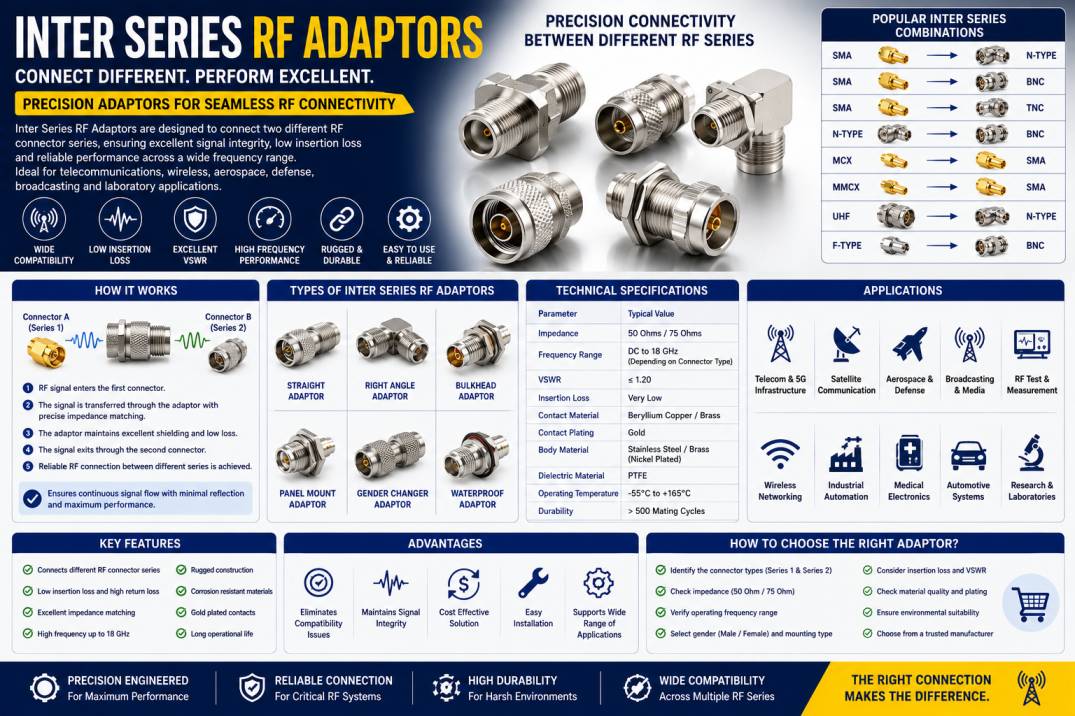
Inter Series RF Adaptors are specialized radio frequency (RF) components designed to connect two different types of RF connectors while maintaining excellent signal integrity and minimal insertion loss. In modern RF and microwave systems, different equipment often uses different connector interfaces, making Inter Series RF Adaptors essential for achieving compatibility without replacing existing cables or devices.
These adaptors are widely used in telecommunications, satellite communication, aerospace, defense, broadcasting, wireless networking, 5G infrastructure, industrial automation, medical electronics, and RF laboratories. They allow engineers to connect connectors such as SMA, N-Type, BNC, TNC, MCX, MMCX, F-Type, UHF, and many others, providing a simple and reliable solution for integrating diverse RF equipment.
Manufactured with precision machining, high-quality conductive materials, and controlled impedance designs, Inter Series RF Adaptors ensure stable electrical performance across a broad frequency range. They are available in numerous configurations, including male-to-female, right-angle, bulkhead, panel mount, and waterproof versions.
This comprehensive guide explains everything you need to know about Inter Series RF Adaptors, including their construction, working principle, types, specifications, applications, advantages, and selection criteria.
What Are Inter Series RF Adaptors?
An Inter Series RF Adaptor is a precision RF connector accessory that joins two different RF connector series together while maintaining a continuous RF transmission path.
Unlike In-Series RF Adaptors, which connect identical connector types, Inter Series RF Adaptors are designed to connect different connector interfaces without compromising signal quality.
For example, these adaptors can connect:
- SMA to N-Type
- SMA to BNC
- SMA to TNC
- BNC to N-Type
- TNC to N-Type
- UHF to N-Type
- F-Type to BNC
- MCX to SMA
- MMCX to SMA
- RP-SMA to SMA
These adaptors eliminate compatibility issues between RF equipment from different manufacturers.
How Do Inter Series RF Adaptors Work?
Inter Series RF Adaptors provide a controlled electrical transition between two different connector interfaces.
The operation includes:
- RF signal enters the first connector.
- The center conductor transfers the signal through the adaptor.
- The adaptor maintains controlled impedance.
- The outer conductor provides shielding continuity.
- The signal exits through the second connector.
The internal design minimizes impedance mismatch, insertion loss, return loss, and signal reflections, ensuring reliable RF performance.
Construction of Inter Series RF Adaptors
Connector Interfaces
Each adaptor includes two different RF connector types.
Examples include:
- SMA
- N-Type
- BNC
- TNC
- MCX
- MMCX
- F-Type
- UHF
- 7/16 DIN
- 4.3-10
Center Contact
The center conductor transfers the RF signal.
Common materials include:
- Beryllium Copper
- Brass
- Phosphor Bronze
Most contacts feature gold plating for superior conductivity and corrosion resistance.
Dielectric Insulator
The dielectric electrically separates the center conductor from the outer body.
Common materials include:
- PTFE
- Teflon
- PEEK
These materials maintain stable impedance across high frequencies.
Outer Body
The adaptor body provides mechanical strength and electromagnetic shielding.
Common materials include:
- Stainless Steel
- Brass
- Nickel-Plated Brass
Plating
Surface finishes include:
- Gold
- Nickel
- Silver
- White Bronze
These coatings improve corrosion resistance and durability.
Working Principle of Inter Series RF Adaptors
The adaptor functions as a low-loss RF transition between two connector standards.
The process includes:
- RF signal enters the input connector.
- Signal transfers through the center contact.
- Controlled impedance minimizes reflections.
- Shielding prevents electromagnetic interference.
- Signal exits through the output connector.
- Connected equipment communicates without compatibility issues.
Technical Specifications
| Specification | Typical Value |
| Characteristic Impedance | 50 Ohms / 75 Ohms |
| Frequency Range | DC to 18 GHz (Depending on Connector Type) |
| VSWR | ≤ 1.20 |
| Insertion Loss | Very Low |
| Contact Material | Beryllium Copper / Brass |
| Contact Plating | Gold |
| Body Material | Stainless Steel / Brass |
| Dielectric Material | PTFE |
| Connector Configuration | Male/Female |
| Operating Temperature | -55°C to +165°C |
Key Features of Inter Series RF Adaptors
- Connect different RF connector types
- Low insertion loss
- Excellent impedance matching
- High-frequency compatibility
- Precision machining
- Rugged mechanical design
- Corrosion-resistant construction
- Reliable shielding
- Compact size
- Easy installation
- Long operational life
- High mechanical durability
Types of Inter Series RF Adaptors
SMA to N-Type Adaptor
One of the most commonly used RF adaptor combinations for laboratory testing and communication systems.
SMA to BNC Adaptor
Frequently used in RF measurement equipment and oscilloscopes.
SMA to TNC Adaptor
Supports wireless communication and industrial RF systems.
N-Type to BNC Adaptor
Used for connecting laboratory instruments and communication equipment.
MCX to SMA Adaptor
Common in GPS modules and wireless embedded systems.
MMCX to SMA Adaptor
Used in compact RF devices and IoT equipment.
UHF to N-Type Adaptor
Supports amateur radio, broadcasting, and communication infrastructure.
F-Type to BNC Adaptor
Widely used in television, video, and surveillance systems.
Right-Angle RF Adaptors
Ideal for installations with limited space.
Bulkhead RF Adaptors
Designed for panel-mounted RF equipment.
Applications of Inter Series RF Adaptors
Telecommunications
Connects different RF interfaces in cellular base stations and communication equipment.
Wireless Networking
Supports Wi-Fi systems, access points, and wireless bridges.
Satellite Communication
Connects antennas, transceivers, and RF distribution systems.
Aerospace
Used in avionics, navigation systems, and aircraft communication equipment.
Defense
Supports radar systems, tactical communication, and electronic warfare.
Broadcasting
Connects television transmitters, radio systems, and RF distribution equipment.
RF Test Laboratories
Compatible with:
- Spectrum Analyzers
- Network Analyzers
- Signal Generators
- Oscilloscopes
Medical Electronics
Supports MRI systems, RF diagnostic equipment, and wireless medical devices.
Industrial Automation
Connects industrial wireless communication systems and IoT infrastructure.
Research Institutions
Used in microwave research, antenna testing, and university laboratories.
Advantages of Inter Series RF Adaptors
- Connects incompatible RF connectors
- Preserves signal quality
- Low insertion loss
- Excellent return loss
- High shielding effectiveness
- Easy installation
- Cost-effective solution
- High durability
- Wide connector compatibility
- Suitable for high-frequency systems
- Long service life
- Reduces equipment replacement costs
Limitations of Inter Series RF Adaptors
- Maximum frequency depends on connector type
- Additional connection introduces minor insertion loss
- Incorrect impedance selection affects performance
- Precision adaptors are more expensive
- Requires proper torque during installation
How to Choose the Right Inter Series RF Adaptor
Before selecting an adaptor, consider:
- Connector types
- Operating frequency
- Characteristic impedance
- Connector gender
- Mounting style
- Environmental conditions
- Power handling
- VSWR
- Insertion loss
- Material quality
Inter Series RF Adaptors vs In-Series RF Adaptors
| Feature | Inter Series RF Adaptor | In-Series RF Adaptor |
| Connector Types | Different | Same |
| Primary Purpose | Connector Conversion | Connector Extension |
| Compatibility | High | Limited |
| Typical Examples | SMA to N-Type | SMA to SMA |
| RF Performance | Excellent | Excellent |
| Applications | Mixed RF Equipment | Same Connector Systems |
Industries Using Inter Series RF Adaptors
Inter Series RF Adaptors are widely used in:
- Telecommunications
- Broadcasting
- Aerospace
- Defense
- Satellite Communication
- Medical Electronics
- Industrial Automation
- Automotive Electronics
- Scientific Research
- RF Testing Laboratories
Maintenance Tips
To maximize adaptor performance:
- Keep connector interfaces clean.
- Avoid over-tightening threaded connectors.
- Inspect contacts for wear or corrosion.
- Use protective dust caps when disconnected.
- Store adaptors in a dry environment.
- Verify connector compatibility before installation.
- Replace damaged adaptors immediately.
Future Trends of Inter Series RF Adaptors
As RF communication systems continue to evolve with 5G Advanced, Open RAN, satellite internet, autonomous vehicles, and future 6G technologies, the demand for precision Inter Series RF Adaptors continues to grow. Manufacturers are developing adaptors with improved impedance control, broader frequency support, enhanced shielding, and reduced insertion loss. Advanced CNC machining, superior plating technologies, and compact designs are enabling these adaptors to meet the requirements of high-speed wireless communication, aerospace systems, laboratory testing, and next-generation microwave applications.
Conclusion
Inter Series RF Adaptors provide a simple yet highly effective solution for connecting different RF connector types without sacrificing electrical performance. Their precision construction, controlled impedance, excellent shielding, and low insertion loss make them indispensable components in telecommunications, aerospace, defense, satellite communication, broadcasting, industrial automation, medical electronics, and RF testing. Choosing the correct adaptor based on connector type, frequency, impedance, and environmental conditions ensures reliable signal transmission, long-term durability, and seamless integration between diverse RF systems.
Frequently Asked Questions (FAQs)
1. What is an Inter Series RF Adaptor?
An Inter Series RF Adaptor is an RF connector accessory designed to connect two different types of RF connectors while maintaining reliable signal transmission.
2. What is the difference between an Inter Series and an In-Series RF Adaptor?
An Inter Series RF Adaptor connects different connector types, such as SMA to N-Type, while an In-Series RF Adaptor connects identical connector types, such as SMA to SMA.
3. What are Inter Series RF Adaptors used for?
They are used to connect different RF connectors in telecommunications, satellite communication, aerospace, broadcasting, defense, wireless networking, and RF testing applications.
4. Which connector combinations are commonly available?
Popular combinations include SMA to N-Type, SMA to BNC, SMA to TNC, N-Type to BNC, MCX to SMA, MMCX to SMA, UHF to N-Type, and F-Type to BNC.
5. What impedance options are available?
Most Inter Series RF Adaptors are available in 50 Ohm and 75 Ohm configurations.
6. What frequency range do Inter Series RF Adaptors support?
Depending on the connector combination, they typically support frequencies from DC up to 18 GHz, with some precision models supporting higher frequencies.
7. What materials are commonly used?
They are typically manufactured using stainless steel or brass bodies, gold-plated beryllium copper contacts, and PTFE dielectric insulation.
8. What are the advantages of using Inter Series RF Adaptors?
They provide connector compatibility, low insertion loss, excellent shielding, reliable RF performance, easy installation, and long service life.
9. Can Inter Series RF Adaptors be used outdoors?
Yes. Many ruggedized versions with corrosion-resistant materials and weather-resistant construction are suitable for outdoor RF installations.
10. How do I choose the right Inter Series RF Adaptor?
Select an adaptor based on connector types, operating frequency, impedance, connector gender, power handling, VSWR, insertion loss, mounting requirements, and environmental conditions.