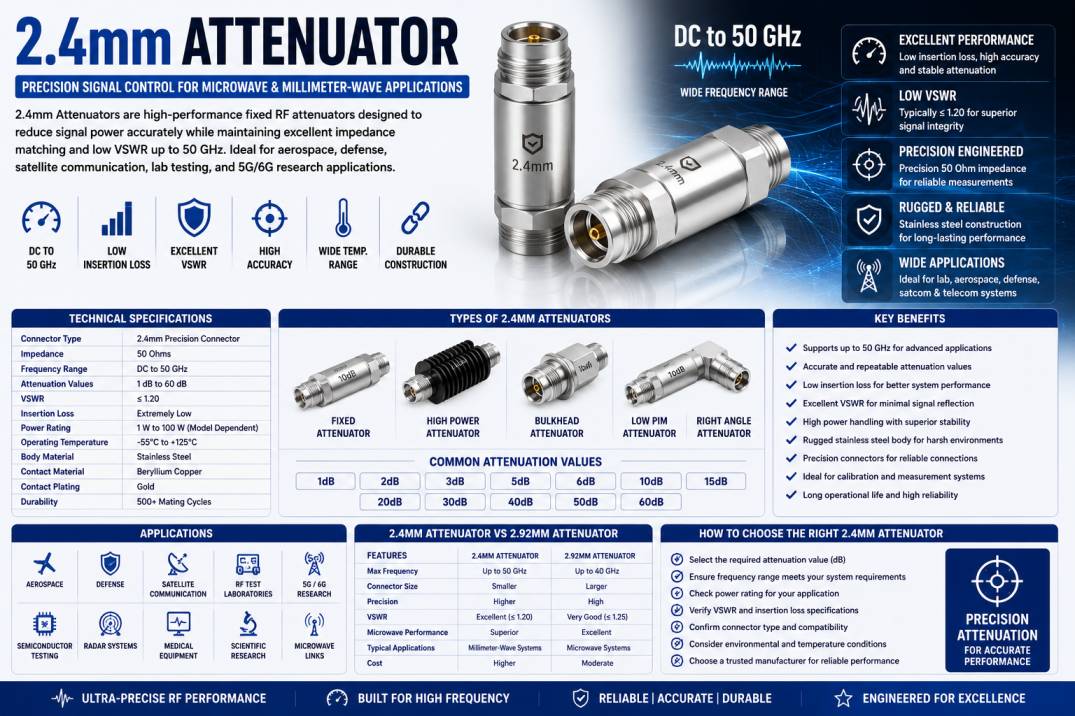
As microwave and millimeter-wave communication technologies continue to evolve, the need for highly accurate RF signal control has become increasingly important. One of the most essential passive components used in high-frequency RF systems is the 2.4mm Attenuator. Designed for precision signal attenuation in microwave applications, 2.4mm attenuators provide stable electrical performance, excellent impedance matching, and extremely low signal reflection across a wide frequency range.
These attenuators are widely used in aerospace, defense, satellite communication, radar systems, semiconductor testing, scientific research, 5G infrastructure, 6G development, and RF laboratories where precise signal level control is critical. They help protect sensitive RF instruments, improve measurement accuracy, reduce signal distortion, and prevent receiver overload.
Unlike variable attenuators, a 2.4mm attenuator provides a fixed attenuation value, ensuring repeatable performance in demanding microwave environments. Their precision manufacturing allows them to support frequencies up to 50 GHz, making them suitable for modern high-frequency communication systems.
This comprehensive guide explains everything about 2.4mm Attenuators, including their working principle, construction, specifications, applications, advantages, and selection criteria.
What Is a 2.4mm Attenuator?
A 2.4mm Attenuator is a precision passive RF device equipped with 2.4mm microwave connectors that reduces the power of a radio frequency signal by a predetermined amount while maintaining a constant 50 Ohm impedance.
It is designed to provide accurate signal attenuation without significantly affecting waveform quality, frequency response, or impedance characteristics.
These attenuators are commonly installed between RF instruments, antennas, amplifiers, signal generators, and test equipment to protect sensitive components and ensure accurate microwave measurements.
How Does a 2.4mm Attenuator Work?
A 2.4mm attenuator works by converting part of the RF signal energy into heat through an internal precision resistor network.
When an RF signal enters the attenuator, a portion of the signal continues to the output while the remaining energy is dissipated within carefully matched resistive elements.
The precision resistor network maintains constant impedance throughout the signal path, minimizing signal reflections, insertion loss beyond the specified attenuation value, and impedance mismatches.
This design enables accurate signal reduction while preserving signal integrity across extremely high frequencies.
Construction of a 2.4mm Attenuator
Precision RF Connectors
The attenuator uses precision 2.4mm connectors designed for microwave applications.
Common materials include:
- Stainless Steel
- Precision Machined Brass
- Passivated Stainless Steel
Internal Resistor Network
Precision thin-film resistors provide stable attenuation over the specified frequency range.
Typical resistor technologies include:
- Thin Film
- Thick Film
- Precision Microwave Resistors
Dielectric Insulator
The dielectric maintains conductor spacing and electrical stability.
Common materials include:
- PTFE
- Air Dielectric
- High-Performance Engineering Polymers
Outer Housing
The rugged housing protects internal components and provides excellent EMI shielding.
Key Features of 2.4mm Attenuators
- Frequency support up to 50 GHz
- Fixed attenuation values
- Excellent impedance matching
- Low VSWR
- Very low insertion loss
- High measurement accuracy
- Precision thin-film resistor technology
- Gold-plated contacts
- Stainless steel construction
- Excellent thermal stability
- Long operational life
- High mechanical durability
Technical Specifications
| Specification | Typical Value |
| Connector Type | 2.4mm Precision Connector |
| Characteristic Impedance | 50 Ohms |
| Frequency Range | DC to 50 GHz |
| Attenuation Values | 1 dB to 60 dB |
| VSWR | ≤ 1.20 |
| Insertion Loss | Extremely Low |
| Power Rating | 1 W to 100 W (Model Dependent) |
| Operating Temperature | -55°C to +125°C |
| Connector Material | Stainless Steel |
| Durability | 500+ Mating Cycles |
Common Attenuation Values
Standard attenuation options include:
- 1 dB
- 2 dB
- 3 dB
- 5 dB
- 6 dB
- 10 dB
- 15 dB
- 20 dB
- 30 dB
- 40 dB
- 50 dB
- 60 dB
Types of 2.4mm Attenuators
Fixed Attenuator
Provides a constant attenuation value throughout its service life.
High-Power Attenuator
Designed for microwave transmitters and high-power RF systems.
Precision Laboratory Attenuator
Optimized for calibration, RF testing, and measurement applications.
Bulkhead Attenuator
Suitable for panel-mounted microwave systems.
Low PIM Attenuator
Designed for advanced wireless communication systems requiring minimal passive intermodulation.
Applications of 2.4mm Attenuators
RF Test Laboratories
Used with:
- Vector Network Analyzers
- Spectrum Analyzers
- Signal Generators
- Calibration Equipment
Aerospace
Supports:
- Aircraft Communication
- Navigation Systems
- Microwave Instrumentation
Defense
Used in:
- Radar Systems
- Electronic Warfare
- Missile Guidance
- Military Communication
Satellite Communication
Applied in:
- Ground Stations
- Payload Testing
- Satellite Communication Equipment
Semiconductor Testing
Used for:
- IC Characterization
- Wafer Testing
- High-Speed Device Measurements
5G and 6G Research
Supports:
- Millimeter-Wave Testing
- Base Station Development
- Beamforming Systems
Medical Equipment
Used in:
- Microwave Imaging
- Diagnostic Systems
- RF Measurement Devices
Scientific Research
Installed in:
- Universities
- Government Laboratories
- RF Research Centers
Advantages of 2.4mm Attenuators
- Supports frequencies up to 50 GHz
- Outstanding signal integrity
- Low insertion loss
- Excellent impedance stability
- Superior return loss
- Highly accurate attenuation
- Long operational life
- Excellent thermal performance
- High mechanical precision
- Reliable microwave performance
- Corrosion-resistant materials
- Ideal for precision RF measurements
Limitations of 2.4mm Attenuators
- Higher cost than standard RF attenuators
- Requires precision handling
- Fixed attenuation cannot be adjusted
- Sensitive connector interfaces require careful maintenance
- Proper torque is necessary during installation
How to Choose the Right 2.4mm Attenuator
Selecting the correct attenuator depends on several important factors.
- Required attenuation value
- Operating frequency
- Power handling capability
- VSWR specifications
- Connector compatibility
- Environmental conditions
- Measurement accuracy
- Mechanical durability
- Temperature range
- Manufacturer quality certifications
2.4mm Attenuator vs 2.92mm Attenuator
| Feature | 2.4mm Attenuator | 2.92mm Attenuator |
| Maximum Frequency | Up to 50 GHz | Up to 40 GHz |
| Precision | Higher | High |
| VSWR | Excellent | Very Good |
| Microwave Performance | Superior | Excellent |
| Signal Accuracy | Outstanding | Excellent |
| Laboratory Testing | Advanced | Standard Precision |
| Cost | Higher | Moderate |
| Typical Applications | Millimeter-Wave Systems | Microwave Systems |
Industries Using 2.4mm Attenuators
2.4mm Attenuators are widely used in:
- Telecommunications
- Aerospace
- Defense
- Satellite Communication
- Semiconductor Manufacturing
- Scientific Research
- Medical Electronics
- RF Testing Laboratories
- Microwave Engineering
- Wireless Infrastructure
Maintenance Tips
To maintain maximum performance:
- Keep connector interfaces clean.
- Use protective caps when not in use.
- Avoid over-tightening connectors.
- Apply manufacturer-recommended torque.
- Store in dry environments.
- Inspect connectors regularly.
- Replace damaged attenuators immediately.
Future Trends of 2.4mm Attenuators
As wireless communication moves toward 6G, advanced radar, satellite internet, quantum computing, autonomous vehicles, and terahertz technologies, the demand for ultra-high-frequency attenuators will continue to increase. Manufacturers are developing next-generation 2.4mm attenuators with improved thin-film resistor technology, enhanced thermal management, lower insertion loss, greater power handling, and higher frequency capabilities. These advancements will support the future of microwave and millimeter-wave communication while ensuring greater accuracy and long-term reliability.
Conclusion
2.4mm Attenuators are precision microwave components designed to deliver accurate and repeatable RF signal attenuation in high-frequency communication systems. Their ability to support frequencies up to 50 GHz while maintaining low VSWR, excellent impedance matching, and superior signal integrity makes them indispensable in aerospace, defense, satellite communication, semiconductor testing, medical electronics, scientific research, and advanced wireless infrastructure. Selecting the correct attenuation value, power rating, and connector configuration ensures dependable performance and accurate microwave measurements across a wide range of professional applications.
Frequently Asked Questions (FAQs)
1. What is a 2.4mm Attenuator?
A 2.4mm Attenuator is a precision RF passive device designed to reduce microwave signal power while maintaining a constant 50 Ohm impedance and excellent signal integrity.
2. What frequency does a 2.4mm Attenuator support?
Most 2.4mm Attenuators support frequencies from DC to 50 GHz, depending on the model and manufacturer.
3. What attenuation values are available?
Common attenuation values include 1 dB, 2 dB, 3 dB, 5 dB, 6 dB, 10 dB, 20 dB, 30 dB, 40 dB, 50 dB, and 60 dB.
4. Where are 2.4mm Attenuators used?
They are widely used in RF laboratories, aerospace, defense, satellite communication, semiconductor testing, medical equipment, and 5G/6G research.
5. What impedance do 2.4mm Attenuators use?
Standard 2.4mm Attenuators are designed with a 50 Ohm characteristic impedance.
6. What are the advantages of a 2.4mm Attenuator?
They provide precise attenuation, low insertion loss, excellent VSWR, stable impedance, high-frequency performance, and reliable microwave measurements.
7. Can the attenuation value be adjusted?
No. A standard 2.4mm Attenuator is a fixed attenuator, meaning its attenuation value remains constant throughout its service life.
8. What materials are used in 2.4mm Attenuators?
They typically feature stainless steel housings, gold-plated contacts, PTFE or air dielectric insulation, and precision thin-film resistor networks.
9. How do I choose the right 2.4mm Attenuator?
Choose based on attenuation value, operating frequency, power rating, VSWR, connector compatibility, environmental conditions, and application requirements.
10. How should a 2.4mm Attenuator be maintained?
Keep connectors clean, use protective caps, apply the correct mating torque, avoid contamination, inspect the device regularly, and replace damaged attenuators to maintain optimal RF performance.