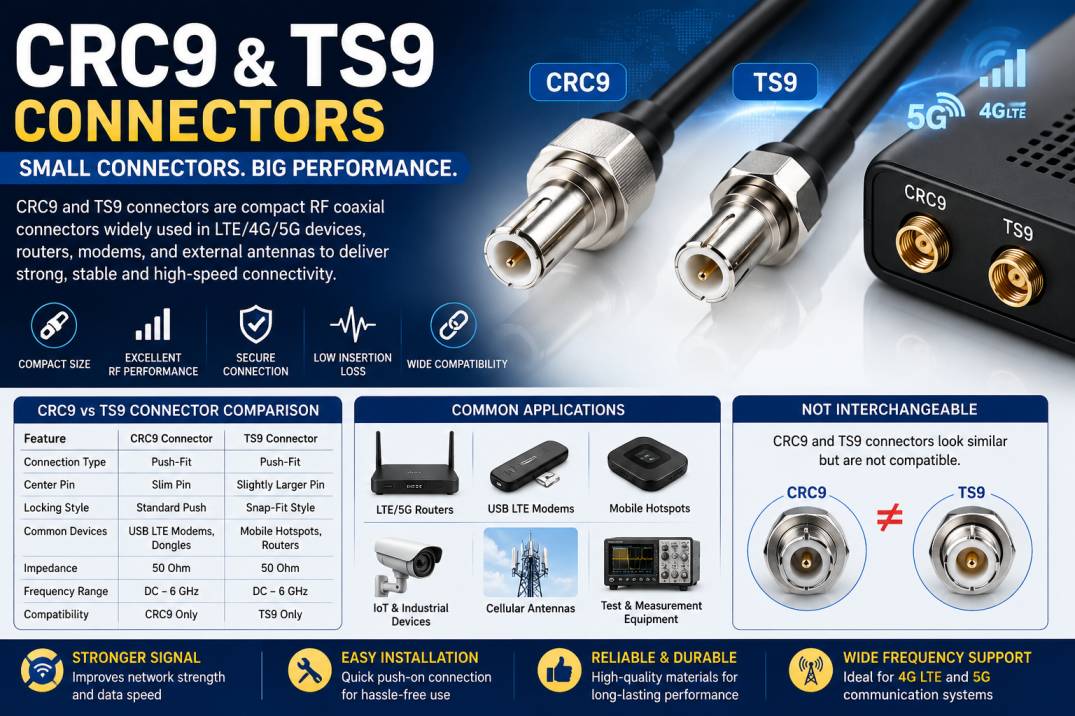
CRC9 and TS9 connectors are compact RF coaxial connectors widely used in wireless communication devices, including 3G, 4G LTE, and 5G modems, mobile hotspots, routers, USB dongles, IoT devices, and external antennas. These miniature connectors provide a secure connection between an RF device and an external antenna, helping improve signal strength, network coverage, and data transmission performance.
As mobile broadband technology continues to expand, CRC9 and TS9 connectors have become increasingly important for users who require reliable cellular connectivity in areas with weak network signals. Although these connectors appear similar in size, they differ in mechanical design, compatibility, and connection method. Selecting the correct connector is essential for maintaining optimal RF performance and preventing damage to communication equipment.
This comprehensive guide explains everything you need to know about CRC9 and TS9 connectors, including their construction, working principles, specifications, differences, applications, advantages, and selection tips.
What Is a CRC9 Connector?
A CRC9 connector is a miniature RF coaxial connector commonly used to connect external antennas to USB LTE modems, cellular routers, and wireless broadband devices. It features a slim push-fit design with a center pin that securely mates with compatible RF ports.
CRC9 connectors are widely used by modem manufacturers because of their compact size and excellent high-frequency performance. They are designed to transmit RF signals with minimal insertion loss while maintaining a stable impedance.
What Is a TS9 Connector?
A TS9 connector is another miniature RF coaxial connector used primarily in mobile broadband devices, wireless routers, MiFi hotspots, LTE gateways, and cellular modems. Like the CRC9 connector, it uses a push-on coupling mechanism but features a different locking and pin design.
TS9 connectors are commonly found in 4G LTE and 5G hotspot devices where users connect external antennas to improve signal reception and transmission.
How Do CRC9 and TS9 Connectors Work?
Both CRC9 and TS9 connectors transmit radio frequency signals between a communication device and an external antenna.
When connected, the center conductor carries the RF signal while the outer metal body acts as the ground and shielding. This coaxial structure minimizes electromagnetic interference (EMI), reduces signal reflections, and maintains the characteristic impedance of the RF system.
The push-fit design allows quick installation and removal without requiring threaded coupling mechanisms.
Construction of CRC9 & TS9 Connectors
Both connectors consist of precision-engineered components designed for reliable RF performance.
Center Contact
The center contact carries the RF signal.
Common materials include:
- Gold-plated brass
- Copper alloy
- Phosphor bronze
Gold plating improves conductivity and corrosion resistance.
Dielectric Insulator
The dielectric separates the center conductor from the outer body.
Common materials include:
- PTFE (Teflon)
- High-temperature thermoplastic
Outer Body
The outer shell provides shielding and mechanical strength.
Typical materials include:
- Brass
- Nickel-plated brass
- Stainless steel
Locking Mechanism
CRC9 and TS9 both use push-on connections but differ slightly in mechanical retention and pin geometry.
CRC9 vs TS9 Connector Comparison
| Feature | CRC9 Connector | TS9 Connector |
|---|---|---|
| Connection Type | Push-fit | Push-fit |
| Center Pin Design | Slim Pin | Slightly Larger Pin |
| Mechanical Lock | Standard Push | Snap-Fit Style |
| Common Devices | USB LTE Modems | Mobile Hotspots |
| Compatibility | CRC9 Only | TS9 Only |
| Frequency Range | DC–6 GHz | DC–6 GHz |
| Characteristic Impedance | 50 Ohm | 50 Ohm |
Technical Specifications
| Specification | CRC9 | TS9 |
|---|---|---|
| Impedance | 50 Ohm | 50 Ohm |
| Frequency Range | DC–6 GHz | DC–6 GHz |
| Connector Type | Push-On | Push-On |
| Contact Material | Gold Plated Brass | Gold Plated Brass |
| Return Loss | Excellent | Excellent |
| VSWR | Low | Low |
| Insertion Loss | Very Low | Very Low |
Common Applications
CRC9 and TS9 connectors are widely used in modern wireless communication systems.
Cellular Routers
External LTE antennas
Industrial routers
Enterprise gateways
USB LTE Modems
Huawei USB dongles
ZTE LTE modems
Sierra Wireless devices
Mobile Hotspots
4G MiFi devices
5G portable routers
Travel Wi-Fi hotspots
Industrial IoT
Remote monitoring
Industrial gateways
Wireless sensors
Machine-to-machine communication
Smart City Infrastructure
Traffic monitoring
Remote surveillance
Environmental monitoring
Wireless communication systems
Test and Measurement Equipment
RF analyzers
Communication testing
Signal generators
Network analyzers
Advantages of CRC9 & TS9 Connectors
- Compact design
- Excellent RF performance
- Low insertion loss
- Reliable signal transmission
- Easy push-on installation
- High-frequency compatibility
- Durable construction
- Lightweight
- Cost-effective
- Suitable for LTE and 5G applications
Limitations
- CRC9 and TS9 are not interchangeable.
- Small connectors require careful handling.
- Not suitable for very high-power RF applications.
- Frequent reconnection may reduce connector lifespan.
- Limited weather protection unless enclosed.
Difference Between CRC9 and TS9 Connectors
Although CRC9 and TS9 connectors look similar, they are not mechanically compatible.
The primary differences include:
- Pin diameter
- Internal locking mechanism
- Connector dimensions
- Device compatibility
- Mechanical retention
Using the wrong connector can damage both the antenna and the device connector.
How to Choose the Right Connector
When selecting a CRC9 or TS9 connector, consider:
- Device compatibility
- Frequency range
- Characteristic impedance
- Connector quality
- Gold-plated contacts
- Cable type
- Antenna compatibility
- Operating environment
- Manufacturer specifications
CRC9 & TS9 Connector Applications by Industry
| Industry | Typical Application |
|---|---|
| Telecommunications | LTE & 5G Routers |
| Consumer Electronics | Mobile Hotspots |
| Industrial Automation | IoT Gateways |
| Transportation | Vehicle Routers |
| Smart Cities | Wireless Monitoring |
| Agriculture | Remote Sensors |
| Security | CCTV Communication |
| Healthcare | Wireless Medical Devices |
CRC9 vs TS9 vs SMA Connector
| Feature | CRC9 | TS9 | SMA |
|---|---|---|---|
| Size | Very Small | Very Small | Larger |
| Locking Type | Push-On | Push-On | Threaded |
| Frequency Range | Up to 6 GHz | Up to 6 GHz | Up to 18 GHz+ |
| Durability | Moderate | Moderate | High |
| Common Use | LTE Modems | Hotspots | RF Equipment |
Future Trends
As 5G, private LTE networks, and Industrial IoT continue to expand, CRC9 and TS9 connectors remain important for compact wireless communication devices. Manufacturers are improving connector durability, reducing insertion loss, enhancing shielding effectiveness, and developing adapters that simplify compatibility with various antenna systems. Although newer devices increasingly adopt SMA and other high-performance RF interfaces, CRC9 and TS9 connectors continue to play a crucial role in portable broadband and compact networking equipment.
Conclusion
CRC9 and TS9 connectors are compact RF coaxial connectors that provide reliable connections between cellular devices and external antennas. Their low insertion loss, excellent signal integrity, compact size, and ease of installation make them ideal for LTE, 5G, IoT, industrial automation, and mobile networking applications. Understanding the differences between CRC9 and TS9 connectors helps users select the correct connector, ensuring optimal wireless performance and protecting valuable communication equipment.
Frequently Asked Questions (FAQs)
1. What is a CRC9 connector?
A CRC9 connector is a miniature RF coaxial connector used to connect external antennas to LTE modems, USB dongles, and wireless communication devices.
2. What is a TS9 connector?
A TS9 connector is a compact RF connector commonly used in mobile hotspots, LTE routers, and portable broadband devices for external antenna connections.
3. Are CRC9 and TS9 connectors the same?
No. Although they appear similar, CRC9 and TS9 connectors have different pin sizes and locking mechanisms and are not interchangeable.
4. What devices use CRC9 connectors?
CRC9 connectors are commonly found on Huawei, ZTE, Sierra Wireless, and other USB LTE modem devices.
5. What devices use TS9 connectors?
TS9 connectors are widely used on 4G LTE hotspots, portable Wi-Fi devices, cellular routers, and some 5G networking equipment.
6. What impedance do CRC9 and TS9 connectors use?
Both connectors are designed with a standard 50 Ohm impedance, making them suitable for RF communication systems.
7. Can I connect a CRC9 antenna to a TS9 device?
Not directly. A compatible CRC9-to-TS9 adapter is required because the connectors have different mechanical designs.
8. What frequency range do CRC9 and TS9 connectors support?
Most CRC9 and TS9 connectors support frequencies from DC up to approximately 6 GHz, covering common LTE and 5G frequency bands.
9. What are the advantages of CRC9 and TS9 connectors?
They provide compact size, low insertion loss, easy installation, reliable RF performance, and compatibility with external cellular antennas.
10. How do I choose between CRC9 and TS9?
Choose the connector specified by your device manufacturer. Always verify the connector type before purchasing an external antenna or adapter to ensure proper compatibility.