HLF-LMR Cable is a premium low-loss coaxial cable designed for high-frequency radio frequency (RF) and microwave signal transmission with minimal attenuation. As wireless communication technologies continue to evolve, the need for efficient signal transfer has become increasingly important. Modern applications such as 5G networks, Wi-Fi systems, satellite communication, broadcasting, defense, aerospace, IoT, industrial automation, and RF laboratories all rely on high-quality coaxial cables that can deliver strong, stable signals over long distances.
Traditional coaxial cables often suffer from significant signal loss as frequency and cable length increase. HLF-LMR cables are specifically engineered to overcome these limitations by using advanced dielectric materials, precision shielding, high-conductivity conductors, and durable outer jackets. The result is lower insertion loss, improved shielding effectiveness, higher power handling, and superior signal integrity.
Available in various sizes such as HLF-100, HLF-195, HLF-240, HLF-300, HLF-400, HLF-500, and HLF-600, these cables are designed to meet the needs of both indoor and outdoor RF installations. Whether connecting antennas, base stations, repeaters, or test equipment, HLF-LMR cables provide reliable performance across a broad frequency range.
What Is HLF-LMR Cable?
HLF-LMR Cable is a flexible, low-loss RF coaxial cable designed to transmit radio frequency and microwave signals with significantly lower attenuation than standard coaxial cables. It is widely used in communication systems where maintaining signal strength and reducing transmission loss are critical.
The term HLF generally refers to High Low Loss Flexible cable, while LMR is a commonly recognized category of low-loss coaxial cable design known for its excellent electrical and mechanical performance.
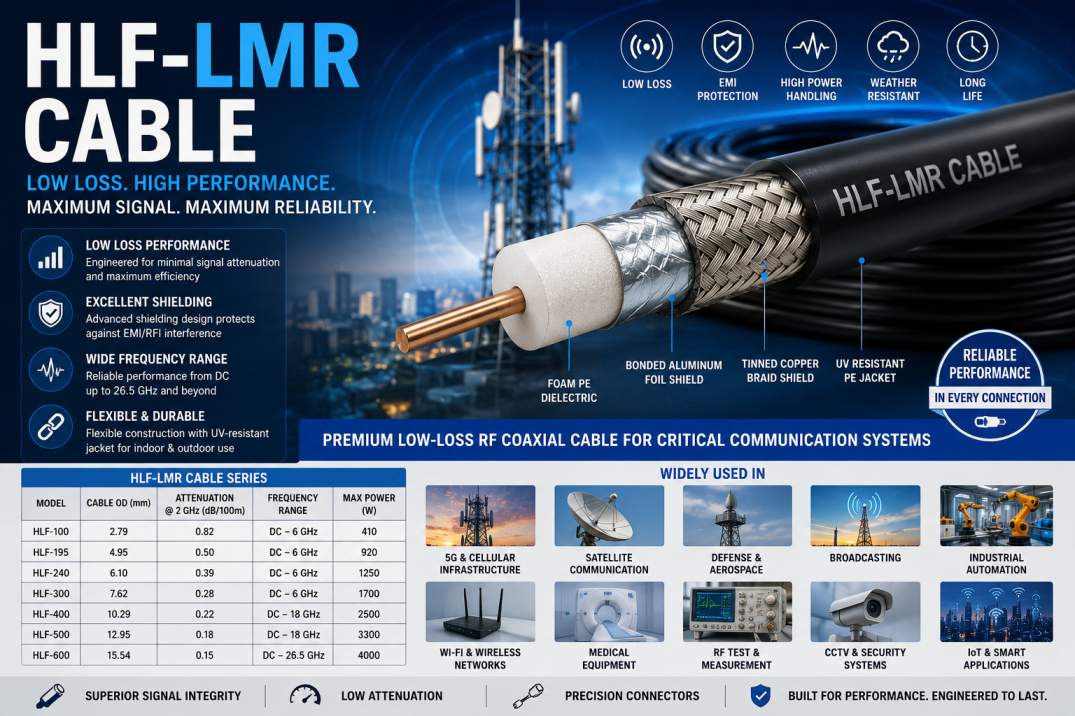
These cables typically feature:
- Copper or copper-clad aluminum center conductor
- Foam polyethylene dielectric
- Bonded aluminum foil shield
- Tinned copper braid
- UV-resistant polyethylene jacket
This multilayer construction provides exceptional electrical performance while maintaining flexibility and long-term durability.
How DoesLMR Cable Work?
HLF-LMR cable transfers RF energy from one device to another while minimizing power loss.
The center conductor carries the RF signal.
The foam dielectric minimizes dielectric losses.
The aluminum foil prevents signal leakage.
The braided shield protects against electromagnetic interference (EMI).
The outer jacket provides mechanical and environmental protection.
Because of this optimized design, HLF-LMR cables deliver excellent signal quality even over long cable runs.
Construction of HLF-LMR Cable
| Component | Function |
|---|---|
| Center Conductor | Carries RF signal |
| Foam Dielectric | Reduces dielectric loss |
| Aluminum Foil Shield | Blocks EMI and signal leakage |
| Braided Shield | Improves shielding effectiveness |
| Outer Jacket | Protects against weather, UV, moisture and abrasion |
Key Features of HLF-LMR Cable
- Low insertion loss
- High shielding effectiveness
- Excellent flexibility
- Wide operating frequency range
- Stable 50 Ohm impedance
- UV-resistant jacket
- Moisture-resistant construction
- High power handling
- Excellent return loss
- Low VSWR
- Easy installation
- Long service life
Types of HLF-LMR Cable
HLF-100
Designed for compact RF devices, GPS systems, IoT equipment, and Wi-Fi modules.
HLF-195
Suitable for wireless routers, communication equipment, and short cable runs.
HLF-240
Offers a balance between flexibility and low attenuation for medium-distance installations.
HLF-300
Commonly used in commercial communication systems and RF laboratories.
HLF-400
One of the most popular low-loss cables for cellular infrastructure, antenna systems, and outdoor communication networks.
HLF-500
Designed for longer cable runs requiring lower attenuation and higher power handling.
HLF-600
Provides extremely low signal loss for high-power RF transmission over extended distances.
Typical Specifications
| Specification | Typical Value |
|---|---|
| Characteristic Impedance | 50 Ohms |
| Frequency Range | DC to 18 GHz (varies by model) |
| Velocity of Propagation | 83–85% |
| Shielding Effectiveness | >90 dB |
| Operating Temperature | -40°C to +85°C |
| Jacket Material | PE / PVC / LSZH |
| Bend Radius | Varies by cable size |
| RoHS Compliance | Yes |
Frequency Range
Depending on the cable model, HLF-LMR cables support frequencies such as:
- DC to 1 GHz
- DC to 3 GHz
- DC to 6 GHz
- DC to 12 GHz
- DC to 18 GHz
- DC to 26.5 GHz
Specialized versions support even higher microwave frequencies.
Common RF Connectors
HLF-LMR cables are compatible with numerous RF connector types.
- SMA
- N-Type
- BNC
- TNC
- 7/16 DIN
- 4.3-10
- MCX
- MMCX
- F-Type
- QMA
- 2.92 mm
Applications of HLF-LMR Cable
5G Infrastructure
Used for connecting antennas, RRUs, and base stations.
Cellular Networks
Supports GSM, LTE, and private wireless communication systems.
Wi-Fi Networks
Provides low-loss connectivity between access points and antennas.
Satellite Communication
Transfers microwave signals with minimal attenuation.
Broadcasting
Ideal for television and FM radio transmission systems.
Aerospace
Used in aircraft communication and navigation equipment.
Military & Defense
Suitable for radar, tactical communication, and electronic warfare systems.
Industrial Automation
Provides reliable RF connectivity for wireless industrial networks.
Medical Equipment
Used in MRI systems and RF diagnostic equipment.
RF Laboratories
Supports accurate testing, calibration, and measurement.
Advantages of HLF-LMR Cable
- Extremely low attenuation
- High signal efficiency
- Excellent EMI protection
- Superior flexibility
- Outdoor durability
- Long operating life
- Low maintenance
- Excellent power handling
- Better return loss
- Reliable performance
- Easy connector termination
- Cost-effective over long cable distances
Limitations
- Higher cost than standard coaxial cables
- Larger cable diameter in high-performance models
- Requires quality RF connectors
- Improper installation can reduce performance
HLF-LMR Cable vs Standard Coaxial Cable
| Feature | HLF-LMR Cable | Standard Coaxial Cable |
|---|---|---|
| Signal Loss | Very Low | Higher |
| Shielding | Excellent | Moderate |
| Frequency Range | Up to 26.5 GHz+ | Limited |
| Outdoor Performance | Excellent | Moderate |
| Flexibility | High | Moderate |
| Power Handling | High | Medium |
| EMI Protection | Superior | Standard |
| Service Life | Longer | Average |
Typical Cable Selection Guide
| Application | Recommended Cable |
|---|---|
| Wi-Fi Router | HLF-195 |
| CCTV RF Systems | HLF-240 |
| Cellular Booster | HLF-300 |
| 5G Base Station | HLF-400 |
| Long Outdoor Installation | HLF-500 |
| High-Power RF System | HLF-600 |
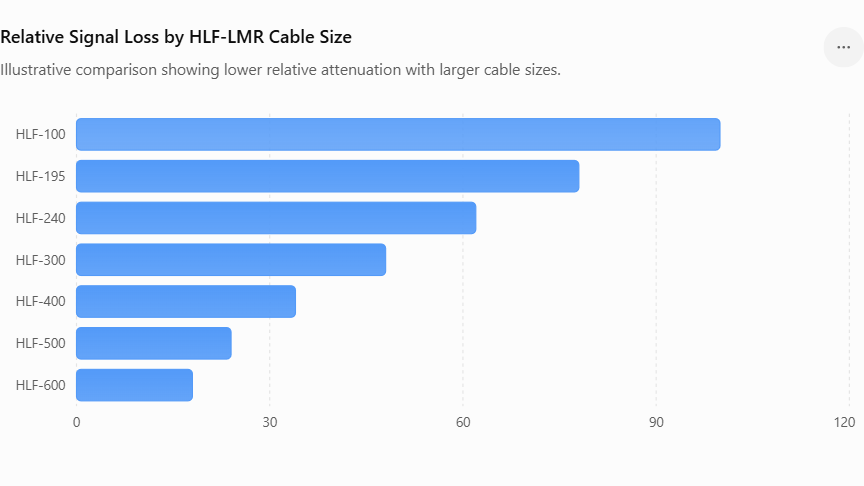
Comparison Chart of Common HLF-LMR Cable Sizes
How to Choose the Right HLF-LMR Cable
Selecting the correct HLF-LMR cable depends on several technical factors.
Consider:
- Operating frequency
- Transmission distance
- Acceptable signal loss
- Power handling
- Installation environment
- Connector compatibility
- Cable flexibility
- Outdoor or indoor use
- Budget requirements
- Future scalability
Installation Best Practices
- Avoid sharp cable bends.
- Use compatible RF connectors.
- Maintain proper connector torque.
- Protect outdoor connections with weatherproof sealing.
- Avoid crushing or stretching the cable.
- Keep cable runs as short as practical.
- Inspect connectors periodically.
- Replace damaged cable assemblies immediately.
Future Trends
The rapid growth of 5G, private LTE, satellite internet, autonomous vehicles, aerospace communication, and future 6G networks is driving the demand for even lower-loss RF cables. Future HLF-LMR cables will feature improved dielectric materials, lighter construction, enhanced shielding, higher operating frequencies above 40 GHz, and increased flexibility while maintaining outstanding electrical performance.
Conclusion
HLF-LMR Cable is one of the most reliable and efficient low-loss coaxial cable solutions available for modern RF and microwave communication systems. Its advanced construction minimizes signal attenuation, improves shielding effectiveness, and ensures stable impedance across a wide range of frequencies. Whether deployed in 5G infrastructure, satellite communication, Wi-Fi networks, defense systems, broadcasting, or laboratory testing, HLF-LMR cables deliver exceptional performance, durability, and long-term reliability. Choosing the correct cable size based on frequency, distance, and power requirements helps maximize system efficiency while reducing maintenance costs and improving overall communication quality.
Frequently Asked Questions (FAQs)
1. What is HLF-LMR Cable?
HLF-LMR Cable is a low-loss RF coaxial cable designed for transmitting high-frequency signals with minimal attenuation and excellent shielding.
2. What is the difference between HLF-LMR Cable and standard coaxial cable?
HLF-LMR cables offer lower signal loss, better shielding, higher frequency capability, and greater durability than standard coaxial cables.
3. What impedance does HLF-LMR Cable have?
Most HLF-LMR cables have a characteristic impedance of 50 Ohms, making them suitable for RF and microwave communication systems.
4. Where is HLF-LMR Cable used?
It is widely used in 5G infrastructure, cellular networks, Wi-Fi systems, satellite communication, broadcasting, aerospace, military, industrial automation, and RF laboratories.
5. What are the common HLF-LMR cable sizes?
Popular sizes include HLF-100, HLF-195, HLF-240, HLF-300, HLF-400, HLF-500, and HLF-600.
6. What connectors are compatible with HLF-LMR Cable?
Common connectors include SMA, N-Type, TNC, BNC, 7/16 DIN, 4.3-10, MCX, MMCX, and QMA.
7. Is HLF-LMR Cable suitable for outdoor installations?
Yes. Most HLF-LMR cables feature UV-resistant and weatherproof jackets, making them ideal for outdoor applications.
8. What frequency range does HLF-LMR Cable support?
Depending on the cable model, HLF-LMR cables can support frequencies from DC up to 18 GHz, 26.5 GHz, or higher.
9. How do I choose the right HLF-LMR Cable?
Choose based on operating frequency, cable length, acceptable attenuation, power handling, connector type, flexibility, and environmental conditions.
10. Why is low signal loss important in RF systems?
Low signal loss ensures stronger transmitted signals, improved receiver sensitivity, better communication reliability, and higher overall system efficiency.
Relative Signal Loss by HLF-LMR Cable Size
Illustrative comparison showing lower relative attenuation with larger cable sizes.
| cable | relativeLoss |
|---|---|
| HLF-100 | 100 |
| HLF-195 | 78 |
| HLF-240 | 62 |
| HLF-300 | 48 |
| HLF-400 | 34 |
| HLF-500 | 24 |
| HLF-600 | 18 |